
- What Is the Mediterranean Diet, Actually?
- What Do You Eat Every Day?
- What Do You Eat a Few Times a Week?
- What Do You Limit?
- Why Does It Work — What Does the Evidence Show?
- What Does It Do for Weight — Honestly?
- How Do You Start Without a Meal Plan?
- Who Should Talk to a Clinician First?
- Frequently Asked Questions
- Do you have to drink red wine on the Mediterranean diet?
- Is pasta allowed on the Mediterranean diet?
- Is the Mediterranean diet expensive?
- Is the Mediterranean diet a weight-loss diet?
- Read This Next
What Is the Mediterranean Diet, Actually?
Start with what it is not. There is no founder selling it, no starter pack, no patented phases and no list of forbidden foods enforced by a trademark. Nobody owns the Mediterranean diet.
It is a description of how people traditionally ate in parts of Greece, southern Italy and Spain — and elsewhere around the Mediterranean basin — before industrial food processing reshaped those cuisines.
The pattern was brought to scientific attention in the mid-twentieth century, when the American researcher Ancel Keys and colleagues compared eating habits and heart disease across countries in the Seven Countries Study.
They observed that rural Mediterranean populations eating vegetables, legumes, grains, olive oil and modest amounts of animal food had strikingly low rates of coronary heart disease compared with northern Europe and the United States.
That observation launched decades of research. It was a starting point, not proof — the proof standard came later, with prospective studies and eventually a large randomised trial, PREDIMED, described in the evidence section below.
The pattern's cultural standing is formal as well as scientific. UNESCO inscribed the Mediterranean diet on its Representative List of the Intangible Cultural Heritage of Humanity, first in 2010 and in expanded form in 2013.
UNESCO's description is revealing: it covers crops, harvesting, fishing, cooking and, particularly, the sharing and consumption of food. Eating together, it says, is the foundation of the cultural identity the listing protects.
That is worth holding onto, because commercial versions often strip the pattern down to a nutrient list. The original is as much about meals — seasonal, shared, unhurried — as about ingredients.
Modern guidelines treat it as a template rather than a museum piece. The Dietary Guidelines for Americans, 2020–2025 include a Healthy Mediterranean-Style Dietary Pattern as one of their recommended ways of eating.
That official version adapts the pattern to American foods and nutrient targets. It keeps the architecture — more plants, seafood and unsaturated oils; less red meat and added sugar — while dropping any requirement to eat like a 1950s Greek islander.
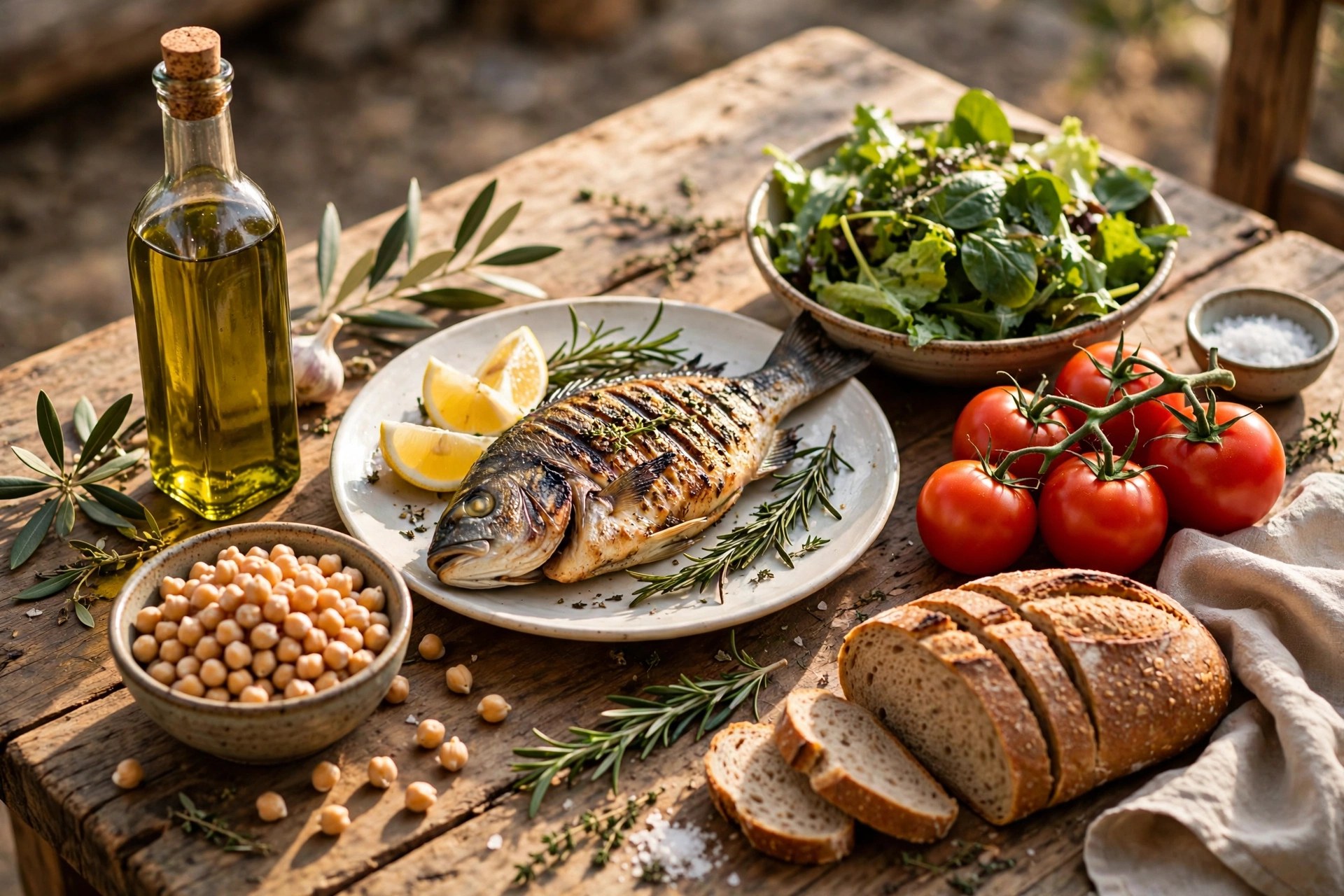
So "the Mediterranean diet" in this article means the pattern, not a recipe book: vegetables and fruit at most meals, legumes and whole grains as staples, olive oil as the main fat, fish regularly, meat and sweets occasionally.
Within that architecture there is wide regional variation. Moroccan, Levantine, Italian and Greek tables differ in spices, grains and dishes. What they share is the structure — plants and olive oil at the centre, animal foods at the edges.
What Do You Eat Every Day?
Vegetables and fruit come first, in quantity and in frequency. In the traditional pattern they appear at most meals — cooked in olive oil, raw in salads, or as the base of soups and stews.
Variety is the operating principle rather than any single "superfood". Leafy greens, tomatoes, peppers, onions, aubergines, courgettes and crucifers rotate with the season, and fruit commonly serves as the default dessert.
Whole grains are the second daily pillar: bread, pasta, rice, couscous, bulgur and other cereals, preferably whole-grain, eaten at most main meals in portions matched to appetite and activity.
This surprises people who arrive expecting a low-carbohydrate plan. It is not one. The traditional pattern is generous with grains — the difference from a modern refined diet lies in processing, portions and what accompanies them.
Legumes deserve their own emphasis. Beans, lentils, chickpeas and peas appear several times a week at minimum, and in many traditional households daily — in soups, salads, dips and slow-cooked stews.
They carry much of the pattern's protein and most of its fibre. A lentil soup or a chickpea dish is not a side in this way of eating; frequently, it is the meal's centre.
Extra-virgin olive oil is the main added fat — the fat you cook with, dress salads with and finish dishes with. It displaces butter and other saturated fats rather than simply being added on top of them.
In PREDIMED, the olive-oil group was supplied with extra-virgin olive oil and used roughly four tablespoons a day. That gives a sense of scale: this is a liberal-fat pattern, not a low-fat one.
Herbs, spices, garlic, onions and lemon do the flavour work. Used generously, they are how the pattern keeps salt modest without making food bland — a practical detail that matters for blood pressure as much as for pleasure.
Nuts and seeds belong in the daily picture too, in small amounts — roughly a handful of nuts a day is the usual description, and it matches the portion PREDIMED supplied to its nuts group.
Water is the default drink, and meals are typically eaten seated, shared and at a pace that allows satiety signals to keep up. That sounds soft, but it is part of the pattern as actually practised.
Put together, a daily plate looks like this: vegetables in abundance, grains or legumes at the centre, olive oil over everything, fruit to finish, and animal protein — if present at all that day — in a supporting role.
What Do You Eat a Few Times a Week?
Fish and seafood are the pattern's signature animal foods. The standard guidance is at least two servings a week, with oily fish — sardines, mackerel, anchovies, salmon — included regularly among them.
Oily fish supply the long-chain omega-3 fats most often credited in the cardiovascular research. Historically they were also the cheap, local option around the Mediterranean coast, which is why sardines and anchovies feature more than luxury species.
Poultry sits in the middle tier: eaten in moderate amounts, typically a few times a week, and usually in smaller portions than in a standard Western diet — a component of a meal rather than its bulk.
Eggs are similarly moderate. They appear regularly but not constantly — a few times a week in most descriptions of the pattern, cooked simply, often with vegetables, as in a frittata or shakshuka-style dish.
Yogurt and cheese are daily-to-weekly foods in modest portions. Traditional forms — strained yogurt, and firm or brined cheeses used as a flavouring crumbled over dishes — deliver dairy flavour at smaller doses than a cheese-centred diet.
Milk itself plays a smaller role than in northern European or American patterns. The dairy emphasis falls on fermented forms, which is one reason the pattern can suit people who tolerate yogurt better than milk.
Potatoes and other starchy vegetables appear in the weekly rotation, cooked with olive oil and herbs, but they do not displace the legumes and greens at the pattern's core.
The weekly rhythm is the point. Nothing in this tier is forbidden and nothing is daily-obligatory; the pattern works through frequency and proportion over weeks, not through the virtue or sin of any single meal.
What Do You Limit?
Red meat is the clearest limit. In the traditional pattern it is eaten in small amounts, occasionally — a few times a month in the strictest historical descriptions, rather than as a daily centrepiece.
Processed meat sits even further out: sausages, cured meats and similar products are small and occasional at most. They carry the pattern's least favourable profile — saturated fat, salt and processing — with none of its compensating strengths.
Sweets and desserts follow the same logic. Fruit is the everyday ending to a meal; cakes, pastries, ice cream and confectionery are celebration foods, eaten in small portions on occasion rather than nightly.
Refined grains are limited by displacement rather than by ban. When whole grains, legumes and vegetables fill the plate, white bread and refined products shrink to a minor role without needing a rule against them.
Butter and cream are displaced in the same way — by olive oil. The pattern does not count saturated fat grams; it simply builds cooking around a different fat, and the saturated total falls as a side effect.
Sugar-sweetened drinks have essentially no place in the traditional pattern. Water is the default, and the calories and sugar load of soft drinks sit outside the pattern's structure entirely.
Wine requires an honest paragraph, because it is traditionally part of the picture — small amounts, with food, in some Mediterranean cultures — and because health guidance has moved. Wine is optional, never required, and the pattern works completely without it.
In 2023 the World Health Organization stated that no level of alcohol consumption is safe for health, noting that cancer risk begins from the first drink and that no threshold has been identified below which it disappears.
Older claims that moderate wine drinking protects the heart have weakened under better study designs, as the WHO statement itself notes. Anyone who does not drink should not start for the sake of this diet.
The Dietary Guidelines for Americans, 2020–2025 take the same practical line: alcoholic beverages are to be limited within a healthy pattern, and some people should not drink at all.
Finally, notice what the limits have in common: nothing is treated as poison, and nothing requires weighing or logging. Frequency and portion do the work — small and occasional for meat and sweets, generous and daily for plants and olive oil.
Why Does It Work — What Does the Evidence Show?
The strongest single piece of evidence is PREDIMED, a Spanish randomised trial whose full name translates as Prevention with Mediterranean Diet. It is the study behind almost every confident sentence written about this pattern.
The design was substantial. As the republished report (Estruch and colleagues, New England Journal of Medicine, 2018) describes, 7,447 adults aged 55 to 80, at high cardiovascular risk but without cardiovascular disease, were assigned to one of three groups.
One group ate a Mediterranean diet supplemented with extra-virgin olive oil, provided free. A second ate a Mediterranean diet supplemented with mixed nuts, also provided. The third received advice to reduce dietary fat.
Participants received regular educational support, and the trial followed them for a median of 4.8 years before it was stopped early, on the basis of a prespecified interim analysis showing benefit.
The outcome was a composite of major cardiovascular events: heart attack, stroke or death from cardiovascular causes. Events occurred in 3.8 percent of the olive-oil group and 3.4 percent of the nuts group, versus 4.4 percent of the control group.
In relative terms, that is roughly a 30 percent reduction — hazard ratios of 0.69 for the olive-oil group and 0.72 for the nuts group. In absolute terms, it is about six to ten fewer events per thousand people over roughly five years.
Both framings are true, and both belong in the article. Thirty percent sounds dramatic; the absolute difference is modest because the annual event rate was low. High-risk older adults were exactly the group in whom a difference could be detected at all.
Now the history that honest accounts must include. The trial's original report was published in 2013 — and was later retracted and republished in 2018, after the investigators identified serious randomisation problems at some sites.
Specifically, some household members had been enrolled without randomisation, some participants at one site were assigned without proper randomisation, and randomisation tables had been used inconsistently at another site. The original paper was withdrawn.
The 2018 republication reanalysed the data using methods that did not rely on assuming everyone was properly randomised. The main result held — similar hazard ratios — including after removing 1,588 participants whose assignments were known or suspected to have departed from the protocol.
That history cuts both ways, and readers deserve both cuts. A trial that needed retraction and reanalysis carries a permanent asterisk; at the same time, the corrected analysis was published openly, and its result survived the removal of the questionable participants.
Beyond PREDIMED, the wider literature is mostly observational: cohorts in which people who eat more Mediterranean-style diets tend to have lower rates of cardiovascular disease and lower overall mortality over time, summarised in umbrella reviews of many studies.
Observational findings cannot prove cause — people who eat this way differ in income, activity, smoking and healthcare too. But the consistency of the direction, across countries and decades, alongside one large randomised trial, is why guideline bodies endorse the pattern.
Mechanistically, the plausible drivers are unglamorous: unsaturated fats replacing saturated ones, high fibre, low intakes of processed meat and added sugar, potassium-rich plant foods, and a calorie density that makes overeating harder without formal restriction.
No single ingredient carries the effect. PREDIMED supplemented with olive oil or nuts, but it tested a whole pattern against low-fat advice — crediting olive oil alone, or any other single food, goes beyond what the trial can show.
What Does It Do for Weight — Honestly?
This article sits in weight-loss reading because readers ask about this diet there. So, plainly: the Mediterranean diet was not designed as a weight-loss diet, and PREDIMED was not a weight-loss trial.
PREDIMED imposed no calorie counting and no calorie targets. Participants were told to eat the pattern freely — olive oil and nuts included — and unsurprisingly, average weight change over the trial was modest.
That design is itself informative. A pattern rich in olive oil and nuts, eaten without portion rules, did not cause weight gain in older, high-risk adults — a useful answer to the fear that dietary fat automatically becomes body fat.
But "did not cause gain" is not "causes loss". Energy balance still governs weight: eat more calories than you use, on any pattern, and weight rises; eat fewer, and it falls.
Where the pattern can help weight is indirect. High-fibre legumes and vegetables, protein from fish and yogurt, and minimally processed foods are satiating — they make a calorie deficit easier to sustain than a diet of refined, energy-dense products.
When trials and programmes pair Mediterranean-style eating with an explicit calorie deficit, weight loss is typically comparable to other sensible dietary patterns followed with the same deficit. The pattern is a vehicle for the deficit, not a substitute for it.
Its real weight advantage may be adherence. Because nothing is banned and the food is widely liked, people tend to stay on it longer than on restrictive plans — and duration is where most weight efforts succeed or fail.
Anyone choosing this pattern purely to lose weight should therefore plan the deficit deliberately: watch portions of the energy-dense parts — olive oil, nuts, cheese — while eating the vegetables, legumes and fish freely. Four tablespoons of olive oil is roughly 480 calories.
That is not a flaw in the diet; it is the honest arithmetic of a liberal-fat pattern. The trial used those amounts for cardiovascular endpoints in older adults, not as a slimming prescription for everyone.
How Do You Start Without a Meal Plan?
You do not need a 28-day plan, a shopping list from a book or a new kitchen. The pattern assembles itself from swaps, and three of them deliver most of the structural change.
Swap one: change the cooking fat. Make extra-virgin olive oil the fat you reach for — for cooking, dressings and finishing — and let butter and cream become occasional rather than default.
Swap two: change one dinner. Replace one meat-centred dinner a week with a legume-centred one: lentil soup, chickpea stew, beans with greens and olive oil. One dinner, repeated weekly, rewires the pattern faster than a perfect fortnight followed by surrender.
Swap three: add the daily handful. A small handful of unsalted nuts as a snack or on salads displaces the crisps and biscuits it replaces — the benefit lies as much in the displacement as in the nuts.
From there, build by frequency rather than by rules. Fish twice this week. Yogurt at breakfast instead of a pastry. Fruit where dessert used to be, most days, with real dessert kept for occasions and enjoyed properly.
Shop the pattern's centre first: vegetables, fruit, beans and lentils (dried or tinned), whole grains, olive oil, tinned and frozen fish, nuts, yogurt and eggs. A kitchen stocked that way makes the default meal a Mediterranean one.
Keep meals social where you can, and give them time. The heritage listing was not being sentimental: shared, unhurried meals are part of how this pattern regulates appetite and survives across generations.
Expect the transition to take weeks, not days, and judge it by the shape of a fortnight's eating rather than by any single plate. Patterns are averages; one pizza does not break one, any more than one salad makes one.
Who Should Talk to a Clinician First?
For most healthy adults, shifting toward vegetables, legumes, olive oil and fish is a low-risk change that needs no permission. Some situations, though, change what a new pattern does inside the body, and those deserve a conversation first.
People taking diabetes medication are the clearest case. A pattern lower in refined carbohydrate and added sugar can lower glucose noticeably, and insulin or sulfonylurea doses set for the old diet may overshoot on the new one.
People with kidney disease may need individual advice on potassium and protein — two things this pattern deliberately increases through legumes, vegetables and fish — before adopting it wholesale.
Blood-pressure medication is a quieter version of the same point. Eating patterns that reduce salt and increase potassium-rich foods can lower blood pressure, which is desirable, but doses occasionally need review as it falls.
Pregnancy is not a barrier to the pattern itself, which is close to standard healthy-eating advice — but it is a reason to take the alcohol point seriously, to choose fish with attention to mercury guidance, and to keep a clinician in the loop.
Anyone with a history of disordered eating should also approach any dietary framework carefully, with professional support. This pattern's flexibility is gentler than most, but structure itself can be a trigger for some people.
And anyone attracted to the wine tradition while taking medicines that interact with alcohol, or with a personal or family history of alcohol problems, should treat the modern guidance as decisive: the pattern works in full without a single glass.
Frequently Asked Questions
Do you have to drink red wine on the Mediterranean diet?
No. Wine is a traditional accompaniment in some regions, not a component of the pattern's benefits. The WHO states there is no safe level of alcohol consumption, and the diet's evidence base stands entirely without it. Do not start drinking for this diet.
Is pasta allowed on the Mediterranean diet?
Yes. Pasta and other grains are staples of the traditional pattern, preferably whole-grain where practical. What matters is the company it keeps — vegetables, legumes, olive oil, seafood — and the portion, not the presence of pasta itself.
Is the Mediterranean diet expensive?
It can be, if built on fresh premium fish and imported oil. The budget version is authentic too: dried or tinned legumes, frozen fish, seasonal vegetables, eggs and tinned sardines are the historical core — inexpensive foods that the pattern was built on.
Is the Mediterranean diet a weight-loss diet?
Not by design. PREDIMED set no calorie targets and produced only modest weight change. Combined with a deliberate calorie deficit, it performs like other sensible patterns — and its flexibility often makes that deficit easier to keep.

Last reviewed: October 2026. This article is educational and is not medical advice.
