
- What Do the Pooled Trials Actually Show?
- Is Berberine Really "Nature's Ozempic"?
- How Does Berberine Work — and How Is That Different?
- What Doses Did the Trials Use, and What Do Labels Sell?
- What Side Effects Does Berberine Cause?
- Who Must Not Take Berberine, and What Does It Interact With?
- What Is the Honest Bottom Line?
- Frequently Asked Questions
- How much weight can you realistically expect from berberine?
- How long do berberine weight trials run?
- Is berberine safe to take with metformin?
- Can berberine replace diabetes medication?
- Does berberine work like Ozempic in the body?
- Read This Next
What Do the Pooled Trials Actually Show?
No single berberine trial is large enough to settle the question. The useful evidence comes from meta-analyses, which pool many small randomised trials and report the average difference against a control group.
The earlier of the two main analyses is Asbaghi and colleagues (Clinical Nutrition ESPEN, 2020). It pooled 12 randomised controlled trials of berberine and obesity measures, inflammation markers and liver enzymes.
Its headline result was a body-weight difference of about −2.07 kg versus control. The same analysis found BMI lower by about 0.47 kg/m² and waist circumference lower by about 1.08 cm.
It also found a small reduction in C-reactive protein, a general inflammation marker. It found no significant effect on the liver enzymes ALT or AST, a point worth noting given how often liver claims appear in marketing.
The larger, newer analysis tells a smaller story. Elahi Vahed and colleagues (International Journal of Obesity, 2026) pooled 23 randomised trials of berberine and obesity indices in adults.
That analysis found a body-weight difference of −0.88 kg, with a 95% confidence interval from −1.36 to −0.39 kg. BMI fell by 0.48 kg/m² and waist circumference by 1.32 cm; waist-to-hip ratio did not change significantly.
So the two pooled estimates are roughly 2 kg and roughly 0.9 kg. Both point the same way — down, modestly — but they do not agree on the size, and the larger pool gives the smaller number.
That pattern is common in supplement research, and it is not a scandal. Early literatures are small, and small trials with striking results are more likely to be published than small trials with none.
As more trials accumulate, the pooled average usually drifts toward the more ordinary result. A reader deciding what to expect should weight the bigger, newer pool more heavily than the older, smaller one.
There is another reason for caution inside the 2026 paper itself. Its authors call for better reporting of what was actually tested — the purity, potency and gram amounts of the berberine used in each trial.
That complaint matters because a meta-analysis can only average what the underlying trials report. If the material, dose and quality vary and are poorly described, the pooled figure inherits all of that uncertainty.
The confidence interval around the newer estimate deserves a plain reading. A range from −1.36 to −0.39 kg means the data are compatible with an average effect as small as about 0.4 kg — a few hundred grams.
The same paper's conclusion flags common weaknesses across the trials it pooled, including lack of blinding and randomisation problems. Those flaws usually push results upward, which is another reason to treat the smaller estimate as the safer planning figure.
The participants also matter. Most berberine weight trials were run in people with metabolic conditions — type 2 diabetes, fatty liver, dyslipidaemia or metabolic syndrome — not in otherwise healthy people simply trying to lose weight.
An average drawn from those populations may not transfer neatly to a healthy adult. It also means part of the weight change may travel with improvements in glucose or lipid control, rather than occurring in isolation.
Finally, these are averages over short periods, mostly weeks to a few months. They say nothing reliable about whether any loss is kept off for a year, which is the outcome that matters most in weight management.
The fair summary is this: berberine has a genuine, repeatedly observed, small average effect on weight in pooled trials — somewhere around 1 to 2 kg against control — surrounded by more uncertainty than the headlines suggest.
Is Berberine Really "Nature's Ozempic"?
The nickname comes from social media, not from any trial. It borrows the fame of semaglutide — sold as Ozempic for diabetes and Wegovy for weight management — and lends that fame to a supplement capsule.
To check the claim, put the numbers on the same scale. Berberine's pooled results are reported in kilograms: about 0.9 to 2.1 kg versus control, over mostly short trials, in mostly metabolically unwell participants.
Now the drug trials. In STEP 1 (Wilding and colleagues, New England Journal of Medicine, 2021), 1,961 adults with overweight or obesity, without diabetes, received weekly semaglutide 2.4 mg or placebo, both with lifestyle support.
At 68 weeks, body weight had fallen by an average of 14.9 percent on semaglutide, versus 2.4 percent on placebo. In kilograms, that was −15.3 kg against −2.6 kg.
More than eight in ten semaglutide participants lost at least 5 percent of their body weight. Half lost at least 15 percent — a threshold almost no one reaches in the berberine literature.
Tirzepatide, a related prescription drug, went further in its own trial. In SURMOUNT-1 (Jastreboff and colleagues, NEJM, 2022), 2,539 adults received weekly tirzepatide or placebo for 72 weeks.
At the highest dose, 15 mg, the average weight change was −20.9 percent, versus −3.1 percent on placebo. Even the lowest tirzepatide dose, 5 mg, averaged −15.0 percent.
These were different trials, in different populations, run for much longer than the berberine studies. They are not a head-to-head comparison, and this article does not present them as one.
But a scale comparison is exactly what the nickname invites, and on scale the claim collapses. One to two kilograms over a few months is not the same category of effect as 15 to 21 percent of body weight over 16 to 18 months.
For a 100 kg person, 15 percent is 15 kg. Berberine's larger pooled estimate, 2.07 kg, is about one-seventh of that — and its newer estimate, 0.88 kg, is less than one-fifteenth.
The regulatory gap is just as wide. Semaglutide and tirzepatide are prescription medicines, tested in thousands of people and approved for weight management after regulators reviewed those trials.
Berberine is sold as a dietary supplement. No berberine product has been approved as a weight-loss drug, and supplement labels are not required to prove effectiveness before sale in the way drug labels are.
The NCCIH's own summary of berberine makes the point directly: preliminary studies have suggested a possible role in losing weight, but there have not been many clinical trials.
Its conclusion deserves quoting in spirit if not in full: there is not enough rigorous scientific evidence to determine whether berberine is effective for weight loss. That is the official position behind the viral nickname.
None of this makes the GLP-1 drugs simple or risk-free. They are injectable, prescription-only, commonly cause gastrointestinal side effects, and in STEP 1 more participants stopped semaglutide because of gut symptoms than stopped placebo.
It simply means the comparison itself is false. A supplement with a small, uncertain average effect and a drug class with large, regulator-reviewed effects are different tools, and calling one by the other's name misleads buyers about both.
How Does Berberine Work — and How Is That Different?
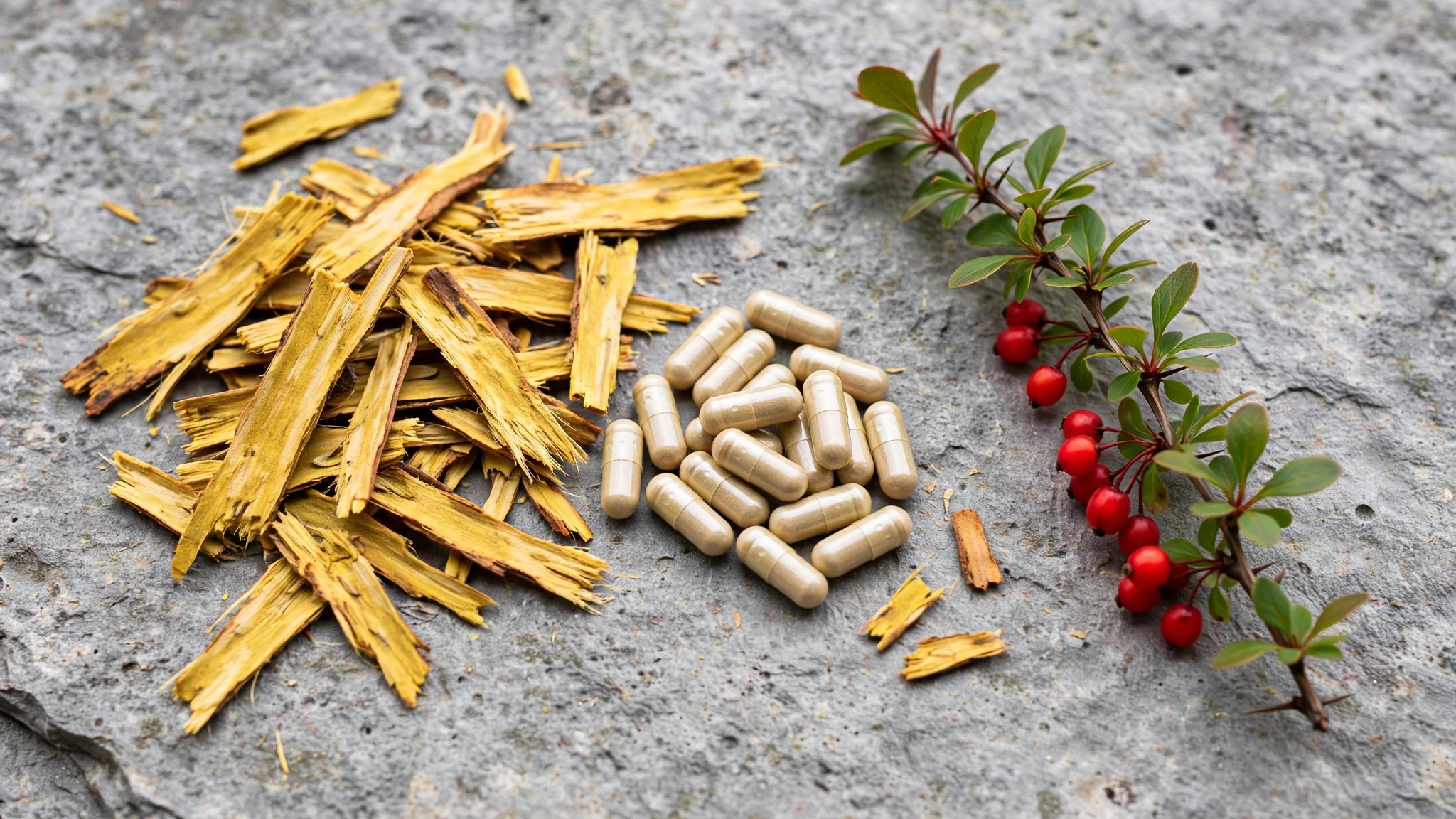
Berberine is an alkaloid — a bitter, yellow plant compound. The NCCIH lists European barberry, goldenseal, goldthread, Oregon grape, phellodendron and tree turmeric among the plants that contain it.
Plants containing berberine have a long history in Ayurvedic and traditional Chinese medicine, mainly for infections and gastrointestinal complaints. That history explains the interest; it does not substitute for modern trials.
In laboratory and human research, berberine's best-described action is metabolic. It activates AMP-activated protein kinase, AMPK, an enzyme that acts as a cellular fuel gauge and influences how cells handle glucose and fat.
Through that and related pathways, berberine is reported to affect glucose production in the liver, insulin sensitivity, lipid handling and the gut microbiome. The NCCIH notes some evidence of a modest glucose-lowering effect in type 2 diabetes.
Notice what is missing from that list: the GLP-1 receptor. Semaglutide works by activating the GLP-1 receptor, a gut-hormone signal that reduces appetite, slows stomach emptying and improves insulin release in a glucose-dependent way.
Tirzepatide activates two such receptors, GLP-1 and GIP. These drugs were designed, molecule by molecule, to hit those targets at drug-level strength, and their trials measure the results of doing so.
Berberine is not a GLP-1 receptor agonist. Any influence it has on gut hormones in laboratory studies is indirect and far weaker than direct receptor activation by an engineered drug.
That is the mechanism mismatch at the heart of the nickname. Two things can both touch metabolism and still be as different as a dimmer switch and a power station.
There is a second pharmacological problem: absorption. Berberine is poorly absorbed from the gut, so its oral bioavailability is very low — only a small fraction of a swallowed dose reaches the bloodstream unchanged.
Low bioavailability helps explain why trial doses are so large, why effects are modest, and why results vary. Much of berberine's action may occur inside the gut itself, including effects on gut bacteria.
It also explains a marketplace of workarounds — alternative chemical forms and absorption enhancers — none of which has trial evidence for weight loss comparable to the standard form's, let alone to the GLP-1 drugs.
So the honest mechanism statement is short. Berberine is a metabolic compound with plausible, partly demonstrated effects on glucose and lipids, a small average effect on weight, and no meaningful resemblance to a GLP-1 drug's way of working.
What Doses Did the Trials Use, and What Do Labels Sell?
Dose is where marketing and evidence quietly part company. The weight and metabolic trials behind the pooled estimates typically used around 1,000 to 1,500 mg of berberine per day.
That total was usually divided — for example, 500 mg taken two or three times a day, generally with or around meals — rather than swallowed as a single daily capsule.
Dividing the dose makes practical sense for a poorly absorbed compound. It also spreads the gastrointestinal effects, which are dose-related, across the day instead of concentrating them in one hit.
Many retail products, however, are built around smaller servings: a single 500 mg capsule once a day, or blends in which berberine is one ingredient among several, sometimes present in far smaller amounts.
A blend that lists berberine on the front of the bottle may contain a fraction of the studied dose. Proprietary blends that hide individual amounts make it impossible for a buyer to know either way.
The 2026 meta-analysis authors raised a version of this problem about the trials themselves, asking for proper reporting of purity, potency and gram amounts. If researchers struggle to state the dose, shoppers stand little chance.
Supplement quality adds a further layer. Unlike approved drugs, supplements are not checked for effectiveness before sale, and the amount of active compound in a bottle can differ from what the label promises.
None of this means a higher dose is automatically better. The trials used 1,000 to 1,500 mg a day in monitored settings, in specific patient groups, for limited periods — not as a lifetime instruction for everyone.
It does mean that someone taking a low-dose blend is not running the trial protocol, whatever the label implies. Comparing your capsule to the pooled trial results requires matching dose, duration and population first.
Duration matters too. Most trials behind the weight estimates ran for weeks to a few months. There is no good evidence base for what years of daily berberine use does, in either direction.
What Side Effects Does Berberine Cause?
The common side effects are gastrointestinal, and they are not rare surprises — they appear consistently across the trials and in official summaries of the compound.
The NCCIH lists the most common adverse effects as abdominal pain, constipation, diarrhoea, nausea and vomiting. It describes berberine, taken orally, as generally well tolerated — with those effects as the standing exception.
The pattern is dose-related in practice: cramps, loose stools or nausea are most likely when starting, or when the daily amount rises. Splitting the dose and taking it with food is the usual way trial protocols softened this.
Gastrointestinal effects are also the main reason people quietly stop. That matters for interpreting trial averages, because a treatment people cannot comfortably continue has a smaller real-world effect than its trial figure.
Beyond the gut, the serious risks of berberine are less about berberine alone and more about combinations — with medicines, with diabetes treatment, and with pregnancy. Those deserve their own section, and it follows this one.
One more caution belongs here. Because berberine can lower blood glucose, symptoms of low blood sugar — shakiness, sweating, confusion, intense hunger — in someone taking it alongside diabetes medication are a stop-and-seek-advice event, not an inconvenience.
And because supplements sit outside the drug-approval system, an unexpected reaction to a particular product can reflect the product — its dose, purity or other ingredients — rather than berberine itself. Keeping the bottle and its details helps any clinician assess it.
Who Must Not Take Berberine, and What Does It Interact With?
The interaction risk is the most under-reported part of the berberine story. Berberine slows down some of the liver enzymes that clear a large share of prescription medicines from the body.
In a human crossover study, Guo and colleagues (European Journal of Clinical Pharmacology, 2012) gave healthy men berberine 300 mg three times a day for two weeks, then measured drug-metabolising enzyme activity.
They found decreased activity of CYP2D6, CYP2C9 and CYP3A4 — three enzymes that between them process many common medicines. Exposure to midazolam, a CYP3A4 test drug, rose by about 40 percent.
When those enzymes slow down, medicines cleared by them can build up to higher levels than the prescriber intended. The practical consequence is simple: berberine is not a casual add-on for anyone taking daily prescription drugs.
One interaction is repeatedly singled out in official material: ciclosporin, the anti-rejection drug used after organ transplants, whose blood levels berberine can raise. For a transplant patient, that is a genuinely dangerous combination.
The list of potentially affected medicines is long because the enzymes are so widely used. It spans some antidepressants, beta-blockers, statins, blood thinners, sedatives and many others — too many to memorise, which is precisely why a pharmacist should check.
Diabetes medicines are the second major category. Berberine itself can lower blood glucose, so combining it with insulin or glucose-lowering drugs can push blood sugar lower than intended — an additive effect, not a synergy to celebrate.
Anyone using metformin or another diabetes medicine who adds berberine without medical input is running an unmonitored experiment on their own glucose control. The FAQ below returns to the metformin question directly.
Pregnancy and breastfeeding are a clear exclusion. The NCCIH states that people who are pregnant or breastfeeding should not use berberine, and that it should not be given to infants.
The reason is specific. Berberine can cross the placenta, and in newborns it is linked to a harmful build-up of bilirubin — it can displace bilirubin from its binding proteins — worsening jaundice and, in severe cases, causing kernicterus, a form of brain damage.
Traditional use adds a further pregnancy concern, as berberine-containing plants have a history of use as uterine stimulants. Whatever weight that tradition carries, it points in the same direction as the official warning: avoid.
Children are outside the evidence base as well. The weight trials were in adults, mostly with metabolic disease, and there is no established safe use in infants — the group at risk from the bilirubin problem.
The practical rule is unglamorous. If you take any prescription medicine, are pregnant or breastfeeding, or are treating diabetes, berberine is a clinician conversation first and a purchase second — if at all.
What Is the Honest Bottom Line?
Berberine is not a scam ingredient. It has real pharmacology, a plausible metabolic mechanism, and pooled trial evidence of a small average effect on weight, glucose and lipids in the populations studied.
It is also not a weight-loss drug. The best current pooled estimate is under a kilogram against control; the older, larger estimate is about two. Neither figure was produced in healthy dieters, and neither was sustained-evidence over years.
The "nature's Ozempic" label fails every test applied to it: different mechanism, different scale of effect, different evidence standard, different regulatory status. It survives because it is a good slogan, not because it is a true sentence.
For an adult with metabolic concerns who takes no interacting medicines, berberine is a modest supplement to discuss with a clinician — with gastrointestinal effects expected and glucose monitoring sensible if diabetes medicines are involved.
For anyone expecting drug-sized weight loss from it, the trials themselves are the correction. Expect, at most, the small average the studies found — and remember that half of any group does worse than the average.
Frequently Asked Questions
How much weight can you realistically expect from berberine?
On the pooled evidence, about 1 to 2 kg more than a control group over weeks to a few months. The 23-trial analysis found −0.88 kg; the earlier 12-trial analysis found −2.07 kg. Individual results vary, and many people will see less.
How long do berberine weight trials run?
Mostly weeks to a few months — far shorter than the 68- and 72-week GLP-1 drug trials. There is no solid evidence on whether berberine's small average loss is maintained over a year or more of use.
Is berberine safe to take with metformin?
That is a clinician question, not a self-experiment. Berberine can lower blood glucose itself, so combining it with metformin or other diabetes medicines can have additive glucose-lowering effects and needs monitoring and medical agreement first.
Can berberine replace diabetes medication?
No. The NCCIH describes, at most, a modest glucose-lowering effect in type 2 diabetes, drawn from small trials. Berberine is an unapproved supplement, not a tested substitute for prescribed treatment, and stopping or reducing diabetes medication to make room for it risks losing glucose control entirely.
Does berberine work like Ozempic in the body?
No. Ozempic's active drug, semaglutide, directly activates the GLP-1 receptor. Berberine does not; its best-described actions are metabolic, centred on AMPK activation and gut and glucose effects, and its oral bioavailability is very low.

Last reviewed: October 2026. This article is educational and is not medical advice.
