
- Quick Answer
- How Much Caffeine Is in Guarana Compared With Coffee?
- How Much Guarana Is in a Typical Serving?
- Is Guarana Caffeine Really Slow-Release and Crash-Free?
- What Else Is in the Seed
- What Are the Side Effects of Guarana and Too Much Hidden Caffeine?
- Who Gets Caught Out by Hidden Guarana Caffeine
- The Piperinox Arithmetic
- Does Guarana Do Anything Beyond Caffeine?
- How to Read a Guarana Label in 30 Seconds
- Counting Guarana Inside Your Total Day
- Frequently Asked Questions
- Is guarana stronger than coffee?
- Does guarana show up on drug tests?
- How long does guarana caffeine last?
- Is guarana caffeine chemically different from coffee caffeine?
- Can guarana keep me awake if I take it in the morning?
- Is guarana safe in pregnancy?
- Who Should Buy Piperinox — and Who Should Skip It
- Read This Next
Disclosure: This article contains affiliate links. If you buy through them, we may earn a commission at no extra cost to you. It never changes our conclusions.
Quick Answer
Guarana seed is roughly two to four times as caffeine-dense as coffee beans — the seeds run 2–8% caffeine by weight against the beans' 1–3%, per Cleveland Clinic's guarana overview. But density is not dose.
In a blend that publishes no guarana amount, the caffeine in your capsule is a range nobody can narrow. Piperinox lists guarana with no amount at all. Best for: caffeine-counters, the caffeine-sensitive, and anyone who thinks "natural energy" means caffeine-free. Piperinox scores 4.4/10 in our review.
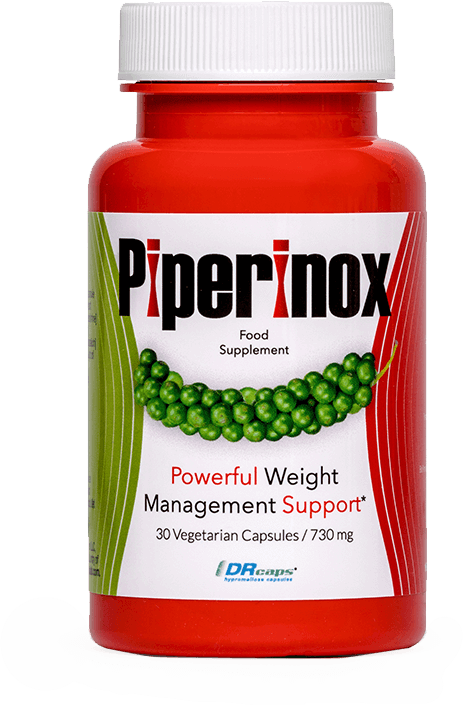
Our Recommendation — Piperinox
Score: 4.4/10 · Best for: adults who want a simple one-capsule-a-day thermogenic and are untroubled by undisclosed doses. Main caution: the panel lists ingredient names only — a delayed-release capsule of an unknown dose is still an unknown dose — and no money-back guarantee is published. Fair trial: the three-bottle pack at $33.33 a bottle — the honest trial length, per our full audit below.
How Much Caffeine Is in Guarana Compared With Coffee?
Guarana (Paullinia cupana) is a climbing plant from the Amazon basin whose seeds have been used as a stimulant for centuries. The seeds' reputation rests on one measurement: caffeine concentration. By weight, guarana seed carries more caffeine than any common coffee source.
| Source | Caffeine by weight |
|---|---|
| Guarana seed | ~2–8% |
| Coffee beans | ~1–3% |
| Tea leaves | ~1–4% |
Those ranges, summarised by Cleveland Clinic and the Drugs.com guarana monograph, describe the raw materials. They explain why a small amount of guarana can carry a real caffeine load — and why "contains guarana" without an amount is such an unhelpful label line.
Now the serving arithmetic, labelled clearly as an illustration. A teaspoon of guarana powder weighs roughly 2–2.5 g. At a mid-range 4% caffeine content, that teaspoon holds about 80–100 mg of caffeine — the same territory as a cup of coffee, from a spoonful of "herbal" powder.
Extracts complicate the range further. Concentrated guarana extracts are reported in the trade and secondary literature at standardisations up to roughly 22% caffeine — several times the raw seed's density.
We flag that figure as a reported range rather than a verified primary measurement, but its direction is certain: extraction pushes caffeine density up, and labels rarely say by how much.
So the honest answer to "how much caffeine is in guarana?" has two floors. Per gram of seed: 20–80 mg. Per serving of an unknown extract in an unknown amount: genuinely unknowable, which is the problem the rest of this article examines.
How Much Guarana Is in a Typical Serving?
The Drugs.com guarana monograph records the doses used in the limited clinical trials: between 75 mg and 1,000 mg of guarana per day. Commercial products cluster in the same territory — a few hundred milligrams of extract per serving is the category's normal architecture.
Convert those servings into caffeine under different assumptions, and the spread is the story:
| Guarana per serving | At 4% caffeine (seed-like) | At 10% caffeine (mild extract) | At 22% caffeine (strong extract, reported range) |
|---|---|---|---|
| 200 mg | ~8 mg | ~20 mg | ~44 mg |
| 500 mg | ~20 mg | ~50 mg | ~110 mg |
| 1,000 mg | ~40 mg | ~100 mg | ~220 mg |
Read the corners of that table. The same "500 mg guarana" line can mean 20 mg of caffeine or 110 mg — the difference between a cola and a strong coffee — depending entirely on a standardisation figure the label may not carry. Serving size alone, without standardisation, narrows almost nothing.
For calibration against familiar drinks: a standard cup of brewed coffee carries roughly 95 mg of caffeine, an espresso shot about 63 mg, a typical energy drink 80–300 mg per can, and a cola around 30–40 mg. A strong-extract guarana serving can sit anywhere from cola-level to energy-drink-level.
Energy drinks, whatever their other faults, usually print a caffeine number per can. The capsule category frequently does not. The least regulated format carries the least information, and guarana is the ingredient that makes the omission possible — because "guarana" sounds like a food, not a drug dose.
Is Guarana Caffeine Really Slow-Release and Crash-Free?
Guarana marketing leans on a second claim: that its caffeine releases slowly, bound by the seed's tannins, producing smooth energy without the crash of coffee. Cleveland Clinic's dietitian repeats a version of this — guarana's caffeine "releases more slowly and over a longer period of time" than coffee's.
The critical reading is thinner. Caffeine is caffeine: the molecule absorbed from guarana is identical to the molecule from coffee, and controlled comparisons showing a different time-course at equal caffeine doses are scarce. Where guarana drinks feel different, dose and the seed's other compounds are likelier explanations than a special release mechanism.
The more defensible statement is about expectations. Users who believe guarana is gentler may dose it more casually — a second serving, an afternoon top-up — and end up with more total caffeine than the coffee they were avoiding.
The "crash-free" framing is, on the critical pages of the SERP, mostly marketing. The variable that matters is not release speed; it is dose uncertainty.
There is also a processing caveat Cleveland Clinic raises: commercial guarana is heavily processed, and what survives manufacturing is essentially the caffeine and little of the fresh seed's other character. The romantic Amazonian ingredient and the powder in a capsule are the same species at very different levels of refinement.
What Else Is in the Seed
Caffeine is not guarana's only stimulant alkaloid. The seed also contains theobromine — the mild stimulant familiar from chocolate — and traces of theophylline, a compound used pharmaceutically as a bronchodilator. Both are present in much smaller amounts than the caffeine.
Neither changes the safety picture materially at supplement doses, but both belong in an honest inventory. A label that says "guarana" is declaring a small stimulant family, not a single compound. Theobromine contributes to the alertness feel and, in sensitive people, to the jitteriness sometimes blamed on the caffeine alone.
The seed is also rich in tannins and catechins — the astringent polyphenols behind the slow-release story. They are genuine constituents with antioxidant activity in test systems. They are not a reason to expect weight effects, and no trial has isolated a benefit from them at capsule doses.
Traditional use deserves a footnote here, because it is often recruited into marketing. Amazonian communities used guarana for centuries — as a grated, diluted drink taken in a social and ritual context, at food-like exposures spread across a day. That history says something about the seed's tolerability as a food.
It says very little about a concentrated extract, standardised for caffeine, compressed into a capsule with six other ingredients and taken daily for months. Traditional use is evidence about the plant as traditionally used. The capsule is a different product wearing the plant's biography.
What Are the Side Effects of Guarana and Too Much Hidden Caffeine?
Cleveland Clinic's list of over-caffeination effects from guarana products reads like a symptom-search index: headaches, dizziness, nausea, heart palpitations, high blood sugar readings, dehydration and uncomfortable jitteriness. For people with anxiety disorders, the clinic notes, the effects can be particularly concerning.
The clinical problem is attribution. A person who develops palpitations or insomnia while taking a "herbal thermogenic" may never connect the symptoms to caffeine, because nobody told them caffeine was in it. Guarana, yerba mate and green tea extract are the three label names under which supplement caffeine most often hides.
Regulatory data support the scale of the issue. Analyses of supplements listing guarana without declaring caffeine have found median daily caffeine contents in the hundreds of milligrams — drug-level exposures arriving under botanical names. The buyer counting "zero caffeine" from the front of the bottle may be consuming the equivalent of several coffees.
Sleep is the quietest casualty. Caffeine taken even six hours before bed measurably shortens and lightens sleep in controlled studies, and half-life varies widely between people. Hidden caffeine defeats the one strategy that works — a personal cutoff time — because you cannot schedule around a dose you do not know exists.
Who Gets Caught Out by Hidden Guarana Caffeine
The pattern repeats across distinct groups. Students and gamers meet guarana in "focus" and energy products marketed as natural alternatives to coffee, and dose it like a herbal tea. The caffeine arrives all the same, often later in the day than coffee would.
Shift workers are the second group. A thermogenic taken to survive a night shift, its caffeine uncounted, is still circulating at the morning attempt to sleep. The product is then blamed for nothing, the insomnia is treated as a separate problem, and a sleep aid joins the stack — three products deep, the original cause still unnamed on a label.
The third group is the one this site worries about most: people actively trying to reduce caffeine. They cut coffee, switch to decaf, read labels for the word "caffeine" — and pass straight over "guarana", "Paullinia cupana" and "natural energy blend". The ingredient's botanical name is doing concealment work, whether or not any individual maker intends it to.
Anxiety sufferers sit across all three groups. Caffeine is a well-documented anxiety amplifier, and unexplained jitteriness from a "calming herbal" product is a miserable diagnostic trap. The fix costs nothing but honesty: print the caffeine number, as the drink category largely does.
The Piperinox Arithmetic
Now run the numbers for the product this set audits. Piperinox's capsule weighs 730 mg in total. Guarana is one of seven listed ingredients sharing that space, alongside two other extract headliners and the capsule's excipients.
Take the most generous possible bound first: if the entire 730 mg were guarana seed — impossible, since six other ingredients share the capsule — the caffeine could range from about 15 mg (at the seed's 2% floor) to about 58 mg (at its 8% ceiling). That is the widest honest range, and it is already a four-fold spread.
As our Piperinox review documents, the label gives no way to narrow it: no guarana amount, no extract standardisation, no caffeine figure. If the maker uses a concentrated extract rather than seed powder, the ceiling rises further. The true value sits somewhere in a range the buyer cannot see.
Set that unknown against the reference point regulators use: the FDA's consumer guidance cites about 400 mg of caffeine per day as the level not generally associated with negative effects in healthy adults. An unknown contributor of perhaps 15–58 mg is not, by itself, a frightening number.
The problem is bookkeeping. A caffeine budget only works if the entries are known. Piperinox's contribution is an unmarked line in the ledger — small or moderate, nobody can say — and that is a strange property for a product whose second-named system is stimulant energy.
Does Guarana Do Anything Beyond Caffeine?
Given how much caffeine it carries, the surprising research question is whether guarana adds anything else. The Drugs.com monograph's clinical summary is restrained: data do not support guarana as a weight-loss aid, and its energiser reputation tracks its caffeine content.
The monograph notes limited trials in other directions — some evidence around chemotherapy-related fatigue, and small cognitive studies. None of it establishes an effect separable from the caffeine dose the guarana delivered, and the monograph's overall posture is that the clinical file is thin.
For a fat-burner buyer, the translation is direct. Guarana is on the label to provide caffeine — the one ingredient in this category with a real, if modest, thermogenic and alertness effect. There is nothing dishonest about caffeine as an ingredient. The dishonesty enters only when its amount is hidden behind a botanical name.
That is also why the "natural caffeine" premium makes little sense. Synthetic caffeine and guarana caffeine are the same molecule at the receptor. The guarana version arrives with extra uncertainty about dose and a small entourage of related alkaloids; it does not arrive with extra efficacy.
How to Read a Guarana Label in 30 Seconds
Four checks separate a quantifiable product from a guessing game. First: does the label state a caffeine amount per serving, in milligrams? That single line settles this whole article — and most guarana products do not carry it.
Second: is the extract standardised, with a percentage printed — "standardised to 10% caffeine" or similar? With a serving size and a percentage, you can do the multiplication yourself. Third: is guarana inside a proprietary blend? Then even the serving size is a shared total, and no arithmetic is possible.
Fourth: does the maker publish the figure anywhere — FAQ, product page, a reply to a customer question? Makers who know their caffeine content tend to say it, because plenty of buyers want it high. Silence on caffeine usually means the number was never a selling point, or never measured at all.
Piperinox fails all four checks: no caffeine figure, no standardisation, a names-only ingredient list, and a maker FAQ that discusses safety without ever mentioning caffeine quantities. It is the complete version of the problem this article describes.
Counting Guarana Inside Your Total Day
The budget method is simple: list every caffeine source with a number, add them, compare against your personal ceiling — 400 mg/day for most healthy adults, 200 mg/day in pregnancy under EFSA's assessment, less if you know you are sensitive.
Worked plainly: two coffees at ~95 mg each, a pre-workout at 200 mg, and a guarana fat burner at an unknown 15–58 mg gives a day somewhere between ~405 and ~448 mg. The known entries already fill the budget; the unknown one decides whether you are over it, and it refuses to say.
Pregnancy deserves its own line. Caffeine limits in pregnancy apply to total intake from all sources, and hidden sources are the ones most often missed. A "natural energy" capsule taken through the first trimester, before pregnancy is even known, is exactly how undisclosed caffeine does its quietest harm.
The practical rules follow. Treat any product listing guarana, yerba mate or green tea extract as caffeinated until proven otherwise. Ask the maker for the caffeine figure in writing; a maker who cannot answer has told you something important. And never stack a guarana product with a pre-workout on the assumption that "herbal" means stimulant-free.
Our Recommendation — Piperinox
Score: 4.4/10 · Best for: adults who want a simple one-capsule-a-day thermogenic and are untroubled by undisclosed doses. Main caution: the panel lists ingredient names only — a delayed-release capsule of an unknown dose is still an unknown dose — and no money-back guarantee is published. Fair trial: the three-bottle pack at $33.33 a bottle — the honest trial length, per our full audit below.
Frequently Asked Questions
Is guarana stronger than coffee?
Per gram, yes: the seed's 2–8% caffeine beats the bean's 1–3%. Per serving, unknowable — a coffee's caffeine is roughly known (about 95 mg in a standard cup), while a guarana capsule's depends on an amount and standardisation the label may not print. "Stronger per gram" is a property of the seed, not of your dose.
That distinction is the whole article in miniature: guarana's reputation is built on a property of the raw material, while your exposure is a property of the finished product. Labels that quote the first and hide the second are telling you the impressive half of the story.
Does guarana show up on drug tests?
Caffeine itself is not the testing issue for most athletes. The risk in a guarana product is company: blends pair it with other stimulants, and synephrine — Piperinox's other stimulant — is NCAA-banned. Our synephrine article covers the banned-substance side in full.
How long does guarana caffeine last?
Like all caffeine: absorption peaks within about 30–60 minutes, and the half-life in most adults runs roughly 3–7 hours, longer in pregnancy and with certain medications. A dose taken at lunch is still half-present in the early evening. The source of the caffeine does not change its kinetics.
Is guarana caffeine chemically different from coffee caffeine?
No. It is the same molecule, 1,3,7-trimethylxanthine, and the body cannot tell which plant made it. What differs is the company it keeps — tannins, theobromine, the seed's other constituents — and, above all, how much of it a given product actually delivers.
Can guarana keep me awake if I take it in the morning?
It can shorten the following night's sleep even so. Controlled caffeine studies show measurable sleep disruption from doses taken six hours before bed, and sensitive metabolisers clear caffeine far more slowly. A morning dose is the safer pattern, but "morning" is a mitigation, not immunity — especially when the dose itself is unknown.
Is guarana safe in pregnancy?
It is a caffeine source, and caffeine is the exposure that matters: EFSA's assessment puts the no-concern level at 200 mg/day in pregnancy, counting all sources. An undisclosed guarana dose makes that budget impossible to keep accurately, which is reason enough to skip such products while pregnant.
Who Should Buy Piperinox — and Who Should Skip It
Buy it if you are relaxed about stimulant bookkeeping, tolerate caffeine well, and value a single daily capsule — accepting that its caffeine contribution is a range you will never be given.
Skip it if you count caffeine for sleep, anxiety, blood-pressure or pregnancy reasons; if you already run close to 400 mg/day from coffee and pre-workouts; or if you take medication caffeine interacts with. For anyone managing a caffeine budget, an unquantified source is the product's defining flaw.
None of this required new science to fix. Guarana's caffeine density has been measured for decades, and a printed caffeine figure would convert this entire article into a footnote. Until a maker prints it, the buyer's only honest answer to "how much caffeine am I getting?" is the one Piperinox forces: nobody knows.
Last reviewed: October 2026. This article is educational and is not medical advice.
