
- Quick Answer
- The Two Statements, Side by Side
- What Is Actually in Silvets?
- Why Do Other Websites List Completely Different Silvets Ingredients?
- If Garcinia Were in It, Would It Work Better?
- Why This Matters Beyond One Ingredient
- What to Do If You Already Bought It
- Frequently Asked Questions
- Is the sidebar maybe describing an older formula?
- Does the bottle itself list garcinia?
- Could the garcinia be hidden inside one of the listed ingredients?
- Where can I check a label claim like this myself?
- Read This Next
Disclosure: This article contains affiliate links. If you buy through them, we may earn a commission at no extra cost to you. It never changes our scores or conclusions.
Quick Answer
No. The maker's own ingredient list for Silvets names six ingredients, and garcinia cambogia is not one of them. The maker's own order page, meanwhile, advertises the product as having the "highest content of Garcinia Cambogia on the market".
Both statements are the maker's. They cannot both be true, because a product cannot simultaneously contain no garcinia on its ingredient list and the highest garcinia content on the market. One of the maker's two documents is wrong, and the maker resolves neither.
Best for: any buyer who saw the order-page claim and wants the documented answer before paying. We score Silvets at 3.5/10, and this contradiction — found in the maker's own documents, not in rumour — is a central reason why.
Our Recommendation — Silvets
Score: 3.5/10 · Best for: only the committed bargain-hunter who tolerates an unauditable label. Main caution: no amounts or directions published on the official store, and an advertised ingredient is missing from the formula. Fair trial: the three-bottle bundle at $39.33 a bottle — the six-pack maths only wins if you accept zero refund protection beyond ten days, unused.
The Two Statements, Side by Side
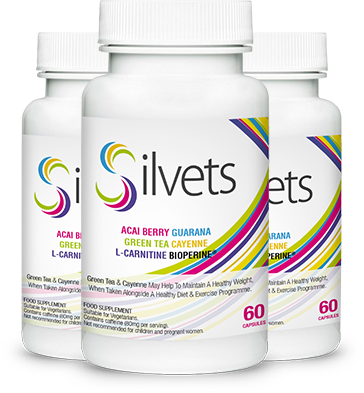
Start with the ingredient list, because it is the document a formula stands or falls on. The maker lists six names for Silvets: acai, green tea, guarana, cayenne, L-carnitine tartrate, and BioPerine. No amount is published for any of the six.
Garcinia cambogia does not appear in that list. It does not appear under its extract name, its active compound hydroxycitric acid, or any synonym we could find in the maker's ingredient documents. The list is short, complete-looking, and garcinia-free.
Now the order page. In the sidebar a buyer sees while paying, the maker advertises the product with wording claiming the "highest content of Garcinia Cambogia on the market". That is not a passing mention. It is a superlative selling point, placed at the point of payment.
Placement matters for judging intent and effect. An ingredient list is read, if at all, by a careful buyer researching in advance. An order-page sidebar is read by every buyer, at the moment of decision, when a superlative claim does its commercial work.
The two documents also ask for different kinds of trust. The ingredient list asks to be believed as a factual record of contents. The sidebar asks to be believed as a reason to buy. When they conflict, a buyer cannot honour both requests at once.
A superlative claim also carries its own burden. To claim the highest garcinia content on the market, a seller would need a stated content for its own product and a comparison against rivals. This seller publishes no garcinia content at all — because, on its own list, there is none to state.
One detail sharpens the contradiction further. The sidebar does not claim the product merely contains garcinia — a trace listing might have allowed a labelling-error defence. It claims the highest content on the market, a comparative boast that presupposes a large, measured garcinia content this formula, on its own list, does not have at all.
We quote both documents as the maker published them, because this article's finding needs no outside evidence. No competitor allegation, no laboratory test, and no anonymous review is required. The maker's order page and the maker's ingredient list contradict each other, in the maker's own words.
There are innocent explanations a seller could offer — an outdated sidebar, a template carried over from another product, a formula changed without updating the page. The maker offers none of them. No correction, footnote, or version note appears in either document we examined.
What Is Actually in Silvets?
The factual baseline is the six-name list, and it is worth setting out plainly, because much of the internet's coverage of this product gets even this wrong. What the maker says is in Silvets is acai, green tea, guarana, cayenne, L-carnitine tartrate, and BioPerine.
Acai is listed first. It is a fruit with genuine nutritional value and, as our acai article documents, no clinical evidence that it causes weight loss in humans at any dose. Its lead position is a recognition choice, not an evidence ranking.
Green tea and guarana are the panel's caffeine sources. Both plants contain caffeine naturally, which makes Silvets a stimulant product, and the maker publishes no total caffeine figure for the two combined. That missing total is audited separately in our caffeine coverage.
Cayenne contributes capsaicinoids, the compounds behind a small energy-expenditure effect at studied doses in human participants versus control conditions. L-carnitine tartrate is the panel's best-evidenced weight ingredient, with a small pooled effect at gram-level doses in adults versus control treatment.
BioPerine is an absorption enhancer rather than a weight-loss ingredient. It is included to increase uptake of other compounds, a role that also raises medication-interaction questions covered in our safety article. It contributes no fat-loss evidence of its own to the formula.
We checked for garcinia under every name it travels by. It is sold as garcinia cambogia, garcinia extract, hydroxycitric acid, and HCA, and a formula containing it in any meaningful quantity would list one of those names. None appears in the maker's ingredient documents, in any form we could find.
That is the whole verifiable formula: six names, no amounts, no published directions, and no garcinia. Everything beyond those six names — in either direction, addition or subtraction — is not in the maker's documents, whatever any other website says about this product.
Notice what the baseline cannot tell you, either. Names alone do not reveal whether any ingredient is present at a studied dose, a token dose, or a trace. The garcinia question has a clean answer only because absence from a list is checkable. Presence, without amounts, is not.
Why Do Other Websites List Completely Different Silvets Ingredients?
Search for this product's ingredients and you will find lists that match neither the maker's panel nor each other. One third-party version includes garcinia, chromium picolinate, and a B-vitamin complex — none of which appears anywhere on the maker's own ingredient list.
Another third-party site names a manufacturer for this product that our research dossier could not confirm from any maker document. The maker's terms, as noted below, leave the operating company's name blank, so any confident attribution elsewhere is going beyond the primary record.
These sites are not correcting the maker. They are review farms: template pages generated around a product name, filled with plausible-sounding formula details, and built to capture search traffic and route it to a buy link. Invented precision is their house style.
The farms also publish directions the maker never gave, presented as the product's real instructions. That invention matters here because it shows how a garcinia listing can feel corroborated: a buyer who sees the ingredient on three farm pages may assume three sources checked it. None of them did.
The pattern is recognisable once seen. A farm page states exact doses the maker never published, directions the maker never gave, and benefits no trial measured, all in a confident register. The more specific such a page sounds, the less of it usually traces to a document.
For most products, a buyer can escape the farms by going to the maker's label. For this product, that escape works only halfway. The maker's ingredient list is the primary document and it is garcinia-free — but the maker's own order page is the source of the garcinia claim.
That is what makes this case unusual, and worth an article. The contradiction is not maker versus internet. It is maker versus maker. The farms merely add noise around a discrepancy the seller created, published, and left standing in its own buying flow.
The lesson generalises beyond one ingredient. For this product, only the maker's documents count as evidence about contents — and when those documents disagree, the disagreement itself is the most reliable information the buyer has about how carefully the seller works.
If Garcinia Were in It, Would It Work Better?
Only briefly, because the full efficacy case belongs to our dedicated garcinia coverage, not to this article. The short version is that garcinia's trial record is weak enough that its absence costs this formula very little in expected effect.
Onakpoya et al. 2011, in the Journal of Obesity pooled randomised trials in adults taking garcinia extract versus adults taking placebo, and found a mean advantage of 0.88 kg favouring garcinia over placebo across those trials, an effect of uncertain clinical relevance.
The largest single garcinia trial was null, and pooled effects shrink as trial rigour rises — the full record, including the dose-response pooling and the safety file, is set out in our article asking whether garcinia cambogia works, and in our garcinia for weight loss explainer.
There is a second reason the hypothetical fails. Garcinia's pooled trials used gram-level daily doses of hydroxycitric acid, sustained over weeks, in adults taking the extract versus adults taking placebo. A capsule formula that added garcinia as one name among many, at an unpublished amount, would not inherit that record either.
So the honest answer to the hypothetical is no, not meaningfully. Even if the order page were right and the ingredient list wrong, the formula would gain an ingredient whose best pooled showing is about a kilogram at gram-level hydroxycitric acid doses in adults versus placebo.
And those gram-level doses could not be verified here anyway. This label publishes no amount for any ingredient it does list. A hypothetical garcinia content, at an unpublished dose, inside an unaudited capsule, would be a claim stacked on two other unknowns.
That is why this article is about documentation, not efficacy. The scandal, if that word fits, is not that a weak ingredient is missing. It is that a seller advertised a superlative content claim for an ingredient its own formula does not contain.
Why This Matters Beyond One Ingredient
A seller whose order page and ingredient list disagree has failed the most basic check a buyer can run. Checking whether a promoted ingredient appears on the formula list takes minutes, requires no expertise, and is the first audit anyone — including the seller — can perform.
If that check fails, every other claim on the same pages inherits the doubt. The guarantee wording, the organic claim, and the safety lines all come from the same source that published two incompatible statements about its own product's contents, and corrected neither.
Consider each in turn. The money-back wording is published with no time period stated anywhere, and the terms separately give only a ten-day withdrawal for unused goods. A buyer relying on the warm wording alone would not know that from the order page.
The contradiction also breaks the one calculation a garcinia buyer would want to run. Comparing products by active content requires two numbers — this product's garcinia amount and a rival's. Here the first number is simultaneously advertised as the market's highest and documented as zero, so no comparison can even begin.
The maker also claims the product is "100% ORGANIC", wording published without a certifier or certificate we could check. And it claims the product is "100% safe" and "free of side effects" — claims we test against the panel's own stimulant ingredients in our safety article.
We documented all of this, claim by claim and document by document, in our full Silvets review. The garcinia contradiction is the clearest exhibit, because it needs no scientific judgement at all: two seller statements, placed side by side, that cannot both be true.
A careful seller can still make mistakes. What distinguishes a trustworthy one is correction — a changelog, an updated page, an answer when asked. Here there is no version history, no correction, and a seller who does not even publish its own company name.
The buyer-facing rule follows directly. When a seller's two documents contradict each other, do not average them into cautious optimism. Score the seller on the contradiction. A formula you cannot verify, from a source that contradicts itself, starts every other question at a disadvantage.
What to Do If You Already Bought It
If you already own a bottle, judge the product by what is actually documented: the six listed ingredients, taken as names without amounts, and the safety record for those ingredients set out in our Silvets side effects article. Ignore the garcinia claim entirely.
That means treating the product as a caffeinated stimulant blend of unknown strength. Guarana and green tea both deliver caffeine, the total is unpublished, and the maker publishes no directions — so timing, stacking with coffee, and sensitivity all deserve the conservative approach.
If you take regular prescription medication, the BioPerine on the panel is a pharmacist question before further use. Absorption enhancers exist to change how compounds are taken up, and that mechanism does not distinguish between supplement ingredients and medicines sharing the same pathways.
Check the bottle you received against the list, too. The packshot's front panel names the same six ingredients as the ingredient documents. If a delivered bottle ever listed different contents, photograph it before opening it — that discrepancy, documented, is stronger than any sales-page wording in a dispute.
On refunds, state the position exactly as the documents give it. The maker's terms provide a ten-day withdrawal right for unused goods. The order page's money-back wording states no time period. Nothing else — no thirty, sixty, or ninety days — is published anywhere we could find.
Do not let any third-party page upgrade that remedy for you. Farm sites routinely invent guarantee periods for products whose makers state none. If a returns promise matters to your purchase, the only version that counts is the one in the maker's own terms.
If the claim influenced your purchase, say so in writing to the seller promptly, while the ten-day unused-goods withdrawal in the terms is still available to you. Keep the product unused and sealed if you intend to use that right, because the withdrawal, as written, covers unused goods only.
Finally, keep the documents. Photograph the bottle's ingredient panel and save the order-page wording you bought under. If the contents or claims are ever disputed, the maker's own published statements — the same ones this article quotes — are the evidence that matters.
Our Recommendation — Silvets
Score: 3.5/10 · Best for: only the committed bargain-hunter who tolerates an unauditable label. Main caution: no amounts or directions published on the official store, and an advertised ingredient is missing from the formula. Fair trial: the three-bottle bundle at $39.33 a bottle — the six-pack maths only wins if you accept zero refund protection beyond ten days, unused.
Frequently Asked Questions
Is the sidebar maybe describing an older formula?
Possibly in principle, but nothing published supports that reading. The maker publishes no version history, no reformulation notice, and no date for either document. Buyers can only judge what is sold today, and today the order page and the ingredient list still contradict each other.
Does the bottle itself list garcinia?
No. The bottle in the maker's own packshot lists the same six names as the maker's ingredient documents — acai, green tea, guarana, cayenne, L-carnitine tartrate, and BioPerine. The physical product's front panel agrees with the ingredient list, not with the order-page sidebar claim.
Could the garcinia be hidden inside one of the listed ingredients?
No plausible reading supports that. The six listed names are distinct ingredients with their own identities, and none is a garcinia extract, a garcinia blend, or a proprietary complex inside which other ingredients could be nested. The list is a flat list of six names, and garcinia is not one of them.
Where can I check a label claim like this myself?
Use the method this article used. Find the maker's own ingredient list, then compare every promotional claim — ingredient superlatives, guarantee wording, safety lines — against that list and the maker's terms. Claims that appear only in sales copy, and nowhere in the formula or terms, should be treated as unverified.
Last reviewed: October 2026.
