
- Quick Answer
- Every Studied Regimen, in One Table
- Why 3.15 Grams and 300 Milligrams Are Both "the Studied Dose"
- The Label Audit: Four Tricks That Hide the Real Dose
- The Standardisation Problem: Standardised to What?
- Drops, Powders and Capsules: Form Changes the Dose Question
- Doing the Maths on Any Label: Three Worked Examples
- Timing: Why "30–60 Minutes Before Meals"?
- Why the Dose Is Split: Two Capsules, Two Meals
- A Note on Doses That Do Not Exist
- How Long Should a Trial Last? Duration and Cycling
- Can I Take More Than the Label Says?
- Frequently Asked Questions
- What is the recommended dosage of African mango?
- How many capsules should I take?
- When should I take it — before or with meals?
- How long should I take African mango?
- Is a higher dose better?
- Read This Next
Disclosure: This article contains affiliate links. If you buy through them, we may earn a commission at no extra cost to you. It never changes our conclusions.
Quick Answer
There is no officially established African mango dosage — no regulator has set one — but the trials used two distinct regimens, and confusing them is the category's favourite trick. The extract regimen is 150 mg of a defined seed extract (IGOB131) twice daily, 30–60 minutes before lunch and dinner — 300 mg/day, used in the 2009, 2018 and 2022 trials.
The whole-seed regimen is 1.05 g of ground seed three times daily — 3.15 g/day, from the 2005 trial. Both are "the studied dose"; they differ tenfold because they are different materials. And the uncomfortable third fact: many commercial products, including the one this site reviews, do not print the Irvingia amount at all — making it impossible to know which regimen, if either, a bottle delivers.
Every Studied Regimen, in One Table
| Trial | Form | Dose | Timing | Duration | Result at that dose |
|---|---|---|---|---|---|
| Ngondi 2005 | Whole ground seed | 1.05 g × 3/day = 3.15 g/day | With the day's meals pattern | 1 month | Weight −5.26% vs −1.32% placebo |
| Oben 2008 | Extract in combination with Cissus | 300 mg/day (in combo) | — | 10 weeks | Cannot isolate mango's contribution |
| Ngondi 2009 | IGOB131 extract | 150 mg × 2/day = 300 mg/day | 30–60 min before lunch and dinner | 10 weeks | −12.8 kg vs −0.7 kg (originator lab; see caveats in our evidence review) |
| Méndez-Del Villar 2018 | Extract | 300 mg/day | Daily | 90 days | Waist −3 cm; triglycerides improved |
| Nonsa-Ard 2022 | Extract | 300 mg/day | Daily | 12 weeks | No significant difference from placebo |
Read the dose column and the result column together and the dosage question answers itself at a deeper level than any label can: the same 300 mg/day produced the genre's biggest claim (2009) and its null result (2022). Dose is necessary for a fair test; it is not sufficient to guarantee an effect that may not exist. Anyone who tells you the secret is their dose has skipped the 2022 row.
Why 3.15 Grams and 300 Milligrams Are Both "the Studied Dose"
The tenfold gap confuses buyers because it looks like a contradiction; it is actually a materials lesson. The 2005 preparation was the whole ground seed — fibre, fat, protein, husks and all — so grams of material deliver milligrams of the fractions researchers care about.
The 2009 preparation, IGOB131, is a defatted, concentrated extract: the oil and bulk removed, the soluble-fibre and polyphenol fractions concentrated into a powder dosed in milligrams. Comparing "3.15 g" with "300 mg" without naming the material is like comparing a glass of orange juice with a vitamin C tablet by weight.
Extract ratios formalise this: a "10:1 extract" claims 10 g of seed became 1 g of extract. The catch — and it is the whole game — is that a ratio says nothing about which constituents were concentrated.
A 10:1 extract of the wrong fraction is not a stronger version of the studied material; it is a different material with a bigger number on the label. IGOB131 is meaningful not because it is concentrated but because it is defined and was itself trialled. Almost nothing else on the shelf can say either.
The Label Audit: Four Tricks That Hide the Real Dose
Trick 1 — the giant equivalence number. A widely sold product advertises "18,000 mg" capsules. On inspection, the capsule contains 500 mg of a 36:1 extract, and the headline is the arithmetic of the ratio (500 × 36) presented as a dose.
The studied dose is 300 mg of extract; by the seller's own arithmetic their capsule is simultaneously "18,000 mg" and one-sixth of a two-capsule studied day. Both numbers come from the same label; only one of them can be compared with a trial, and it is not the big one.
Trick 2 — the proprietary blend. Irvingia listed inside a "metabolic blend 1,200 mg" with five other ingredients discloses the blend's total and nothing else. The mango could be 400 mg or 40 mg; fairy-dusting (a label-visible sprinkle below any studied amount) is the industry norm in blends.
Trick 3 — below-study "typical" doses. Some buying guides reassure readers that "150–200 mg per day is typical" — below even the extract regimen, and sourced from other labels rather than from any trial. Typicality is not evidence; it is an echo.
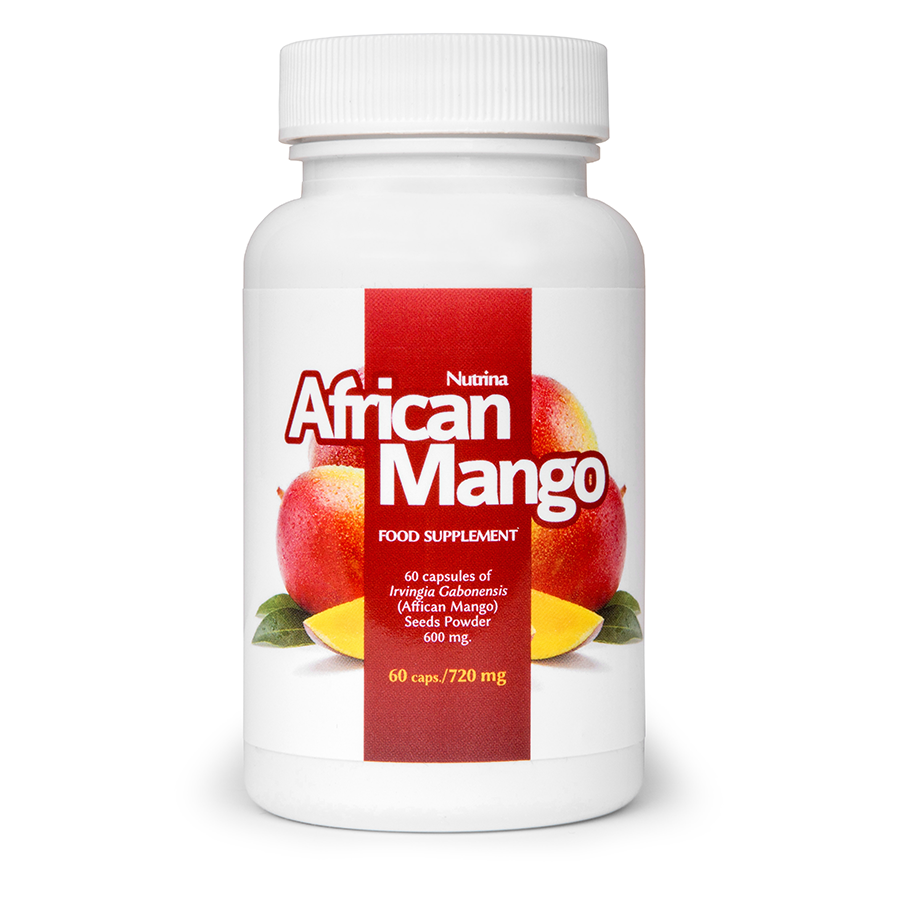
Trick 4 — the missing amount entirely. Which brings us to the worked example this site is positioned to give, because we reviewed the product: Nutrina's African Mango is a single-ingredient product — the honest format — yet its maker publishes neither the per-capsule Irvingia amount nor a standardisation.
A buyer cannot compute a daily dose, cannot compare it with 300 mg, and cannot know whether two capsules a day replicate a trial or a tenth of one. That omission, more than anything in the trial literature, is why our review scores the product 5.0/10: the evidence for the ingredient is weak. But the evidence for this bottle's dose does not exist at all.
The Standardisation Problem: Standardised to What?
Buyers trained on better-documented ingredients look for a standardisation line — "standardised to X% of compound Y" — and find none here, for a structural reason worth understanding. Standardisation requires an agreed marker: a measurable constituent believed to carry the effect (EGCG for green tea, hypericin historically for St John's wort).
Irvingia has no agreed marker. Its candidate actives are a class (soluble fibres) rather than a molecule, plus a polyphenol mixture nobody has crowned. IGOB131 solves this privately — it is a defined proprietary preparation, standardised by its manufacturer's own process — which is why it can be trialled and why its dose means something.
Every other extract on the market is standardised, at best, to its extraction ratio: a statement about how much seed went in, not about what came out. This is the deep reason labels hide doses: for most products there is no meaningful dose to print beyond raw milligrams of an undefined powder.
When a category cannot define its unit, "dosage" becomes theatre — and the consumer's only defences are the trial table above and a preference for products that at least commit to milligrams of something named.
Drops, Powders and Capsules: Form Changes the Dose Question
The category sells three forms, and each hides the dose differently. Capsules at least contain a weighable amount of powder — the failure mode is printing it or not.
Whole-seed powders (sold by herb suppliers at teaspoon doses around 3 g) accidentally land near the 2005 regimen — the one form whose folk dosing matches a trial — but with uncontrolled composition: a teaspoon of ground seed varies with grind and seed lot. And powder sellers' own protocols sometimes direct gram doses while citing the 150 mg extract trial, a tenfold category error in the seller's own copy.
Drops and tinctures are the worst case: no trial has ever used a liquid Irvingia preparation, droppers deliver unstandardised volumes of unstandardised extracts. And "30 drops" is a dose in the way "some" is a quantity.
Our safety guide makes the matching point for side effects: an untested form inherits none of the trials' reassurance. If the trials are your reason for interest, the capsule of printed milligrams is the only form that can even pretend to follow them.
Doing the Maths on Any Label: Three Worked Examples
The audit skill generalises; here it is applied to the three label styles you will actually meet. Label A: "Irvingia gabonensis extract 300 mg per capsule; take 1 daily." Verdict: half the studied daily extract dose, unless the extract is claimed equivalent to IGOB131 — total daily intake 300 mg only if you take two, which the label does not direct.
Label B: "African Mango 18,000 mg (36:1 extract, 500 mg actual)." Verdict: the real intake is 500 mg of extract per capsule — actually above the studied 300 mg/day in raw extract weight, while being an undefined preparation. the headline number should be ignored entirely.
Label C: "Proprietary Weight Blend 1,150 mg: Irvingia extract, green tea, garcinia…" Verdict: unknowable — the Irvingia share could be anywhere from most of the blend to a sprinkle. treat the mango content as decorative. And Label D, the one from our own review shelf: single ingredient named, amount absent — unknowable without the blend excuse.
The pattern across all four: the studied dose is a complete sentence (150 mg of a named preparation, twice daily, before meals). And every commercial label is that sentence with words removed. Count the missing words before you count the milligrams.
Timing: Why "30–60 Minutes Before Meals"?
The pre-meal timing comes straight from the 2009 protocol — doses 30–60 minutes before lunch and dinner — and it has a coherent rationale: if the mechanism is soluble-fibre satiety, the fibre should be hydrated and gastric when the meal arrives.
What the trial design cannot tell us is whether the timing mattered, because no arm took the same dose with meals for comparison. the timing is part of the studied package, not a separately proven variable.
The practical guidance follows: if you are replicating a trial, replicate its timing; if a label instructs "with food" instead, it is not following the protocol it cites. One genuine timing caution does exist, and it is about other things in your stomach: fibre doses can slow absorption of some medicines.
So separating supplements from prescription medication by a couple of hours — and asking a pharmacist about narrow-window drugs — is the conservative routine (the interaction detail is in the safety guide).
Why the Dose Is Split: Two Capsules, Two Meals
The studied pattern is not 300 mg once a day; it is 150 mg twice, each dose parked in front of a meal. That structure follows from the fibre mechanism's logic: a satiety agent works per-meal, on the meal it precedes.
And a morning dose has dissipated — literally passed through — by dinner. Contrast this with how supplements are usually sold (one capsule with breakfast, for adherence) and a systematic drift appears: commercial directions optimise for the routine that keeps subscriptions alive, trial protocols optimise for the mechanism.
And the two quietly diverge while citing each other. The same logic explains the 2005 design — 1.05 g three times daily is a dose in front of every meal.
If there is a generalisable rule in this whole dosage story, it is this: for agents whose plausible action is mechanical and meal-bound (fibres, amylase inhibitors), when and how divided are part of the dose. A product that changes the schedule has changed the intervention, whatever its capsule weight — one more reason a label must be read as a protocol, not an ingredient list.
A Note on Doses That Do Not Exist
Two populations ask about dosage and deserve the honest answer that none exists. Children and adolescents: no trial enrolled them, no paediatric dose has been derived, and weight-loss supplementation in minors is a paediatric conversation, full stop. Pregnancy and breastfeeding: no safety data at any dose; the correct dose is none until a clinician says otherwise.
These are not disclaimers pasted for legal comfort — in a category whose adult dose is itself undefined on most labels, the absence of data for these groups is total. And any seller providing a "gentle" dose for them is inventing it. The safety guide collects the full who-should-avoid list in one place.
How Long Should a Trial Last? Duration and Cycling
The evidence window is 4–12 weeks: one month for whole seed, ten to twelve weeks for extracts.
Nothing beyond twelve weeks has been studied for efficacy or safety, which disciplines two common questions. "How long until I judge it?" — at the studied dose, the 10–12 week mark is the fair verdict point. the trials that found anything had found it by then. "Should I cycle it?" — cycling is a practice borrowed from stimulant products, where tolerance is pharmacology. no tolerance mechanism is known or claimed for Irvingia fibre, and no trial cycled anything.
The honest reason to stop at twelve weeks is not cycling doctrine but the evidence boundary itself: beyond it you are in unstudied territory on both benefit and harm, paying monthly for the privilege. Sellers who convert that boundary into "subscribe forever" are monetising the absence of data.
Can I Take More Than the Label Says?
The trial record gives no support for escalation: no dose above 300 mg/day of extract (or 3.15 g/day of whole seed) has been tested for greater effect.
And the one trial with a dramatically larger material dose — the 2005 whole-seed study — was testing a different preparation, not a bigger extract dose. "More" in this category buys more fibre-side effects (gas, loose stool) and more of the unknown, including the interaction surface discussed in the safety guide. the single serious case report in this ingredient's literature involved 500 mg twice daily — above-label dosing in a woman with pre-existing kidney damage — which is not proof of harm at that dose but is the opposite of a reason to improvise upward.
The ceiling logic is simple: the studied dose is the most you can justify. if it does nothing in twelve weeks, the evidence-based escalation is to a different strategy, not a bigger capsule count.
Frequently Asked Questions
What is the recommended dosage of African mango?
No official recommendation exists. The studied extract dose is 150 mg twice daily before meals (300 mg/day); the studied whole-seed dose is 1.05 g three times daily (3.15 g/day).
How many capsules should I take?
Only answerable if your label prints the amount per capsule — divide the studied 300 mg/day by it. If the amount is not printed (as with the Nutrina product we review), the honest answer is that nobody can tell you, which is itself the finding.
When should I take it — before or with meals?
The main trial used 30–60 minutes before lunch and dinner. That timing is part of the studied protocol, though never isolated as the active variable.
How long should I take African mango?
Judge at 10–12 weeks, the outer edge of the trial record. Longer use is unstudied for both effect and safety.
Is a higher dose better?
Untested and unjustified. Above-studied doses add side effects and unknowns, not evidence.
Last reviewed: October 2026. This article is educational and is not medical advice.
