
- Quick Answer
- First, Separate the Two Meanings of “Appetite Suppressant”
- Mechanism 1: Fibre That Fills the Stomach
- Mechanism 2: Stimulants That Blunt Hunger
- Mechanism 3: Sweet Taste and Blood-Sugar Modulation
- Mechanism 4: Everything Else
- Are OTC Appetite Suppressants Safe to Use With Other Medications?
- How to Judge an Appetite Suppressant Before Buying
- Where Crave Burner Fits
- What Results Should You Actually Expect, and Over What Period?
- Frequently Asked Questions
- Read This Next
Affiliate disclosure: This article contains affiliate links. If you buy through a link on this page, we may earn a commission at no extra cost to you. Our conclusion is not the one a supplement seller would choose: most appetite suppressants do far less than their labels suggest.
Quick Answer
Some appetite suppressants do a little; none does a lot. Prescription appetite-suppressing medicines are tested, regulated drugs with real effects and real side effects. Over-the-counter (OTC) supplements are a different world: GoodRx's evidence review concludes there is no reliable evidence that natural appetite-suppressant supplements work.
And the strongest mechanism in the whole OTC category — soluble fibre that swells in the stomach — produces modest fullness, not drug-like appetite shutdown. If a supplement helps you eat somewhat less at one meal, it has done about as much as this category can honestly promise.
That is the standard we apply to Crave Burner below: an unusually transparent fibre-led formula that still has no trial of the finished product and no published money-back guarantee.
Our Recommendation — Crave Burner
Score: 6.5/10 · Best for: adults whose main problem is eating too much at one daily meal — usually dinner — who want a fibre-led fullness aid with every amount printed, so the dose can be judged before spending. Main caution: the evidence is ingredient-level — there is no trial of the finished product; the maker is unnamed and no money-back guarantee is published. Fair trial: judge over four weeks of pre-dinner use on portions finished and evening snacking; one bottle (90 capsules, a month at 3 a day) costs $59.99 plus $12 shipping — start with one, because there is no refund if it does nothing.
First, Separate the Two Meanings of “Appetite Suppressant”
Prescription medicines (such as phentermine, and the GLP-1 medicines that reduce appetite through gut-hormone pathways) have passed clinical trials, carry known risk profiles, and are prescribed to selected patients with monitoring. Their results cannot be used to sell capsules.
OTC supplements do not need to prove effectiveness before sale. “Appetite suppressant” on a supplement label is a marketing description covering at least four different mechanisms — and the evidence differs sharply between them.
Mechanism 1: Fibre That Fills the Stomach
Soluble fibres such as glucomannan absorb water, form a viscous gel and physically occupy space in the stomach. This is the most plausible OTC mechanism: fullness signals are partly mechanical. And fibre taken with enough water before a meal can reduce how much a person eats at that meal. Human trial evidence for fibre-based appetite control is modest but real — the best in this category.
The conditions matter. The fibre must be taken with sufficient water and before the meal, not alongside dessert. Dry-swallowing swelling fibres is a choking and obstruction risk, and people with swallowing disorders or gut strictures should avoid them. Bloating and gas are the common trade-offs.
Mechanism 2: Stimulants That Blunt Hunger
Caffeine and bitter orange (synephrine) can reduce hunger perception while raising heart rate and alertness. The appetite effect is inseparable from the stimulant effect: jitters, blood-pressure rises, anxiety and broken sleep come from the same pharmacology. This is why stimulant “appetite control” is a poor trade for anyone with cardiovascular risk — and why we treat it separately in our guide to fat burner safety.
Mechanism 3: Sweet Taste and Blood-Sugar Modulation
Gymnema, chromium and cinnamon are marketed at the craving side of appetite: gymnemic acids can dull sweet taste perception on the tongue. And the ingredients are positioned around steadier blood glucose, on the theory that fewer glucose swings mean fewer between-meal cravings.
The human research here is mostly about blood sugar, much of it in people with diabetes — not about weight loss in the general population. We examine gymnema in depth in our gymnema sylvestre guide.
Mechanism 4: Everything Else
Garcinia, raspberry ketones, most “carb blockers” and proprietary mood blends have weak, mixed or absent human evidence. A long ingredient list is not a mechanism; it is often a way to make a label look scientific while every ingredient sits at an unknown dose. This is the part of the market where testimonials replace trials.
Are OTC Appetite Suppressants Safe to Use With Other Medications?
Not automatically — and this is the question buyers ask least and should ask first. Specific issues by ingredient type:
- Blood-sugar ingredients (gymnema, chromium, cinnamon, nopal fibre): can add to the effect of diabetes medicines. Anyone using insulin or glucose-lowering drugs should treat an appetite supplement as something to clear with their clinician, because hypoglycaemia risk is a dosing issue, not a branding issue.
- Stimulants (caffeine, bitter orange): can conflict with blood-pressure control, heart-rhythm medicines, ADHD stimulants, some antidepressants and simple sleep.
- Absorption enhancers: piperine (BioPerine®) is added to some formulas precisely because it increases absorption of other compounds. That is a reason to check prescription medicines with a pharmacist, not a detail to skip.
- Fibres: a gel in the stomach can slow the absorption of medicines taken at the same time. Separating supplement and medicine timing is a pharmacist-level detail.
- Pregnancy, breastfeeding and under-18s: appetite suppressants of every OTC type are a no unless a clinician says otherwise.
How to Judge an Appetite Suppressant Before Buying
- Can you name the mechanism? If the page cannot explain how it reduces appetite in one sentence, it is selling adjectives.
- Are the amounts published? Fibre works by dose and water. A hidden-dose fibre claim cannot be assessed at all.
- Was the finished product tested, or only ingredients? Ingredient research is weaker evidence; borrowed trials from a different branded ingredient are weaker still.
- Is the maker identifiable and the guarantee real? Anonymous sellers with no refund policy leave you carrying all the risk.
- Does it fit your medicines and health? Run the label past a pharmacist if you take anything regularly.
Where Crave Burner Fits
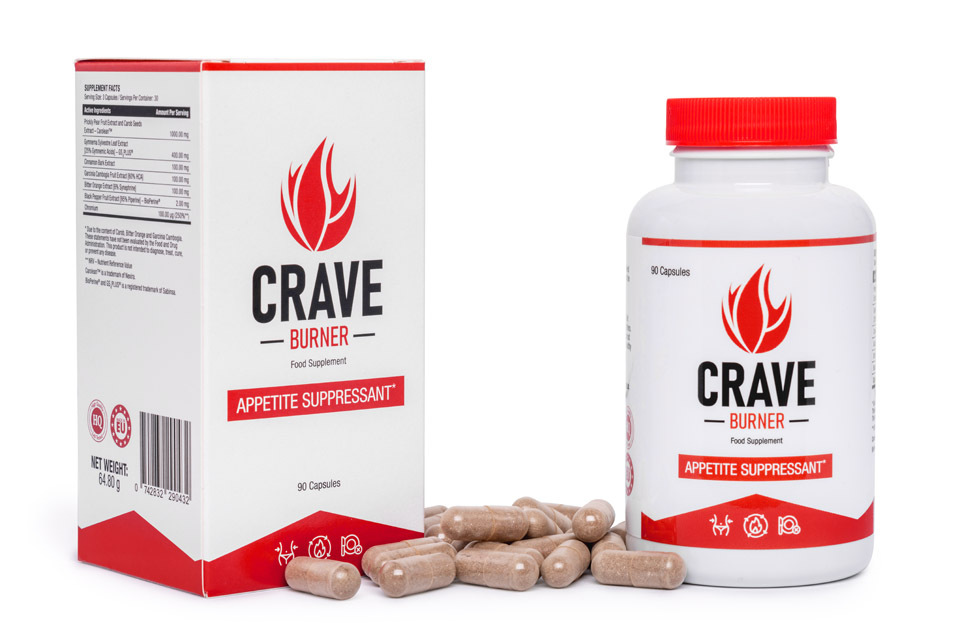
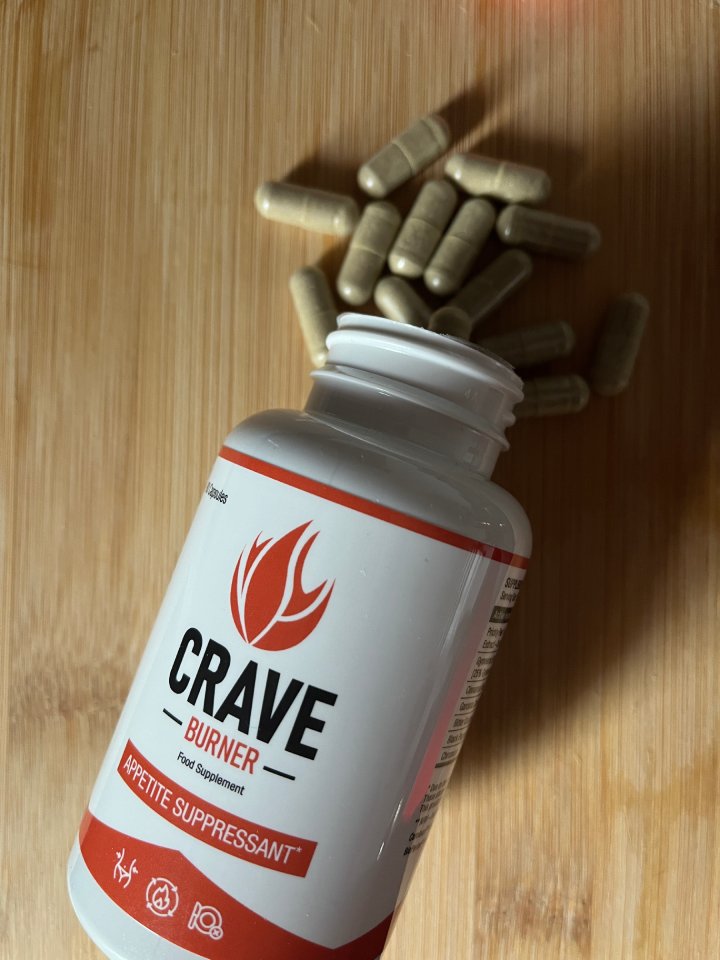
Crave Burner is a fibre-led formula with an unusually complete label. Per daily serving (3 capsules, taken with 300 ml of water 15 minutes before the main meal) it publishes: Carolean™ (prickly pear fruit and carob fibre blend) 1,000 mg, GS4 PLUS® gymnema extract 400 mg, cinnamon bark extract 100 mg, Garcinia Cambogia fruit extract 100 mg (60% HCA), bitter orange extract 100 mg (6% synephrine), BioPerine® 2 mg and chromium 100 µg.
The maker's website lists green coffee in this slot instead — the printed box panel, which governs, lists Garcinia; see our Crave Burner review for the full audit.
It is vegan, made in the EU, and one bottle of 90 capsules lasts a month at $59.99 plus shipping.
That transparency is why our Crave Burner review scores it 6.5/10 — high for this category. The limits are structural: the research the maker cites is ingredient-level, not a trial of these capsules; the seller is not named; and no money-back guarantee is published.
The maker's claim that the product can help you “burn up to 500 calories a day more” is a marketing statement we cannot verify and do not repeat as a result. Judge it as a fullness aid for one meal a day, priced accordingly — not as an appetite cure.
If your problem is specifically the evening, the same product logic applies at dinner. our guide to controlling hunger and cravings at night covers the behavioural side, which for most people matters more.
What Results Should You Actually Expect, and Over What Period?
Set the expectation before the trial, because “I feel a bit less hungry” is not measurable. A fibre-led product is used at one meal a day; its best-case contribution is a somewhat smaller meal, repeated.
Judge it over four weeks with three measures: how often you finish the planned portion without returning for more, evening snacking frequency. And the weekly weight trend inside a diet you were actually following. If none of those moves, the product is not working for you regardless of how scientific the label is.
Also notice what does not count as evidence: a lighter feeling in week one (often water and routine change), a testimonial with a before-and-after photo, or a mechanism diagram. Appetite is strongly suggestible — the placebo effect in feeding studies is large, which is precisely why uncontrolled personal trials over a few days mislead. Four honest weeks beat four excited days.
Our Recommendation — Crave Burner
Score: 6.5/10 · Best for: adults whose main problem is eating too much at one daily meal — usually dinner — who want a fibre-led fullness aid with every amount printed, so the dose can be judged before spending. Main caution: the evidence is ingredient-level — there is no trial of the finished product; the maker is unnamed and no money-back guarantee is published. Fair trial: judge over four weeks of pre-dinner use on portions finished and evening snacking; one bottle (90 capsules, a month at 3 a day) costs $59.99 plus $12 shipping — start with one, because there is no refund if it does nothing.
Frequently Asked Questions
Do OTC appetite suppressants really work?
Modestly at best. Fibre-based fullness has the most plausible evidence; most other OTC mechanisms are weak or unproven, and no supplement matches a tested prescription medicine.
Do natural appetite suppressants really work?
“Natural” describes origin, not effect. GoodRx's review finds no reliable evidence that natural appetite-suppressant supplements work; fibre is the partial exception, with small effects under the right conditions.
Are OTC appetite suppressants safe to use with other medications?
Not by default. Blood-sugar ingredients, stimulants, absorption enhancers and fibres can each interact with medicines. Show the exact label to a pharmacist or doctor first.
Disclaimer: This article is general information, not medical advice. Dietary supplements are not intended to diagnose, treat, cure or prevent any disease. Always consult a qualified healthcare professional before starting a supplement, especially if you take prescription medication.
Last reviewed: November 2026
