
- Quick Answer
- What Are the Maca Colours, Exactly?
- The Colour Claims, Side by Side
- Does Maca Raise Testosterone?
- What Does Maca Do for Desire and Erections?
- What About Energy, Mood and Athletic Claims?
- What About Sperm and Fertility?
- Black, Red and Yellow in the Animal Data
- Red Maca and the Prostate: Animal Data Only
- Raw or Gelatinised, and How Much Did Trials Use?
- What About Blends and Single-Colour Products?
- Safety, Thyroid Questions and Who Should Be Careful
- The Bottom Line
- Frequently Asked Questions
- So which maca colour should a man actually buy?
- Does black maca raise testosterone more than other colours?
- How long does maca take to affect desire?
- Is gelatinised maca better than raw maca?
- Can maca help a couple trying to conceive?
- Can red maca shrink an enlarged prostate?
- Read This Next
Quick Answer
There is no proven "best" maca colour for men, because no human trial has ever compared black, red and yellow maca against each other. The colour categories sold online rest almost entirely on rat studies and seller tradition.
What human trials do show is narrower and more interesting: maca can raise sexual desire in men without raising testosterone at all. Hormones stayed flat in every well-run trial that measured them.
Black maca has the strongest animal data for sperm production, red maca the only animal data for prostate size, and yellow is simply the traditional, most-used form behind most of the human research.
If you buy maca, the evidence supports choosing a gelatinised product at the doses trials used, 1.5 to 3 grams a day, and treating colour as a minor detail rather than the main event.
What Are the Maca Colours, Exactly?
Maca (Lepidium meyenii) is a cruciferous root grown at 4,000 metres and above in the Peruvian Andes, in the same plant family as cabbage and broccoli. The harvested part is the swollen root, or hypocotyl.
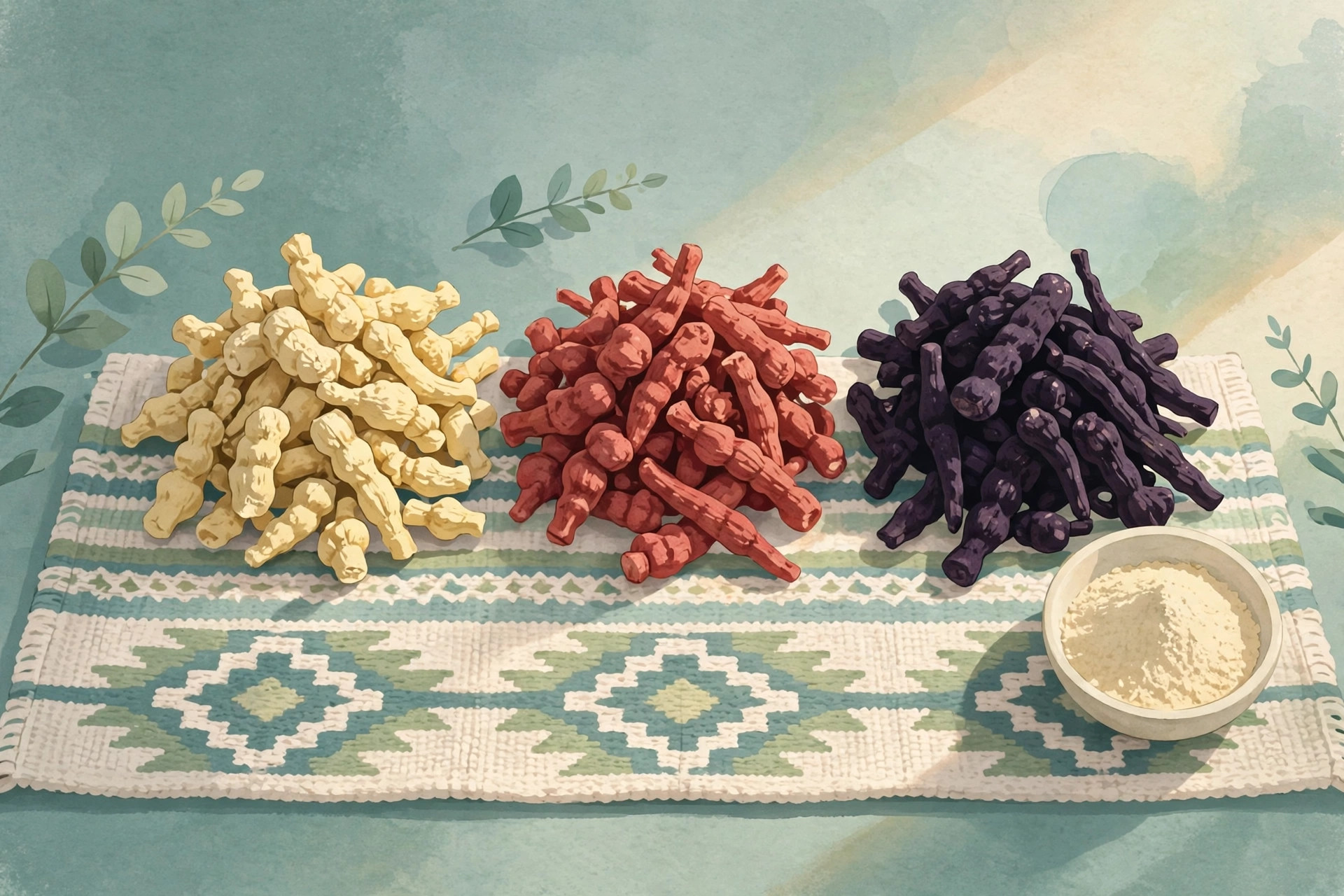
The colours are skin phenotypes of that root: yellow, red and black are the three sold as distinct products, within a wider range that also includes purple and intermediate shades. They are not different species.
The phenotypes do differ chemically. Laboratory analyses find different levels of glucosinolates, macamides and other compounds across the colours, so the idea that they might act differently is not unreasonable in principle.
Yellow is the most common colour in the traditional harvest and usually the cheapest. Black is the scarcest and typically the most expensive, which is part of why it is marketed hardest.
Traditionally, the colours were not separated into supplement categories at all. Andean communities dried and cooked the mixed roots as food, which is worth remembering when a shop presents the colour system as ancient wisdom.
The colour-specific claims are a modern, research-adjacent construction. One Peruvian research group ran the animal experiments that separate the colours, and the supplement market converted those rat results into product lines.
The Colour Claims, Side by Side
| Colour | Marketed to men for | What the evidence actually rests on |
|---|---|---|
| Yellow | Everyday energy, balance, general use | The default traditional form. Most human trials used gelatinised maca without any colour-specific claim or comparison. |
| Black | Sperm production, desire, physical performance | The strongest rat data: in the head-to-head rat study, black alone raised daily sperm production. No human colour comparison exists. |
| Red | Prostate support | Rat studies in which red maca reduced prostate size, including in hormone-induced enlargement. No human prostate trial exists. |
Read the right-hand column carefully, because it is the whole story of this article. Every colour-specific claim a seller makes traces back to animal work or to tradition, not to trials in men.
That does not make the claims impossible. It makes them unproven, and it means paying a large premium for a colour is paying for a hypothesis.
Does Maca Raise Testosterone?
No, and this is the most replicated finding in the entire maca literature. It is also the finding most often missing from product pages.
In 2002, Gonzales and colleagues ran a twelve-week, double-blind, placebo-controlled trial of gelatinised maca at 1,500 or 3,000 mg a day in healthy men aged 21 to 56.
Sexual desire improved, measurably, from week eight. Serum testosterone and oestradiol, however, were not different from placebo, and the desire effect was independent of both hormone levels and anxiety or depression scores.
The paper's own title makes the point: it studies maca's effect on desire "and its absent relationship with serum testosterone levels".
A companion twelve-week trial from the same group (Gonzales et al., 2003, Journal of Endocrinology) measured six reproductive hormones: LH, FSH, prolactin, 17-alpha hydroxyprogesterone, testosterone and oestradiol. None changed on maca versus placebo, at any time point.
The pattern has held since. A 2023 placebo-controlled trial in men with symptoms of late-onset hypogonadism likewise found symptom improvement without significant hormone changes, and no effect on PSA.
So file maca correctly: whatever it does for desire, it does not do it through testosterone. Men with a confirmed low testosterone reading gain nothing hormonal from maca, in any colour.
What Does Maca Do for Desire and Erections?
The desire result above is the strongest human finding for maca in men, and even it comes from small trials. A 2010 systematic review of maca for sexual function found just four randomised trials in total.
Shin and colleagues concluded the evidence was "limited", with trial numbers, sample sizes and methodological quality all too low for firm conclusions. Two trials were positive on desire or dysfunction, one in healthy cyclists was not.
For erectile function specifically, Zenico and colleagues randomised 50 men with mild erectile dysfunction to 2,400 mg of maca extract daily or placebo for twelve weeks.
IIEF-5 scores rose in both groups, but more on maca: an increase of 1.6 points versus 0.5 on placebo. The authors described their own result as "a small but significant effect" on subjective well-being and sexual performance, which is the right calibration.
Set against prescription ED medication, a 1.6-point questionnaire gain is minor. Set against the "natural Viagra" framing on product pages, it is a useful reality check in both directions: something may be there, and it is small.
A related signal comes from outside the male literature: a small double-blind trial in women with antidepressant-related sexual dysfunction reported improvement at 3 grams a day (Dording et al., 2015). Different population, same direction, same small scale.
What About Energy, Mood and Athletic Claims?
Maca is also sold as an energy and endurance supplement, often with the black colour attached. The human evidence here is thinner than for desire.
One of the four trials inside Shin's 2010 review was conducted in trained male cyclists and found no significant effect on sexual function measures. Small exercise studies since have produced mixed results on performance outcomes, none of them large or definitive.
Mood claims rest on similarly small foundations: a handful of short trials, mostly in postmenopausal women, reporting improved anxiety or depression scores alongside the sexual-function outcomes. Interesting, preliminary, and not a basis for treating low mood with a root powder.
The honest summary for the energy category is that maca is a nutritious food with a long history of use at altitude, and that supplement-grade claims about stamina and performance remain unproven in adequate trials.
What About Sperm and Fertility?
The fertility reputation starts with a 2001 study by Gonzales and colleagues, in which nine healthy men took 1,500 or 3,000 mg of maca daily for four months.
Semen volume, sperm count per ejaculate, motile sperm count and motility all rose; as later summarised, sperm concentration rose about 35 percent, total count about 84 percent and motile count about 109 percent. Hormones did not change, and the gains were not related to dose.
Those percentages circulate widely, so their context matters: nine men, no placebo group, no blinding. Semen parameters vary substantially on their own, and without a control arm, improvement cannot be separated from natural variation or regression to the mean.
Later controlled work is more sobering. A double-blind pilot trial (Melnikovova et al., 2015) found only rising trends that did not reach significance. A 2020 trial in 69 men with mildly low counts gave 2 g daily and found sperm concentration improved versus placebo, but motility, volume and shape did not (Alcalde and Rabasa, 2020).
Going the other way, a sixteen-week placebo-controlled trial of yellow maca in 50 men with reproductive problems found no significant benefit (Poveda et al., 2013).
The fairest summary remains the systematic review by Lee and colleagues (2016), which found five clinical studies and called the evidence "suggestive", while stating that trial numbers, sample size and bias risk prevent firm conclusions. Later reviews, including a 2022 systematic review and meta-analysis, work from essentially the same small trial base.
One gap deserves emphasis: no maca trial in men has used pregnancy or live birth as an endpoint. Improved semen numbers in small studies are a lead, not a fertility treatment, and couples trying to conceive should not spend a year on maca instead of a workup.
Black, Red and Yellow in the Animal Data
The colour hierarchy comes mainly from one set of experiments. Gonzales and colleagues (2006, Journal of Ethnopharmacology) gave rats yellow, red or black maca for seven and for forty-two days and examined sperm production directly.
Black maca was the only colour that increased daily sperm production at both time points, and the only one that increased epididymal sperm motility at forty-two days. Yellow and red did not raise sperm production in that study.
The same experiment produced the red-maca prostate finding: red, but not black or yellow, reduced prostate weight in the rats. Two distinct animal signals, from one laboratory's programme, became two product categories.
Rat sperm production is not human fertility, and the doses used in gavage studies do not map neatly onto a spoonful of powder. These results justify human colour trials. They are not a substitute for them, twenty years on.
Red Maca and the Prostate: Animal Data Only
Because this claim targets a real medical condition, it gets its own fence. In 2005, Gonzales and colleagues reported that red maca reduced ventral prostate size in rats, and prevented the prostate growth induced by testosterone enanthate injections.
Yellow and black maca did not show that effect in the same study, and no colour changed the rats' testosterone or oestradiol levels. Follow-up rat work in 2012 found red maca also normalised prostate zinc levels in the same induced-enlargement model (Andrologia, 2012).
All of it is rat work, in an artificially induced model, from essentially one research group. There is no human trial of red maca, or any maca, for prostate enlargement, prostate symptoms or prostate cancer prevention.
A man with urinary symptoms from an enlarged prostate needs assessment and, where appropriate, treatments with human evidence behind them. Red maca is, at present, a rodent finding with a marketing department.
Raw or Gelatinised, and How Much Did Trials Use?
Form matters more than colour in the human data. The Gonzales trials used gelatinised maca: root powder processed with heat and pressure so the dense starch matrix breaks down, making it easier to digest and more concentrated per gram.
Raw maca powder keeps that starch intact. It is harder to digest, and gastrointestinal complaints are the most commonly reported problem with maca generally, particularly with raw powder at higher doses.
Traditional Andean preparation points the same way: the roots were dried and then cooked, boiled in water or milk or roasted, not eaten raw in smoothies.
Gelatinisation also modestly reduces glucosinolates, the sulphur compounds discussed in the safety section. It does not turn maca into a different substance, and gram-for-gram comparisons between raw, gelatinised and concentrated extracts are not interchangeable.
Doses in the human trials cluster tightly: 1,500 to 3,000 mg a day of gelatinised powder for desire and hormones, 2,400 mg a day of extract for erectile function, and 1,500 to 3,000 mg in the semen studies, over eight to sixteen weeks.
Products suggesting a few hundred milligrams will transform energy or hormones are not working from this trial record. Neither are megadose products: intakes well above 3 grams a day are simply untested territory.
What About Blends and Single-Colour Products?
Many products blend the colours, often in trademarked ratios with names suggesting the proportions were clinically derived. They were not: no blend ratio has been tested in humans against any other ratio, or against a single colour.
Labels frequently omit the proportions entirely, listing "red, black and yellow maca" inside a proprietary blend with only a total weight. A blend that is 90 percent yellow and 10 percent black can legally wear the same colour claims as the reverse.
Single-colour products at least tell you which phenotype you are getting. What they cannot tell you is that the phenotype does in men what the rat studies suggest, because that trial has never been run.
Practical buying order, then: first a gelatinised product, second a dose in the trial range, third a brand that publishes contaminant testing. Colour comes fourth, and paying double for it is difficult to justify on evidence.
Safety, Thyroid Questions and Who Should Be Careful
In trials at 1.5 to 3 grams a day for up to twelve weeks, maca has been well tolerated. The 2003 hormone trial recorded no side effects different from placebo, and reviews of the wider literature describe the same pattern, while noting how much remains unstudied (Clinics, 2024).
The commonest real-world complaints are digestive: bloating, gas and stomach discomfort, mostly with raw powder. Headache, jitteriness and sleep disturbance are reported occasionally, which is why some users take it earlier in the day.
The thyroid question deserves a straight answer. Maca is a brassica, and brassicas contain glucosinolates, breakdown products of which can interfere with iodine uptake by the thyroid. At food-level intakes this is a non-issue for most people.
At large supplemental doses, especially of raw maca, the theoretical concern grows. Anyone with hypothyroidism or on thyroid medication should discuss maca with their doctor first, and gelatinised forms are the more cautious choice.
Because laboratory studies show some estrogen-like activity, specialists also advise people with hormone-sensitive cancers to check with their oncologist before using maca, even though human trials show no change in hormone levels.
There are no adequate safety data for supplement-dose maca in pregnancy or breastfeeding, so the standard advice is to avoid it then. Finally, colour blends rarely state their proportions, and independent testing of maca products is uncommon: buy from brands that test for heavy metals and state what is actually in the jar.
On interactions, the record is reassuring but thin: no major drug interaction with maca is well documented, which reflects how little formal interaction study exists rather than proof of none. The thyroid and hormone-sensitive cautions above are the ones with a plausible mechanism behind them.
One last calibration: maca's long history as a food in the Andes is genuine reassurance about ordinary dietary amounts. It says little about concentrated extracts taken daily for months, which is the exposure supplements actually create.
The Bottom Line
No maca colour is proven best for men, because the colours have never been compared in humans. Black's sperm reputation and red's prostate reputation are rat findings; yellow is the traditional form behind most human trials.
The solid human finding is different from the marketing: maca modestly improves sexual desire, and slightly improves erectile-function scores in mild ED, while leaving testosterone and other hormones measurably unchanged.
Sperm-parameter evidence is suggestive at best: one tiny uncontrolled study with headline percentages, followed by small controlled trials pointing in different directions, and no pregnancy data at all.
If you use maca, use it like the trials did: gelatinised, 1.5 to 3 grams a day, judged over eight to twelve weeks, with colour a distant second consideration.
Frequently Asked Questions
So which maca colour should a man actually buy?
On current evidence, colour should not drive the purchase, because no human trial compares the colours. A gelatinised product with a stated dose, from a brand that tests for contaminants, matches the trial record better than an expensive single-colour product with no human data behind its specific claim.
Does black maca raise testosterone more than other colours?
No colour of maca has been shown to raise testosterone in men. The human trials that measured hormones, using gelatinised maca at 1.5 to 3 grams daily, found testosterone, LH, FSH and oestradiol all unchanged. Black maca's reputation comes from rat sperm studies, not from hormone effects.
How long does maca take to affect desire?
In the key placebo-controlled trial, the desire effect appeared at week eight and was present at week twelve; measurements at two and four weeks showed nothing. Trials of erectile function and semen parameters ran twelve to sixteen weeks. Judge maca over two to three months, not days.
Is gelatinised maca better than raw maca?
For most users, probably: gelatinisation breaks down the root's starch, making it easier to digest and more concentrated, and the positive human trials used gelatinised maca. Raw powder retains more glucosinolates and more often causes digestive discomfort. Traditional Andean preparation cooked the root rather than eating it raw.
Can maca help a couple trying to conceive?
Not on present evidence. Small studies disagree on semen parameters, the most-cited positive study had nine men and no control group, and no trial has measured pregnancy rates. Maca is unlikely to harm at trial doses, but it should not delay a fertility workup for either partner.
Can red maca shrink an enlarged prostate?
There is no human evidence that it can. Red maca reduced prostate size in rats, including in a hormone-induced enlargement model, and follow-up rat studies exist, but no trial has tested red maca in men with prostate symptoms. Urinary symptoms deserve medical assessment and proven treatments first.
Last reviewed: November 2026. This article is educational and is not medical advice.
