
- Quick Answer
- Which Ginseng? The Naming Trap Comes First
- Claim 1: Erections — the Strongest File, and It Is Still Modest
- Claim 2: Testosterone — Unproven in Healthy Men
- Claim 3: Energy, Fatigue and Sperm — Small, Specific, Preliminary
- Fatigue and "energy"
- Sperm quality
- The Dose Audit: Trials vs Blends
- Safety and Interactions
- How to Read a Ginseng Label
- Frequently Asked Questions
- Korean red ginseng vs regular ginseng — which one was studied?
- How long do the erection trials take to show anything?
- Does ginseng raise testosterone at all?
- Can ginseng interact with blood thinners?
- Why is there so little ginseng in most men's formulas?
- Is Siberian ginseng the same plant?
- Read This Next
Quick Answer
Ginseng is sold to men as one ingredient that does three jobs: stronger erections, higher testosterone, and more energy. We checked the human trials behind each claim separately, because the evidence is not equally strong for all three.
That separation matters. Blending the claims into one "male vitality" verdict is how a weak claim borrows strength from a stronger one. Graded individually, the record looks like this:
| Claim | What the human trials show | Our verdict |
|---|---|---|
| Erections | Several small placebo-controlled trials of Korean red ginseng in men with erectile dysfunction; pooled effects are real but small | Modest support — the strongest claim of the three |
| Testosterone | The trials that measured testosterone found no significant rise versus placebo; one positive study was in men with metabolic syndrome | Unproven in healthy men |
| Fatigue and energy | A small pooled benefit for fatigue, mostly in people who were ill or exhausted; no benefit for physical performance | Small effect, only in the populations studied |
| Sperm quality | One small trial in infertile men who all had a varicocele | Preliminary — cannot be generalised |
One number frames everything that follows. The trials used roughly 1,000 to 3,000 mg of ginseng a day, while multi-ingredient men's formulas typically include it at around 100 mg per serving.
Whatever the trials found, they did not find it at blend doses. Keep that gap in mind as you read each claim.
Which Ginseng? The Naming Trap Comes First
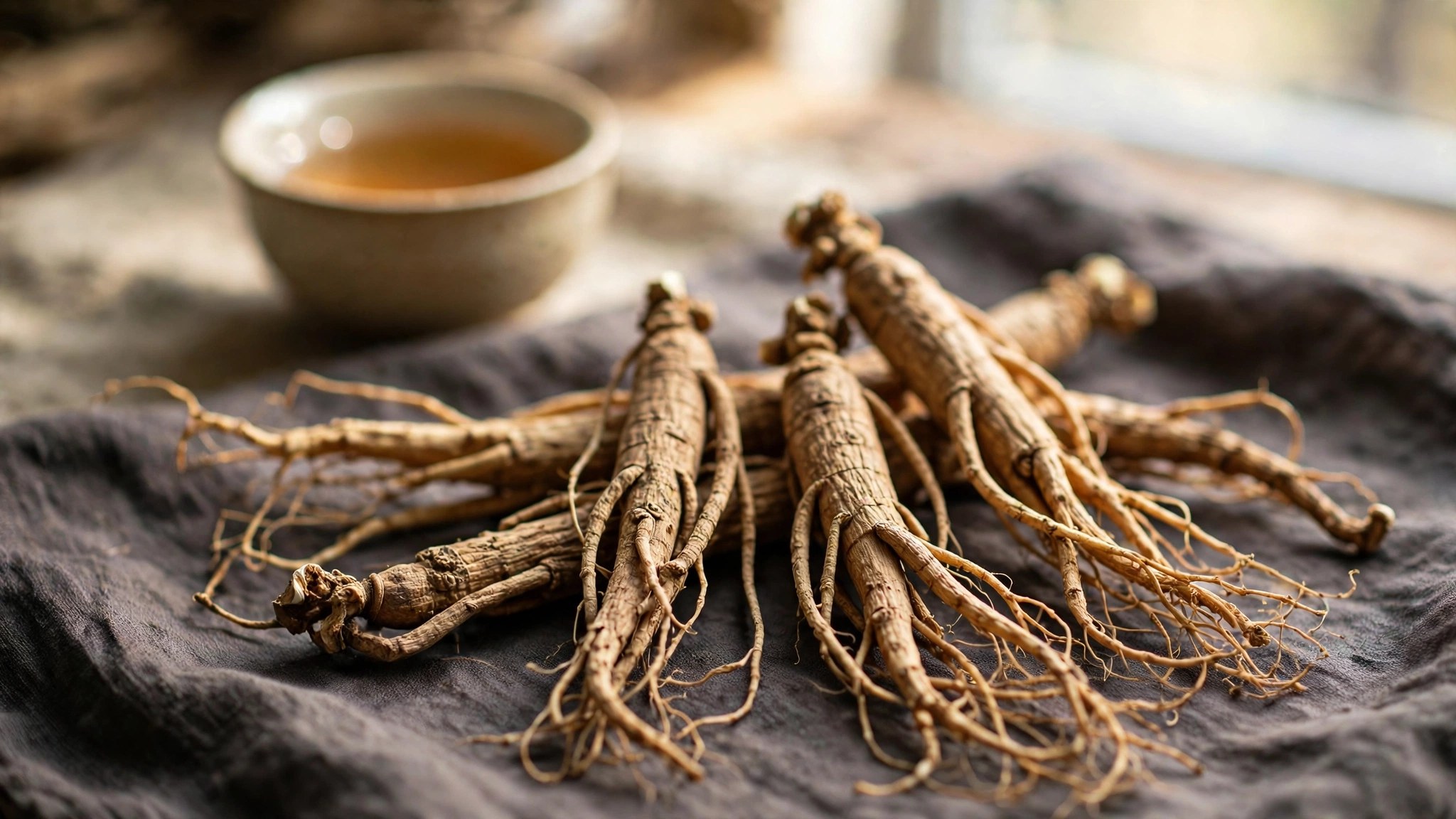
Almost every men's-health claim traces back to one plant: Panax ginseng, also called Asian or Korean ginseng. Korean red ginseng is that same root, steamed and then dried, which gives it its colour.
White ginseng is the same root dried without steaming. The distinction matters because, as the 2008 systematic review in the British Journal of Clinical Pharmacology specifies, the erectile dysfunction trials used the steamed red form.
American ginseng is a different species, Panax quinquefolius, with a different ginsenoside profile. It has its own small trial record, mostly on fatigue, and it cannot borrow the Korean erection data.
"Siberian ginseng" is not a ginseng at all. It is Eleutherococcus senticosus, a different genus whose active compounds are eleutherosides, not ginsenosides — and none of the trials in this article used it.
Plant part matters too. Most trials used root. One large erection trial used berry extract, which has a ginsenoside profile distinct from the root, so its results do not transfer automatically.
If a label just says "ginseng blend" with no species, part, or extract details, there is no trial record anyone can honestly attach to it.
Claim 1: Erections — the Strongest File, and It Is Still Modest
This is the one ginseng claim with genuine human randomised trials behind it. Nearly all of them tested Korean red ginseng root in men diagnosed with erectile dysfunction, over eight to twelve weeks.
The file is old as well as small. The first controlled trial, Choi and colleagues in 1995, compared red ginseng with placebo and the drug trazodone in 90 men; 60% of the ginseng group rated the treatment effective, against 30% in the placebo group.
The best-known early trial is Hong and colleagues (Journal of Urology, 2002): 45 men with erectile dysfunction crossed over between Korean red ginseng at 900 mg three times daily — 2,700 mg a day — and placebo, in eight-week periods.
On ginseng, 60% of the men said their erections had improved, mean erectile-function scores were higher than on placebo, and a device measure of penile tip rigidity also improved. Serum testosterone did not change, a point we return to below.
The largest root trial, de Andrade and colleagues (Asian Journal of Andrology, 2007), randomised 60 men with mild to mild-to-moderate erectile dysfunction to 1,000 mg of Korean red ginseng three times daily or placebo for twelve weeks.
In the ginseng group, IIEF-5 scores rose from 16.4 to 21.0, against 17.0 to 17.7 on placebo, and 20 of the 30 ginseng-treated men (66.6%) reported improved erections, with no significant improvement reported in the placebo group.
The berry trial reads differently. Choi and colleagues (International Journal of Impotence Research, 2013) gave 119 men with mild-to-moderate erectile dysfunction 1,400 mg a day of ginseng berry extract or placebo for eight weeks.
Scores rose inside the berry group, but a published re-analysis of that trial the following year found the differences against placebo did not survive correction for the number of comparisons made. Improvement within a group is not the same as beating placebo.
Pooled, the older reviews look encouraging. Jang and colleagues (2008) combined six placebo-controlled trials with 349 men and found men on red ginseng were 2.40 times as likely to report improved erectile function as men on placebo (risk ratio 2.40, 95% CI 1.65–3.51).
The same authors were explicit about the limits: the trials were few, small, and of low methodological quality on average, so the evidence was "suggestive" rather than definitive.
The most recent check is more restrained. The 2021 Cochrane review of ginseng for erectile dysfunction pooled nine studies with 587 men and found a mean advantage over placebo of 3.52 points on the IIEF erectile-function domain.
That is below the 4-point difference the Cochrane reviewers set as the smallest clinically important one, and the IIEF-5 advantage of 2.39 points fell below its 5-point threshold too. Their word for the effect was "trivial," at low-to-moderate certainty.
Our reading: something real is probably there for men with mild-to-moderate erectile dysfunction, at gram-level doses, over two to three months. It is a small effect, measured only against placebo — no review we read reports a head-to-head trial against prescription erectile dysfunction medicines.
The proposed mechanism is laboratory work, not human proof: ginsenosides increased nitric oxide release and relaxed penile tissue in animal experiments. Plausible, and a reasonable explanation to test — not a demonstrated pathway in men.
Claim 2: Testosterone — Unproven in Healthy Men
Start with the cleanest data point available. The two best erection trials above drew blood, and in neither of them did testosterone move: Hong's crossover trial recorded no change in serum testosterone on Korean red ginseng.
De Andrade's trial found serum testosterone, prolactin, and cholesterol were not significantly different between the ginseng and placebo groups after twelve weeks at 3,000 mg a day.
So even where erections improved, testosterone did not. Whatever ginseng does for erections, the trial record says it does not do it by raising testosterone.
The reviewers noticed this early. Jang and colleagues noted in 2008 that although a hormone-like mechanism had been proposed for red ginseng, direct measurements of testosterone concentrations appeared to refute it.
The dedicated check came from Smith and colleagues (Advances in Nutrition, 2021), who systematically reviewed randomised trials of single herbs and testosterone concentrations in men: 32 trials across 13 herbs.
For Asian ginseng they found seven studies using berry or root extracts. Only one showed a testosterone increase, and it recruited men with metabolic syndrome — not healthy men with normal hormone levels.
Most participants across the review were young, nonclinical populations, and the herbs the reviewers judged to have positive evidence were fenugreek and ashwagandha. For ginseng, "some evidence exists" was the ceiling, resting largely on that single study.
There is also a language trick to watch for. Phrases like "supports the hormone axis" usually trace back to rodent experiments in which ginseng extracts altered luteinising hormone or testosterone in rats — a hypothesis about humans, not a result in men.
Where does the testosterone reputation come from, then? Mostly from animal work — rodent studies on the hormone axis and mating behaviour fill the reference lists of narrative reviews — plus fragments from stressed or unwell populations.
Animal findings are a reason to run a human trial. They are not a human result, and no adequate human randomised trial demonstrates a testosterone increase in healthy men. That absence is the finding.
Our verdict: if a page or label claims ginseng "boosts testosterone," ask which human trial it is quoting. For healthy men, there isn't one that holds up.
Claim 3: Energy, Fatigue and Sperm — Small, Specific, Preliminary
Fatigue and "energy"
The fatigue trials studied people who were already exhausted, which is not the same as giving a healthy man more energy. The distinction decides what this evidence can claim.
Kim and colleagues (PLoS ONE, 2013) randomised 90 patients with idiopathic chronic fatigue — 69 of them women — to 1 g or 2 g a day of Panax ginseng extract or placebo for four weeks.
Mental fatigue scores improved significantly more on ginseng than on placebo. The total fatigue score, the trial's headline measure, did not differ significantly between the groups. A partial result, in a mostly female patient group.
A meta-analysis by Bach and colleagues (Journal of Korean Medical Science, 2016) pooled 12 randomised trials with 630 participants and found a small benefit for fatigue (standardised mean difference 0.34) — and no benefit at all for physical performance (standardised mean difference −0.01).
The largest single fatigue trial used the other species: Barton and colleagues (Journal of the National Cancer Institute, 2013) gave 364 patients with cancer-related fatigue 2,000 mg a day of American ginseng or placebo.
Fatigue scores improved more on American ginseng than on placebo at eight weeks, but not at four. Again: patients, a different species, and an effect that took two months.
The regulator's summary matches that picture. The NCCIH fact sheet on Asian ginseng reports that a 2023 review of 19 studies with 2,413 participants suggested ginseng alone may have a small beneficial effect on general fatigue not related to a specific disease.
Our verdict: a small fatigue-relief effect in tired or ill people is plausible. Nothing in this record shows a performance or energy benefit in healthy men, and the physical-performance data is specifically null.
Sperm quality
The sperm file is thinner still. Its one controlled human trial is Park and colleagues (Chinese Journal of Integrative Medicine, 2016), in 80 infertile men who all had a varicocele — a specific, treatable cause of poor semen quality.
Men received Korean red ginseng at 1.5 g a day for twelve weeks, surgery, both, or neither. Semen concentration, motility, morphology, and viability improved in the ginseng-only group, while the placebo-only group did not improve.
But the surgery groups improved too, and the four-arm design cannot cleanly separate how much of the change belongs to ginseng. Hormones, including testosterone, did not differ significantly between the groups.
Beyond that trial, the human sperm literature is small and uncontrolled, and the encouraging spermatogenesis data is largely from animals. Our verdict: preliminary, from one small trial in one specific condition — no basis for sperm claims aimed at healthy men.
The Dose Audit: Trials vs Blends
Ginseng's men's-health reputation rests on gram-level dosing. Here is what the trials actually used, set against what a typical multi-ingredient men's formula provides per serving:
| Claim | Trial dose and duration | Typical blend amount |
|---|---|---|
| Erections (root) | 2,700–3,000 mg/day for 8–12 weeks | ~100 mg per serving |
| Erections (berry) | 1,400 mg/day for 8 weeks | Rarely used in blends |
| Sperm quality | 1,500 mg/day for 12 weeks | ~100 mg per serving |
| Fatigue | 1,000–2,000 mg/day for 4–8 weeks | ~100 mg per serving |
The trial doses are roughly ten to thirty times the blend amounts. A 100 mg line in a formula cannot inherit a result produced at 3,000 mg a day — dose is not a detail; in this literature it is most of the story.
The trials also used a single defined extract of a named species and plant part, taken every day for weeks. Blends frequently disclose none of that, and no trial we found tested ginseng as an on-demand, take-it-tonight ingredient.
Duration compounds the dose problem. Every trial in the table ran at least four weeks of daily use, and the erection trials ran eight to twelve — so an occasionally taken blend differs from the evidence in both variables at once.
Safety and Interactions
The NCCIH position is a reasonable summary: short-term oral use of Asian ginseng, up to about six months in recommended amounts, appears safe for most people. Long-term safety is unresolved, and most trials were small and short.
The most common side effect is insomnia. Others reported include increased heart rate, high or low blood pressure, headache, loss of appetite, and digestive problems; severe rash, liver damage, and severe allergic reactions have been reported uncommonly.
Blood thinners deserve a specific warning. In a randomised trial by Yuan and colleagues (Annals of Internal Medicine, 2004), 20 healthy volunteers took American ginseng at 1 g twice daily alongside warfarin, and ginseng significantly reduced warfarin's anticoagulant effect.
Peak INR — the measure of how strongly warfarin is working — fell by 0.19 points more in the ginseng group than in the placebo group. That direction means less protection against clots, and an American Family Physician summary of the trial underlines the same conclusion.
For Asian ginseng and warfarin specifically, NCCIH describes the study results as mixed. Mixed is not reassuring: anyone taking warfarin should treat ginseng as a clinician conversation, not a personal experiment.
Diabetes medication is the second interaction to respect. Ginseng can lower blood sugar, so combining it with glucose-lowering drugs can push levels too low; NCCIH advises people with diabetes to consult their provider before using it.
NCCIH also flags uncertainty about interactions with calcium channel blockers and some other blood-pressure medicines, statins, and some antidepressants. Uncertainty at a regulator means the honest answer is "ask," not "assume it's fine."
Pregnancy is a firmer line: NCCIH notes Asian ginseng may be unsafe in pregnancy, because one of its chemicals caused birth defects in animals, and some experts advise against use by children and by women who are pregnant or breastfeeding.
Practically: because insomnia is the commonest complaint, taking ginseng late in the day, or stacking it with other stimulants, is the easiest way to manufacture a side effect. That is our practical inference, not a trial result.
How to Read a Ginseng Label
Species first. Look for Panax ginseng (Asian) or Panax quinquefolius (American) in the ingredient list. If the front of the tub says "Siberian ginseng," you are looking at a different plant with none of this trial record.
Plant part second. The erection and sperm trials used root; the berry trial used berry extract. Leaf or stem material has no men's-health trial record that we could find.
Standardisation third. Trials used defined extracts. A label that states a ginsenoside percentage can at least be compared with the literature; a label that lists only an unnamed "ginseng" amount inside a proprietary blend cannot.
Form fourth. The erection trials used red — steamed — ginseng. A white-ginseng product may be a perfectly good product, but it is borrowing red ginseng's data.
Root-age claims last. Korean roots are commonly harvested at around six years, and "6-year root" signals a cultivation grade. No human trial compared root ages, so treat it as a sourcing claim, not an efficacy claim.
Frequently Asked Questions
Korean red ginseng vs regular ginseng — which one was studied?
Korean red ginseng: Panax ginseng root that has been steamed and dried. It is what the erection trials used, at 2,700–3,000 mg a day. White ginseng is the same root without the steaming step and does not carry the same trial record.
How long do the erection trials take to show anything?
The trials ran eight to twelve weeks and measured outcomes at the end. Nothing in the human record supports an on-demand effect from a single dose; if ginseng does anything for erections, the evidence describes a slow, daily-use effect.
Does ginseng raise testosterone at all?
Not in any adequate trial of healthy men. The erection trials that measured testosterone found no change, and the one positive testosterone study in the systematic-review record recruited men with metabolic syndrome. In healthy men, the claim is unproven.
Can ginseng interact with blood thinners?
Yes. American ginseng significantly reduced warfarin's anticoagulant effect in a randomised trial in 20 healthy volunteers, and results for Asian ginseng with warfarin are mixed. Anyone on warfarin or another anticoagulant should clear ginseng with their clinician first.
Why is there so little ginseng in most men's formulas?
Arithmetic. The studied doses are one to three grams a day of a single extract; a blend capsule divides its space among many ingredients, and ginseng typically ends up at around 100 mg. At that amount the name is on the label, but the trial dose is not in the capsule.
Is Siberian ginseng the same plant?
No. Siberian ginseng is Eleutherococcus senticosus, a different genus with different active compounds (eleutherosides, not ginsenosides). None of the erection, testosterone, sperm, or fatigue trials in this article used it.

Last reviewed: October 2026. This article is educational and is not medical advice.
