
- Quick Answer
- Where did the boron and testosterone claim come from?
- What did the Naghii 2011 study actually find?
- Why can't that study carry the claim?
- What did the placebo-controlled trial find?
- How is boron supposed to work, mechanistically?
- Can you test your boron level?
- How much boron do you get from food anyway?
- Dose audit: diet, supplements, studies and safety limits
- Who should be careful with boron?
- The Bottom Line
- Frequently Asked Questions
- Does boron raise total testosterone?
- What dose of boron was used in the testosterone study?
- Is boron an essential nutrient?
- How much boron is too much?
- Can food give me as much boron as a supplement?
- Read This Next
Quick Answer
The honest answer is that nobody knows, and the evidence that exists leans against a meaningful effect. The entire claim rests on one uncontrolled study of 8 men given 10 mg of boron a day for a single week, in which free testosterone rose and estradiol fell.
The only placebo-controlled trial ever run, 19 bodybuilders taking 2.5 mg a day for seven weeks, found no effect on testosterone, muscle or strength at all. There is no large randomised trial of boron and testosterone in men, at any dose.
Boron is a normal part of food, richest in plant foods, and typical diets provide roughly 1 to 1.5 mg a day. Safety limits exist and differ by authority: 20 mg a day in the United States, 10 mg a day in Europe. The studied dose sits right at the European ceiling.
Where did the boron and testosterone claim come from?
The claim is older than most of the men buying it. Its origin is a 1987 metabolic study by Nielsen and colleagues, in which postmenopausal women who had been kept on a low-boron diet were given about 3 mg of boron a day, and their serum estradiol and testosterone rose from the depleted state.
That study was about correcting a deficiency in older women. It said nothing about men, nothing about normal diets, and nothing about raising levels above normal. Through the 1990s, supplement marketing quietly moved the finding across all three of those gaps and into bodybuilding products.
The pitch of that era is worth remembering. Boron was sold to athletes as a natural, legal route to steroid-like effects, at exactly the moment anabolic steroids were becoming harder to obtain and riskier to use. Naghii's own 1999 review opens on that market. The testosterone claim was a sales answer to a regulatory problem before it was ever a research finding.
An early human follow-up kept the pattern ambiguous. Summarising a single-blind crossover trial, Naghii (1999) reported that boron produced a significant increase in plasma 17β-estradiol, while testosterone showed only a trend toward increasing. The estradiol-to-testosterone ratio rose significantly, which is not the direction the advertising describes.
So before the famous 2011 paper, the record was: a deficiency study in women, an estradiol signal stronger than the testosterone signal, and a marketing claim already decades old. The 2011 study is what the claim stands on now, and it deserves a close read.
What did the Naghii 2011 study actually find?
Naghii and colleagues (2011), publishing in the Journal of Trace Elements in Medicine and Biology, gave boron to eight healthy male volunteers. The design was simple: a baseline day with placebo, a first day with a 10 mg boron capsule, then 10 mg every day with breakfast for a week, with blood drawn again on day seven.
Six hours after dosing, sex hormone-binding globulin (SHBG) had fallen significantly, along with two inflammatory markers. After the full week, in samples taken at 8 a.m., mean plasma free testosterone had increased significantly and mean plasma estradiol had decreased significantly. DHT, cortisol and vitamin D were also higher.
That is a real result, and the authors noted it was the first human study to report a free-testosterone increase after boron consumption. Free testosterone is the small unbound fraction of the hormone, and it is the figure quoted, usually as a percentage, on every page selling boron for testosterone.
Notice what the headline leaves out. The significant mover was free testosterone, with SHBG falling alongside it, which mechanically raises the free fraction without the body producing more hormone. Total testosterone was not the study's significant finding. A redistribution is not the same event as a production increase.
The distinction is worth a paragraph, because the whole claim hides inside it. Most testosterone in blood is bound, to SHBG and albumin, and only a small fraction circulates free. If a substance lowers SHBG, the free percentage rises arithmetically even when the testes produce exactly the same amount of hormone as before.
Free testosterone also swings more between measurements than total testosterone does, which makes it the easiest number to move in a tiny, short study and the hardest to interpret. A marketer quoting "free testosterone up" from Naghii is quoting the softest endpoint in the paper, from the smallest design that could produce it.
Why can't that study carry the claim?
Eight men. One week. No control group. Each of those is survivable alone; together they cap what the study can show. The volunteers were compared against their own baseline day, so anything that changed over that week, sleep, training, stress, ordinary hormonal weather, is inside the result.
Testosterone is a moving target even in one man. It peaks in the morning, varies meaningfully from day to day, and responds to sleep and illness. A design with a single baseline morning and a single end-of-week morning cannot separate a boron effect from a good week, which is why controlled trials exist.
The study also ran for seven days. Even a true one-week shift in a blood marker says nothing about whether it persists at seven weeks or seven months, whether it changes how a man feels or performs, or whether the body compensates. No symptom, strength or body-composition outcome was measured.
Finally, the result has had fifteen years to be replicated at the same dose with a proper control group, and it has not been. In evidence terms, Naghii 2011 is a hypothesis-generating pilot. Marketing treats it as a settled finding, which is a promotion the paper itself never made.
What did the placebo-controlled trial find?
The one randomised, placebo-controlled trial in men is Ferrando and Green (1993), in the International Journal of Sport Nutrition. Nineteen male bodybuilders aged 20 to 27 took either 2.5 mg of boron or a placebo every day for seven weeks, while training.
The supplement worked as a supplement: plasma boron rose significantly in the boron group and fell in the placebo group, confirming the men absorbed it. On every outcome that matters here, the analysis found no significant effect of boron: not on total testosterone, not on free testosterone, not on lean body mass, and not on strength.
Both groups did get stronger and slightly raise their testosterone across the seven weeks. That was the training, which is itself a finding worth remembering when a before-and-after photo is offered as supplement evidence. The authors' companion review concluded that boron supplementation affects these variables not at all.
One more detail from that trial underlines how fragile supplement effects are. Even the absorption check was inconsistent: of the ten men given boron, only six showed a measurable increase in plasma boron across the study. When a third of the treatment group does not register the treatment, null results and positive results alike deserve a sceptical read, and single small trials deserve no confidence at all.
The fair caveat cuts both ways, and it should be printed. Ferrando used 2.5 mg a day, a quarter of Naghii's dose. So the record is genuinely two-sided in structure: the high dose was never controlled, and the controlled dose was never high. What that adds up to is not "proven" or "disproven", but unproven, with the only controlled evidence pointing at zero.
How is boron supposed to work, mechanistically?
The proposed mechanisms are plausible chemistry, not demonstrated physiology. Boron interacts with steroid hormones and vitamin D metabolism in laboratory work, and the acute fall in SHBG in Naghii's study hints at a binding effect that could free up existing testosterone rather than create new hormone.
Context from the NIH Office of Dietary Supplements fact sheet keeps this in proportion. Boron is not classified as an essential nutrient for humans, because no clear biological function for it has been identified. There is no recommended daily allowance, and deficiency symptoms in humans have not been firmly established.
A nutrient with no established essential function can still have pharmacological effects at supplement doses. But the burden of proof sits with the claim, and a mechanism story plus one uncontrolled week is not proof. It is a reason to run the real trial, which nobody has done.
The supporting cast does not strengthen the case. The steroid findings beyond Naghii come from deficiency-correction in women, from a crossover trial whose strongest signal was estradiol, and from rat work summarised in the same author's 1999 review. Animal steroidogenesis is a reason for human trials. It is not a substitute for them, and in this field the human trial, when it finally ran under placebo control, found nothing.
Can you test your boron level?
Not usefully, which is part of how the claim survives. The NIH notes that boron status is not routinely measured in clinical practice. Urinary boron tracks recent intake, and blood levels stay in a narrow band because the body excretes the excess rather than storing it in most tissues.
There is no boron blood test a doctor can order to tell a man whether boron is limiting his testosterone, no defined deficiency range to correct, and no study showing that men with lower boron status have lower testosterone. The claim cannot be checked in an individual, only believed.
Contrast that with testosterone itself, which is cheap to measure and has guideline-defined thresholds. A man worried about his hormones can get a definitive answer about the hormone. What he cannot get, from any lab, is evidence that boron was his problem.
How much boron do you get from food anyway?
Boron is widespread in plant foods, and ordinary eating delivers more than most people assume. US survey data summarised by the NIH put median dietary intakes for adults at roughly 0.87 to 1.35 mg a day, with total intake from food and supplements around 1.0 to 1.5 mg a day.
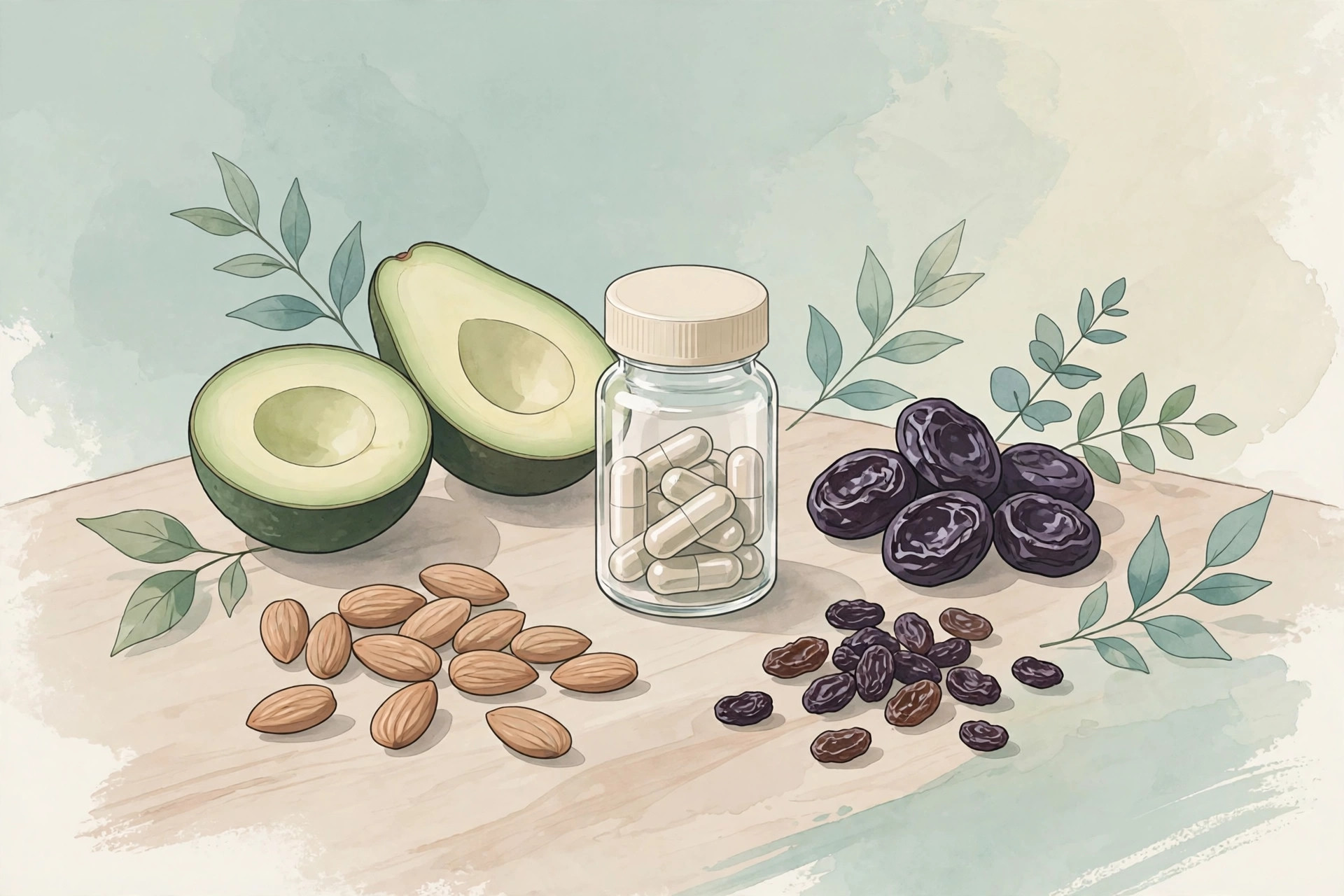
The richest common sources are fruit and legumes. Per the NIH's figures, a cup of prune juice provides about 1.43 mg, half a cup of avocado about 1.07 mg, a small box of raisins about 0.95 mg, and a medium peach about 0.80 mg. Beans, peanuts and apples all contribute around half a milligram per serving.
By volume, the biggest contributors to American intakes are unglamorous: coffee, milk, apples, beans and potatoes, eaten often. A man eating a plant-rich diet is plausibly getting 2 mg or more a day without thinking about it, which matters for the dose audit below.
Dose audit: diet, supplements, studies and safety limits
Lined up in one place, the numbers behind this claim look like this.
| Exposure | Boron per day | Note |
|---|---|---|
| Typical adult diet | ~1 to 1.5 mg | Median total intake, US survey data |
| Common supplement products | 0.15 to 6 mg | Range reported by the NIH for boron supplements |
| Ferrando 1993 trial dose | 2.5 mg | Placebo-controlled, 7 weeks, no effect |
| Naghii 2011 study dose | 10 mg | Uncontrolled, 1 week, free testosterone rose |
| EFSA upper limit, adults | 10 mg | Tolerable upper intake level, Europe |
| US upper limit, adults | 20 mg | Food and Nutrition Board tolerable upper intake level |
Two things stand out. First, the dose in the one positive study is above the range of most boron supplements on sale, so a standard 3 mg capsule is not even a copy of the weak evidence behind it. Second, that same dose sits exactly at Europe's safety ceiling for total daily intake, food included.
The upper limits are not arbitrary. The US Food and Nutrition Board set its 20 mg ceiling from reproductive and developmental effects in animal studies, as the NIH fact sheet records. EFSA, working from the same animal data with a different safety factor, set 10 mg. The World Health Organization's acceptable safe range for adults is 1 to 13 mg a day.
Notice the asymmetry in what is known. The harm side of the ledger rests on controlled animal dosing studies systematic enough to set international limits from. The benefit side rests on eight men and one week. When the safety science is stronger than the efficacy science, the correct response is caution about the claim, not enthusiasm for the product.
Who should be careful with boron?
Staying under the ceiling matters most for people stacking products. Boron hides inside multivitamins, joint formulas, and testosterone blends simultaneously, and a man taking all three can drift past 10 mg a day while believing he takes 3. Add the label doses together, not the product names.
Pregnancy deserves specific care. The safety limits exist because high boron intakes damaged development in animal studies, so boron supplements aimed at men should be kept out of a household routine where a pregnant partner might take them casually. This is a keep-separate warning, not a panic.
The clearest documented harm is accidental poisoning, mostly in small children who swallowed boric-acid products, with nausea, vomiting, diarrhoea, skin flushing and rash among the reported symptoms in the NIH's summary. Supplements belong in the same cupboard discipline as medicines.
Keep the chemistry in perspective while you are at it. Boric acid and borax, the same boron compounds, are sold as household cleaners and pesticides. That does not make dietary boron dangerous; dose and context decide toxicity, and food boron is trivially small. It does mean "natural trace mineral" is a description, not a safety certificate, at any dose a formulator chooses.
On interactions, the news is genuinely quiet: the NIH records that boron is not known to have any clinically relevant interactions with medications. The risk profile of a normal supplement dose is low. The honest problem with boron for testosterone is not danger. It is paying for an effect that has never survived a control group.
The Bottom Line
Boron has never been shown to raise testosterone in a controlled trial in men. One 8-man, one-week, uncontrolled study found a free-testosterone rise at 10 mg a day; one placebo-controlled trial at 2.5 mg a day found nothing over seven weeks. That is the whole human record, and it does not support the confidence of the labels.
Eat the raisins and the beans if you enjoy them; dietary boron is part of a normal plant-rich diet. But if your testosterone is genuinely low, the answer is two morning blood tests and a diagnosis, not a trace mineral whose best study could fit in a minibus.
Frequently Asked Questions
Does boron raise total testosterone?
There is no reliable evidence that it does. The 2011 study behind the claim reported a significant rise in free testosterone, not a demonstrated rise in total testosterone, in eight men with no control group. The only placebo-controlled trial, at 2.5 mg a day for seven weeks in 19 bodybuilders, found no effect on total or free testosterone.
What dose of boron was used in the testosterone study?
Naghii 2011 used 10 mg a day for one week in eight men, with no control group. Ferrando and Green's controlled trial used 2.5 mg a day for seven weeks in 19 men and found nothing. Most boron supplements contain 0.15 to 6 mg, so typical products match neither the positive study's dose nor any proven effect.
Is boron an essential nutrient?
Not officially. The NIH Office of Dietary Supplements states that boron is not classified as an essential nutrient for humans, because research has not identified a clear biological function for it. There is no recommended daily allowance, and human deficiency symptoms have not been firmly established. It is a normal dietary trace element, mainly from plant foods.
How much boron is too much?
The US Food and Nutrition Board sets the adult tolerable upper intake level at 20 mg a day from all sources; EFSA sets 10 mg a day. These limits derive from developmental effects in animal studies. A single supplement is unlikely to breach them, but stacking a multivitamin, a joint formula and a testosterone blend can pass the European ceiling unnoticed.
Can food give me as much boron as a supplement?
Partly. A typical diet provides about 1 to 1.5 mg a day, and a plant-rich one more: prune juice, avocados, raisins, peaches, beans and peanuts are the richest common sources. Food alone will not reach the 10 mg used in the one positive study, but that study is uncontrolled and unreplicated, so the gap is not a reason to chase it.

Last reviewed: November 2026. This article is educational and is not medical advice.
