
- Quick Answer
- What Brushing Misses
- The Tongue's Back Third
- Gum Pockets and Interdental Plaque
- Dry Mouth Undoing the Clean
- Test Yourself: What Self-Checks Can and Can't Tell You
- What a Dentist Measures
- Masking vs Treating
- The Fix Order
- Frequently Asked Questions
- Why does my breath smell again so soon after brushing?
- Does scraping my tongue actually help, or is it a trend?
- Can I reliably test my own breath at home?
- Is mouthwash enough if I use it twice a day?
- When should breath after brushing become a dental appointment?
- Could it be my stomach after all?
- Read This Next
Disclosure: This article contains affiliate links. If you buy through them, we may earn a commission at no extra cost to you. It never changes our conclusions.
Quick Answer
Brushing cleans tooth surfaces. Most bad breath is not made on tooth surfaces. It is made on the back third of the tongue, below the gumline, and between the teeth — three places a toothbrush barely reaches, or never reaches at all.
That is why breath can smell minutes after a thorough brush. The brush did its job. The job was simply aimed at the wrong target, and the bacteria producing the odour were left undisturbed where they actually live.
The fix is an order, not a product: clean the tongue, clean between the teeth, get a professional clean if deposits remain, and only then reassess. Best for: anyone whose breath survives brushing. Dentolan scores 5.4/10 in our review.
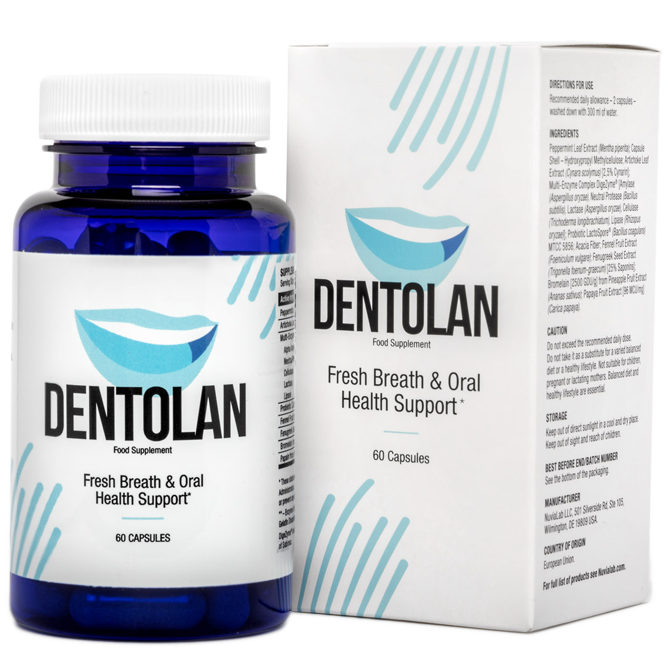
Our Recommendation — Dentolan
Score: 5.4/10 · Best for: adults whose breath worsens with meals and heavy digestion, who want every ingredient amount and the probiotic's strain printed on the label. Main caution: most bad breath is oral in origin, not digestive — and no money-back guarantee is published. Fair trial: one bottle — one month — judged honestly, with dental causes ruled out before a second.
What Brushing Misses
A toothbrush is designed for smooth, hard, reachable surfaces. The mouth's odour sources are none of those things. They are soft, sheltered, and low in oxygen — conditions where the anaerobic bacteria that produce volatile sulfur compounds thrive undisturbed.
The gases themselves are worth naming. Hydrogen sulfide smells of rotten eggs; methyl mercaptan is sharper and more potent at lower concentrations. Both come from bacteria breaking down sulfur-containing amino acids in trapped protein — shed cells, food debris, saliva proteins, and blood.
The MSD Manual's halitosis entry frames the cause the same way: most cases result from conditions inside the mouth, including bacteria and debris accumulating on the tongue, plaque between the teeth, gingivitis, and periodontitis.
Understanding that geography changes the response. Stronger brushing, harder bristles, and longer sessions polish the same surfaces harder. They do not reach the reservoir. Three missed sites account for most breath that survives the brush, and each needs a different tool.
The Tongue's Back Third
The back third of the tongue is the largest bacterial reservoir in most mouths. Its surface is rough and papillated, trapping shed cells, food debris, and blood components in a coating that thickens towards the throat, exactly where cleaning is hardest.
Anaerobic bacteria break that coating's proteins down and release volatile sulfur compounds — chiefly hydrogen sulfide and methyl mercaptan. Those gases are what other people smell. The coating, not the teeth, is usually the factory, and it rebuilds daily.
Most people brush the front of the tongue briefly, if at all, and gag before reaching the back. The result is predictable: the cleanest part of the tongue gets cleaned, and the dirtiest part — the part that matters — is left fully coated.
Tongue cleaning with a scraper or brush lowers volatile sulfur compound levels in the short term, based on the intervention literature we reviewed. We state that effect qualitatively: the review evidence is short-term, and we have not attached numbers we could not verify.
Technique matters more than force. Extend the tongue, place the scraper as far back as comfort allows, and draw it forward in a few gentle passes, rinsing between passes. Hard pressure injures the surface and achieves nothing extra; the coating lifts with repetition, not aggression.
The practical point survives the caution. If breath persists after brushing and the tongue has never been cleaned, the tongue is the first suspect — ahead of the gums, ahead of digestion, and well ahead of any supplement.
Gum Pockets and Interdental Plaque
The second missed site sits below the gumline. Where gums have pulled away from teeth, shallow pockets form that no brush enters. Plaque and bacteria collect there in low-oxygen conditions, producing the same sulfur gases as the tongue coating does.
Gingivitis and periodontitis live in those pockets. Bleeding when you brush or floss is a common sign the tissue is inflamed. Inflamed, bleeding tissue also feeds the bacteria: blood components are protein-rich, and protein breakdown is precisely what generates the odour.
Between the teeth is the third part of the same problem. A brush cannot pass through a contact point, so interdental plaque survives every brushing session intact. Floss or interdental brushes are not optional extras here; they are the only tools that reach it.
Decay, broken fillings, and poorly cleaned dentures belong to the same geography. Each creates a sheltered trap where debris and bacteria sit beyond the brush. They are less common than coating and pockets, and a dental examination finds them quickly when they are present.
This is why a professional clean changes breath when home brushing cannot. Scaling removes hardened deposits above and below the gumline that no home tool dislodges. If pockets and calculus are the source, that appointment is the treatment, not a preliminary.
Dry Mouth Undoing the Clean
Saliva is the mouth's rinse cycle. It washes debris away, buffers acids, and limits bacterial growth. When saliva flow falls, the mouth dries, bacteria multiply faster, and odour builds — even in a mouth that was cleaned well hours earlier.
Overnight is the obvious case: saliva flow drops during sleep, which is why morning breath is normal and usually clears after eating, drinking, and brushing. A dry mouth that persists through the day is a different problem from a dry mouth at waking.
Common drivers include many prescription medicines, mouth-breathing, dehydration, and alcohol-based rinses used repeatedly. Each one reduces the rinse or increases evaporation. The bacteria notice the change within hours, long before the person using the products connects the two.
Dry mouth also explains a frustrating pattern: breath that is fine after breakfast and poor by mid-afternoon. Nothing about the teeth changed during those hours. The saliva did, and with it the mouth's ability to keep bacterial by-products diluted and cleared.
Test Yourself: What Self-Checks Can and Can't Tell You
The first obstacle to testing your own breath is physiological. Olfactory adaptation means your nose stops registering a constant smell, including your own. Cupping hands over the mouth and sniffing is unreliable for exactly this reason: the signal never left your nose.
The wrist-lick test is the common workaround. Lick the inner wrist, let it dry briefly, then smell it. What it samples is saliva from the front of the tongue — useful as a rough hint, but the front is rarely where the coating is thickest.
The floss-sniff test samples a different site. Floss between the back teeth, then smell the floss. It tells you something real about interdental plaque and gum pockets, because it physically removes material from them. It tells you nothing about the tongue.
The spoon or scrape test comes closest to the main source. Draw a spoon gently across the back of the tongue, then smell what it collected. It is unpleasant and informative in roughly equal measure — it samples the coating itself, where most odour originates.
The most informative home test is not a device at all: ask someone you trust. A partner or close family member can smell what adaptation hides from you, and can repeat the check after changes. Awkward for a minute, it outperforms every gadget-free trick.
Each test samples one site, and none samples the whole mouth. A clean result from one test does not clear the others. Treat self-checks as pointers towards a likely site, not as verdicts, and distrust any test that returns a product recommendation.
There is also an honest limit to name. Some people who are certain their breath is severe have no measurable odour at all — a pattern clinicians call pseudo-halitosis. Self-testing cannot settle that case. Only an outside measurement can, which is the next section's subject.
What a Dentist Measures
A dental assessment replaces guessing with three kinds of evidence: a trained nose, a gas measurement, and a bacterial test. Each answers a slightly different question, and together they locate the source instead of treating the whole mouth as one suspect.
Organoleptic scoring is the reference standard: a trained clinician smells the breath directly and grades its intensity on a scale. It sounds unscientific and remains the benchmark, because the human nose detects the full mixture of gases, not just the sulfur fraction instruments count.
A halimeter measures volatile sulfur compounds in parts per billion. It is quick, repeatable, and useful for tracking change over visits. Its limit is scope: it reads sulfur gases well and other odour compounds poorly, so a low reading does not always mean odourless breath.
The BANA test takes a third route, detecting enzymes produced by specific odour-associated bacteria in plaque and tongue samples. A positive result points to the bacterial population itself, which helps when the question is whether gum disease organisms are driving the problem.
None of these measurements requires expensive commitment to obtain. They are part of a standard halitosis work-up, and they convert an anxious guess — is it my tongue, my gums, my stomach? — into a located cause with a matched treatment.
Measurement also separates two problems that feel identical. Genuine halitosis shows raised readings and responds to source treatment. Pseudo-halitosis shows normal readings despite strong conviction — a result that redirects help towards reassurance and, where worry persists, a clinician conversation about the anxiety itself.
Measurement also protects against wasted spending. A reader who learns their volatile sulfur levels are normal has saved every dollar a supplement, rinse programme, or digestive formula would have cost. A reader with high readings has a target to re-measure after treatment.
Masking vs Treating
Mints, gums, and most mouthwashes work by masking. They add a stronger, pleasanter smell on top of the existing one. For an hour or two the mixture reads as fresh. Underneath, the coating, pockets, and bacteria continue producing gas at the same rate.
Masking is not useless. Before a meeting or a close conversation, an hour of cover is a real benefit, honestly labelled. The problem starts when masking is sold or used as treatment — when daily cover replaces the cleaning that would remove the source.
Alcohol-based rinses carry a specific drawback in this picture. Alcohol dries the mouth, and dry mouth accelerates the bacterial growth the rinse was meant to control. A product that freshens at nine can leave the mouth drier, and smellier, by noon.
Chewing sugar-free gum sits between masking and treating. Its flavour masks, but chewing also stimulates saliva, and saliva genuinely helps — washing debris and diluting gases while flow lasts. The benefit ends when the chewing does, which is why it complements cleaning rather than replacing it.
Antimicrobial and zinc-containing rinses sit in a middle category. Used alongside mechanical cleaning, they can reduce tongue bacteria temporarily. The MSD Manual describes rinses as adjunctive to hygiene rather than substitutes for it — support for the cleaning, never the cleaning itself.
Hold any breath product to the same test, including capsules. Does it remove or reduce the source where the source actually is? A swallowed product cannot scrape a tongue or clean a pocket. That framing disciplines every claim made later in this article.
The Fix Order
Step one is tongue cleaning, daily, reaching as far back as comfort allows. A scraper used gently from back to front removes the coating the brush leaves. Judge it over two weeks of consistent use, not after a single morning.
Step two is interdental cleaning, daily. Floss or interdental brushes clear the plaque between teeth that survives brushing. Bleeding in the first week usually reflects existing inflammation; bleeding that persists beyond that is information for a dentist, not a reason to stop.
Step three is a professional clean and gum assessment if breath survives the first two steps, or sooner if gums bleed, teeth feel loose, or a check-up is overdue. This is the step that treats pockets and hardened deposits no home routine reaches.
Step four is reassessment after roughly two weeks of the full routine. If measured, ordinary bad breath has not improved by then, the cause is probably not simple coating or plaque — and that is when throat, sinus, reflux, and other routes earn investigation.
Keep the reassessment honest. Note what changed and when, and use the same check each time — the same trusted person, or a repeat dental measurement. Breath judged by mood and memory drifts; breath judged by a fixed yardstick shows whether the order worked.
Only a breath problem that survives that order raises the digestive question at all. As our full Dentolan review sets out, Dentolan is built for that digestive route — while, across the halitosis literature, 80–90% of cases are oral in origin.
That base rate is the whole argument. A swallowed digestive formula addresses the minority pattern: breath genuinely linked to digestion. For the majority pattern on this page — tongue coating, gum pockets, dry mouth — the fix is mechanical, local, and considerably cheaper.
Dentolan's panel deserves the credit our score gives it. Amounts are printed in full, enzyme activity is given in units, and the probiotic is named to strain level: Bacillus coagulans MTCC 5856, at 2 billion CFU per two-capsule serving.
None of that changes the order of operations. Transparency tells you what you are buying; it does not move a gut-targeted capsule ahead of a tongue scraper. Run the fix order first. If breath survives it, you have learned something a capsule purchase could not teach.
Our Recommendation — Dentolan
Score: 5.4/10 · Best for: adults whose breath worsens with meals and heavy digestion, who want every ingredient amount and the probiotic's strain printed on the label. Main caution: most bad breath is oral in origin, not digestive — and no money-back guarantee is published. Fair trial: one bottle — one month — judged honestly, with dental causes ruled out before a second.
Frequently Asked Questions
Why does my breath smell again so soon after brushing?
Because the odour source was probably never brushed. Volatile sulfur compounds come mainly from tongue coating, gum pockets, and interdental plaque. Brushing polishes tooth surfaces while those reservoirs keep producing gas, so the smell returns as soon as toothpaste flavour fades.
Does scraping my tongue actually help, or is it a trend?
It helps in the short term, on the intervention evidence available: removing coating lowers the bacterial load and volatile sulfur levels temporarily. The coating rebuilds daily, so scraping is a daily habit rather than a cure — like brushing itself.
Can I reliably test my own breath at home?
Only roughly. Olfactory adaptation stops you smelling your own breath directly. Wrist-lick, floss-sniff, and spoon tests each sample one site and can point towards a cause, but none clears the whole mouth. A dental measurement is the reliable version.
Is mouthwash enough if I use it twice a day?
No. Most rinses mask odour for an hour or two, and alcohol-based rinses can worsen dry mouth. Antimicrobial rinses help as an adjunct to tongue and interdental cleaning. On their own, they leave the coating and pockets producing gas undisturbed.
When should breath after brushing become a dental appointment?
When it persists beyond about two weeks of thorough hygiene that includes the tongue and between the teeth — or sooner with bleeding gums, pain, a loose tooth, or a coating that will not clear. Those signs point to treatable dental causes.
Could it be my stomach after all?
Occasionally, but it is the minority pattern. Across the literature, 80–90% of halitosis cases are oral in origin, and gastric causes specifically account for roughly 1% of cases. Exhaust the mouth first; a persistent case after proper cleaning earns the wider investigation.
Last reviewed: October 2026. This article is educational and is not medical advice.
