
- Quick Answer
- Why This Article Is About Men
- The Male Trial Record
- The Testofen libido trial
- Does fenugreek raise testosterone?
- What has never been tested: fenugreek for erections directly
- The Extract Problem
- Fenugreek side effects — blood sugar and diabetes medication?
- Frequently Asked Questions
- Does fenugreek increase libido in men?
- Does fenugreek raise testosterone in men?
- Does fenugreek help erections?
- How much fenugreek did the male studies use?
- What are fenugreek's side effects for men?
- How long does fenugreek take to affect libido?
- Will fenugreek help my training or muscle?
- Who Should Buy — and Who Should Skip It
- Read This Next
Disclosure: This article contains affiliate links. If you buy through them, we may earn a commission at no extra cost to you. It never changes our conclusions.
Quick Answer
For men, the fenugreek libido file is one small trial deep. Sixty healthy men aged 25–52, none with erectile dysfunction, took a standardised fenugreek extract (Testofen, 600 mg a day) for 6 weeks; their libido questionnaire scores improved, particularly sexual arousal and orgasm.
Their testosterone did not rise. That separation — desire up, hormone flat — is the single most useful fact in this article, because fenugreek is usually sold to men as if the two were the same claim.
The formula this cluster reviews, Eron Plus (4.3/10), lists plain "fenugreek" with no extract name and no amount. The trial's material was a named, standardised extract at a stated dose; nothing on this label can be matched to it.
Best for: men whose concern is desire rather than erections, and who want the male evidence separated from the much noisier female literature that dominates search results for this ingredient.
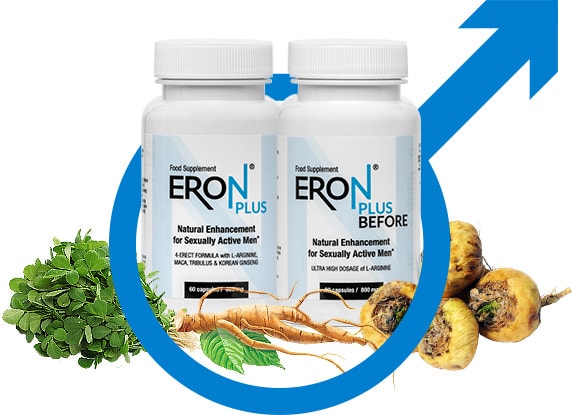
Our Recommendation — Eron Plus
Score: 4.3/10 · Best for: men who specifically want a daily-plus-on-demand two-part system, and who are comfortable buying a formula whose doses are undisclosed. Main caution: the panel lists ingredient names only, and the guarantee conflicts: a 90-day badge against 10-day unused-only withdrawal terms. Fair trial: the three-pack (buy 2, get 1 free, $119.98) — the daily formula's research ran 6 to 12 weeks, not single evenings.
Why This Article Is About Men
Search for fenugreek and libido and most of what you find is about women. The best-known branded fenugreek libido product (Libifem) was trialled in women, and its studies fill the first page of results for a query many men are asking about themselves.
Female trial results do not transfer to men — different hormones, different questionnaires, different claims. So this article fences them off: everything below is the male record, and it is thinner than the search results make it look.
The practical risk is real: men land on female-trial pages, read percentages generated in women's studies, and buy expecting a male result that was never measured. If a fenugreek page does not state plainly whose trial it is quoting, assume the impressive number is not about you.
The Male Trial Record
The Testofen libido trial
Steels, Rao and Vitetta (2011, Phytotherapy Research) ran a double-blind, placebo-controlled trial in 60 healthy men aged 25–52 who did not have erectile dysfunction. The treatment was 600 mg a day of Testofen — a standardised fenugreek seed extract, combined with a small mineral formulation — for 6 weeks.
On the DISF-SR questionnaire, the Testofen group improved in the physiological aspects of libido versus placebo, with the significant gains in the sexual arousal and orgasm subdomains. The men also reported better self-rated energy, strength and well-being.
Hold the limits alongside the result: 60 men, 6 weeks, a branded extract-plus-minerals formulation rather than plain fenugreek, and a population without ED. This is a real but narrow finding — improved desire scores in healthy men, from one trial, never yet replicated at scale.
Two further caveats belong on the record. The treatment combined Testofen with magnesium, zinc and vitamin B6, so the trial cannot separate the extract's effect from the formulation's.
And Testofen is a commercial branded ingredient; the study was funded through its commercial partners, which does not invalidate it but does raise the value of an independent replication that has not come.
The measurement point matters too. Libido was assessed at 3 weeks and again at 6, with scores higher at 6 — desire, in this trial, was a slow variable, not a same-week one. Men judging a fenugreek product after a few days are judging it before its only trial would have expected anything.
Does fenugreek raise testosterone?
Fenugreek's marketing to men usually leads with testosterone. The libido trial itself separates the two: in Steels 2011, testosterone and prolactin stayed within the reference range — libido improved without the hormone moving.
The wider male record is mixed rather than null. Mansoori and colleagues' 2020 meta-analysis of four trials found fenugreek extract had a statistically significant effect on total testosterone in men.
The largest single trial behind that finding (Rao 2016, 120 men aged 43–70 on 600 mg of Testofen for 12 weeks) reported total testosterone rising 12.4% versus placebo, with calculated free testosterone also rising modestly in that trial.
A later, larger systematic review of the male trials graded the certainty of evidence for both total and free testosterone as very low, with a small pooled effect on total testosterone and no reliable effect on free testosterone. Our dedicated fenugreek-and-testosterone explainer works through that file in full.
The individual trials explain the disagreement. Rao, Mallard and Grant (2020) randomised 138 men aged 25–47 to 600 mg, 300 mg or placebo alongside an exercise programme: total testosterone rose at 600 mg, did not move at 300 mg or on placebo, and free testosterone stayed identical in every arm.
So the pattern across the male record is dose-sensitive, inconsistent for total testosterone, and consistently flat for the free fraction — the fraction most relevant to how a man feels. "Mixed and small" is the accurate summary; "boosts testosterone" is not.
The takeaway for a libido buyer: even the friendliest reading gives you a small, uncertain hormone effect in some trials — and the one libido trial doesn't need it, because desire improved while testosterone stayed put.
What has never been tested: fenugreek for erections directly
No trial has tested fenugreek as a treatment for erectile dysfunction in men. Steels 2011 deliberately recruited men without ED and measured desire, not erection quality.
So when fenugreek appears in an erection formula, it is there on a libido rationale borrowed from a healthy-men trial. That may be a reasonable formulation guess; it is not evidence about erections, and it should never be sold as such.
The Extract Problem
Everything above attaches to a specific material: Testofen, a standardised extract with a declared saponin specification, at 600 mg a day. Fenugreek seed powder, a generic "fenugreek extract", and Testofen are three different things sharing one plant name.
"Standardised" is doing real work in that sentence. It means the extract is manufactured to a fixed content of a marker compound class — for fenugreek extracts, the furostanol saponins — so that the capsule in the trial and the capsule in the shop are, chemically, the same bet.
Plain seed powder carries whatever saponin content the harvest had, and an unstandardised extract carries an unknown multiple of it. Neither can inherit a trial run on a pinned-down material, any more than a wine can inherit the reviews of a different vineyard's vintage.
The economics make the substitution tempting. Fenugreek seed is a cheap culinary spice, sold by the kilo; a standardised, trial-grade extract costs real money to produce and test. When a formula lists the cheap word and charges for the expensive implication, the gap between them is where the margin lives.
Eron Plus lists the fifth ingredient of its two-part system as "fenugreek" — no extract name, no standardisation, no amount, and no statement of which part of the system it sits in. None of the male trial record can be carried across to it.
This is the audit pattern for the whole product, scored 4.3/10: recognisable ingredient names, each with some genuine research somewhere, attached to a label that publishes nothing the research can be checked against.
Fenugreek side effects — blood sugar and diabetes medication?
Fenugreek's best-documented physiological effect is on blood sugar: it can lower glucose, which is why it is studied in diabetes — and why a man on diabetes medication should not add it casually. Combined effects can push blood sugar too low.
Allergy is the second hard caution. Fenugreek is a legume, in the same family as peanut and chickpea; allergic reactions, including serious ones, are documented in sensitised people. A peanut or chickpea allergy is a reason to avoid fenugreek or clear it medically first.
The everyday effects are milder: digestive upset and diarrhoea at higher intakes, and a distinctive maple-syrup smell in sweat and urine from the compound sotolone — harmless, but startling if nobody warns you. The maker of the reviewed product claims its formula causes no side effects at all; fenugreek's file alone shows why that claim should never be printed.
Our Recommendation — Eron Plus
Score: 4.3/10 · Best for: men who specifically want a daily-plus-on-demand two-part system, and who are comfortable buying a formula whose doses are undisclosed. Main caution: the panel lists ingredient names only, and the guarantee conflicts: a 90-day badge against 10-day unused-only withdrawal terms. Fair trial: the three-pack (buy 2, get 1 free, $119.98) — the daily formula's research ran 6 to 12 weeks, not single evenings.
Frequently Asked Questions
Does fenugreek increase libido in men?
On current evidence, modestly, in one small trial: 60 healthy men aged 25–52 taking 600 mg of standardised Testofen extract daily for 6 weeks improved their libido questionnaire scores versus placebo, most clearly for arousal and orgasm. It is a promising single result, not a settled one.
Does fenugreek raise testosterone in men?
The trials disagree. A 2020 meta-analysis of four trials found a significant pooled effect on total testosterone; the libido trial itself found none, and a later larger review rated the evidence very low certainty, with no reliable effect on free testosterone. Our fenugreek-and-testosterone article covers the full record; do not buy fenugreek as a proven testosterone product.
Does fenugreek help erections?
It has never been directly tested for erectile dysfunction — the libido trial excluded men with ED. Any erection benefit in a formula is inferred from the desire data, which is a different outcome in a different population.
How much fenugreek did the male studies use?
600 mg a day of a standardised extract (Testofen), for 6 weeks in the libido trial and 12 weeks in the largest testosterone trial. Unstandardised seed powder at an undisclosed dose — the form on the reviewed product's label — has no trial behind it at any amount.
What are fenugreek's side effects for men?
Digestive upset, a maple-syrup odour in sweat and urine, possible blood-sugar lowering (important alongside diabetes medication), and legume-family allergy risk. Men with peanut or chickpea allergy should treat fenugreek as a legume, not as a neutral herb.
How long does fenugreek take to affect libido?
The one male libido trial measured at 3 and 6 weeks, with the stronger scores at 6 weeks — so six weeks of daily use is the evidence-based judging point. There is no same-day or first-week effect in the male record, whatever a label implies.
Will fenugreek help my training or muscle?
That is a different literature — mostly the same standardised extracts in exercising men — and its honest summary mirrors the hormone story: some trials report body-composition or strength changes that occurred without testosterone changing, which suggests any effect is not the androgen boost the marketing describes. It is not evidence about libido, and this article doesn't grade it.
Who Should Buy — and Who Should Skip It
Buy fenugreek if your issue is desire rather than erection quality, you choose a standardised extract at the trialled 600 mg a day, and you accept that the case rests on one small trial in healthy men. Judge it over six weeks, as the trial did.
Buy this two-part system only if the structure itself appeals. Its fenugreek is unstandardised and unquantified, and may sit in either part of the system — the label does not say. None of the male fenugreek record can be claimed for it.
Skip fenugreek if you take diabetes medication without medical advice, you have a peanut or chickpea allergy, or you are buying it as a testosterone booster or an erection treatment — the male evidence supports neither purchase.
Last reviewed: October 2026. This article is educational and is not medical advice.
