
- Quick Answer
- The Two Clocks
- The daily clock: what trial durations actually were
- The on-demand clock: the same-day claim, and the missing trial
- Why "you'll feel it in week two" borrows the maker's own marketing
- The guarantee clock: the third timeline nobody mentions
- A Trial-Anchored Timeline Table
- The Fair-Trial Rules
- How long should you use a male enhancement supplement before deciding it isn't working?
- The stop rules
- The myth-checks
- Do sleep, weight and alcohol matter more than supplements for erections?
- Frequently Asked Questions
- How long before I should decide a daily ED supplement isn't working?
- Can a natural supplement really work the same day?
- Do stronger or faster results mean a better product?
- Will a supplement make my erections guaranteed stronger, or increase my size?
- What if my ED is getting worse while I take a supplement?
- I felt a difference in the first few days. Was that the supplement?
- Should I take breaks between courses, or cycle supplements?
- Who Should Buy — and Who Should Skip It
- Read This Next
Disclosure: This article contains affiliate links. If you buy through them, we may earn a commission at no extra cost to you. It never changes our conclusions.
Quick Answer
There are two clocks, and most disappointment in this category comes from reading the wrong one. Daily formulas run on the trial clock: the research behind their ingredients measured outcomes after 6 to 12 weeks of daily use, so 8–12 weeks is the honest judging window.
On-demand products run on the same-day clock: taken shortly before intercourse and judged that night. That clock is real for prescription drugs, whose timing was measured in trials. No herbal capsule has ever had its onset timed that way.
Any timeline a seller gives you beyond the trial record — "comprehensive action in two weeks", "feel it from the first capsule" — is marketing, not evidence. The formula reviewed in this cluster, Eron Plus (4.3/10), uses exactly such a two-week claim for its daily part; its ingredient categories were trialled for 6–12 weeks at doses the label doesn't disclose.
Best for: men deciding how long to give a product before judging it — and men deciding when "not working" means "see a doctor instead".
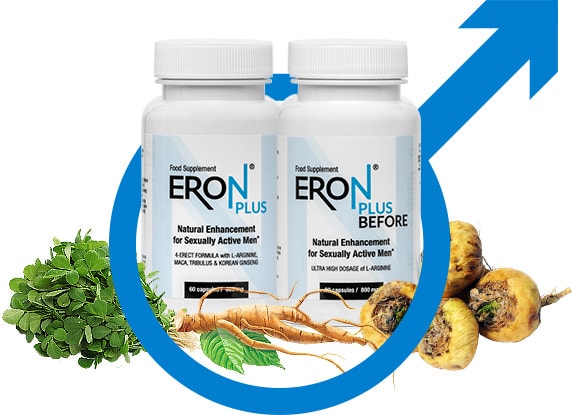
Our Recommendation — Eron Plus
Score: 4.3/10 · Best for: men who specifically want a daily-plus-on-demand two-part system, and who are comfortable buying a formula whose doses are undisclosed. Main caution: the panel lists ingredient names only, and the guarantee conflicts: a 90-day badge against 10-day unused-only withdrawal terms. Fair trial: the three-pack (buy 2, get 1 free, $119.98) — the daily formula's research ran 6 to 12 weeks, not single evenings.
The Two Clocks
The daily clock: what trial durations actually were
Look at how the research was actually run. L-arginine's classic trial dosed for 6 weeks and measured at weeks 3 and 6. The ginseng trials in Cochrane's review ran 4 to 12 weeks. The fenugreek libido trial ran 6 weeks. Tribulus's largest ED trial ran 12 weeks.
None of these studies reported a meaningful result at day three, or week one, because none of them looked — the designs assumed cumulative, daily exposure, and their endpoints were set accordingly. The daily clock is not slowness; it is simply the only schedule with data.
It also matches the plausible biology. Ingredients aimed at blood-vessel function, nitric-oxide availability or desire are nudging systems, not flipping switches. Nudges compound over weeks or they do nothing; there is no third option in the trial record.
One more feature of the daily clock explains most early "results". In these trials, placebo groups routinely improve too — in one tribulus trial in men over 40, both arms improved symptomatically while nothing hormonal moved in either. Expectation, attention and a new routine are active ingredients in week one.
That is not an argument that early improvement is fake to the man feeling it. It is an argument that the first fortnight cannot distinguish the capsule from the occasion — which is precisely why the trials wait, and why your judgement should too.
Nor should you expect the curve to keep climbing if it starts. The trials measured an end-of-course state, not a trajectory: nothing in this literature shows benefits compounding past the course length, and nothing studies tolerance either.
The realistic shape, on the evidence, is "nothing, then perhaps something modest by week 8–12, then a plateau" — plan around that, not around a rising line.
The on-demand clock: the same-day claim, and the missing trial
Prescription on-demand drugs earned their clock honestly: sildenafil's label window (30 minutes to 4 hours before activity) comes from timed pharmacokinetic and efficacy studies. A user can plan around a number that was measured.
For herbal before-intercourse capsules, no equivalent measurement exists — for any product, at any dose. Absorption of a botanical extract is variable, its active compounds are often unidentified, and nobody has run the onset study. "Works in 30 minutes" on a supplement label is a borrowed drug claim wearing no data.
Even the drug exception proves the measurement rule. Tadalafil's as-needed label can promise a window of up to 36 hours because onset and duration were actually timed in studies. The number on the label is a measurement, not a hope — the standard no supplement in this aisle currently meets.
This distinction has a sharp edge. A "natural" capsule that genuinely performs like a drug, within the hour, is a recognised warning pattern — regulators have repeatedly found such products to contain undeclared PDE5 drugs, as our safety companion article documents.
Why "you'll feel it in week two" borrows the maker's own marketing
Between the two clocks sits a third, invented one: the seller's reassurance timeline. The maker of the reviewed product claims its daily part delivers "comprehensive action" after about two weeks of use. Two weeks appears in no trial of any ingredient in the formula.
The function of such a claim is commercial, not informational. It is long enough to carry a buyer past the first bottle's disappointment, and short enough to promise relief soon. When you see a timeline with no trial behind it, price it accordingly: it is worth exactly what it cost to write.
The guarantee clock: the third timeline nobody mentions
There is a practical collision between the trial clock and the refund clock. A fair trial of a daily formula runs 8–12 weeks — 56 to 84 days. Whether you can still get your money back at the end of it depends entirely on the seller's guarantee terms.
This cluster's product illustrates the trap. Its sales page displays a 90-day guarantee badge, which would just cover a 12-week trial. Its terms, however, allow withdrawal only within 10 days, for unused goods — a window that closes before the daily part could plausibly be judged, on a product that must be used to be judged.
Check the guarantee's terms, not its badge, before starting any long trial in this category. A fair test you cannot refund is a commitment, and it should be entered knowingly.
A Trial-Anchored Timeline Table
Everything defensible about "how long" fits in one table — ingredient, trial dose, trial length, and when the outcome was measured.
| Ingredient | What the trials did | When outcomes were measured | What was actually measured |
|---|---|---|---|
| L-arginine | 1,500–5,000 mg/day, daily (Chen 1999: 5,000 mg/day) | 6 weeks | Self-reported sexual function; responders were men with low nitric-oxide production at baseline |
| Korean ginseng | 600–3,000 mg/day, daily | 4–12 weeks | IIEF erectile-function scores (trivial gain) and self-reported ability to have intercourse (improved) |
| Fenugreek (Testofen) | 600 mg/day of a standardised extract, daily | 6 weeks | Libido questionnaire scores — in men without ED; testosterone unchanged |
| Tribulus (Tribestan) | 1,500 mg/day of a standardised extract, daily | 12 weeks | Erectile-function scores improved; testosterone unchanged |
| A two-part system as a system | Never trialled, for any product | — | — |
| Sildenafil (prescription, for contrast) | 50 mg, single dose, timed in trials | Same day — label window 30 minutes to 4 hours | Erection firmness in timed efficacy studies; what a measured on-demand clock looks like |
Two patterns deserve attention. First, no row in that table is shorter than four weeks: the category's entire evidence base lives at a month and beyond. Second, the effects measured were modest even at full duration — these are the timelines of small effects, not slow-building large ones.
There is one more honest row that cannot be printed: a per-week expectation curve. Nobody can tell you what you should feel at week 2 versus week 5, because no trial measured weekly. Anyone who draws you that curve is inventing it.
The Fair-Trial Rules
How long should you use a male enhancement supplement before deciding it isn't working?
Eight to twelve weeks, at the label dose, with one variable changed at a time. Shorter than eight weeks and you are judging inside the noise of the shortest trials; longer than twelve and you are past the longest, spending money on a question the evidence already answered.
Judge against a defined outcome, not a mood. The trials used questionnaires for a reason: "did my erections and desire improve, measurably, over the course?" is answerable. "Do I feel like it's working?" is how placebo responses — which are large in this field — write your review for you.
A workable home version: score your erections weekly on the simple 1–4 hardness scale the citrulline researchers used (1 = larger but not hard, 4 = completely hard and rigid), note it, and review the trend monthly. Written scores resist the optimism that memory applies retrospectively.
Keep the log boring: date, dose taken, weekly score, anything unusual. Four lines a week for twelve weeks produces the only dataset about you that exists — and it is a better basis for a reorder decision, or a doctor conversation, than any testimonial page.
And keep the rest of the experiment still. Starting a supplement, a gym habit and a sleep fix in the same week guarantees you will never know which one worked — fine for your health, useless for deciding whether to reorder.
Budget the trial honestly, too. A monthly-supply product needs two to three purchases to complete an 8–12 week course — for this cluster's product, $119.98 for the three-month bundle against $59.99 bought month by month. One bottle is not a trial; it is the first third of one, and judging at that point misjudges in both directions.
These rules apply to the product in this cluster with a specific asterisk. Eron Plus discloses no doses, so a fair trial of it can test the routine but never the regimen: if nothing happens by week twelve, you cannot tell whether the ingredients failed or were never present at a studied level.
The stop rules
Rule one: no perceptible change by 12 weeks means stop. Not "try a stronger one", not "double the dose" — stop, because the entire trial tradition says the effect, if it exists, has declared itself by then.
Rule two: worsening ED during those weeks is not a supplement problem at all. New or deteriorating erection problems can be an early cardiovascular signal, and the correct next purchase is a medical work-up — blood pressure, blood sugar, cholesterol — not a different capsule.
Rule three: side effects end the trial immediately, whatever the calendar says. Dizziness, palpitations, blood-pressure symptoms or an erection lasting over four hours are stop-and-seek-care events, and no maker's "no side effects" assurance outranks them.
The myth-checks
No pill in this category guarantees stronger erections. The best pooled results are modest averages across groups of men — an odds improvement in a meta-analysis is not a promise to an individual, and the flagship ingredients' questionnaire gains were, in Cochrane's word for ginseng, trivial.
No pill permanently increases size. The Mayo Clinic's assessment of enlargement products is blunt: pills and lotions claiming enlargement have never been proved to work, and there is no proven non-surgical way to make a penis larger.
That myth-check lands on this cluster's own product. The maker's FAQ promises erections that are "stiffer and larger" — two claims fused into one phrase. Firmness is a blood-flow outcome a product might modestly influence. Size is not, and any maker who implies otherwise is telling you how to weigh his other claims.
Do sleep, weight and alcohol matter more than supplements for erections?
The unglamorous variables out-perform the supplement variables, and they run on the same 8–12 week clock. Sleep is the largest: testosterone and erectile quality both track sleep duration and quality, and treating sleep apnoea — a common, underdiagnosed cause of ED — changes the timeline more than any ingredient in this article.
Sleep deserves its own sentence of mechanism. Most testosterone is produced during sleep, and erections themselves are partly a sleep phenomenon — healthy men have several per night. Fragmented sleep cuts both, which is why a snoring, exhausted man can have a "supplement problem" that is actually a sleep problem wearing a wallet.
Weight and exercise follow. Aerobic exercise has its own trial record for erectile function, operating through the same blood-vessel pathway every capsule in this category gestures at. Alcohol works the other way, acutely and chronically, and cutting it is a same-week intervention.
Smoking belongs on the same list: it is a direct vascular toxin, and cessation studies show erectile improvement on a timescale of months. A man who quits smoking during his 12-week supplement trial has, again, run the stronger intervention second and credited it last.
Finally, review the prescription list itself. Several common medicines — some blood-pressure drugs and antidepressants among them — cause or worsen ED, and a prescriber can sometimes substitute an alternative with a timeline measured in weeks. If your difficulties began around a medication change, that conversation outranks every capsule in this article.
None of this is a reason to feel lectured; it is a calibration. A man who fixes sleep and adds exercise while taking a daily formula for 12 weeks has run three interventions, two of which have better evidence than the third. Credit them in that order.
Our Recommendation — Eron Plus
Score: 4.3/10 · Best for: men who specifically want a daily-plus-on-demand two-part system, and who are comfortable buying a formula whose doses are undisclosed. Main caution: the panel lists ingredient names only, and the guarantee conflicts: a 90-day badge against 10-day unused-only withdrawal terms. Fair trial: the three-pack (buy 2, get 1 free, $119.98) — the daily formula's research ran 6 to 12 weeks, not single evenings.
Frequently Asked Questions
How long before I should decide a daily ED supplement isn't working?
Twelve weeks at the label dose is the evidence-based deadline — it matches the longest trials of the category's ingredients. No change by then means the fair trial is over. Deciding at two weeks, whatever the seller's timeline says, judges the product before its own evidence base would.
Can a natural supplement really work the same day?
No herbal on-demand capsule has had its onset of effect measured in a trial, so "works in 30 minutes" is an unmeasured claim for every such product. A capsule that performs exactly like a drug, that fast, matches the pattern of products regulators have found to contain hidden PDE5 drugs.
Do stronger or faster results mean a better product?
On this evidence base, the opposite suspicion is warranted. The trialled ingredients produce modest average effects over weeks. Dramatic, immediate results from a "natural" product should trigger a check of the FDA's fraud database before they trigger a reorder.
Will a supplement make my erections guaranteed stronger, or increase my size?
No to both. Pooled trial effects are modest and not guaranteed to any individual man, and no pill has been shown to increase penis size — the Mayo Clinic states there is no proven non-surgical method. Firmness claims and size claims are different claims; makers who blur them are marketing.
What if my ED is getting worse while I take a supplement?
Stop and see a doctor. Worsening erectile function can be an early sign of cardiovascular disease, diabetes or hormonal problems — conditions with real treatments and real consequences if missed. A supplement trial should never delay that assessment.
I felt a difference in the first few days. Was that the supplement?
Almost certainly not the ingredient — no trialled ingredient in this category acts in days, and the trials' own placebo arms improved early too. Expectation, a partner's response, better sleep that week: all plausible, all free. Enjoy it, but don't let a good first week shorten the 12-week judging window or justify a bulk order.
Should I take breaks between courses, or cycle supplements?
There is no cycling evidence to copy: the trials ran continuous daily courses of 4–12 weeks and then stopped and measured. Open-ended daily use beyond 12 weeks is simply unstudied territory for most of these ingredients. The evidence-shaped pattern is a defined course, an assessment, and a decision — not permanent supplementation by default.
Who Should Buy — and Who Should Skip It
Buy a daily formula if you can run an honest 8–12 week trial: fixed dose, defined outcome, one change at a time. Choose a product whose label states gram-level doses, so the trial you run is the trial the research ran.
Buy this two-part system only if you want the daily-plus-before structure itself and accept its evidential position: a two-week maker claim for the daily part, no onset data for the before part, and no doses published for either. You are buying a routine, not a timeline.
Skip the whole category for now if your ED is new, worsening or unassessed — the doctor's timeline matters more than the supplement's — or if any seller's promised schedule ("results in days") is doing the persuading. On the trial record, days are not a unit this category trades in.
Last reviewed: October 2026. This article is educational and is not medical advice.
