
- Quick Answer
- What "Korean Ginseng" Means — and What Labels Leave Out
- How much ginseng did the ED studies use, and for how long?
- The individual trials
- The Cochrane 2021 verdict, stated whole
- Why Cochrane grades its own answer "low certainty"
- The Label Audit
- Is Korean ginseng safe — sleep problems and drug interactions?
- Frequently Asked Questions
- How much Korean ginseng did the ED trials use?
- How long does ginseng take to work for erections?
- Is red ginseng better than white ginseng?
- Does ginseng raise testosterone?
- Who should not take ginseng?
- Can I take ginseng alongside a prescribed ED drug?
- Who Should Buy — and Who Should Skip It
- Read This Next
Disclosure: This article contains affiliate links. If you buy through them, we may earn a commission at no extra cost to you. It never changes our conclusions.
Quick Answer
Both halves of the answer matter. In the Cochrane review's pooling of six small trials, men with ED who took ginseng were more likely than men on placebo to say they were able to have intercourse (relative risk 2.55) — a real, if soft, signal.
On the validated measurement, though, the effect shrank to what Cochrane itself calls trivial: erectile-function questionnaire scores improved by a margin below the threshold patients can actually feel. Cochrane's certainty rating for nearly all of this is low.
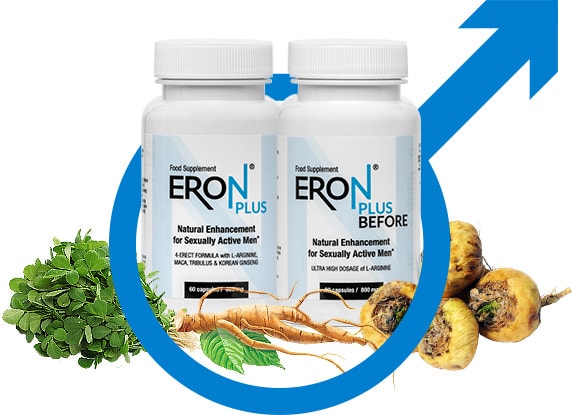
So: ginseng probably does something small for some men with mild-to-moderate ED, at 600–3,000 mg a day over 4–12 weeks. The formula this cluster reviews, Eron Plus (4.3/10), lists "Korean ginseng" with no form, standardisation or amount — nothing about it can be matched to those trials.
Best for: men weighing ginseng on the actual record, and label-readers who want to know what the words "Korean ginseng" do and do not guarantee.
Our Recommendation — Eron Plus
Score: 4.3/10 · Best for: men who specifically want a daily-plus-on-demand two-part system, and who are comfortable buying a formula whose doses are undisclosed. Main caution: the panel lists ingredient names only, and the guarantee conflicts: a 90-day badge against 10-day unused-only withdrawal terms. Fair trial: the three-pack (buy 2, get 1 free, $119.98) — the daily formula's research ran 6 to 12 weeks, not single evenings.
What "Korean Ginseng" Means — and What Labels Leave Out
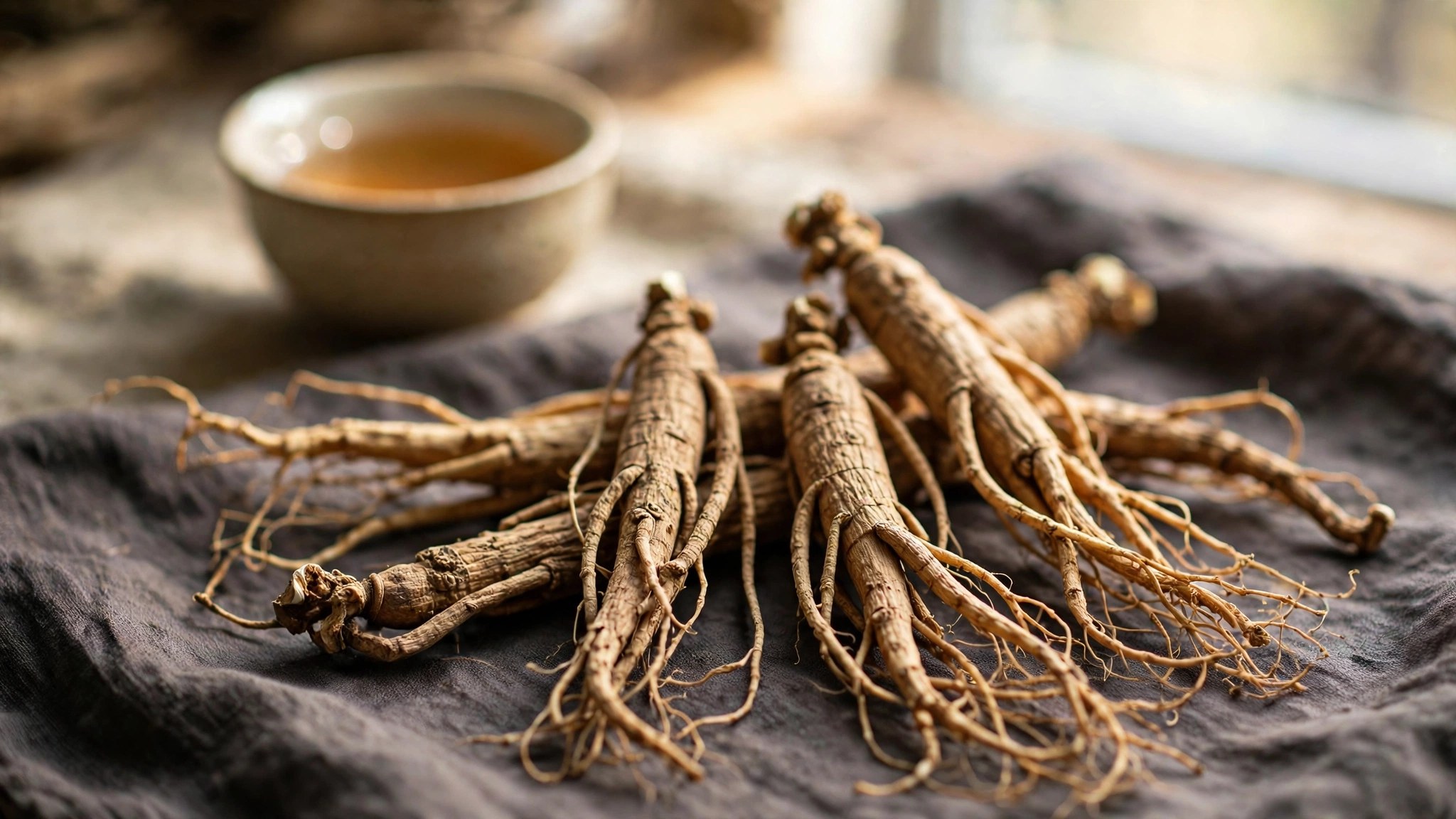
Korean ginseng is Panax ginseng, grown in Korea and north-east Asia, and it comes in materially different forms. White ginseng is the root dried as harvested. Red ginseng is steamed before drying, a process that changes its ginsenoside profile — the family of compounds the effects are attributed to.
The ED trials used specific preparations, usually red ginseng root extracts at stated doses. A label that says only "Korean ginseng" tells you the species and the geography. It does not tell you the form (red or white), the part (root or berry), the extract strength, or the ginsenoside standardisation.
That vagueness is not a technicality. Ginsenoside content varies with all four variables, so two products both honestly labelled "Korean ginseng" can be quite different substances. The trial record attaches to the described preparations, not to the words.
The ginsenosides themselves are a family, not a single compound — Rg1, Rb1 and their relatives occur in different ratios in root, berry and leaf, and steaming converts some into others. A standardisation claim ("standardised to X% ginsenosides") at least pins the family total; most labels in this category do not even offer that.
How much ginseng did the ED studies use, and for how long?
The individual trials
Cochrane gathered nine randomised trials with 587 men aged 20–70 who had mild-to-moderate ED, all comparing ginseng against placebo, with follow-up of up to 12 weeks. The regimens were substantial: Hong and colleagues (2002) used 2,000 mg a day; Choi and colleagues (2002) used 1,000 mg three times a day.
Across the set, doses ran from about 600 to 3,000 mg a day for 4 to 12 weeks. These were not homeopathic sprinklings of root powder — they were gram-level daily intakes of defined preparations, sustained for one to three months.
The earlier synthesis, Jang and colleagues' 2008 meta-analysis in the British Journal of Clinical Pharmacology, had already found a positive pooled signal for ginseng in ED. Cochrane's 2021 review is the one to rely on: it is larger, stricter, and it grades its own certainty.
The Cochrane 2021 verdict, stated whole
Start with the encouraging half. Pooling six trials, Cochrane found ginseng may improve men's self-reported ability to have intercourse compared with placebo (relative risk 2.55, 95% CI 1.76–3.69) — low-certainty evidence, in men with mild-to-moderate ED.
Now the qualifying half, which marketing never quotes. On the IIEF-15 erectile-function domain — the validated questionnaire — ginseng's advantage over placebo in three trials was a mean difference of 3.52 points on a 30-point scale, below the 4-point minimum considered clinically important. Cochrane's word for it is "trivial".
The gap between those two halves is itself instructive. "Were you able to have intercourse?" is a global, memory-based judgement — the kind most open to expectation and goodwill toward a treatment.
The IIEF asks graded questions about firmness, maintenance and confidence. When a soft endpoint moves and the hard endpoint barely does, the cautious reading is a small real effect amplified by hope, not a large effect hiding.
The IIEF-5 told the same story: a 2.39-point advantage against a 5-point importance threshold. Satisfaction scores moved trivially too, and no trial measured quality of life at all. The honest summary is Cochrane's own: a possible small benefit, mostly low-certainty, that men may notice as "I managed it" more than as stronger erections.
Equally important is what the review could not answer. No trial compared ginseng against an actual ED drug, so there is no evidence placing it anywhere on the same scale as sildenafil or tadalafil — anyone who tells you ginseng is "nature's version" of those drugs is inventing the comparison.
And every trial was short. Twelve weeks is the outer edge of the entire record, so the review says nothing — in either direction — about men who take ginseng daily for years, which is how supplements are actually used.
Why Cochrane grades its own answer "low certainty"
The downgrade is not pedantry; it is the review telling you how much weight the numbers can bear. Cochrane rated the evidence down for study limitations — small trials, several with unclear methods reporting — and for indirectness, because the preparations and populations varied between studies.
Most of the trials were also conducted in one country's research ecosystem, by groups studying a culturally prominent local remedy. That does not make them wrong. It makes independent replication by unconnected groups the missing ingredient — the same pattern this site keeps meeting across this category.
Hold both ideas at once, because both are true: ginseng has one of the better ED files of any botanical in this aisle, and that file is nine small trials, 587 men, and a self-confessed low certainty grade.
What would upgrade the file is easy to specify: one modern, independently run trial of a standardised extract, at a declared dose, with the IIEF as the primary endpoint and follow-up beyond 12 weeks. Ginseng is one of the few botanicals in this aisle where such a trial is worth running.
Until it exists, "promising, low certainty" is the accurate label — and any product page saying more is saying it without evidence.
That restraint is not a dismissal. Of every ingredient in the reviewed formula, ginseng is the one whose underlying science most nearly justifies a buyer's interest — which is exactly why its treatment on this particular label, two words and no numbers, deserves the sharpest criticism in this article.
The Label Audit
Audit the reviewed formula against that record. Eron Plus lists "Korean ginseng" among five named ingredients in a two-part system — daily capsules plus before-intercourse capsules — and publishes no amount, no form, and no standardisation for it.
It does not even say which part of the system the ginseng sits in. If it is in the daily capsules, the dosing pattern at least resembles the trials. If it is in the before capsules, it is being used on a same-day schedule no ginseng trial has ever tested.
Nothing about the label lets a buyer close that gap. The trial material was red ginseng extract at up to 3,000 mg a day; the label offers two words. Our 4.3/10 score for this product is what an unauditable label earns, and ginseng is its clearest example.
For contrast, a checkable ginseng label is not hard to imagine — other categories manage it. It would state the form (red or white), the plant part (root), an extract ratio or ginsenoside percentage, and the milligrams per daily serving. Four facts, all printable, all missing here.
Until a label supplies them, the correct mental model for "Korean ginseng" in a blend is not "the Cochrane ingredient". It is "an unknown quantity of an unspecified preparation of the right species" — related to the trial material the way a postcode is related to a house.
Is Korean ginseng safe — sleep problems and drug interactions?
In the Cochrane trials, ginseng produced little to no difference in adverse events versus placebo (relative risk 1.45, with a confidence interval spanning no effect) — reassuring as far as 12 weeks of trial use goes.
The best-known effect outside the trials is insomnia: the US National Center for Complementary and Integrative Health names trouble sleeping as Asian ginseng's most common side effect, alongside headache, digestive problems and blood-pressure changes in either direction.
Interactions deserve a direct list. NCCIH notes the warfarin evidence is mixed — some studies suggest ginseng can blunt the blood thinner's effect — and that ginseng may affect blood sugar, which matters for anyone on diabetes medication. Uncertainties also exist around some blood-pressure medicines.
Practical translation: short-term use at studied doses looks well tolerated in healthy men. Men on warfarin, diabetes medication or blood-pressure treatment should clear ginseng with a clinician first — and should not accept a maker's blanket "no side effects" claim, of the kind this product's maker makes, as a substitute.
Long-term safety is a genuine unknown rather than a formality. NCCIH notes that short-term use (up to about 6 months) in recommended amounts appears safe for most people, while questions remain about longer use — a relevant caveat for a daily-formula ingredient with no natural stopping point.
Our Recommendation — Eron Plus
Score: 4.3/10 · Best for: men who specifically want a daily-plus-on-demand two-part system, and who are comfortable buying a formula whose doses are undisclosed. Main caution: the panel lists ingredient names only, and the guarantee conflicts: a 90-day badge against 10-day unused-only withdrawal terms. Fair trial: the three-pack (buy 2, get 1 free, $119.98) — the daily formula's research ran 6 to 12 weeks, not single evenings.
Frequently Asked Questions
How much Korean ginseng did the ED trials use?
Between about 600 and 3,000 mg a day, for 4 to 12 weeks. The best-known trials sat at the top of that range — 2,000 mg a day in Hong 2002, and 1,000 mg three times daily in Choi 2002. A blend that hides its ginseng content cannot be placed anywhere on that scale.
How long does ginseng take to work for erections?
The trials measured outcomes after 4 to 12 weeks of daily use; none tested a same-day effect. Any ginseng product positioned as working within the hour is using a schedule with no trial behind it. Our companion article on how long natural ED supplements take to work lays out the trial-anchored timelines.
Is red ginseng better than white ginseng?
The ED trial record belongs mostly to red (steamed) ginseng preparations, whose ginsenoside profile differs from white ginseng's. That is a statement about which material was studied, not proof the other form is inert — but a label that does not even state the form cannot claim the studied one.
Does ginseng raise testosterone?
That is not what these trials showed or set out to show. The Cochrane review measured erectile function and self-reported ability, in men with ED. Testosterone claims for ginseng rest on much thinner material; our general ginseng explainer covers the wider evidence without the ED focus of this article.
Who should not take ginseng?
Anyone on warfarin, diabetes medication or blood-pressure treatment should check with a clinician first — the interaction evidence is unsettled rather than clean. People prone to insomnia should note that disturbed sleep is ginseng's most commonly reported side effect, and long-term safety beyond the trials' 12 weeks is not established.
Can I take ginseng alongside a prescribed ED drug?
There is no trial of that combination — Cochrane found no study comparing or combining ginseng with PDE5 drugs at all. Because ginseng can affect blood pressure and blood sugar, the combination belongs in a conversation with the prescriber, not in self-experimentation.
Who Should Buy — and Who Should Skip It
Buy ginseng if you have mild-to-moderate difficulties, you pick a product that states its form and a gram-level daily dose, and your expectation is set by Cochrane: a possible modest improvement in managing intercourse, not a drug-grade change in erection scores.
Buy this two-part system only if you want the daily-plus-before structure for its own sake. Its ginseng could be a studied red extract at a real dose or a token sprinkle in the wrong capsule set; the label is designed so you cannot find out.
Skip ginseng if you take warfarin or diabetes or blood-pressure medication without medical clearance, if you expect a same-day effect, or if your ED is severe or new and unevaluated — that presentation deserves a doctor before it deserves a botanical.
Last reviewed: October 2026. This article is educational and is not medical advice.
