
- Quick Answer
- What VERISOL Is
- Who makes it (GELITA) and where it comes from (bovine)
- The peptide profile (~2.0 kDa)
- Is VERISOL different from regular collagen peptides?
- Claim by Claim: What the Trials Support
- Skin elasticity — small trial support
- Eye-wrinkle volume — small trial support
- Skin density and surface
- Nails
- Cellulite
- Hair — no VERISOL trial support
- The Dose the Studies Used
- The Funding Question
- Does the Product in Front of You Deliver 2.5 g?
- Our Verdict
- Frequently Asked Questions
- Is VERISOL the same as collagen peptides?
- How much VERISOL did the studies use?
- Is VERISOL vegan or vegetarian?
- Who funded the VERISOL trials?
- Does VERISOL help hair?
- Who Should Buy Collagen Select — and Who Should Skip It
- Read This Next
Disclosure: This article contains affiliate links. If you buy through them, we may earn a commission at no extra cost to you. It never changes our conclusions.
Quick Answer
VERISOL is GELITA's branded bioactive collagen peptide — bovine-derived, engineered to a small peptide profile (around 2.0 kDa), and studied at one consistent dose: 2.5 g/day.
Two of its claims have small randomised-trial support — skin elasticity and eye-wrinkle volume. The rest of its claim list (density, nails, cellulite, hair) rests on thinner or absent evidence, and every trial in the programme is connected to the maker.
Products built on it inherit both halves. Collagen Select is a VERISOL product whose per-serving grams are unpublished — so the one number that defines the ingredient is the one number its label withholds.
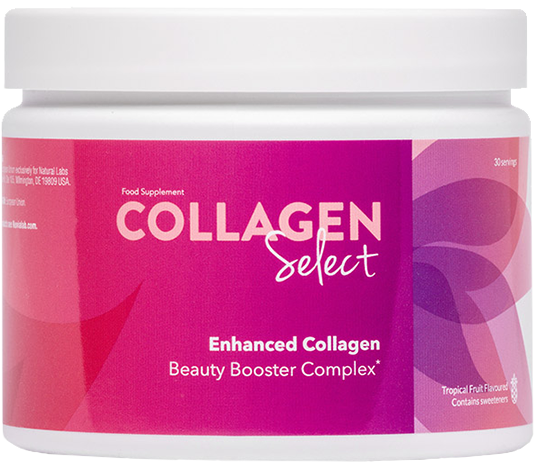
Our Recommendation — Collagen Select
Score: 5.2/10 · Best for: people who prefer a drink to capsules and want the branded VERISOL® ingredient specifically. Main caution: the maker does not publish ingredient amounts, so the dose cannot be audited — and the money-back badge carries no published day length. Fair trial: eight weeks, the VERISOL® trial window — the three-tub pack at $41.99 a tub is the trial the evidence describes; the six-tub pack is the cheapest route only for continuing users.
What VERISOL Is
Who makes it (GELITA) and where it comes from (bovine)
VERISOL is a trademark of GELITA, the German gelatin and collagen-peptide manufacturer. It belongs to GELITA's "Bioactive Collagen Peptides" family — ingredients produced by controlled enzymatic hydrolysis, tuned per product for a target tissue.
The source is bovine: cattle hides, processed into collagen and then cut into peptides. That single fact decides the dietary questions — VERISOL is neither vegetarian nor vegan, a point our source guide works through in full.
The peptide profile (~2.0 kDa)
"Bioactive" in the name refers to the peptide size distribution. Hydrolysis cuts collagen's long chains into fragments; VERISOL's process targets an average molecular weight around 2.0 kDa — small enough that characteristic di- and tri-peptides survive digestion and appear in blood.
That is a real, measurable specification, and it distinguishes branded peptides from commodity collagen powder whose fragment sizes are whatever the process happened to produce.
Is VERISOL different from regular collagen peptides?
Honestly: in specification, yes; in proven outcome, unproven. VERISOL differs from generic hydrolysate in its controlled peptide profile, its single studied dose, and the fact that its trials used the actual commercial ingredient rather than a laboratory preparation.
What has never been done is the comparison that would settle the question — VERISOL against a generic bovine hydrolysate at the same dose, head-to-head, on skin endpoints. Until someone runs it, "different" is a manufacturing statement, not an efficacy result.
Claim by Claim: What the Trials Support
Skin elasticity — small trial support
The anchor study: 69 women aged 35–55 took 2.5 g or 5 g of the peptides daily for 8 weeks in a double-blind, placebo-controlled trial (Proksch et al., 2014). Elasticity improved significantly versus placebo in both dose groups.
Eye-wrinkle volume — small trial support
The second anchor: 114 women aged 45–65 took 2.5 g/day for 8 weeks (Proksch et al., 2014). Eye-wrinkle volume was about 20% lower than in the placebo group, with procollagen I content 65% higher and elastin 18% higher than placebo in the biopsy subgroup.
Both trials are real and both are small, short, single-group studies connected to the maker. "Supported" in this category means exactly that — no more.
Skin density and surface
Density claims draw on the same biopsy data (the procollagen and elastin changes above) plus ultrasound measures in related work. Surface texture is the weak point: skin roughness — a surface measure — did not improve in the umbrella evidence, which cuts against any "smoother skin surface" phrasing built on this ingredient.
Nails
The nail evidence is one open-label study: Hexsel and colleagues (2017) gave 25 participants 2.5 g/day for 24 weeks with no placebo group. Nail growth rate increased 12% and the frequency of broken nails fell 42% versus baseline in those 25 participants.
Open-label means everyone knew what they were taking — for a subjective, slow-growing endpoint, that design can suggest but cannot establish. We grade the nail claim "plausible, unproven".
Cellulite
One double-blind trial exists: Schunck and colleagues (2015) randomised 105 women aged 24–50 with moderate cellulite to 2.5 g/day or placebo for 6 months. Cellulite degree and thigh skin waviness improved significantly versus placebo in normal-weight women; the effect was BMI-dependent and weaker in overweight women.
That is a better design than the nail study and a narrower result than the claim built on it: six months, moderate cellulite, normal BMI.
Hair — no VERISOL trial support
There is no VERISOL hair trial. Hair claims attached to VERISOL products borrow from the ingredient's general "beauty" positioning or from unrelated ingredients in the blend. If a label implies VERISOL grows hair, it has left its evidence behind.
The Dose the Studies Used
Every VERISOL skin trial above used the same dose: 2.5 g/day. Elasticity, wrinkles, nails, cellulite — the programme is unusually disciplined on this point, which makes the dose an unusually clean audit standard.
It is also a regulator-tested standard. Brazil's health regulator ANVISA placed VERISOL on its positive list for food supplements: products delivering 2.5 g/day may carry skin-health claims in Brazil, as trade coverage of the approval documents. That is what a regulator-grade claim looks like — a named ingredient, a named dose, a named effect.
Hold any VERISOL product to the same three-part test. If the dose is missing, the product is asking to borrow the claim without meeting its condition.
The Funding Question
GELITA ran or funded the trial programme behind its own ingredient, and the trial author lists include researchers from the Collagen Research Institute, GELITA's research arm. GELITA's own programme summary describes six studies involving nearly 500 participants — we cite that as the maker's aggregate claim, not as an independent finding.
This is normal practice in ingredient science and it is still a discount factor. The programme has never been replicated by a group with no stake in the outcome, and the wider collagen literature's funding split — benefits significant in funded trials, absent in unfunded ones in the 2025 meta-analysis — gives that discount a number-shaped reason.
Our scoring treats VERISOL as the best-documented collagen ingredient available and, simultaneously, as maker-documented. Both halves stay in every article in this cluster.
Does the Product in Front of You Deliver 2.5 g?
This is where ingredient quality stops mattering and label quality takes over. A VERISOL product delivers the evidence only if a daily serving delivers 2.5 g of VERISOL — checkable in one line of a supplement panel, when the maker prints one.
Collagen Select does not print one, anywhere in readable text. Its serving is 5 g of powder in total, shared between the peptides, flavouring and eight other ingredients, so the VERISOL content is somewhere below 5 g and could be at, above, or under the 2.5 g standard.
The formula choice deserves credit — this cluster exists because the ingredient is genuinely the category's best-documented. But a buyer cannot verify the single fact the ingredient's reputation is built on, and that is why the product scores 5.2/10 while its ingredient anchors a cluster.
Our Verdict
VERISOL is what a branded ingredient should be: a defined peptide profile, a consistent studied dose, a regulator-recognised claim, and trials a sceptic can read. It is also a case study in the category's limits — small trials, one research ecosystem, no independent replication, and claim lists that outrun the two endpoints with real support.
Buy the ingredient where its dose is printed. That sentence is the entire audit.
Our Recommendation — Collagen Select
Score: 5.2/10 · Best for: people who prefer a drink to capsules and want the branded VERISOL® ingredient specifically. Main caution: the maker does not publish ingredient amounts, so the dose cannot be audited — and the money-back badge carries no published day length. Fair trial: eight weeks, the VERISOL® trial window — the three-tub pack at $41.99 a tub is the trial the evidence describes; the six-tub pack is the cheapest route only for continuing users.
Frequently Asked Questions
Is VERISOL the same as collagen peptides?
VERISOL is a branded, specification-controlled collagen peptide made by GELITA from bovine collagen. All VERISOL is collagen peptide; most collagen peptide is not VERISOL. Whether the specification produces better outcomes than generic hydrolysate has never been tested head-to-head.
How much VERISOL did the studies use?
2.5 g/day, consistently — in the elasticity trial (69 women aged 35–55), the wrinkle trial (114 women aged 45–65), the open-label nail study (25 participants) and the cellulite trial (105 women aged 24–50).
Is VERISOL vegan or vegetarian?
No. It is made from bovine collagen. No collagen from any animal source is vegetarian, and "vegan collagen" products are builder blends or rare fermented products — a different thing, covered in our vegetarian guide.
Who funded the VERISOL trials?
GELITA, the ingredient's maker, funded or ran the programme, with authors from its Collagen Research Institute. The trials are randomised and placebo-controlled (except the open-label nail study), but none is independently replicated.
Does VERISOL help hair?
There is no VERISOL hair trial. Hair claims on VERISOL products rest on other ingredients or on general beauty positioning, not on this ingredient's evidence.
Who Should Buy Collagen Select — and Who Should Skip It
Buy it if: you have decided on VERISOL specifically, you prefer a drink format you will actually keep for the 8-week trial window, and you are comfortable that the dose — while unverifiable — comes in a 5 g serving that leaves room for the studied amount.
Skip it if: verifying 2.5 g on the label is your buying rule (choose a powder that prints it); you avoid bovine products; or you want the claim list beyond elasticity and wrinkle volume — nails, cellulite and hair are not reasons to buy this ingredient at this price.
VERISOL survives an audit better than any rival ingredient in its category. Collagen Select's label survives one worse than it should — and the label is what you actually buy.
Last reviewed: October 2026. This article is educational and is not medical advice.
