
- Quick Answer
- Why the Timelines You Read Are Measurement Schedules
- What the Trials Measured, and When
- The Skin Timeline Specifically
- The Signs People Judge By
- Can You See Results in One Week?
- What Happens When You Stop
- A Maker's Two-Month Promise, Tested
- Our Verdict
- Frequently Asked Questions
- How long does collagen take to work for skin?
- Can collagen work in a week?
- What happens if I stop taking collagen?
- How will I know if it's working?
- Do I need to take it forever?
- Who Should Buy Collagen Select — and Who Should Skip It
- Read This Next
Disclosure: This article contains affiliate links. If you buy through them, we may earn a commission at no extra cost to you. It never changes our conclusions.
Quick Answer
Skin trials measure collagen's effects at 8–12 weeks. That number is a measurement schedule, not an onset promise: no trial has tracked users week by week to find when changes begin, so every "results in X weeks" claim on a product page is a trial's diary read backwards.
Collagen Select's maker promises visible effects after two months — which happens to match the trials' 8-week measurement point exactly. Whether this drink reproduces them is a separate question, because its dose is unpublished.
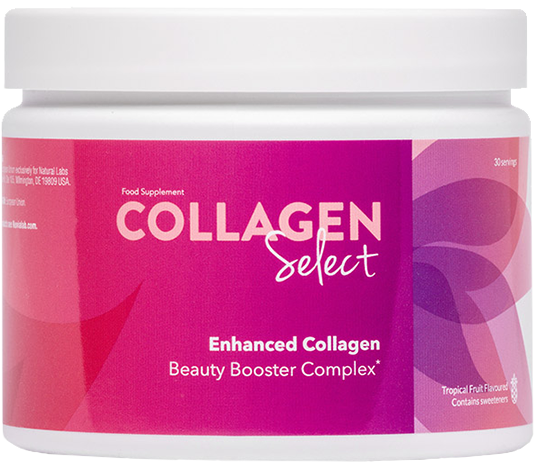
Our Recommendation — Collagen Select
Score: 5.2/10 · Best for: people who prefer a drink to capsules and want the branded VERISOL® ingredient specifically. Main caution: the maker does not publish ingredient amounts, so the dose cannot be audited — and the money-back badge carries no published day length. Fair trial: eight weeks, the VERISOL® trial window — the three-tub pack at $41.99 a tub is the trial the evidence describes; the six-tub pack is the cheapest route only for continuing users.
Why the Timelines You Read Are Measurement Schedules
Open any collagen trial and you will find the same design: measure at baseline, dose daily, measure again at fixed weeks. The weeks in the paper are the weeks the researchers booked the instruments — not a discovered calendar of when skin changes.
That distinction sounds pedantic until you watch it get sold. A brand runs an 8-week trial, then prints "visible results in 8 weeks". The sentence smuggles in two claims the trial never tested: that nothing happens before week 8, and that something visible happens at it.
The first is unlikely (biology rarely waits for the appointment), the second is unproven (the endpoints were instruments, not visibility). Honest timelines have to be rebuilt from what was actually measured, endpoint by endpoint.
What the Trials Measured, and When
| Endpoint | Trial | Dose | Measured at | Result against placebo |
|---|---|---|---|---|
| Skin elasticity | 69 women aged 35–55 | 2.5 g and 5 g/day | 8 weeks | Significantly improved in both dose groups |
| Eye-wrinkle volume | 114 women aged 45–65 | 2.5 g/day | 4 and 8 weeks; again 4 weeks after stopping | About 20% lower than placebo at 8 weeks; effect persisted at the post-treatment check |
| Skin hydration | Pooled trials (2021 analysis: 19 trials, 1,125 participants) | 2.5–10 g/day | Mostly 8–12 weeks | Improved versus placebo in the pooled result |
| Nail growth / breakage | 25 participants, open-label | 2.5 g/day | 24 weeks | Growth rate up 12%, broken-nail frequency down 42% versus baseline (no placebo group) |
Read the table as a floor, not a forecast. It tells you the earliest points at which effects were demonstrated — 4 weeks for the wrinkle instrument reading, 8 weeks for most endpoints, 24 weeks for nails. It cannot tell you when any individual will notice anything, because noticing was never an endpoint.
The Skin Timeline Specifically
For skin — the reason most people buy collagen — the trial calendar compresses to two dates. At 4 weeks, one instrument endpoint (eye-wrinkle volume) had already separated from placebo in 114 women aged 45–65 on 2.5 g/day.
At 8 weeks, the main cluster of results lands: elasticity in the 69-woman trial, wrinkle volume, and most hydration endpoints across the pooled literature. Twelve weeks is where several wider hydrolysate trials put their final measurements.
So a fair self-trial for skin is 8 weeks minimum and 12 weeks for a confident verdict. Anything judged at week 3 is being judged before the evidence's first full measurement — in both directions: too early to celebrate, too early to quit.
Slower tissues run on longer calendars, and the trials respect that even if the marketing doesn't. The cellulite trial dosed for a full 6 months before its endpoint; the nail study needed 24 weeks because nails grow slowly enough that a shorter trial would measure nothing. A product that borrows the category's results while promising the category's fastest-ever timeline is mixing calendars from different studies — another reason to read timelines as schedules, not promises.
The Signs People Judge By
Since the trials measured instruments, what should a buyer measure? The trap is the mirror: lighting, hydration that day, sleep and angle all move the reflection more than eight weeks of peptides plausibly will.
The workable method is the one this site recommends everywhere: weekly photographs, same room, same light, same angle, no filter, compared at week 8 — not scrolled daily. Skin feel is a legitimate second signal; elasticity and hydration changes, if they come, are the kind you notice as texture before you see them as lines.
What is not a sign: a single good-skin day, a compliment, or the absence of new lines. Ageing's clock is slow; eight quiet weeks prove nothing either way.
Can You See Results in One Week?
No — and this one is not close. The earliest measurement in the entire skin literature is 4 weeks, and even that was an instrument reading, not a visible change. Peptide blood levels peak within hours of a dose, but a blood signal is not a skin result; the tissue the signal supposedly instructs remodels over weeks.
What one week can show: whether the product agrees with you (taste, routine, digestion) and whether the habit will survive. Those are worth knowing — they decide whether you reach week 8 at all — but they are logistics, not efficacy.
Any product promising visible change in seven days is promising something its own category's best trial never measured. Treat the promise as a review of the seller, not of the supplement.
What Happens When You Stop
One data point exists, and it is a good one. In the wrinkle trial, women were measured again 4 weeks after the last dose — and the eye-wrinkle volume effect was still detectable versus placebo at that check, in the 114 women aged 45–65 who had taken 2.5 g/day for 8 weeks.
Beyond four weeks post-treatment, nothing is measured. The reasonable inference is decay rather than permanence: the peptides' blood pulse is daily, the hypothesised signal stops when dosing stops, and no study shows a banked benefit at three or six months off.
Practically: collagen, if it works for you, is a subscription to a small ongoing effect, not a course that fixes something. Price it that way — monthly cost, indefinitely — when you compare it with one-off or slow-decay alternatives.
A Maker's Two-Month Promise, Tested
Collagen Select's FAQ tells buyers to expect visible effects after two months of use. Against the trial calendar, two months is the one defensible promise a collagen maker can make — it is exactly the 8-week point where the VERISOL trials measured their results.
Two qualifications keep it honest. First, "visible" overstates the trial endpoints, which were instruments; the fair word is "measurable". Second, the trials' calendar belongs to a confirmed 2.5 g dose — and this product's dose is unpublished, sitting somewhere inside a 5 g serving shared with flavouring and eight other ingredients.
A promise can match the schedule and still not match the study. Judge this drink at two months if you buy it — but know that a null result would leave the central question (was the dose even there?) permanently unanswered.
Our Verdict
Collagen's timeline is 8–12 weeks for skin, 24 weeks for nails, and unknown for everything between measurements. Set your trial window before you start, photograph it, and let the window — not hope, not impatience — deliver the verdict.
Our Recommendation — Collagen Select
Score: 5.2/10 · Best for: people who prefer a drink to capsules and want the branded VERISOL® ingredient specifically. Main caution: the maker does not publish ingredient amounts, so the dose cannot be audited — and the money-back badge carries no published day length. Fair trial: eight weeks, the VERISOL® trial window — the three-tub pack at $41.99 a tub is the trial the evidence describes; the six-tub pack is the cheapest route only for continuing users.
Frequently Asked Questions
How long does collagen take to work for skin?
The trials measured skin endpoints at 8–12 weeks, with one instrument result (eye-wrinkle volume) already present at 4 weeks in 114 women aged 45–65 on 2.5 g/day. Judge a fair trial at 8 weeks minimum.
Can collagen work in a week?
Nothing in the trial record supports it. The earliest measured endpoint is 4 weeks, and it was an instrument reading. A week tells you about taste and tolerance, not results.
What happens if I stop taking collagen?
The one measured case: the wrinkle-volume effect persisted at a check 4 weeks after stopping, in women who had dosed 2.5 g/day for 8 weeks. Beyond that, decay is the reasonable assumption — no study shows a permanent banked benefit.
How will I know if it's working?
Weekly photographs in identical light, compared at week 8, plus skin feel. The trial effects are instrument-sized; expecting mirror-visible change is the most common reason buyers wrongly conclude collagen "did nothing" — or wrongly conclude it did.
Do I need to take it forever?
If it works for you, the evidence implies ongoing use: the plausible mechanism is a daily signal, and persistence past 4 weeks off-dose is unmeasured. Budget it as a continuing monthly cost, not a course.
Who Should Buy Collagen Select — and Who Should Skip It
Buy it if: you are willing to run the honest experiment — daily use, photographs, a verdict at two months — and you want the drink format and the VERISOL name for that experiment.
Skip it if: you need results on a deadline shorter than 8 weeks (nothing in this category can offer them truthfully); you would find a null result at two months unacceptable at $62.99 a tub with an unspecified guarantee; or you want your two-month trial to answer the dose question too — an unpublished dose means it can't.
Timelines expose sellers. This one's promise matches the trial calendar — the most that can be said, and more than most competitors manage — while its label withholds the dose that would let the calendar apply.
Last reviewed: October 2026. This article is educational and is not medical advice.
