
- Quick Answer
- Dose by Goal
- Skin: 2.5–10 g in trials
- Joints and bone: the higher ranges, briefly
- The mg-vs-g trap
- Is 1 Gram Enough? The Capsule Problem
- Can You Take Too Much?
- How to Read a Label in Grams
- Per serving vs per 100 g
- When the maker won't print the number
- Our Verdict
- Frequently Asked Questions
- What is the minimum effective collagen dose for skin?
- Is 1,000 mg of collagen enough?
- Can I take 20 g of collagen a day?
- Does the dose differ for men?
- How do I know how much collagen is in my product?
- Who Should Buy Collagen Select — and Who Should Skip It
- Read This Next
Disclosure: This article contains affiliate links. If you buy through them, we may earn a commission at no extra cost to you. It never changes our conclusions.
Quick Answer
Skin trials dosed collagen at 2.5–10 g/day. There is no established upper limit, and no evidence that more works faster — the skill that matters is reading a label in grams.
Start with the uncomfortable part: one prominent label in this category — Collagen Select — prints no grams at all, so its dose cannot be checked against any figure in this article. The audit section below shows how to handle that.
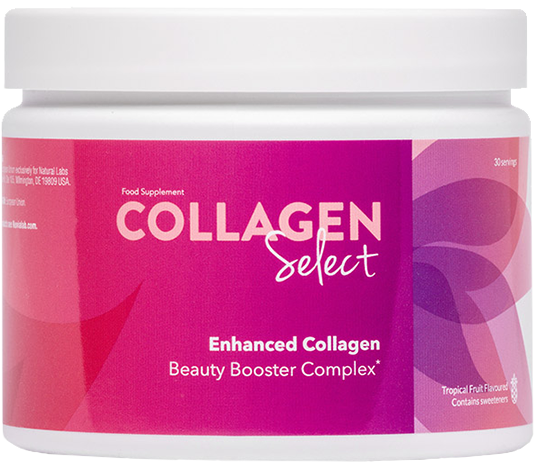
Our Recommendation — Collagen Select
Score: 5.2/10 · Best for: people who prefer a drink to capsules and want the branded VERISOL® ingredient specifically. Main caution: the maker does not publish ingredient amounts, so the dose cannot be audited — and the money-back badge carries no published day length. Fair trial: eight weeks, the VERISOL® trial window — the three-tub pack at $41.99 a tub is the trial the evidence describes; the six-tub pack is the cheapest route only for continuing users.
Dose by Goal
Skin: 2.5–10 g in trials
The skin literature's dose floor is the VERISOL programme: 2.5 g/day in the elasticity trial (69 women aged 35–55) and the wrinkle trial (114 women aged 45–65).
The wider hydrolysate literature pooled in 2021 — 19 trials, 1,125 participants — ranged higher, and the 2019 systematic review summarised its included studies at 2.5–10 g/day over 8–24 weeks. Above 10 g/day, skin evidence thins to nothing; the extra grams buy protein, not proof.
Joints and bone: the higher ranges, briefly
Joint and bone studies generally dose higher than skin studies — commonly in the 5–15 g/day region in their own trial literature — and they answer different questions with different endpoints.
We keep those ranges generic deliberately: this article's citations are skin citations, and borrowing joint doses to size a skin purchase is a category error in both directions.
The mg-vs-g trap
One label pattern deserves a warning of its own. Undenatured type II collagen (UC-II) is dosed at 40 milligrams a day — a genuinely different ingredient with a different mechanism, not a tiny dose of the peptides this article is about.
Labels that blur the two — "collagen complex 500 mg" beside peptide imagery — are comparing milligrams of one ingredient with grams of another. If the unit is mg and the claim is skin elasticity at peptide endpoints, the product is outside the evidence entirely.
Is 1 Gram Enough? The Capsule Problem
Almost certainly not, for skin. One gram a day is 60% below the lowest dose any skin trial used, and no study has tested whether a sub-trial dose produces a sub-sized effect or none at all.
The capsule arithmetic explains why the question exists. A standard capsule holds roughly 0.5–1 g of powder. Reaching the 2.5 g floor takes three to five capsules a day; reaching 10 g takes a handful nobody sustains.
So capsule products cluster at 1–2 g/day — not because that dose was chosen from evidence, but because that is what fits in two capsules. The dose was set by the packaging. Our format comparison runs the price-per-gram side of the same arithmetic.
Can You Take Too Much?
No tolerable upper intake level has been set for collagen peptides by any major authority — there is no official ceiling to exceed. That is a statement about missing data, not a safety medal.
Is 20 g a day dangerous? Untested is the accurate word: skin trials top out around 10–15 g, and the feeding research that exists at high loads measured kidney-relevant chemistry, not skin. In the Knight group's gelatin-loading work, urinary oxalate rose measurably at 5–10 g gelatin loads — which is why stone-formers, specifically, should treat very high doses as a question for their doctor rather than a dare.
For everyone else, the practical ceiling is set by tolerance (fullness and digestive complaints are the usual reports), by cost, and by the absence of any dose-response evidence that more helps more. The elasticity trial's 2.5 g and 5 g arms both improved versus placebo in 69 women aged 35–55 — nobody has shown 15 g beating either.
How to Read a Label in Grams
Per serving vs per 100 g
Two numbers on a panel can describe the same product: amount per serving and amount per 100 g. Per-100 g figures always look bigger. Convert before comparing: per-serving is the only number that meets your glass.
Then check what the serving is made of. A 10 g serving of pure peptide powder is 10 g of collagen. A 5 g serving of a flavoured nine-ingredient drink is a blend in which collagen is one line among nine.
When the maker won't print the number
Collagen Select is the limiting case. Its maker names nine ingredients — VERISOL peptides first — and publishes no amount for any of them in readable text. The tub gives a ceiling only: 150 g over 30 servings is 5 g of powder per serving, shared with flavouring and eight other ingredients.
The collagen dose is therefore somewhere under 5 g, possibly at the studied 2.5 g, possibly well under it. There is no reading of the label that settles it, and our dose verdict for such products is fixed: uncheckable counts as unproven, and the score (5.2/10) reflects it.
The shopping rule that follows costs nothing: if a maker will not tell you the dose, assume you are not getting the studied one — and price the product as a flavour-and-format purchase, not an evidence purchase.
Our Verdict
For skin, aim at the studied floor: 2.5 g/day of a named peptide, printed on the label, sustained for at least 8 weeks. Doses up to 10 g/day stay inside the literature; beyond that you are self-experimenting.
And treat the label check as part of the dose itself. In this category, grams are not a detail — they are the intervention.
Our Recommendation — Collagen Select
Score: 5.2/10 · Best for: people who prefer a drink to capsules and want the branded VERISOL® ingredient specifically. Main caution: the maker does not publish ingredient amounts, so the dose cannot be audited — and the money-back badge carries no published day length. Fair trial: eight weeks, the VERISOL® trial window — the three-tub pack at $41.99 a tub is the trial the evidence describes; the six-tub pack is the cheapest route only for continuing users.
Frequently Asked Questions
What is the minimum effective collagen dose for skin?
The lowest dose with positive randomised-trial results for skin is 2.5 g/day — the VERISOL programme's dose. Nothing lower has been shown to work for skin endpoints, so 2.5 g is the floor a label must meet to borrow the evidence.
Is 1,000 mg of collagen enough?
1,000 mg is 1 g — below every skin trial's dose. It is a common capsule serving because it fits the format, not because it was validated. Expect, at most, an untested fraction of the studied effect.
Can I take 20 g of collagen a day?
No authority sets an upper limit, and 20 g is not known to be dangerous for healthy adults — but it is untested rather than endorsed. Stone-formers should ask a clinician first, because gelatin loads of 5–10 g measurably raised urinary oxalate in feeding studies.
Does the dose differ for men?
The trials are overwhelmingly in women (95% of participants in the 2021 pooled analysis), so any male dose is an extrapolation. The studied range, 2.5–10 g/day, is the only defensible starting point for anyone.
How do I know how much collagen is in my product?
Read the amount per serving, in grams, of collagen or collagen peptides specifically — not the serving weight of the whole blend. If the panel lists only ingredient names or a proprietary blend total, the dose is unpublished and the product cannot be checked.
Who Should Buy Collagen Select — and Who Should Skip It
Buy it if: the drink format is what will keep you consistent for two months, you want the VERISOL ingredient, and you accept that its dose sits unverifiably somewhere below a 5 g blend ceiling.
Skip it if: dose discipline is your reason for buying — you cannot run a 2.5 g check on a label with no grams; you are a kidney-stone former who has not discussed collagen loads with a clinician; or you are choosing between this and a powder that prints its peptide grams — the printed one wins this category's audit every time.
A dose article can only end one way for this product: the studied dose exists, the serving might contain it, and the maker has arranged things so you will never know. Buy accordingly.
Last reviewed: October 2026. This article is educational and is not medical advice.
