
- Quick Answer
- What Are DRcaps?
- The Scintigraphy Study
- What Are the Benefits of a Delayed-Release Capsule?
- Delayed Release Across the Supplement Aisle
- DRcaps in Piperinox: A Shell Around a Question Mark
- Frequently Asked Questions
- Are DRcaps the same as enteric-coated capsules?
- Do delayed-release capsules improve absorption?
- Is the 52-minute figure reliable?
- Does the delay change when Piperinox should be taken?
- Who Should Buy Piperinox — and Who Should Skip It
- Read This Next
Disclosure: This article contains affiliate links. If you buy through them, we may earn a commission at no extra cost to you. It never changes our conclusions.
Quick Answer
DRcaps are a genuinely engineered delayed-release vegetarian capsule — hydroxypropyl methylcellulose (HPMC) with gellan gum — with exactly one human study behind them: a scintigraphy trial commissioned by their manufacturer, Capsugel, and never independently replicated.
In that study, release began on average around 52 minutes after swallowing, versus roughly 5–10 minutes for an ordinary capsule. Best for: readers deciding whether a delayed-release shell is a benefit or a bullet point. Piperinox (4.4/10) uses DRcaps; what the delay buys its ingredients is much less clear.
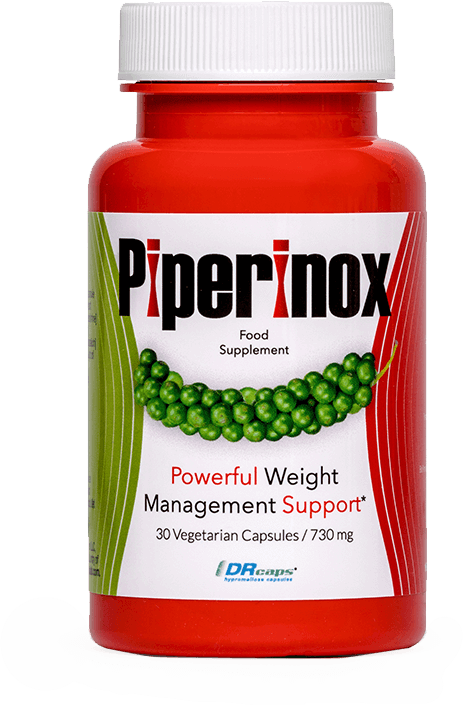
Our Recommendation — Piperinox
Score: 4.4/10 · Best for: adults who want a simple one-capsule-a-day thermogenic and are untroubled by undisclosed doses. Main caution: the panel lists ingredient names only — a delayed-release capsule of an unknown dose is still an unknown dose — and no money-back guarantee is published. Fair trial: the three-bottle pack at $33.33 a bottle — the honest trial length, per our full audit below.
What Are DRcaps?
Start with the shell most supplements come in. A standard capsule is gelatin — or, in vegetarian products, plain HPMC — and it disintegrates in stomach acid within roughly five to ten minutes of swallowing. The contents meet the stomach first, then move on.
DRcaps modify that shell. They are made of HPMC blended with gellan gum, a plant-derived polysaccharide. When the capsule meets stomach acid, the gellan gum forms a gel layer that resists the acid and delays the shell's breakdown — a delay built into the material rather than added as a drug-style enteric coating.
The shell is made by Capsugel, a major capsule manufacturer now within Lonza — a real, established supplier whose capsules are used across the supplement and pharmaceutical industries. Whatever else this article concludes, the technology itself is not a fiction invented by a marketing department.
That distinction matters for how to read Piperinox's use of it. When a label names DRcaps, it is naming a procured component with a datasheet. It is one of the few claims on the bottle a buyer can verify against a manufacturer's public record.
The Scintigraphy Study
The human evidence for DRcaps is a single study, and its design is worth understanding because it determines what the numbers mean. Volunteers swallowed capsules containing a radiolabelled marker — lactose powder tagged with a tracer — and were imaged with a gamma camera as the capsule travelled and opened.
The study was run by Bio-Images Research in Glasgow in spring 2013 and was commissioned by Capsugel, the capsule's manufacturer. Trade coverage in Nutritional Outlook and Nutraingredients reported its findings at the time; it was not published as a peer-reviewed paper.
The headline results: DRcaps began releasing their contents at a mean of about 52 minutes after ingestion, with complete release at a mean of about 72 minutes. The comparison capsules started releasing at around 5–10 minutes. The delay, on average, is roughly 45 minutes — and for most subjects, complete release occurred in the intestine rather than the stomach.
Now the qualifiers, which are the substance of this article. The marker load was about 300 mg of lactose — a tracer payload, not a drug or a botanical extract.
The numbers are means with individual variation around them; some capsules will have opened earlier, some later. And a manufacturer-commissioned, non-peer-reviewed study of its own product is the weakest tier of human evidence that still counts as human evidence.
Most importantly: no independent group has repeated the experiment in the decade since. The 52-minute figure has been quoted in trade and marketing material ever since, acquiring familiarity without acquiring confirmation. That is the entire evidentiary position, stated as plainly as we can state it.
What Are the Benefits of a Delayed-Release Capsule?
The technology has one clear, principled use case: protecting contents from stomach acid. Probiotics and enzymes are the canonical examples — living organisms and fragile proteins that acid genuinely damages. For those payloads, an acid-resistant shell solves a real problem, and the scintigraphy data support the shell doing its job.
A second possible benefit is tolerability: ingredients that irritate the stomach lining may be gentler when released lower down. A third, occasionally implied, is targeting — delivering a compound to the intestine where it is absorbed. For acid-labile or stomach-irritating contents, these are coherent claims.
What delayed release does not do is change what an ingredient is worth once released. It does not raise a dose, improve an evidence base, or make a stimulant gentler on the heart. The shell governs where and when the contents appear; the contents still do whatever they were going to do, about 45 minutes later.
That last point has a practical consequence buyers rarely consider: a delayed-release stimulant product taken in the evening delivers its caffeine later into the night than the same product in a standard capsule. For a fat burner — a category with a complicated relationship with sleep — the delay is not obviously a favour.
Delayed Release Across the Supplement Aisle
DRcaps sit in a family of delivery claims that buyers meet constantly, and the family repays sorting. At the legitimate end are pharmaceutical delayed- and extended-release systems, validated in formal dissolution and pharmacokinetic testing because drug timing is a dosing variable, not a feature.
In supplements, the honest use cases are narrower: probiotics that must survive acid, enzymes that acid denatures, and fish oils where delaying release reduces reflux aftertaste. In each case there is a named enemy — acid, denaturation, stomach release — that the shell plausibly defeats.
At the marketing end are delay claims attached to ingredients with no acid problem at all. There the shell functions as differentiation: a trademarked component name on a label whose active ingredients are undisclosed creates one verifiable line in a sea of unverifiable ones — which is a real service to the label, if not to the buyer.
One condition the trade reports rarely emphasise: gastric timing is variable. Food, stomach pH, and individual motility all shift when any capsule opens; the 52-minute mean came from a controlled study setting. A delayed-release capsule taken with a large meal may behave differently from the scintigraphy figure in either direction. Delivery claims, like doses, are averages wearing a uniform.
DRcaps in Piperinox: A Shell Around a Question Mark
Our Piperinox review records the product's use of DRcaps accurately: it is a genuine named technology, and we credited it as such in the score. It is also worth examining what problem the shell solves for this particular formula.
Piperinox's ingredients are black pepper extract, bitter orange, guarana, cayenne, cinnamon, ginger and chromium. None is a living organism or an acid-fragile protein. Capsaicin is a stomach irritant, so a tolerability rationale exists for one ingredient — an ingredient whose amount, like all the others, is undisclosed.
The stimulants point the other way. Bitter orange's synephrine and guarana's caffeine are robust molecules that stomach acid does not threaten; delaying them mainly delays their peak. For a once-a-day morning capsule, that is harmless. As a marketed benefit, it is decoration.
So the DRcaps on this label are best understood as a quality signal rather than a functional one: the maker bought a branded shell from a serious manufacturer. It tells you something about the supply chain. It tells you nothing about the dose, the evidence, or the effect of what is inside — and those remain undisclosed in full.
Our Recommendation — Piperinox
Score: 4.4/10 · Best for: adults who want a simple one-capsule-a-day thermogenic and are untroubled by undisclosed doses. Main caution: the panel lists ingredient names only — a delayed-release capsule of an unknown dose is still an unknown dose — and no money-back guarantee is published. Fair trial: the three-bottle pack at $33.33 a bottle — the honest trial length, per our full audit below.
Frequently Asked Questions
Are DRcaps the same as enteric-coated capsules?
No. Enteric coating is a film applied to a tablet or capsule that resists acid and dissolves at intestinal pH. DRcaps achieve their delay through the shell material itself — HPMC with gellan gum that gels in acid. The goal is similar; the construction and the evidence base are different, and pharmaceutical enteric coatings carry a far deeper validation literature.
Do delayed-release capsules improve absorption?
Only for contents that stomach acid would otherwise destroy — the probiotic and enzyme case. For stable small molecules like caffeine or synephrine, the total absorbed amount is broadly unchanged; only the timing shifts. "Delayed" is not a synonym for "more", and marketing that lets the two blur is trading on the ambiguity.
Is the 52-minute figure reliable?
It is the manufacturer's own commissioned measurement, imaging a 300 mg lactose marker load, reported in trade press in 2013 rather than a peer-reviewed journal, and never independently replicated. Treat it as a plausible engineering figure from an interested source — probably roughly right, certainly unconfirmed.
Does the delay change when Piperinox should be taken?
The maker's direction is one capsule between meals, and the shell adds roughly an hour to the contents' appearance on the manufacturer's own figures. Taken mid-morning, that places the stimulant peak nearer midday.
There is no evidence the timing improves the formula's effect — the practical point is simply the reverse of the evening warning: the later the capsule, the later the hidden caffeine lands.
Who Should Buy Piperinox — and Who Should Skip It
Buy it if you value the small genuine things: a vegetarian delayed-release shell from a named manufacturer, one capsule a day, a low price — and you are buying those logistics with open eyes about the undisclosed formula inside the shell.
Skip it if the DRcaps branding is doing persuasive work. A verified delivery system around unverified contents is the label equivalent of a strong lock on an empty room: impressive hardware, nothing audited behind it. Skip it, too, if you dose in the evening — the delay pushes its hidden stimulants later into your night.
Last reviewed: October 2026. This article is educational and is not medical advice.
