
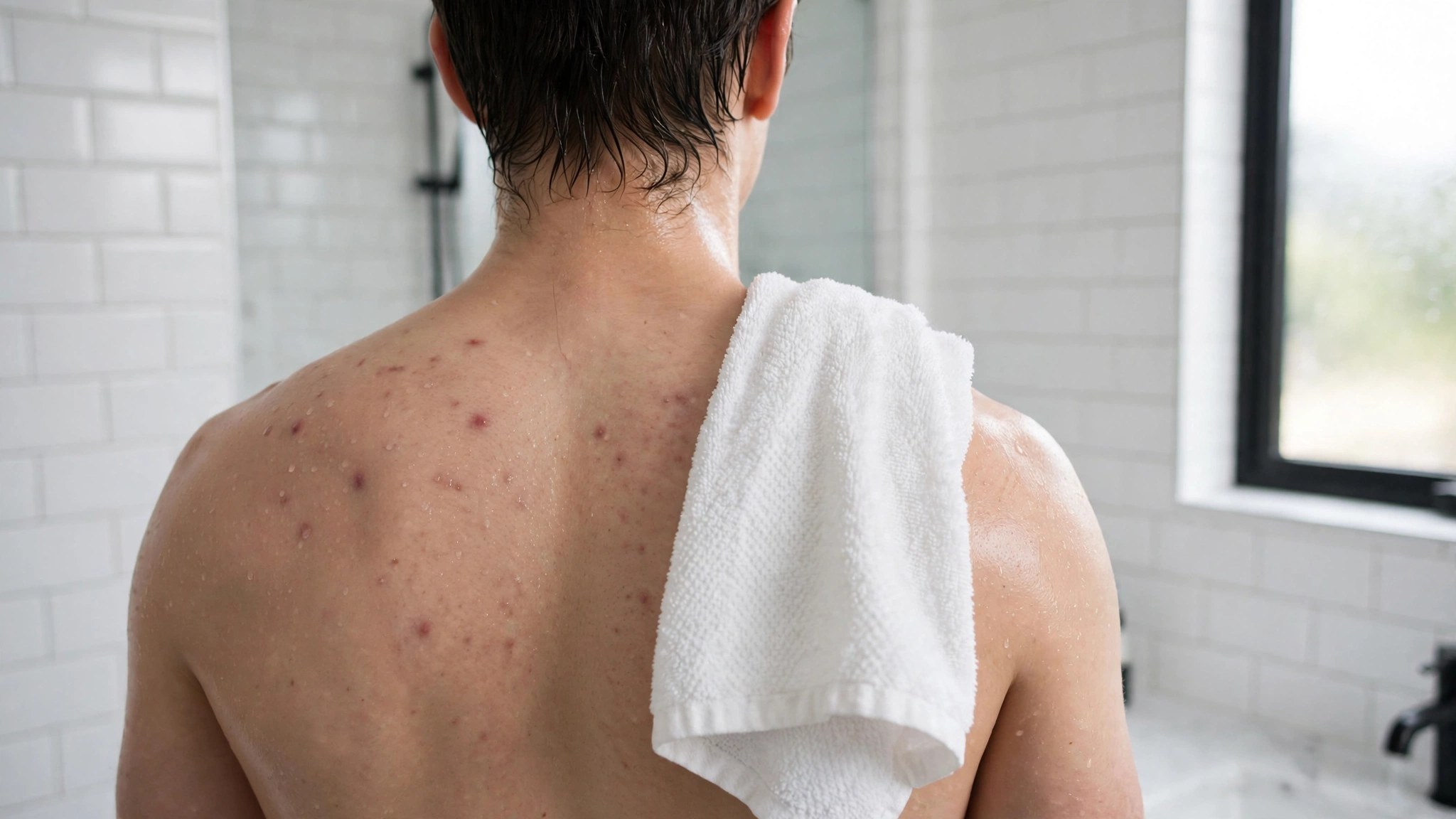
- Why the back breaks out so easily
- The friction factor: acne mechanica
- The shower-order mistake
- The routine that actually works
- How long before you judge it
- When it is not acne at all
- When to see a dermatologist
- Frequently Asked Questions
- Does diet matter for back acne?
- Can supplements cause back acne?
- Should you exfoliate your back with a brush?
- Will back acne clear on its own?
- Can you use facial acne products on your back?
- Read This Next
Why the back breaks out so easily
Acne starts in the pilosebaceous unit: a hair follicle attached to an oil gland. Excess oil, sticky dead skin cells, bacteria and inflammation combine to plug and swell that unit.
The back is unusually well supplied with oil glands. Along with the face, chest and shoulders, it is one of the most sebaceous areas of the whole body.
Its follicles are larger, too, and its skin is thicker. A plug that would make a small facial whitehead can build into a larger, deeper lesion between the shoulder blades.
The bacteria in the story is Cutibacterium acnes, a normal skin resident. It thrives in the oily, low-oxygen environment of a blocked follicle and drives the inflammation that follows.
Hormones set the oil level. Androgens rise at puberty and increase sebum production, which is why back acne so often starts in adolescence and can persist into adult life.
Heat and sweat then add pressure from outside. Sweat itself does not create acne, but sweat held against oily skin under clothing keeps follicles warm, wet and occluded for hours.
Reach is a mechanical problem unique to the back. The middle of the back is the hardest area to wash, to treat evenly and even to inspect without a mirror.
That is why back acne is often undertreated rather than resistant. A product applied only where fingers reach leaves the central, most breakout-prone zone effectively untreated.
It is also why washes dominate back treatment. A wash spreads across a large, hard-to-reach area in the shower in a way a pea-sized gel application simply cannot.
Severity varies widely. Some people get scattered blackheads and small pimples. Others develop deep, painful nodules across the shoulders that heal slowly and leave lasting marks and scars.
Those two patterns should not be managed the same way. Surface, mild back acne is reasonable home territory. Deep, painful or scarring back acne is dermatology territory from the start.
The guideline frame is the same as for facial acne. The American Academy of Dermatology guideline, Reynolds and colleagues, 2024, recommends treatments by mechanism, not by body site.
In practice that means the back gets the facial acne toolkit — benzoyl peroxide, topical retinoids, salicylic acid — delivered in formats a large area can actually use consistently.
The friction factor: acne mechanica
Acne mechanica is acne provoked by repeated friction, pressure, heat and trapped sweat. It appears exactly where equipment touches skin, in a pattern that maps the contact.
Classic triggers sit in a line across the back: backpack straps, sports bra bands, weightlifting bench contact, tight rucksack frames, instrument straps and occlusive gym clothing.
The mechanism is physical before it is bacterial. Rubbing irritates the follicle opening, pressure and heat swell the surrounding skin, and the pore closes over oil that would otherwise escape.
Sweaty synthetic fabrics extend the exposure. A shirt that stays damp for an hour after training holds warmth and moisture against the back long after the workout itself ended.
The diagnostic clue is geography. Breakouts concentrated under straps, along a bra line or only where a bench presses, with clearer skin elsewhere, point to friction as a driver.
Fixing the friction is treatment, not lifestyle garnish. A cleaner strap, a padded layer, a looser fit or a shower straight after training can remove the provoking force entirely.
Wash straps, bands and gym kit regularly. Fabric that carries dried sweat, oil and bacteria back onto the same follicles every session re-seeds the problem you are treating.
Change out of training clothes promptly. Every extra hour in damp, tight clothing is another hour of heat, occlusion and rubbing on already irritated follicles.
Where friction cannot be avoided — a required uniform, a carried pack, protective equipment — a clean, smooth base layer between equipment and skin reduces direct rubbing.
Do not compensate by scrubbing harder. Friction-damaged skin plus aggressive scrubbing is two mechanical insults stacked, and inflamed follicles respond by getting angrier, not clearer.
Acne mechanica also explains a common confusion: the person whose face is clear but whose back breaks out every sports season. Same skin, different mechanical environment.
If a friction pattern is obvious, judge any wash or gel only after the friction fix is in place. Otherwise you are grading a treatment against a cause still running daily.
The shower-order mistake
One of the cheapest fixes in back acne costs nothing: wash your body after you wash and condition your hair, not before. Order, in the shower, is a treatment variable.
Conditioners and hair masks are designed to coat. They contain rich, film-forming ingredients that cling to hair — and that rinse down across your shoulders and back as you wash them out.
If you wash your body first and condition last, that film is the final layer left sitting on your back as you step out, towel off and dress.
Reversing the order solves it mechanically. Shampoo and condition first, rinse, clip the hair up if it is long, then wash the back last with your treatment wash.
Hair oils, leave-in products and heavy styling creams can travel the same route during the day, especially on longer hair resting against the upper back in warm weather.
The same principle applies to thick body products applied before dressing. A heavy, fragranced lotion across breakout-prone shoulders adds occlusion without adding any acne benefit.
Timing after exercise matters as much as order. Shower promptly after sweating where you can. Dried sweat, oil and bacteria left on skin under clothes prolong follicle exposure.
When a shower is impossible, changing into dry clothes and gently wiping the back is a reasonable interim step. It is a harm-reduction measure, not a substitute for washing.
Water temperature and force deserve restraint. Very hot water and hard scrubbing strip and irritate skin, and irritated skin tolerates benzoyl peroxide and retinoids far worse.
Use your hands or a soft cloth to spread a treatment wash across the back. A long-handled soft brush can help reach, provided it is gentle, cleaned and dried between uses.
Rinse thoroughly. Residue from any wash left on the back, trapped under clothing, can irritate. The treatment needs its contact minutes in the shower, not an unplanned extra hour.
Finally, pat dry and dress in clean clothes. Putting a used, sweat-damp shirt back over a freshly treated back undoes the wash in the least visible way possible.
The routine that actually works
The workhorse is a benzoyl peroxide wash, in the usual over-the-counter range of 2.5–10%. The AAD guideline gives benzoyl peroxide a strong recommendation for acne.
Use it as a short-contact treatment, not a quick splash. Spread it over the whole breakout-prone area, leave it for one to two minutes, then rinse it off thoroughly.
Those contact minutes are the step most people skip. Benzoyl peroxide needs time on skin to work; a wash applied and immediately rinsed delivers a fraction of its effect.
Treat the area, not the spots. Acne prevention happens in follicles that have not yet surfaced. Washing only visible pimples leaves tomorrow’s lesions, already forming, completely untouched.
Expect the fabric warning to be real. Benzoyl peroxide bleaches towels, sheets, pillowcases and clothing. Use white towels and bedding on treatment routines, and rinse skin well before dressing.
Start once a day, or every other day if your skin is reactive. Dryness, peeling and stinging are the usual early effects, and the back generally tolerates treatment better than the face.
A salicylic acid wash is the main alternative or companion type. Salicylic acid is oil-soluble and helps loosen the plug inside the pore, suiting blackhead-heavy, comedonal backs.
The AAD guideline conditionally recommends salicylic acid for acne. “Conditionally” means a weaker evidence grade than benzoyl peroxide or retinoids, not that it is useless.
Adapalene 0.1% gel is the leave-on option. As a topical retinoid, it normalises cell turnover inside the follicle, preventing the plugs that start both whiteheads and inflamed lesions.
Topical retinoids receive a strong recommendation in the AAD guideline. On the back, adapalene suits a maintenance role once a wash routine is established and tolerated.
Apply leave-on gel thinly across the breakout zone at night, ideally with help or a lotion applicator for reach. More gel is not more effect; it is more irritation.
Introduce one active at a time, a week or two apart. Starting a peroxide wash, an acid wash and a retinoid together guarantees irritation and destroys your ability to judge each one.
Keep the rest of the routine boring: gentle cleansing, a light non-comedogenic moisturiser if dryness appears, clean clothing against the skin, and no picking, squeezing or harsh exfoliation.
Do not add topical antibiotics on your own as a shortcut. The guideline warns against antibiotic monotherapy because of resistance, and pairs antibiotics with benzoyl peroxide when they are used.
Consistency beats intensity at every point in this routine. A moderate wash used daily for eight weeks outperforms a strong wash used fiercely for four days, then abandoned as intolerable.
How long before you judge it
Back acne does not turn around in a week, and judging it early is the most common reason working routines get discarded. Follicles clear on a cycle of weeks, not days.
The minimum fair trial is four to eight weeks of consistent use. Early in that window, the realistic goal is fewer new lesions forming, not a completely clear back.
For a full judgement, allow eight to twelve weeks. Lesions already deep in the skin when you started will still surface and heal during the first month of treatment.
That surfacing is frequently misread as failure. A pimple appearing in week three was usually set in motion before the routine began; the routine is judged by the trend after it.
Track the trend simply. A dated photo of your back, in the same light, every two weeks gives a comparison that memory, mirrors and mood cannot provide reliably.
Count roughly, if counting helps: new inflamed lesions per week is a better measure than total marks visible, because flat marks linger long after active acne has quietened.
Post-inflammatory marks deserve a separate expectation. Red or brown marks on the back fade over months, not weeks, and their persistence does not mean active treatment is failing.
If, at eight weeks, new lesions are clearly fewer and shallower, continue. Maintenance matters in acne: stopping the moment skin clears usually invites the original cycle back.
If nothing has changed at all by eight to twelve weeks of genuinely consistent use, change the plan rather than intensifying the scrubbing. Add or swap one element, or seek assessment.
And if the pattern matches the next section — uniform, itchy, no comedones — do not extend the trial at all. No duration of acne treatment fixes a condition that is not acne.
When it is not acne at all
The differential that matters most on the back is Malassezia folliculitis, historically called pityrosporum folliculitis. It is an overgrowth of a normal skin yeast inside the follicles.
The StatPearls review of folliculitis, Winters and Mitchell, describes this form as typically appearing across the shoulders, back and neck, in a cape-like distribution.
Its look is distinctive once described. The bumps are small, remarkably uniform in size, and itchy — often intensely — where ordinary acne is usually varied in size and not especially itchy.
The second clue is what is missing. Malassezia folliculitis has no comedones: no blackheads and no whiteheads mixed in. Acne, by definition, produces comedones as its starting lesion.
The third clue is treatment behaviour. StatPearls notes suspicion should arise when supposed acne fails to respond to, or even worsens after, antibiotic treatment. Antibiotics can favour yeast overgrowth.
Warm, humid conditions, sweating, oily skin and a history of dandruff or seborrheic dermatitis all raise the likelihood, because the same yeast family is involved in those conditions too.
Treatment runs in the opposite direction to acne care. Malassezia folliculitis needs an antifungal approach, typically antifungal washes or creams, and oral antifungals in more extensive cases, prescribed by a clinician.
Benzoyl peroxide, retinoids and antibiotics do not address a yeast-driven folliculitis. Months of faithful acne routine against this condition produce exactly the “nothing works” story it is known for.
Self-diagnosis has limits here. Other folliculitis types, including bacterial folliculitis with itchy or tender pustules centred on hairs, can look similar to an untrained eye in a bathroom mirror.
That is an argument for assessment, not for guessing harder. A dermatologist can often distinguish these patterns on sight, and can sample or swab where the picture is unclear.
If your “bacne” is monotonously uniform, dominantly itchy and comedone-free, stop grading your acne routine. Get the diagnosis checked. It is the single most useful branch point in this article.
Note also that the two can coexist. A person can have ordinary acne on the shoulders and Malassezia folliculitis across the back at once, which is another reason examination beats assumption.
When to see a dermatologist
Deep, painful lesions are the clearest escalation signal. Nodules and cysts on the back sit deep, heal slowly, and carry the highest risk of permanent scarring.
Scarring itself, at any lesion size, changes the threshold. Once scars are forming, the cost of delay is permanent, and prescription treatment should not wait for another home trial.
The AAD guideline strongly recommends oral isotretinoin for acne that is severe, scarring, causing significant psychosocial burden, or failing standard oral or topical therapy.
Oral antibiotics are the other prescription tier for widespread inflammatory back acne, used with topical therapy and benzoyl peroxide, for limited periods, under medical supervision.
A dermatologist can also judge hormonal and medication contributors, review supplements and gym products, and separate true acne from folliculitis and other look-alikes in one visit.
Rapid change deserves prompt care in its own right: a sudden, severe eruption, pain out of proportion, fever, or rapidly spreading redness is not routine acne behaviour.
So does pigmentation that is worsening in darker skin, where post-inflammatory hyperpigmentation can become the dominant, long-lasting problem even as individual lesions resolve.
Bring specifics to the appointment: how long it has been present, what you used, for how long, whether it itches, and whether antibiotics ever made it worse.
That history, especially the itch, uniformity and antibiotic clues, is often what lets a clinician reach the folliculitis differential in minutes rather than after another failed course.
Home treatment remains entirely appropriate for mild to moderate, surface back acne given a fair eight to twelve weeks. Escalation is not failure; it is matching treatment strength to lesion depth.
The mistake to avoid is symmetrical: neither escalating a deep, scarring back to ever-stronger washes, nor medicalising a few strap-line pimples that friction control alone would settle.
Frequently Asked Questions
Does diet matter for back acne?
Diet does not create a separate “back acne” mechanism. The back responds to the same influences as the face, and the AAD guideline makes no specific dietary recommendation as acne treatment.
Emerging evidence links high-glycaemic-load diets and, in some studies, skimmed milk with acne in general. That supports general dietary awareness, not a back-specific food ban or a supplement prescription.
Can supplements cause back acne?
Yes, some can contribute. High-dose vitamin B12 has a documented mechanism for triggering acneiform eruptions, and whey protein has been associated with trunk breakouts in case reports and observational work.
If a breakout began soon after starting a supplement or a whey-heavy gym routine, note the timing and discuss stopping it with a clinician. Timing is a clue, not proof on its own.
Should you exfoliate your back with a brush?
Gently, if at all. A soft brush or cloth helps reach and spread a wash, but hard scrubbing inflames follicles, worsens irritation from active ingredients and can deepen marks and scarring risk.
Never scrub inflamed, painful lesions, and keep any tool clean and dry between uses. A dirty brush reapplied daily is a bacteria-delivery system pointed at exactly the wrong skin.
Will back acne clear on its own?
Mild, friction-driven back acne can settle once the trigger is removed and shower habits change. Established, recurring inflammatory back acne usually persists without treatment, because its drivers persist.
Waiting is a reasonable choice only while lesions stay shallow and leave no scars. The moment depth, pain or marking appears, “waiting it out” stops being the low-risk option.
Can you use facial acne products on your back?
In principle, yes: the same active ingredient types apply. In practice, washes suit the back better than small facial tubes, because coverage and consistent reach decide real-world results.
Strength needs the same respect as on the face. A 10% wash is not automatically better than a lower strength used consistently, and irritation that stops treatment helps no one.
Last reviewed: October 2026. This article is educational and is not medical advice.
