
- Quick Answer
- How L-Arginine Is Supposed to Work
- Does L-arginine help erections?
- The pooled evidence
- The classic high-dose trial
- The combination trap
- How much L-arginine was used in the erection studies?
- When should you take L-arginine, and how long before it does anything?
- What are the side effects of L-arginine?
- Frequently Asked Questions
- How much L-arginine did the studies use?
- When should I take L-arginine — daily or before intercourse?
- Is citrulline better than arginine?
- What are the side effects of L-arginine?
- Can I take arginine with blood-pressure medication?
- Does L-arginine raise testosterone or libido?
- Can I get enough arginine from food instead?
- Who Should Buy — and Who Should Skip It
- Read This Next
Disclosure: This article contains affiliate links. If you buy through them, we may earn a commission at no extra cost to you. It never changes our conclusions.
Quick Answer
L-arginine is the one male-enhancement ingredient with a real pooled trial signal: a 2019 meta-analysis of 10 randomised trials in 540 men found arginine supplements improved erectile dysfunction versus placebo or no treatment, in men with mild-to-moderate ED, at doses of 1,500–5,000 mg a day.
That dose range is the whole story. The evidence belongs to gram-level daily dosing over weeks — not to the unknown number of milligrams inside a blended capsule.
The formula this cluster reviews, Eron Plus (scored 4.3/10), lists L-arginine first among its ingredients and publishes no amount for it. The studied dose is known; this product's dose is unknowable, and that gap is what the audit below is about.
Best for: men comparing arginine products on dose, and anyone who has been quoted "clinically studied ingredient" marketing for a label that hides the milligrams.
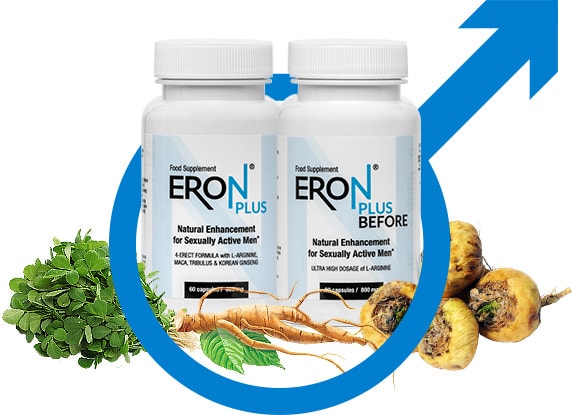
Our Recommendation — Eron Plus
Score: 4.3/10 · Best for: men who specifically want a daily-plus-on-demand two-part system, and who are comfortable buying a formula whose doses are undisclosed. Main caution: the panel lists ingredient names only, and the guarantee conflicts: a 90-day badge against 10-day unused-only withdrawal terms. Fair trial: the three-pack (buy 2, get 1 free, $119.98) — the daily formula's research ran 6 to 12 weeks, not single evenings.
How L-Arginine Is Supposed to Work
An erection is a blood-flow event, and nitric oxide (NO) is its trigger molecule. NO relaxes the smooth muscle in penile arteries and erectile tissue, blood flows in, and the tissue expands against its own outer sheath, trapping the blood that keeps the erection firm.
L-arginine is the raw material that pathway runs on. The enzyme nitric-oxide synthase converts arginine into NO, which is why arginine is called an "NO donor" in the older literature and why it has a more plausible mechanism than most ingredients in this aisle.
Plausible is not the same as proven, and one step in the chain matters: raising arginine intake only helps if arginine supply was the limiting factor. The classic trial below found exactly that pattern — the men who responded were the men whose NO production measured low at the start.
There is also a delivery problem the marketing skips. Much of an oral arginine dose is broken down in the gut and liver before it reaches the bloodstream — one reason the trials used grams rather than milligrams, and one reason citrulline, which bypasses some of that breakdown, has its own trial record (covered in the FAQ).
Physiologists call the puzzle the "arginine paradox": cells already hold enough arginine to saturate the NO enzyme, yet extra arginine sometimes still helps. The paradox is unresolved, which is another way of saying the mechanism story, while plausible, is not a settled escalator from capsule to erection.
The rationale is strongest where the problem is vascular. Erection difficulties driven by endothelial dysfunction — the blood-vessel lining underperforming — are the logical target for an NO-pathway ingredient.
Chen's responder pattern (men with measurably low NO output) fits that logic exactly. Arginine was never a plausible answer to hormonal, neurological or psychological ED, and the trials did not enrol those men.
Does L-arginine help erections?
The pooled evidence
The reference point is Rhim and colleagues' 2019 systematic review and meta-analysis in the Journal of Sexual Medicine: 10 randomised controlled trials, 540 men with ED, comparing arginine supplements against placebo or no treatment.
Across trials using 1,500 to 5,000 mg a day, men on arginine had higher odds of reporting improvement than men on placebo or nothing (odds ratio 3.37). Scores for erectile function, intercourse satisfaction, orgasmic function and overall satisfaction also improved; sexual desire did not.
Read that with the reviewers' own cautions attached. The trials were small, the doses and durations varied, some tested arginine combined with other ingredients, and the population was men with mild-to-moderate ED — the result does not automatically extend to severe ED or to healthy men.
Read the headline number carefully, too. An odds ratio of 3.37 does not mean "3.4 times more likely to improve" in everyday terms, and its confidence interval (1.29–8.77) is wide — the pooled data are consistent with anything from a small advantage to a large one.
The moderate statistical heterogeneity between the trials (I² = 44%) tells the same story: these were not ten copies of one experiment. They were ten different small experiments, at doses from 1.5 to 5 grams, pointing in the same general direction.
The classic high-dose trial
Chen and colleagues (1999, BJU International) gave 50 men with confirmed organic ED either 5 g of L-arginine a day or placebo for 6 weeks, after a placebo run-in period.
Nine of 29 men on arginine (31%) reported significant improvement in sexual function, against 2 of 17 men on placebo. Every one of the nine responders had started with low urinary NOx — a marker of low nitric-oxide production — and that level had doubled by the end of the study.
Just as important is what did not change: the objective haemodynamic measurements stayed flat even in responders. The benefit was real but subjective and subgroup-shaped — strongest where a measurable NO shortfall existed to correct.
The combination trap
One more trial marks the low end of the dose range. Zorgniotti and Lizza (1994) reported improvement in 40% of their ED patients on 2.8 g of arginine a day for just 2 weeks — an early, small study, but a reminder that even the quickest positive result in this literature used nearly 3 grams, daily.
Some of the most-quoted arginine results are not arginine results. Stanislavov and Nikolova (2003) gave 40 men aged 25–45 a modest 1.7 g of arginine a day; after a month, just 2 of the 40 men (5%) had normal erections, a non-significant result.
Only when pycnogenol (pine-bark extract) was added in months two and three did the numbers jump — to 80% and then 92.5% of the same 40 men reporting normal erections, in an open study with no placebo group.
Whatever drove that improvement, it was the combination, in an uncontrolled design. A label that pairs arginine with other ingredients cannot borrow the pooled arginine verdict, and a label selling arginine alone cannot borrow the combination's headlines. Each has to stand on its own trial — or admit it has none.
How much L-arginine was used in the erection studies?
Now the arithmetic this category avoids. The studied range is 1,500–5,000 mg of arginine a day. Chen's responders took 5,000 mg. Even the modest combination trial used 1,700 mg — of arginine alone, in drinkable ampoules, before anything else was added.
Set that against how arginine is usually sold: as one of five or more named ingredients inside capsules of a few hundred milligrams each. A two-capsule daily serving of a blend cannot physically contain 5 g of anything; the entire serving would not reach the bottom of the studied range even if it were pure arginine.
Make the arithmetic concrete. Two generous 500 mg capsules hold 1,000 mg of material in total. If every milligram were arginine — no ginseng, no fenugreek, nothing else — the serving would still fall 500 mg short of the lowest dose in the pooled trials, and 4,000 mg short of Chen's.
Real blends divide that capsule space five ways. Whatever fraction arginine gets, it is structurally incapable of reaching the studied range inside a normal capsule count. This is not a formulation failure unique to one brand; it is geometry, and it is why gram-dose ingredients sit awkwardly in capsule products.
Now apply the same geometry to the on-demand format. Four to six capsules at the standard fill hold roughly 2,000–3,000 mg of everything combined — several named ingredients sharing the space. Even if half of it were arginine, the dose would land at or below 1,500 mg: the very bottom of the pooled trial range.
And it would arrive as a single pre-activity dose rather than spread across weeks of daily use — the pattern every positive trial actually followed. The on-demand costume fails the audit twice: on amount, and on schedule.
Which brings us to the label at the centre of this cluster. Eron Plus names L-arginine as an ingredient of its two-part system and publishes no amount for it — not per capsule, not per serving, not for either formula. The maker does not even say whether the arginine sits in the daily capsules or the before-intercourse ones.
"Studied dose known, product dose unknowable" is the audit result. A buyer cannot tell whether this product delivers 5,000 mg, 500 mg or 50 mg of its lead ingredient, and the maker has arranged the label so that the question cannot be answered.
It is worth adding that the studied dose is not hard to sell honestly. Arginine is inexpensive and widely sold as a powder, where a 3–5 g daily serving is trivial to formulate and to label.
The gram doses live in powders and drinks; they shrink inside capsules. A capsule product trading on arginine research has chosen the one format that cannot hold the researched amount — and then, in this case, declined to print the amount it does hold.
When should you take L-arginine, and how long before it does anything?
Every trial behind the pooled verdict dosed arginine daily, for weeks. Chen measured at 3 and 6 weeks. The meta-analysis's trials ran on daily schedules. There is no trial of arginine taken once, shortly before intercourse, at any dose.
That matters because arginine is marketed in both costumes — as a daily supplement, which matches the evidence, and as a fast-acting before-intercourse ingredient, which does not. Acute dosing is a drug pattern (sildenafil's label window is 30 minutes to 4 hours) borrowed for an ingredient whose data is all chronic.
If you take arginine, the evidence-consistent way is the boring way: a stated gram-level dose, daily, judged after about six weeks. A "before" capsule containing an undisclosed amount of arginine is asking the ingredient to perform a trick it has never been tested performing.
What are the side effects of L-arginine?
In the pooled trials, 8.3% of men on arginine reported adverse effects, against 2.3% of men on placebo — none severe. The usual list is gastrointestinal: nausea, diarrhoea, stomach discomfort, plus headache and flushing in some men.
The serious cautions sit outside the ED trials. Arginine lowers blood pressure modestly, which is a feature until it stacks with medication. Anyone taking blood-pressure drugs, nitrates or ED medication should treat arginine as an interaction question, not a food — our companion article on ED supplements and blood-pressure medication works through that in full.
The starkest warning comes from cardiology. In the VINTAGE MI trial (Schulman et al., JAMA 2006), 153 patients recovering from a first heart attack were given 9 g of L-arginine a day or placebo; 6 patients on arginine (8.6%) died within six months, against none on placebo, and the trial was stopped early.
That was a very high dose in a very specific, fragile population — it does not condemn gram-level arginine in healthy men. It does settle one thing: arginine is pharmacologically active, and "it's just an amino acid" is not a safety argument.
Standard cautions complete the file: arginine can aggravate asthma in some people and may trigger herpes outbreaks in those prone to them. And the maker of the product reviewed here claims its formula "does not cause any side effects" — a claim no arginine-containing product is entitled to make.
Our Recommendation — Eron Plus
Score: 4.3/10 · Best for: men who specifically want a daily-plus-on-demand two-part system, and who are comfortable buying a formula whose doses are undisclosed. Main caution: the panel lists ingredient names only, and the guarantee conflicts: a 90-day badge against 10-day unused-only withdrawal terms. Fair trial: the three-pack (buy 2, get 1 free, $119.98) — the daily formula's research ran 6 to 12 weeks, not single evenings.
Frequently Asked Questions
How much L-arginine did the studies use?
Between 1,500 and 5,000 mg a day, taken daily for weeks. The best-known single trial (Chen 1999) used 5,000 mg a day for 6 weeks in men with organic ED. Any product that will not state its arginine content cannot be compared with that record.
When should I take L-arginine — daily or before intercourse?
Daily, on the evidence. Every trial in the pooled analysis dosed daily over weeks; no trial supports a one-off dose before intercourse. "Before" positioning for arginine is a marketing pattern borrowed from prescription drugs, not a tested schedule for this ingredient.
Is citrulline better than arginine?
Citrulline is converted into arginine in the body and bypasses some of arginine's breakdown in the gut and liver.
In Cormio and colleagues' 2011 trial, 1.5 g of citrulline a day for a month improved erection hardness in 12 of 24 men with mild ED (50%), against 2 of 24 (8.3%) during their placebo month — a small, single-blind study, but a real one.
What are the side effects of L-arginine?
Mostly gastrointestinal — nausea, diarrhoea, cramps — plus headache and flushing in some users; pooled trial rates were 8.3% on arginine versus 2.3% on placebo, with nothing severe. The harder cautions are interactions with blood-pressure medication and nitrates, and the post-heart-attack warning from the VINTAGE MI trial.
Can I take arginine with blood-pressure medication?
That combination deserves a pharmacist's or doctor's answer, not a label's. Arginine's blood-pressure-lowering tendency can add to medication effects, and the undisclosed doses in blended products make the size of the addition unknowable. Our blood-pressure companion article works through the medication classes one by one.
Does L-arginine raise testosterone or libido?
Neither was shown. In the pooled analysis, the IIEF sexual-desire score did not improve on arginine versus control — the gains were in erectile function and satisfaction domains. Arginine is a blood-flow ingredient with a hormone-free record, and products implying otherwise are decorating it.
Can I get enough arginine from food instead?
Arginine is a normal dietary amino acid — meat, fish, nuts and legumes all supply it, and ordinary diets provide gram quantities across a day.
But the trials supplemented defined gram doses on top of diet, in men with ED, and measured against placebo. "Eat more protein" has never been trialled as an ED intervention, and it cannot borrow Chen's results.
Who Should Buy — and Who Should Skip It
Buy arginine if you have mild-to-moderate difficulties, you choose a product that prints a gram-level dose on the label, and you judge it the way the trials did — daily, for about six weeks, then honestly. The evidence supports a modest expectation, not a transformation.
Buy this two-part system only if the daily-plus-before structure itself is what you want, and you accept that its arginine content cannot be checked against a single study. The structure is the product; the dose is a blank.
Skip arginine if you have had a heart attack, you take nitrates or blood-pressure medication without medical clearance, or a seller tells you a capsule works within the hour. Skip any arginine product — including this one — whose maker claims it causes no side effects at all.
Last reviewed: October 2026. This article is educational and is not medical advice.
