
- Quick Answer
- Before the Clock Starts: What You Need
- Minutes 0–2: Serving Size and Servings Per Container
- Minutes 2–4: Amount Per Serving and % Daily Value
- Minutes 4–6: The Proprietary-Blend Rule
- Minutes 6–7: Elemental Amounts, Compound Weight and Standardisation
- Minutes 7–8: Other Ingredients, Allergens and Warnings
- Minutes 8–9: Who Made It, Who Sells It — and the Disclaimer
- Minutes 9–10: Seals That Certify Something — and Badges That Don't
- The Last 30 Seconds: Dates and Lot Numbers
- A Worked Example: Auditing an Invented Label
- What a Label Can Never Tell You
- Frequently Asked Questions
- Is the amount on the label per capsule or per serving?
- What does "Daily Value not established" mean?
- Can a brand legally hide how much of an ingredient is in a blend?
- Does 500 mg on a mineral label always mean 500 mg of the mineral?
- What does "standardised to 10%" mean on a botanical extract?
- Does a USP or NSF seal mean a supplement is FDA approved or proven to work?
- What is the difference between "manufactured by" and "manufactured for"?
- Should I use a supplement after its expiry date?
- Read This Next
Quick Answer
Read the Supplement Facts panel, not the front of the bottle. The front is marketing. The panel is a regulated format with defined fields, and ten minutes is enough to audit all of them in order.
Start with serving size, because every amount below it is per serving, not per capsule. Then check servings per container, which tells you how long the bottle lasts and what a day actually costs.
Next, read each amount beside its % Daily Value. Where a brand groups ingredients into a proprietary blend, only the blend's total weight must be shown. Individual amounts inside it can legally be hidden.
Finish with the parts most readers skip: other ingredients and allergens, who actually made the product, any certification seal, and the expiry date and lot number. Each one answers a different question.
This audit will not tell you whether a supplement works. No label can. It tells you what is claimed to be inside, in what quantity, made by whom, and checked by whom — which is the honest limit of a label.
Before the Clock Starts: What You Need
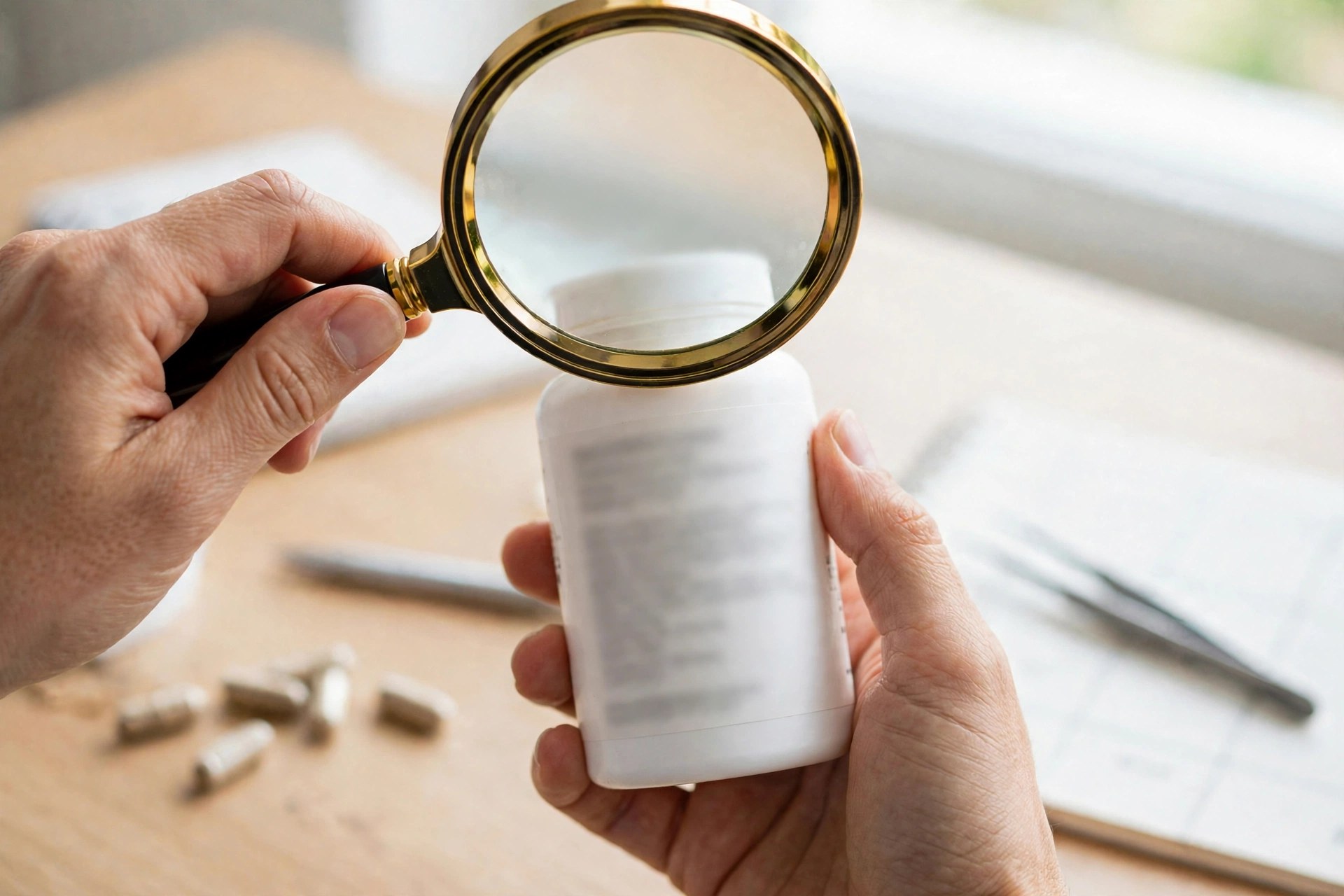
You need one thing: a clear photo, or the bottle itself, showing every panel. The Supplement Facts panel, the ingredient list beneath it, and the small print around the edges all matter.
Online listings often crop the label to the front and one panel. If a listing shows no complete Supplement Facts panel, the audit cannot run, and that absence is itself information about the seller.
The NIH Office of Dietary Supplements (ODS) explains that products sold as dietary supplements carry a Supplement Facts label listing active ingredients, the amount per serving, and other ingredients such as fillers, binders and flavourings.
That ODS summary is the right mental model. The manufacturer suggests the serving size printed on the panel, and a healthcare provider might advise a different amount for you personally.
Work through the steps below in order. The order is deliberate: serving maths first, because it rescales every number that follows, and seals and dates last, because they judge the maker, not the formula.
Minutes 0–2: Serving Size and Servings Per Container
Serving size is the first line of the panel and the multiplier for everything under it. A serving might be one capsule, two capsules, two gummies, one scoop, or a measured liquid amount.
Every amount in the panel refers to one full serving. If the serving is two capsules and a row says 400 mg, that 400 mg is in the two capsules together, not in each one.
This single misreading inflates more comparisons than any other label trick. Two products can look identical until you notice one serving is one capsule and the other serving is four.
Servings per container is the second line, and it converts the bottle into time. Divide it by the servings you would take each day, following the label directions, to get the days one container covers.
A container holding 120 capsules at four capsules a day is a 30-day supply, however generous the capsule count sounds on the front. The capsule count is packaging. The serving count is the product.
Now do the only price maths that compares fairly: divide the price you would actually pay by the number of days the container covers. Cost per day is comparable across brands. Cost per bottle is not.
Directions can call for more than one serving a day. When they do, daily amounts are the per-serving amounts multiplied by the number of daily servings, and daily cost rises in step.
Note three numbers before moving on: units per serving, servings per day, and days per container. Every later step uses them.
Minutes 2–4: Amount Per Serving and % Daily Value
Each dietary ingredient gets a row: its name, the amount in one serving, and, where one exists, a % Daily Value. Read the amount and the percentage as two separate facts.
The amount is a weight: milligrams, micrograms, or international units for some vitamins. One milligram equals one thousand micrograms, so compare numbers only after checking that the units match.
The % Daily Value tells you what share of a standard daily reference amount one serving provides. At 100%, one serving supplies the full reference amount for an average adult, before any food is counted.
Those reference amounts are set by regulation, not by the brand. The FDA publishes the Daily Values for adults and children aged four and over that percentages on the panel must be calculated against.
A figure above 100% means one serving contains more than the reference amount. It does not, by itself, establish that the extra amount is useful, needed, or appropriate for you.
It also ignores everything else you take. The same nutrient may arrive from food, a multivitamin, and a single-nutrient product on the same day, and only the combined total matters to your body.
Many rows show a symbol, usually an asterisk, instead of a percentage, with a footnote reading "Daily Value not established." That is normal for most herbs, botanicals and specialty ingredients.
No established Daily Value does not mean the ingredient is unsafe, and it does not mean it is effective. It means regulators have not set a daily reference amount for it, so no percentage can be printed.
For those rows, the printed amount is all you have. That is why the next step matters so much: whether that amount is printed at all, or hidden inside a blend.
Minutes 4–6: The Proprietary-Blend Rule
A proprietary blend is a group of ingredients listed together under one combined name, with one combined weight. You will see names like "Energy Blend" followed by a single milligram figure.
The rule is precise, and it is worth stating exactly. Ingredients inside a blend must be listed in descending order by weight, heaviest first. Only the total weight of the blend must be shown.
Individual amounts inside the blend do not have to be disclosed. A brand may keep each ingredient's dose private, legally, while still listing every ingredient by name in the correct weight order.
Ingredients that have an established Daily Value, such as vitamins and minerals, are still declared separately with their own amounts and percentages. Blends are built from ingredients without Daily Values.
The FDA's labelling guidance sets out the panel's required statements and placement; the FDA Dietary Supplement Labeling Guide is the manufacturer's reference for what a compliant label must carry.
What can you still learn from a blend? Two things. The order tells you which ingredient dominates by weight. And the total caps what any single ingredient inside it could possibly be.
Run the cap test. If a blend totals 300 mg and lists six ingredients, no ingredient inside it can exceed 300 mg, and the later ingredients, sharing what remains, must be far below it.
If research you have read used a specific dose of one ingredient, a blend cannot confirm or deny that the dose is present. That is not a reason to assume the worst. It is a reason to know the limit of the label.
A fully disclosed panel, where every ingredient carries its own amount, removes this problem entirely. Treat disclosure as a spectrum: full amounts, then a blend with a plausible total, then a blend whose total is plainly too small.
Minutes 6–7: Elemental Amounts, Compound Weight and Standardisation
Minerals arrive inside compounds. A capsule does not contain bare magnesium; it contains a magnesium compound, and the mineral itself is only a fraction of that compound's weight.
Well-written labels state the elemental amount: the weight of the mineral itself. Look for wording like "Magnesium (as magnesium citrate) 200 mg" — the 200 mg is the magnesium, and the words in brackets name its source.
Now compare a label that reads "Magnesium citrate 500 mg" with no elemental figure. That 500 mg is the weight of the whole compound, and the magnesium inside it is substantially less.
Neither label is necessarily dishonest. They are answering different questions, and only one of them answers yours. When comparing two mineral products, compare elemental amounts, or you are comparing packaging chemistry.
The same caution applies to botanical extracts. An extract is concentrated plant material, and labels may give a ratio, such as 10:1, meaning ten parts of raw plant produced one part of extract.
Standardisation is the related percentage. "Standardised to 10%" means the maker guarantees that a named constituent makes up 10% of the extract, batch standard, rather than leaving its level to natural variation.
So a 500 mg extract standardised to 10% delivers 50 mg of the named constituent. The other 450 mg is the rest of the extract. That arithmetic is simple, but only if you perform it.
Note also the plant part, where the panel names it — root, leaf, bark or fruit. Different parts of the same plant are different ingredients in practice, and a careful label says which one you are getting.
Minutes 7–8: Other Ingredients, Allergens and Warnings
Below the panel sits a separate list, usually headed "Other ingredients." These are not dietary ingredients. They are the capsule shell, fillers, binders, flow agents, coatings, colours, sweeteners and flavours that make the product manufacturable.
No amounts are given for them, on any label. That is normal and not a hidden-dose problem. This list answers different questions: what you are swallowing besides the actives, and whether anything in it is a problem for you.
Read it closely if you avoid gelatin, specific sweeteners, artificial colours, or common excipients, or if you follow a dietary pattern that excludes animal-derived capsule materials.
Allergens deserve their own scan. Where a product is made with a major food allergen, the label must name the allergen's food source, in or near this ingredient information.
Check also for "made in a facility that also processes" style statements where they appear. They describe shared equipment or premises, which matters to someone with a serious allergy and means little to anyone else.
Warnings belong to this minute too. Pregnancy and nursing cautions, "keep out of reach of children," and medicine-interaction warnings are printed because the maker judged, or was required, to state a risk plainly.
The ODS consumer booklet on dietary supplements makes the underlying point directly: supplements can interact with medicines and laboratory tests, and can have side effects, which is why this small print exists.
Minutes 8–9: Who Made It, Who Sells It — and the Disclaimer
Every label must carry the name and address of a responsible business. The wording before that name tells you which role the business played, and the difference is real.
"Manufactured by" names the maker. "Manufactured for," or "distributed by," names the company that commissioned or sells the product, while the actual manufacturing happened elsewhere, at a facility the label does not identify.
Neither wording is a quality verdict. Contract manufacturing is normal across the industry. But "manufactured for" tells you the brand on the front may not operate the factory, which is worth knowing before crediting it with factory standards.
The FDA explains that a supplement's statement of identity must include the term "dietary supplement," or an accepted substitute naming the ingredient type, on the principal display panel.
Now find the sentence almost every reader skips: "These statements have not been evaluated by the Food and Drug Administration. This product is not intended to diagnose, treat, cure, or prevent any disease."
That is the DSHEA disclaimer. The Dietary Supplement Health and Education Act of 1994 lets makers print structure and function claims — "supports immune health," for example — without FDA pre-approval, provided this disclaimer accompanies them.
Translated, it means three things. The claim was not reviewed and approved by the FDA before sale. The maker must hold substantiation and notify the FDA, but notification is not approval. And the product is legally not a medicine.
The ODS states the same boundary from the consumer side: medicines must be approved by the FDA before sale, supplements do not require that approval, and supplement companies are responsible for their products' safety and truthful labelling.
Minutes 9–10: Seals That Certify Something — and Badges That Don't
A small number of seals mean a named, independent organisation tested this product against a published standard. A much larger number of badges mean only that the maker designed a badge.
USP Verified. The United States Pharmacopeia runs a voluntary verification programme. Its mark indicates the product contains the listed ingredients in the declared potency and amounts, without harmful levels of specified contaminants, made under good manufacturing practices, and able to break down as intended.
NSF certification. NSF certifies supplements to NSF/ANSI 173, which it describes as the American National Standard for testing and certifying dietary supplements, verifying that the Supplement Facts panel reflects the product's contents (see NSF's product and ingredient certification page).
NSF Certified for Sport adds a second layer: screening for substances banned by major sporting organisations. NSF states that its Certified for Sport programme screens for over 290 banned substances and that certified products must also meet its contents standard.
Informed Sport, run by the laboratory LGC, is built for drug-tested athletes. Informed Sport states that every single batch of a certified product is tested before release to market, including each flavour and variant, with additional blind testing afterwards.
Notice what none of these programmes certifies. None of them decides that a supplement is effective, that its claims are proven, or that you need it. They certify identity, quantity, purity and process — whether the bottle matches its label.
Now the badges that certify nothing by themselves: "third-party tested" with no tester named, "GMP certified" with no certifier named, "made in an FDA-registered facility," and any gold medal or shield the brand awarded itself.
Facility registration is an administrative listing, not an inspection pass or an approval. "Tested" without a named programme, standard and registry cannot be checked, and an uncheckable claim should be weighed accordingly.
The verification habit takes one minute: search the certifier's own registry for the exact product name. If the product is not listed there today, the seal on the bottle is a picture, whatever it once meant.
The Last 30 Seconds: Dates and Lot Numbers
Two printed codes close the audit. The first is a date, and it comes in two kinds that are easy to confuse: an expiry or "best by" date, and a manufacture date.
An expiry or best-by date is the maker's own estimate of how long the product keeps its labelled potency under proper storage. It is not a federal safety deadline, and potency, not sudden danger, is usually what declines.
A manufacture date only tells you when the batch was made. A product showing only a manufacture date is asking you to guess its shelf life, and different ingredient types age at very different rates.
The second code is the lot or batch number. It identifies the production run your bottle came from, and it is the handle used if that run is ever recalled, investigated or tested.
Keep the bottle, or a photo of the lot number, until the product is finished. If you ever report a problem with a supplement, the lot number is the detail that makes your report traceable to a specific run.
Our verdict on dates: respect an expiry date as the maker's potency promise expiring, treat a manufacture-only date as incomplete information, and never treat either date as evidence that a product works.
A Worked Example: Auditing an Invented Label
The label below is invented for this article. It names no real product, and every figure was chosen to exercise the audit. Read it as a practice run against the clock.
Example panel — "Daily Mineral and Botanical Capsules" (fictional). Serving size: 2 capsules. Servings per container: 30. Magnesium (as magnesium citrate): 200 mg, 48%. Botanical Blend: 600 mg, listing three botanicals in descending order, amounts not shown.
Minute 0–2: two capsules make one serving, so the bottle holds 60 capsules and covers 30 days at one serving a day. At an invented price of $30, the honest figure is $1 per day.
Minutes 2–4: the magnesium row is complete — an elemental amount, a source in brackets, and a percentage to check. At 48%, one serving supplies just under half the adult Daily Value before food.
Minutes 4–6: the botanical row is a blend. The total is 600 mg across three botanicals, heaviest first. The third botanical must be well under 200 mg, and its actual amount is unknowable from this label.
Minutes 6–7: the magnesium passes the elemental test, because 200 mg names the mineral itself. Had it read "magnesium citrate 200 mg," the mineral content would have been a fraction of that figure.
Minutes 7–10, compressed: other ingredients list a gelatin capsule, which matters to some readers. The label says "manufactured for" a distributor. No recognised certification seal appears. An expiry date and lot number are present.
Verdict on the invented label: partly auditable. The mineral half can be compared with any competitor in seconds. The botanical half can only be judged on its total and its ordering, and no independent programme has checked either half.
What a Label Can Never Tell You
A label is a manufacturer's declaration, formatted by law. Even a perfectly compliant, fully disclosed, independently certified label leaves three questions completely unanswered.
First, whether the ingredients work for the purpose on the front. The FDA does not determine whether dietary supplements are effective before they are marketed, as the ODS consumer fact sheet states plainly.
Second, whether you need the nutrients it contains. A panel can show 100% of a Daily Value without telling you anything about your diet, your blood levels, or your actual shortfall, if any.
Third, whether the product fits your medicines and conditions. The ODS booklet advises talking with your healthcare provider about supplements, precisely because interactions and individual risks live outside anything a label can know about you.
That is the audit's proper place in a buying decision: first, not only. It removes products whose own paperwork fails, cheaply and quickly, before evidence, price and medical fit are even considered.
Ten minutes, once, also builds a permanent skill. After two or three audits, serving games, blend caps and hollow badges become visible at a glance.
Frequently Asked Questions
Is the amount on the label per capsule or per serving?
Per serving, always, unless the panel says otherwise. Find the serving size at the top first. If a serving is two capsules, every amount in the panel is the total across both capsules together.
What does "Daily Value not established" mean?
It means regulators have set no daily reference amount for that ingredient, so no percentage can be printed. Most herbs and botanicals sit in this category. It is a statement about reference values, not about safety or effectiveness.
Can a brand legally hide how much of an ingredient is in a blend?
Yes. Inside a proprietary blend, the label must list ingredients in descending order by weight and show the blend's total weight. The amount of each individual ingredient inside the blend does not have to be disclosed.
Does 500 mg on a mineral label always mean 500 mg of the mineral?
No. "Magnesium (as magnesium citrate) 500 mg" states 500 mg of magnesium itself. "Magnesium citrate 500 mg" states 500 mg of the compound, of which the mineral is only a fraction. Compare elemental amounts between products.
What does "standardised to 10%" mean on a botanical extract?
It means the maker guarantees a named constituent makes up 10% of the extract. A 500 mg extract standardised to 10% therefore contains 50 mg of that constituent, with the remaining 450 mg being the rest of the extract.
Does a USP or NSF seal mean a supplement is FDA approved or proven to work?
No. Supplements are not FDA approved before sale, and these voluntary programmes do not certify effectiveness. They independently check that contents match the label, contaminants stay within limits, and manufacturing follows good practice. Confirm any seal in the certifier's own registry.
What is the difference between "manufactured by" and "manufactured for"?
"Manufactured by" names the company that made the product. "Manufactured for," like "distributed by," names the company that commissioned or sells it, while an unnamed facility did the manufacturing. It is common and legal, but it tells you the brand may not run the factory.
Should I use a supplement after its expiry date?
The date is the maker's estimate of how long labelled potency lasts under proper storage, not a guarantee afterwards. This article cannot advise you on a specific product. When in doubt, ask a pharmacist, and treat heat or moisture damage as shortening any date.

Last reviewed: October 2026. This article is educational and is not medical advice.
