
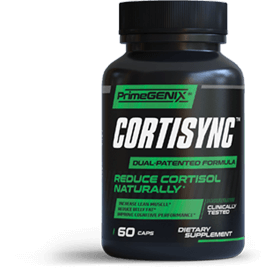
Affiliate disclosure: We sell CortiSync (PrimeGENIX; our score 6.0/10), a cortisol-positioned adaptogen blend, through our affiliate link and earn a commission if you buy it. It is used throughout this guide as the worked example — and it fails the guide's most important check, which we print rather than bury: its maker publishes no ingredient amounts in text anywhere. Every claim below about the five headline ingredients traces to the maker's pages we audit or to our own published comparisons; where a number could not be verified on a maker's own pages, we say so instead of printing it.
Quick Answer: Buy the Label, Not the Adaptogen
The cortisol shelf sells names — Sensoril®, KSM-66®, rhodiola, phosphatidylserine, L-theanine — as if the name were the result. It isn't. The study results in this category belong to specific extracts, at specific standardisations, at specific doses, and a product earns them only if its label lets you verify all three. So this guide is five checks, not five endorsements: (1) a named extract, not generic powder; (2) a printed standardisation; (3) a printed amount inside the studied range; (4) figures attributed to the ingredient, not implied to be the product's; and (5) a guarantee long enough to cover the weeks these ingredients take. Run those checks and most of the shelf, including parts of ours, scores worse than its marketing. That is the point of printing them.
The Five Names, at the Label
Sensoril® (ashwagandha, root and leaf). The extract our shelf's product is built on. It standardises to 10% withanolides and is studied at low doses — 125–250 mg a day — with a positioning around stress, cortisol and calm cognition. Its maker-cited ingredient studies are the strongest paperwork in this guide: double-blind, placebo-controlled results quoted as cortisol down 24% versus placebo and overall stress down 62.2% — quoted, note, with no sample sizes published, a caveat that travels with the figures wherever they are used. Label check: the name plus an amount inside 125–250 mg. A product that names Sensoril but hides the amount has given you the trademark and withheld the dose.
KSM-66® (ashwagandha, root only). Sensoril's great rival: the traditionally used part of the plant only, standardised to 5% withanolides, studied at 300–600 mg a day, and licensed into a wide spread of stress and sports formulas. Its maker likewise cites controlled trials of the extract. In keeping with the convention we set in our head-to-head, we do not print KSM-66 outcome percentages here, because we did not verify them on its maker's own pages — the same standard we would want applied to us. Label check: identical to Sensoril's, at its own dose range. The full design comparison is in Sensoril vs KSM-66.
Rhodiola. The third adaptogen of the classic trio, marketed for fatigue and stress resilience. On our shelf it appears as one of CortiSync's six supporting adaptogens — named on the label, with no amount published and no study figures cited for it in the maker's material we audited. That is the common pattern for rhodiola in blends: present, plausible, unquantified. Label check: on a single-ingredient product, look for the extract and its amount; in a blend, assume the dose is unknown unless printed.
Phosphatidylserine. Not an adaptogen at all, but a membrane phospholipid marketed into the cortisol conversation — as we noted in our cortisol explainer, it is sold here with a thinner file than the ashwagandha extracts. It is not in CortiSync's formula; it appears in rival cortisol products, where the same rule applies: a named ingredient without a printed amount and an attributed study is a story, not a specification.
L-Theanine. The amino acid from tea, included in blends for calm-focus positioning — again, one of CortiSync's supporting cast, named without an amount and without maker-cited figures in the material we audited. Theanine's appeal in a formula is that it is the non-sedating calm ingredient; its audit position is the same as rhodiola's: presence is printed, dose is not.
These statements have not been evaluated by the Food and Drug Administration. This product is not intended to diagnose, treat, cure, or prevent any disease. This article is educational and is not medical advice.
The Worked Example: CortiSync Against the Five Checks
Run our shelf's entry through the guide. Check 1, named extract: pass — the formula leads with Sensoril® and names all seven adaptogens (Sensoril, holy basil, L-theanine, lemon balm, lychee, magnolia, rhodiola). Check 2, standardisation: partial — Sensoril's 10% standardisation is a property of the branded extract, but the product's own pages do not build on it with amounts. Check 3, printed amount in the studied range: fail — no per-ingredient amounts are published in text on the brand site, the maker's store page or its retail page; the Supplement Facts exist only as images, so whether a serving delivers Sensoril inside 125–250 mg cannot be verified. Check 4, honest attribution: mixed — the cortisol −24% and stress −62.2% figures are ingredient studies and are presented as the product's headlines; and the maker's own pages disagree with each other, putting Sensoril's human clinical studies at 12 on some pages and 14 on others, and its sleep improvement at both 67% and 70%. Check 5, guarantee: pass — 67 days, with the store page's wording allowing bottles to be returned "even if they're empty," which covers the four-to-eight-week judging period these ingredients need. Price: $59 a bottle, $165 for three, $294 for six, $49 a month on subscription; two capsules daily with a meal. Full audit: our CortiSync review. For the science the shelf is built on, start with Cortisol Belly Fat and Signs Your Cortisol Might Be High.
How to Shop the Shelf in Ten Minutes
Open the product page and work down. First, find the extract name — a trademark, not the word "ashwagandha." Second, find its amount; if the trail leads to a proprietary blend or an image-only facts panel, stop: the product cannot be audited, and everything after that is faith. Third, compare the amount with the studied range for that extract — 125–250 mg for Sensoril, 300–600 mg for KSM-66 — remembering that dose times standardisation is the real number. Fourth, read every percentage on the page and ask whose it is: the product's own trial (rare), the ingredient's trial (common), or nobody's (commoner than it should be). Fifth, check the guarantee against the timeline: these ingredients are judged in weeks, so a 67-day window is roughly the minimum honest trial, and anything shorter is a tasting. A product passing all five is genuinely rare in this category. A product failing the second has failed the guide, whatever else it passes — including, on the evidence above, the one we sell.
Frequently Asked Questions
What is the best cortisol supplement?
The honest answer is a method, not a name: the best-documented ingredients in this category are the branded ashwagandha extracts, and the best product is the one whose label prints the extract, its standardisation and an amount inside the studied range — under a guarantee that covers the trial period. Most products, including our shelf's CortiSync (6.0/10), fail at least the amount check.
Sensoril or KSM-66 — which should I choose?
By design, not by hype: Sensoril is root-and-leaf at 10% standardisation and 125–250 mg studied doses; KSM-66 is root-only at 5% and 300–600 mg. No head-to-head trial settles superiority. Choose the one whose finished product lets you verify its dose — our full comparison is Sensoril vs KSM-66.
Do I need all seven adaptogens, like CortiSync has?
There is no evidence in the maker's material that the seven-ingredient combination was tested together — the cited studies belong to Sensoril alone. A blend buys breadth you cannot dose-check; a single-extract product buys one ingredient whose arithmetic you can. Which trade suits you is the subject of our CortiSync vs Plain Ashwagandha comparison.
How long before a cortisol supplement can be judged?
Weeks. The ingredient studies in this category run on that scale — the maker-cited Sensoril file includes a two-week cognitive finding and a twelve-week strength study. Judge at four to eight weeks of daily use, inside the guarantee; CortiSync's 67-day window covers roughly nine.
Are the cortisol percentages on these pages real?
The Sensoril figures quoted for our product — cortisol down 24% versus placebo, overall stress down 62.2% — are from double-blind, placebo-controlled studies of the ingredient as cited by the maker, with no sample sizes published. They are real citations with real limits: they are not a trial of CortiSync, and no page should let you read them as one.
The Bottom Line
The cortisol category runs on borrowed evidence — ingredient studies wearing product labels — and the only defence a buyer has is arithmetic the label either permits or prevents. Buy the product that prints its extract, its standardisation and its dose, attributes its percentages honestly, and guarantees you the weeks the ingredient needs. Where a label withholds the amount — as CortiSync does — price that silence into the decision, because the dose is not a detail. In this category, the dose is the product.
Disclaimer: This article is for general information only and is not medical advice. Always consult a qualified healthcare professional before starting any supplement, especially if you have a medical condition or take prescription medication.
Last reviewed: October 2026
