
- Quick Answer
- What Cortisol Actually Does All Day
- Where the Belly-Fat Story Comes From: A Disease, Not a Deadline
- "Flush Your Cortisol": The Question That Gives the Game Away
- What Lowering Your Stress Picture Can and Can't Change
- What About a Cortisol Supplement?
- When Belly Fat Is a Doctor's Question, Not a Supplement's
- Frequently Asked Questions
Affiliate disclosure: This article discusses CortiSync, a supplement we sell through our affiliate link; if you buy it through our link, we earn a commission. Everything printed about it below comes from its maker's own pages — including the parts a seller would rather skip: the ingredient amounts it does not publish, and the study figures that belong to one ingredient rather than to the product. The hormone science in this article depends on no product at all.
Quick Answer
Yes, cortisol is genuinely involved in where the body stores fat — and no, that fact does not support most of what is sold on top of it. Cortisol that stays pathologically high, around the clock, for months — the levels seen in the medical condition Cushing's syndrome — does drive fat toward the abdomen. Ordinary stressed-life cortisol is a different scale of thing: it rises and falls every day by design, and its best-documented route to your waistline is indirect, through appetite, cravings and sleep. Nothing — no drink, no cleanse, no supplement — spot-reduces belly fat by "lowering cortisol," and there is no reservoir of cortisol in your body waiting to be flushed. What improving your stress picture can honestly change is the behaviour around eating and sleeping. That is a smaller promise than the trend makes, and it is the real one.
What Cortisol Actually Does All Day
Cortisol is not a toxin or a stress poison; it is an essential hormone with a daily rhythm — highest shortly after waking, lowest around midnight — that helps regulate energy release, blood pressure, blood sugar and the immune response. Fat enters the picture through two honest mechanisms. First, cortisol interacts with appetite: stressed people, on average, eat more, and preferentially reach for energy-dense food. Second, fat tissue is not all equal. Visceral fat — the deep abdominal fat wrapped around the organs — is more responsive to cortisol than the fat under the skin elsewhere, which is why sustained cortisol excess shows up at the waist first. A Yale physician, F. Perry Wilson, framed the question the way this article tries to: "Does high cortisol really cause belly fat and heart disease?" It is a real question with a graded answer, not the slogan the social feeds run. The hormone is a supporting actor in weight gain. The lead actor remains how much you eat, move and sleep over months.
Where the Belly-Fat Story Comes From: A Disease, Not a Deadline
The strongest version of the cortisol–belly-fat claim is true — inside a disease. In Cushing's syndrome, the body produces too much cortisol continuously, day and night, for months or years. Central weight gain is one of its hallmarks, alongside a rounded face, thinning skin and muscle weakness. That is the evidence base the trend quietly borrows. The leap happens in the retelling: because extreme, unremitting cortisol excess redistributes fat, everyday stress — where cortisol spikes for an hour and returns to baseline — is treated as a milder dose of the same process. It is not the same process. A hormone that peaks in the morning and settles by night is doing its normal job; the Cushing's pattern is what happens when the off-switch fails. If your waistline has crept up over two stressful years, the likeliest cortisol involvement is that stress changed your eating and sleeping — which is worth fixing, but it is not a hormone disorder, and it will not be measured or treated like one.
"Flush Your Cortisol": The Question That Gives the Game Away
Two of the most-asked questions in this whole topic, captured from a clinician service's question pages, are "How do I lower my cortisol to lose belly fat?" and "How do you flush cortisol out of your body?" The second question reveals the model in people's heads: cortisol as a stored sludge that a drink or a supplement can drain. That model is wrong in a specific, checkable way. Cortisol circulates, does its work, and is broken down continuously — mainly by the liver, with the by-products cleared by the kidneys. There is no tank, no build-up, nothing to flush. What people reaching for the word usually mean is "how do I stop feeling wired, tired and stressed?" — a real goal whose levers are boring and effective: sleep, regular exercise, daylight, workload, and not running on caffeine and four hours of rest. No product changes the clearance of a hormone your body already clears by itself, on schedule, every day of your life.
What Lowering Your Stress Picture Can and Can't Change
Set the trend language aside and there is a sensible core left. Chronic stress is associated with stress-eating, poorer sleep, and less capacity for the routines that keep weight stable. Interventions that genuinely reduce perceived stress — and ingredients studied for stress and cortisol measures, covered below — can plausibly help at those margins: fewer evening raids on the kitchen, better sleep, a calmer baseline. What they cannot do is choose where fat comes off. Fat loss follows sustained energy balance, and it leaves the body in an order your hormones influence but no supplement directs. Any page that promises belly-specific loss from cortisol reduction is promising the one thing the mechanism does not offer. Expect, at most, help with the inputs — appetite, sleep, stress — and judge every product, ours included, on that scale.
What About a Cortisol Supplement?
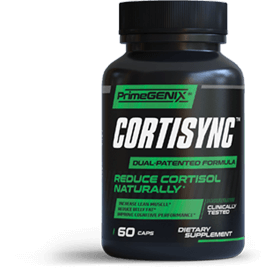
"What are some effective supplements for reducing cortisol levels?" is a real, much-answered question on Quora, and the honest summary of the answers is: one ingredient family has actual human trial data behind it — the adaptogens, ashwagandha best studied among them — and everything else is extrapolation. The shelf option on our store is CortiSync (PrimeGENIX; our score 6.0/10), a seven-adaptogen formula led by Sensoril®, a patented ashwagandha extract. Its maker cites double-blind, placebo-controlled studies of that ingredient reporting cortisol down 24% versus placebo and overall stress down 62.2%. Read those figures precisely: they are ingredient studies, quoted by the maker, with no sample sizes published and no trial of CortiSync itself — and the maker publishes no ingredient amounts in text anywhere, so the first question a buyer should ask — does a serving deliver Sensoril® at the level the studies used? — cannot be checked from its pages. The rest of the file is conventional: $59 a bottle, and a 67-day guarantee whose wording allows returning bottles "even if they're empty." For the extract-versus-extract detail, see our comparison of Sensoril vs KSM-66.
These statements have not been evaluated by the Food and Drug Administration. This product is not intended to diagnose, treat, cure, or prevent any disease. This article is educational and is not medical advice.
When Belly Fat Is a Doctor's Question, Not a Supplement's
There is one pattern in this topic that should bypass the supplement aisle entirely. Weight gain that is rapid, concentrated in the trunk while the arms and legs stay thin, arriving with a rounding face, wide purple stretch marks, skin that bruises at a touch, or new weakness climbing stairs — that is the Cushing's pattern, and it is diagnosed with laboratory tests, not managed with adaptogens. We lay the full sign list out in Signs Your Cortisol Might Be High. Ordinary gradual weight gain in a stressful season of life is common and usually has ordinary causes. The skill this topic actually rewards is telling the two apart — because one of them is a medical workup, and the other is a lifestyle repair job that no capsule can subcontract.
Frequently Asked Questions
How do I lower my cortisol to lose belly fat?
Work on the inputs cortisol actually influences: sleep first, then regular exercise, then the stress-eating loop — and give it months, because fat loss follows energy balance, not hormone tweaks. Adaptogen supplements have ingredient-level trial data for stress and cortisol measures (see the CortiSync section above), but no supplement has been shown to remove belly fat by lowering cortisol, and any that promises to is ahead of its evidence.
How do you flush cortisol out of your body?
You don't, because there is nothing to flush. Cortisol is broken down continuously, mainly by the liver, and cleared by the kidneys. The "flush" framing treats a normal, self-regulating hormone like a toxin build-up. What you can change is how much stress signalling you generate — sleep, workload, caffeine timing — not the clearance, which was never broken.
Does high cortisol really cause belly fat?
At medical extremes, yes: Cushing's syndrome — cortisol high around the clock — characteristically produces central fat gain. At everyday stress levels, the effect is real but indirect and much smaller: cortisol nudges appetite, cravings and sleep, and those move weight over time. The trend's error is borrowing the disease's outcome and attaching it to the deadline week's hormone levels.
What are some effective supplements for reducing cortisol levels?
The best-studied are the adaptogens, ashwagandha above all — specifically its branded extracts, which carry the placebo-controlled data. Phosphatidylserine, rhodiola and L-theanine are also marketed here with thinner files. Judge any product by three checks: a named extract, a published amount matching the studied range, and study figures attributed to the ingredient rather than implied to be the product's own. Most labels, including our shelf's CortiSync, fail at least one of the three.
How long does it take to feel the effects of ashwagandha?
Weeks, on the evidence that exists. The studies behind the branded extracts run for weeks, and the maker-cited Sensoril® results our store's product quotes include a two-week cognitive finding and a twelve-week strength study. Anyone promising a same-day transformation is selling the ritual, not the ingredient. A 67-day guarantee window — the one CortiSync carries — covers roughly nine weeks, which is the honest timescale on which to judge it.
Disclaimer: This article is for general information only and is not medical advice. Always consult a qualified healthcare professional before starting any supplement, especially if you have a medical condition or take prescription medication.
Last reviewed: October 2026
