
- Quick Answer
- What Are Keto Gummies Supposed to Do?
- What Is Ketosis, and Does a Gummy Create It?
- What Do Exogenous Ketones Actually Do in the Body?
- The Dose Problem
- Is There Any Trial Showing Fat Loss?
- Why the "Shark Tank" and Celebrity Claims Are Fake
- What Are the Side Effects and Costs?
- Then Why Do Some Users Report Losing Weight?
- What Would Actually Put Someone in Ketosis?
- What Is Actually Inside a Typical Keto Gummy?
- And the MCT oil in some formulas?
- The Economics: What a Gram of Nothing Costs
- A five-point spot-the-pattern check
- The Ironies: Sugar, Fasting and "Staying in Ketosis"
- The Bottom Line
- Frequently Asked Questions
- Do keto gummies put you into ketosis?
- Has any keto gummy been on Shark Tank?
- Can exogenous ketones suppress appetite?
- Are keto gummies safe?
- Why do reviews online say keto gummies work?
- Read This Next
Quick Answer
No — not in any sense a clinical trial would recognise. There is no randomised trial showing that keto gummies, or the exogenous ketones inside them, cause fat loss in humans.
The claim rests on a bait-and-switch. Eating ketones is not the same as being in ketosis, and being briefly in measurable "ketosis" after a supplement is not the same as burning your own body fat.
In fact, the physiology points the other way: supplying ketones from outside gives the body fuel it must use first, and it dials down its own fat-burning and ketone production in response.
Add a dose problem — gummies contain a fraction of the ketone doses used in research — and a marketing ecosystem built on fabricated celebrity endorsements, and the category fails on every level this article can test.
What Are Keto Gummies Supposed to Do?
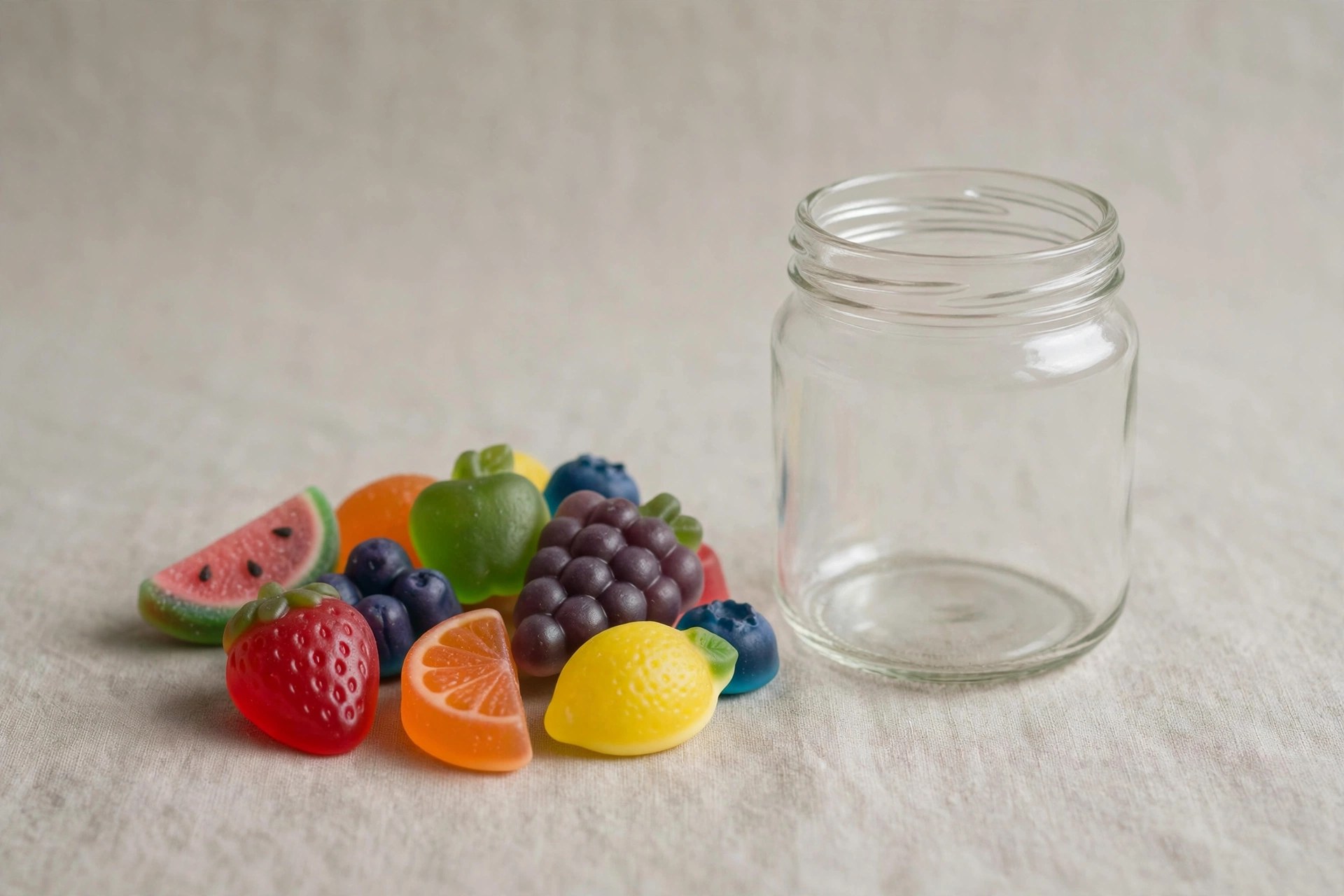
Keto gummies are chewable supplements built around BHB — beta-hydroxybutyrate — usually in salt form, bound to sodium, potassium, calcium or magnesium. Many also add apple cider vinegar powder or MCT oil.
The pitch goes like this: the ketogenic diet forces the body to burn fat for fuel, but it is hard. The gummy supposedly delivers the diet's active molecule directly — "ketosis in a bottle", fat burning without the diet.
Some versions promise the gummies will "put you into ketosis within hours", suppress appetite, and melt stored fat while you eat normally. Subscription offers and fake review sites do most of the selling.
Each element of that pitch can be checked against physiology and the trial literature. That is what the next sections do — because the category survives on most consumers never seeing the checks.
What Is Ketosis, and Does a Gummy Create It?
Ketosis is a metabolic state, not a substance. When carbohydrate intake stays very low for days, insulin falls, the liver breaks down body fat, and it converts the released fatty acids into ketone bodies — including BHB.
In nutritional ketosis, blood BHB typically runs between about 0.5 and 3.0 mmol/L, sustained around the clock, because the body is continuously manufacturing ketones from its own fat stores.
The fat loss of a ketogenic diet comes from that process — an energy deficit in which stored fat is the fuel. The ketones are the smoke, not the fire: a by-product of fat burning, not its cause.
Swallowing BHB reverses the arrow. A dose of ketone salts raises blood BHB to roughly 0.3–0.7 mmol/L for a short window — measurable on a blood meter, which feels like proof — then levels fall back to baseline within two to three hours.
During that window you have ketones in your blood. You are not in the metabolic state the diet creates, you have not adapted to burning fat, and your liver has received a signal it can stop making its own.
This is the central trick of the category: a measurable number on a meter, produced by the supplement itself, marketed as evidence that fat is burning. The meter cannot tell swallowed ketones from earned ones. Your fat stores can.
What Do Exogenous Ketones Actually Do in the Body?
"Exogenous ketones" — ketones from outside — are a legitimate research tool. Scientists use ketone esters and salts to study metabolism, athletic performance and neurology, at doses far beyond any gummy.
What the research shows is a fuel, not a fat-burner. BHB is itself a calorie-containing energy source. Burned for fuel, it is burned instead of something else — including, potentially, your own fat.
The feedback loop is the deeper problem for the marketing claim. Rising ketone levels signal the body that fuel is abundant, and one documented response is suppression of lipolysis — the release of fat from stores.
In plain terms: flood the system with ketones and the body turns down its own fat mobilisation and ketone production. The supplement is competing with the very process it advertises.
None of this makes BHB dangerous at ordinary doses, and none of it is disputed physiology. It simply leaves no mechanism by which a gummy could produce net fat loss in someone eating a normal diet.
The Dose Problem
Even if the mechanism worked, the format cannot deliver it. Research studies of exogenous ketones typically use 10 to 25 grams of ketone salts or esters per day — drinks, measured in grams.
A keto gummy serving usually contains under a gram of BHB salts — frequently a few hundred milligrams inside a blend with vinegar powder, flavourings and sweeteners.
That is roughly a tenth to a twenty-fifth of a research dose, delivered in a matrix research never used. The transient blood-ketone bump from a gummy is correspondingly smaller and shorter than the figures quoted from studies.
There is a reason the products are gummies and not honest gram-dose drinks: ketone salts taste intensely salty and unpleasant, and gram doses commonly cause nausea and diarrhoea. A palatable gummy is, almost by definition, an underdosed one.
When a product category's only survivable format cannot contain a studied dose of its active ingredient, the studies cannot rescue it.
Is There Any Trial Showing Fat Loss?
No randomised controlled trial — of keto gummies specifically, or of exogenous ketone supplements generally — has demonstrated fat loss as an outcome. That sentence is the whole efficacy record.
The closest genuine finding is about appetite, briefly. Stubbs and colleagues (2018, Cell Metabolism) found that a ketone ester drink acutely lowered ghrelin — a hunger hormone — and reduced reported appetite for a few hours versus a sugary drink.
Note every qualifier in that sentence. A drink, not a gummy. An ester, not salts. Hours, not weeks. Appetite ratings, not weight. It is a legitimate scientific observation that marketing has stretched past breaking.
Appetite suppression for an afternoon does not establish weight loss: people compensate, later meals adjust, and no follow-up study has converted that acute signal into kilograms.
Set the bar where regulators and clinicians set it — a trial, a control group, a scale, a meaningful duration — and keto gummies have nothing to put on it.
Why the "Shark Tank" and Celebrity Claims Are Fake
Search for any keto gummy brand and the marketing pattern repeats: the product was "featured on Shark Tank", endorsed by a celebrity, or blessed by a television doctor. These claims are fabricated.
No keto or weight-loss gummy has been endorsed or featured on Shark Tank. The programme's name and images are used without authorisation, a pattern consumer-protection agencies have repeatedly flagged with weight-loss gummies specifically.
The US Federal Trade Commission has warned consumers about exactly this machinery: fake news-style pages, doctored celebrity photos, and "free trial" offers that convert into recurring subscription charges.
The fraud pattern is diagnostic in itself. A product with trial evidence leads with the trial. A product without any leads with borrowed fame — and hides its price inside a subscription.
If a gummy's page shows a celebrity, a television logo, a countdown timer and a "just pay shipping" trial, you are looking at the full checklist at once.
What Are the Side Effects and Costs?
BHB salts carry their minerals with them. Each gram of ketone salt brings sodium, potassium, calcium or magnesium — a real consideration for people managing blood pressure or kidney disease, and for anyone taking potassium-sensitive medicines.
The common side effects are gastrointestinal: nausea, stomach discomfort and diarrhoea, which is why research doses are often split and why so many users quietly stop.
The financial side effects deserve equal billing. These gummies are typically sold by subscription at prices that, gram for gram, make them among the most expensive ways to buy a few hundred milligrams of salts and vinegar powder.
There is also an opportunity cost with medical weight to it: months spent on a product with no efficacy evidence are months not spent on approaches — dietary change, activity, sleep, and where appropriate medical treatment — that trials support.
Then Why Do Some Users Report Losing Weight?
Testimonials for keto gummies exist, and most are probably sincere. They are explained by what else changes when someone starts a product like this.
Buying a weight-loss gummy usually coincides with starting the diet the packaging recommends alongside it — many brands instruct users to follow a low-carbohydrate diet "for best results". The diet then does what diets do, and the gummy takes the credit.
Early low-carbohydrate weight change is also flattering: dropping glycogen releases its stored water, and several kilograms of water can leave in the first fortnight regardless of any supplement.
Expectation does the rest. A product that promises appetite control makes people watch their eating; attention alone changes intake. That is the placebo pathway, and it is real — it is just not the gummy's pharmacology.
This is why controlled trials exist: to subtract the diet, the water and the expectation, and see what the ingredient adds. For exogenous ketones, that subtraction has never left anything behind.
What Would Actually Put Someone in Ketosis?
Carbohydrate restriction, sustained. Eating few enough carbohydrates — typically under about 50 grams a day — for the liver to switch to producing ketones from body fat. There is no supplement shortcut to that state; the state is defined by the switch.
Whether a ketogenic diet is a good weight-loss strategy is a separate, genuinely debatable question — adherence is hard, and long-term trial advantages over other diets are modest. But its ketosis is real, and it cannot be bought in gummy form.
Anyone determined to try exogenous ketones for other reasons — athletic or experimental — should at least know they are buying research-grade questions at consumer-grade doses, with no fat-loss evidence at any dose.
What Is Actually Inside a Typical Keto Gummy?
Read a representative label and the formulation tells its own story. The headline ingredient is a BHB salt blend — beta-hydroxybutyrate bound to sodium, potassium, calcium or magnesium — usually a few hundred milligrams per serving.
Behind it comes the supporting cast: apple cider vinegar powder (inheriting a second ingredient's retracted-trial folklore), sometimes pomegranate or beetroot powder for colour and halo, and the gummy matrix itself.
The matrix matters more than marketers admit. Gummies are held together with syrups, gelatin or pectin and sugar alcohols or sugars — meaning the "keto" product can carry several grams of carbohydrate per serving.
For someone actually following a ketogenic diet with a 20–50 g daily carbohydrate budget, the gummies consume a visible share of the day's allowance in exchange for a sub-research dose of salts.
Compare that with what a studied exogenous-ketone intervention looks like: a weighed 10–25 g dose of salts or esters, in a drink, with blood ketones measured. The gummy is to that intervention what a grape is to a glass of wine.
And the MCT oil in some formulas?
Medium-chain triglycerides are the one ingredient in this neighbourhood with a real ketone connection: the liver converts MCTs to ketones more readily than other fats, and MCT oil measurably — modestly — raises blood ketones.
But the dose arithmetic fails again. Studies use tablespoons of oil; gummies contain MCT in trace amounts, when they contain it at all.
And raising ketones modestly was never the same claim as losing fat — MCT oil itself carries about 100 calories per tablespoon, which is why its own weight-loss trial record is, at best, marginal.
Every path through this category returns to the same junction: a mechanism that produces a meter reading, a dose that cannot reproduce the studies, and an outcome — fat loss — that no trial has ever delivered.
The Economics: What a Gram of Nothing Costs
Run the arithmetic the brands hope you will not. A typical bottle holds 60 gummies — a month's supply at two a day — and sells for the price of a modest grocery run, often on a subscription that renews silently.
Inside that month's supply sits perhaps 15–30 grams of ketone salts in total, delivered in sub-gram daily amounts. The same salts, sold plainly as a research chemical powder, cost a fraction as much per gram.
The gummy premium buys flavour, convenience and — chiefly — the story. The story is the product; the salts are its prop.
Subscription mechanics complete the model: a discounted first bottle, auto-renewal at full price, cancellation friction. Consumer agencies' complaint files on weight-loss gummies are dominated by billing disputes, not by efficacy disappointments.
That ordering is telling. The category's most documented real-world effect is not on waistlines but on bank statements.
A five-point spot-the-pattern check
Before buying any product in this category, the marketing itself can be audited in under a minute. Fabricated endorsements are point one: a television show or celebrity who never mentioned the product.
Point two is the miracle timeline — "ketosis in 24 hours", "melt fat in your sleep" — claims no trial of anything supports. Point three is the before-and-after photograph, unverifiable by design.
Point four is price concealment: the true cost appears only at the final checkout step, wrapped in a "trial". Point five is ingredient fog — proprietary blends, fairy-dusted doses, research citations about different products entirely.
Keto gummies, as a category, routinely score five out of five. A product with evidence scores zero, because it leads with the trial instead.
The Ironies: Sugar, Fasting and "Staying in Ketosis"
Two questions from actual keto dieters expose the category's contradictions neatly. The first: do the gummies themselves break ketosis?
A gummy serving can carry 2–5 g of sugar or syrup solids. For a dieter on a strict 20 g carbohydrate budget, the "ketosis product" can be the day's largest single source of the macronutrient that ends ketosis.
The second irony is physiological and was covered earlier: exogenous ketones feed back to suppress the body's own fat release and ketone production. The product marketed as ketosis insurance works, mechanistically, as ketosis's mild opponent.
Neither irony makes the gummies harmful in these small amounts. Both make the marketing incoherent on its own terms, to its own target customer.
It is a useful general test for supplement claims: read the promise literally, as a statement about the buyer's own goal, and check the product against it. Categories survive by keeping the promise vague; precision is fatal to them.
Keto gummies fail the precision test at every joint — the state, the dose, the outcome, the endorsement. Few categories manage all four.
The Bottom Line
Keto gummies fail three independent tests. Mechanism: swallowed ketones are a fuel that suppresses the body's own fat-burning signals, not a trigger for them. Dose: the gummy format holds a small fraction of research doses. Evidence: no trial shows fat loss — for gummies or for exogenous ketones at all.
The one genuine scientific finding in the neighbourhood — a few hours of reduced appetite after a ketone ester drink — does not describe these products, these doses, or any weight outcome.
What remains is marketing, and its most famous claims — the television endorsements — are fabricated. As a weight-loss purchase, this is one of the clearest noes in the supplement aisle.
Frequently Asked Questions
Do keto gummies put you into ketosis?
They put ketones into your blood for two to three hours, which a meter will register. That is not the metabolic state of ketosis — sustained internal ketone production from body fat — and it does not produce the diet's fat-burning adaptation.
Has any keto gummy been on Shark Tank?
No. No keto or weight-loss gummy has been featured or endorsed on the programme. The logos, screenshots and celebrity endorsements in gummy marketing are unauthorised fabrications, flagged by consumer-protection agencies including the FTC.
Can exogenous ketones suppress appetite?
Briefly, in one context: a 2018 Cell Metabolism study found a ketone ester drink lowered ghrelin and appetite for a few hours. That effect has never been shown with gummies, at gummy doses, or converted into weight loss in any trial.
Are keto gummies safe?
For most healthy adults the ingredients are low-risk, but the salts add sodium and potassium loads, gastrointestinal upset is common, and people with kidney disease, blood-pressure issues or potassium-sensitive medication should not use them without medical advice. The larger harm is usually financial.
Why do reviews online say keto gummies work?
Most "review" pages for these products are affiliate marketing: they rank whichever gummy pays commission, cite the appetite study out of context, and repeat the fabricated endorsements. None of them can cite a fat-loss trial, because none exists.



Last reviewed: October 2026. This article is educational and is not medical advice.
