
- Quick Answer
- Our Findings
- Why You Should Trust This Review
- Our Verdict
- How We Scored It
- What Is PrimeGENIX Prostate Support?
- The Ingredients
- Flowens® Cranberry Fruit Solids
- Saw Palmetto Extract
- Phytopin® (Plant Sterols, from Pine)
- The Proprietary Herbal Blend: Pygeum, Nettle Root and Graminex® G63®
- Lycopene (from LycoRed® Beadlets)
- Boron (as Boron Chelate)
- The Label Audit: What the Sales Page Says vs What the Label Shows
- 1. Two Minerals That Are Not in the Bottle
- 2. "15 Ingredients" vs Six Label Lines
- 3. "Clinically Proven" Saw Palmetto
- 4. Prices Without Pack Sizes
- The Evidence, Read Properly
- No Trial of This Finished Formula
- Saw Palmetto: Two Large Rigorous Trials Found No Benefit
- Beta-Sitosterol: Real Symptom Evidence, With a Preparation Gap
- Cranberry: One Small Non-Placebo Trial at Six Times This Dose
- Nettle Root, Flower Pollen and the Remaining Lines
- How Long Does It Take to Work?
- Is It Safe?
- Side Effects: What Is Actually Known
- When a Doctor Comes First
- Is It a Scam?
- Price and Packs
- Purchase Options
- How It Compares
- Who Should Buy It — and Who Should Skip It
- Who Should Buy PrimeGENIX Prostate Support
- Who Should Skip It
- Frequently Asked Questions
- Does PrimeGENIX Prostate Support actually work?
- Why is the saw palmetto only 150 mg?
- What is Phytopin® — and are the 53% and 54% figures real?
- What is Flowens® — and does cranberry help men's urinary symptoms?
- What is hidden in the 175 mg proprietary blend?
- Is it safe — and why does the maker list no warnings?
- PrimeGENIX Prostate Support or NuProstate — which should I buy?
- Where can I buy it — and why don't the pack prices say how many bottles they contain?
- Sources & Method
- Read This Next
SuppChecked is an independent supplement review site. When you buy a product through links on our pages, we may earn a commission at no extra cost to you. Every score, price, and product claim on this page is checked against the maker's official records and the published scientific literature, and brands never pay to change our scores.
Men looking for a prostate supplement usually fall into two camps. One group wants a natural daily option for the classic enlarged-prostate pattern: a weak stream, straining to empty, and repeated night-time bathroom trips. The other group has already learned that prostate formulas often hide behind undisclosed blends and borrowed study numbers.
This review does three simple things. It reads the maker's published Supplement Facts label line by line. It checks every printed dose against the human clinical trial record, and it tests the sales page against its own bottle label.
Quick Answer
PrimeGENIX Prostate Support scores 6.5/10. Three audit findings explain that mid-range score. First, the maker publishes its full Supplement Facts label with amounts for five of six lines, which is rarer than it should be in this category.
Second, the headline saw palmetto sits at 150 mg a day — half the 320 mg dose that showed no benefit over placebo in a 225-man NEJM trial. It is also a fraction of the 960 mg reached in the CAMUS trial, which was also null, while the maker calls the extract "clinically proven." Third, the branded figures on the sales page (+53% flow, −54% residual volume, −22.5% PSA) come with no study that can be checked.
A single bottle costs $49, backed by a 67-day guarantee. Best for: men who want a published label with branded sterol and pollen ingredients, judged inside that 67-day window.
PrimeGENIX Prostate Support — Our Score: 6.5/10
Score: 6.5/10 · Sub-scores: Ingredients 7.0 · Evidence 5.0 · Safety 6.5 · Value 6.0 · Best for: Men who want a prostate formula whose headline doses are printed on a published label, with branded sterol and pollen ingredients, judged inside a 67-day guarantee · Main caution: The headline saw palmetto is 150 mg — half the dose that showed no benefit over placebo in two large trials; the maker's 53%, 54% and 22.5% ingredient figures come with no study that can be checked, and 175 mg of the formula is an undisclosed blend · Fair trial: Two bottles ($98) — at two capsules a day they last 60 days, inside the 67-day guarantee; decide by about day 55 so a return arrives in time
Our Findings
What we like
- Published label with stated doses: The maker prints individual amounts for five of six label lines, along with a stated 45% total fatty acids standardisation for its saw palmetto extract.
- Credible supporting botanicals: Beta-sitosterol, stinging nettle root, and flower pollen extract carry genuine — if older or smaller — human clinical trial support for urinary symptoms.
- Usable 67-day guarantee: The return window covers the maker's own "matter of weeks" timeline and gives you room to judge two full bottles across 60 days.
- Fair subscription pricing: At $39 a month ($1.30 a day, with free USA and Canada shipping), the ongoing price is reasonable for a branded multi-ingredient formula.
What gives us pause
- Half-dose saw palmetto called "clinically proven": The label delivers 150 mg daily — half the 320 mg dose that failed against placebo in a 225-man trial, and under a sixth of the 960 mg top dose in the null CAMUS trial.
- Unverifiable branded figures: The sales page prints +53% urine flow, −54% residual bladder volume, and −22.5% average PSA reduction with no inspectable study design, sample size, duration, or sponsor.
- A 175 mg undisclosed blend: Pygeum bark, nettle root, and Graminex® G63® flower pollen share one 175 mg line, so you cannot verify how much of each herb you get.
- Sales-page errors against the label: The page advertises "Zinc & Selenium" twice even though neither is on the label, and claims "15 Total Science-Backed Ingredients" against six label lines.
- No published warnings or exclusions: Neither the sales page nor the published label image lists cautions, medicine interactions, or who should skip the product.
Why You Should Trust This Review
For this review, we read the maker's sales page and store in full, read its published Supplement Facts label line by line, and read the human trial record for the formula's ingredients at the doses actually used — Bent et al. 2006 (PMID 16467543) and Barry et al. 2011 (PMID 21954478) — and every score, price and figure in this review traces back to one of those records.
Our Verdict
PrimeGENIX Prostate Support earns a 6.5/10. That places it ahead of prostate formulas that hide every milligram behind a proprietary wall, yet well short of the claims printed on its own sales page.
The main drag is clear. The maker wraps a reasonably transparent label around a half-dose headline ingredient and a set of branded percentage claims that cannot be checked against any published study. Add a 175 mg herbal blend, two advertised minerals missing from the bottle, and multi-bottle prices that never state the bottle count, and the gap between sales copy and evidence is hard to ignore.
Still, the formula is not empty. Its pine-derived plant sterols, nettle root, and flower pollen sit in the parts of the prostate literature that have shown real urinary symptom improvements in older or smaller human trials. It is worth considering only if you judge it on those ingredients and ignore the prostate-shrinking pitch.
The fair-trial maths are straightforward. At two capsules a day, one $49 bottle lasts 30 days. Two bottles cost $98 and cover 60 full days, which fits cleanly inside the 67-day guarantee where both unused product and empty containers can be returned minus shipping. Mark your delivery date and decide by about day 55 so any return arrives on time.
How We Scored It
Every supplement we review is graded across four core areas: Ingredients, Evidence, Safety, and Value. Each sub-score below reflects the published label, the store terms, and the human clinical literature for the doses inside this bottle.
| Criterion | Score |
|---|---|
| Ingredients | 7.0 |
| Evidence | 5.0 |
| Safety | 6.5 |
| Value | 6.0 |
Ingredients — 7.0: PrimeGENIX publishes exact amounts for five of its six label lines, states a 45% fatty-acid standardisation for saw palmetto, and uses four named branded ingredients. Those are real strengths in a crowded prostate aisle. The score is held back by the undisclosed 175 mg herbal blend, a headline saw palmetto dose cut to 150 mg, and a token 1.5 mg of lycopene.
Evidence — 5.0: Beta-sitosterol, stinging nettle root, and flower pollen extract all carry genuine human trial support, even though the studies are older, smaller, or single-centre. Pulling the score down are four major gaps: no trial tests this finished formula, saw palmetto failed against placebo in its two largest trials at higher doses, the lone men's cranberry trial used six times this dose without a placebo, and the maker's branded percentage figures have no checkable study attached.
Safety — 6.5: Published trials on the individual ingredients report good general tolerability, and the CAMUS trial found no attributable adverse effects even at 960 mg daily of saw palmetto. The score stops at 6.5 because the maker prints no warnings, exclusions, or interaction notices anywhere on its page or label, relying instead on "no reported side effects" in a category where urinary symptoms can mask serious medical conditions.
Value — 6.0: At $49 for a single 30-day bottle ($1.63 a day) and $39 on monthly subscription ($1.30 a day), the verified pricing sits squarely in the mid-range for prostate formulas. The 67-day guarantee also gives buyers enough runway to test the maker's "matter of weeks" claim. Value loses ground because the $139 and $239 order options never state how many bottles you receive, making their per-bottle cost impossible to verify.
What Is PrimeGENIX Prostate Support?
PrimeGENIX Prostate Support at a Glance
- Our score: 6.5/10
- Brand: PrimeGENIX Prostate Support
- Company: Leading Edge Health
- Product type: Prostate and urinary-support capsules — 60 vegetarian capsules per bottle
- Primary purpose: Marketed for enlarged-prostate urinary symptoms — weak stream, straining and night-time bathroom trips
- Formula: 6 label lines with amounts for five of them; one 175 mg proprietary blend (pygeum bark, nettle root, flower pollen extract)
- Clinical research: No trial of the finished formula; the headline ingredient was tested at two to six times this dose and showed no benefit over placebo
- Research limitation: The maker's branded-ingredient figures (flow +53%, residual volume −54%, PSA −22.5%) are published with no study design, size or sponsor that can be checked
- Recommended use: 2 capsules daily
- Money-back guarantee: 67 days
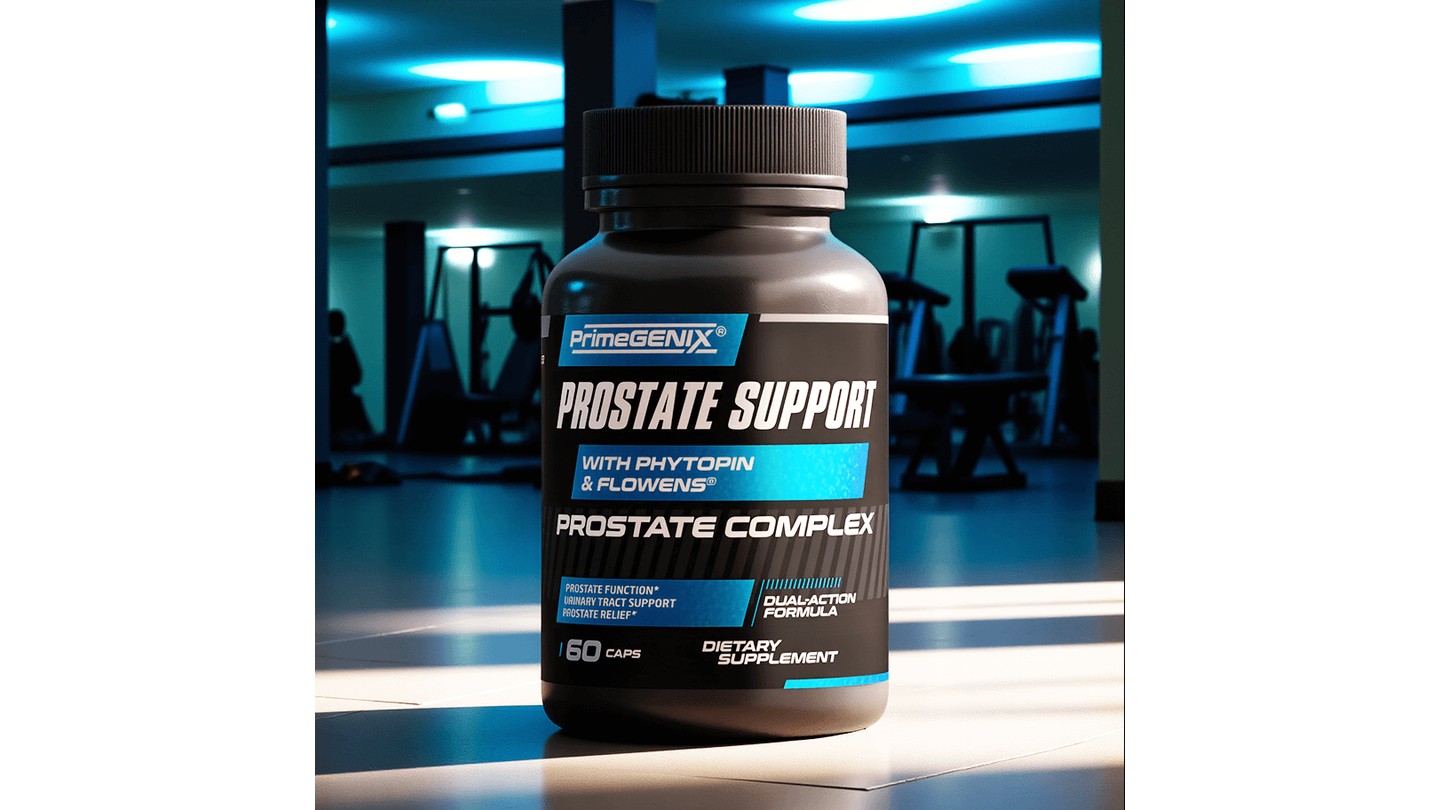
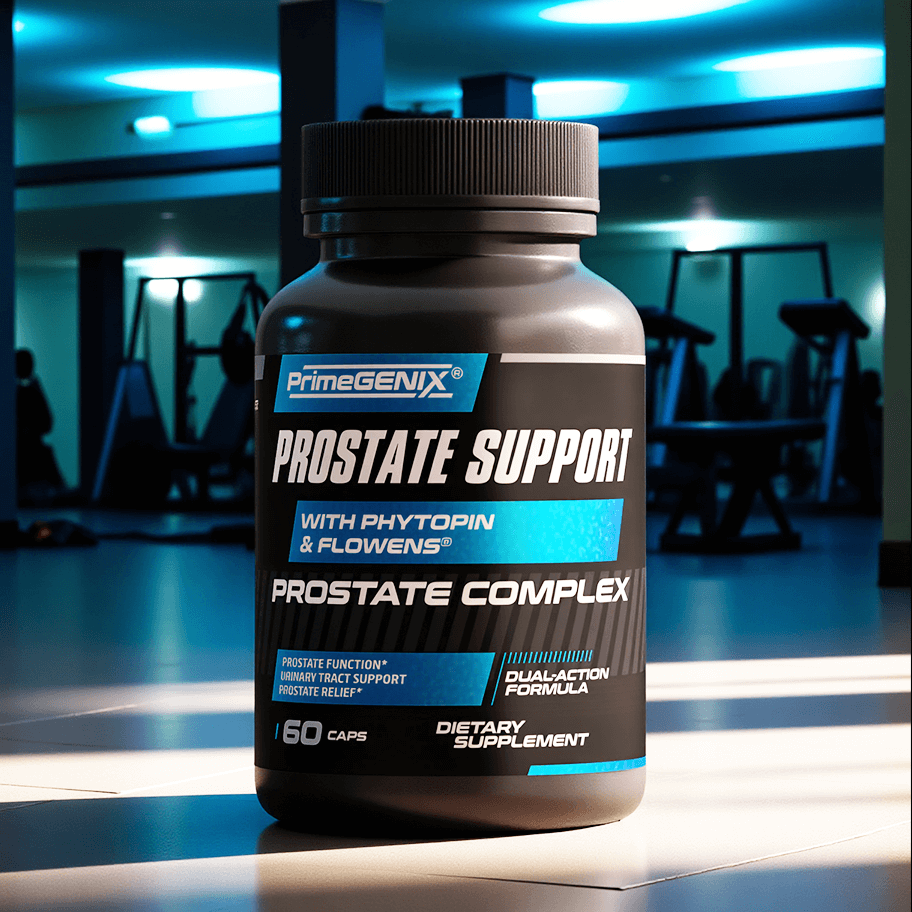
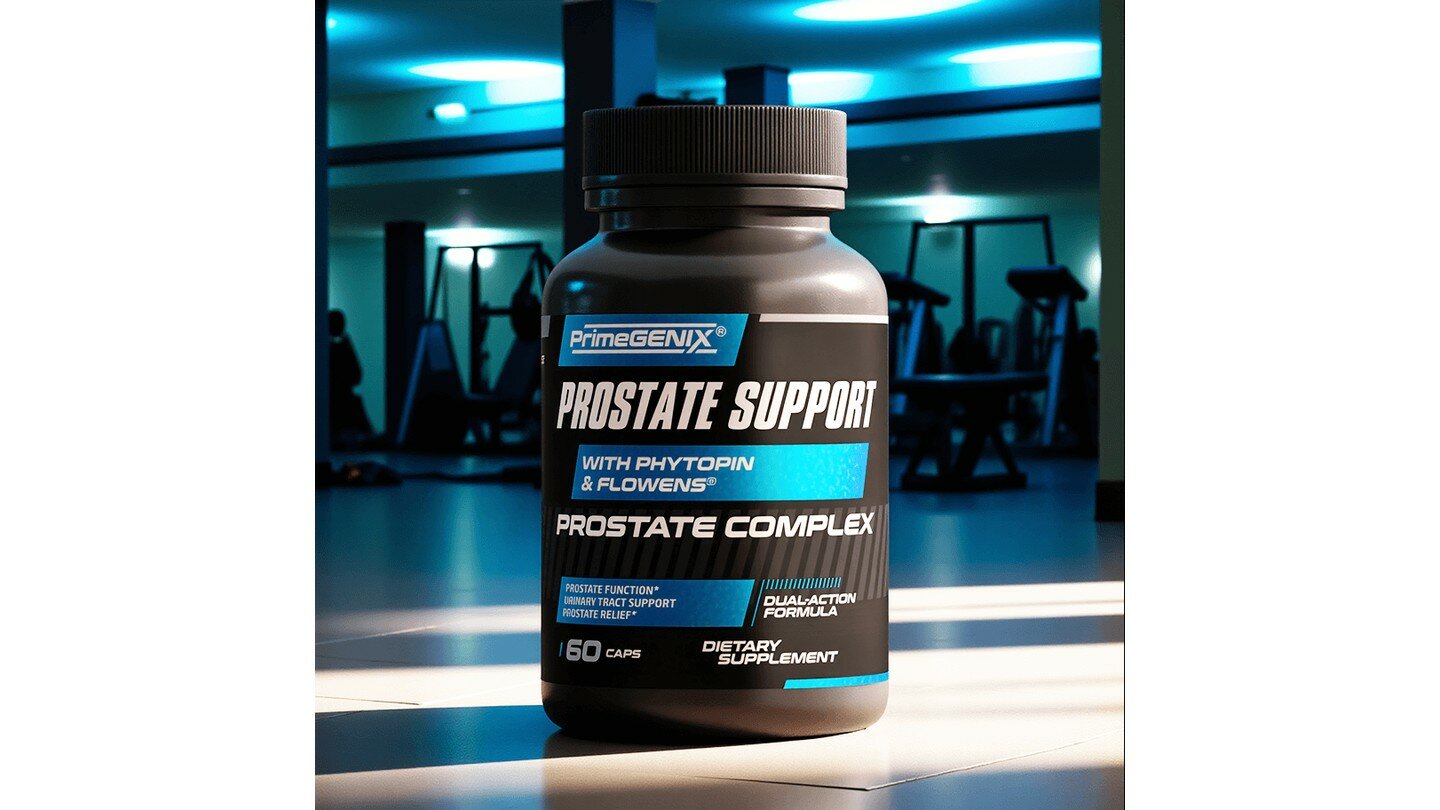
PrimeGENIX Prostate Support is a daily prostate and urinary-support supplement produced by Leading Edge Health under its PrimeGENIX men's health line. Each bottle contains 60 vegetarian capsules, giving 30 daily servings at the label direction of two capsules per day. The formula combines cranberry fruit solids, saw palmetto extract, pine-derived plant sterols, a three-herb blend, lycopene, and boron.
On its sales page, the maker pitches the product as a "100% natural, dual-action solution" for men dealing with a weak urinary stream, straining, and waking two to five times a night. According to the maker, most prostate supplements address only age-related swelling, whereas this formula also targets harmful urinary-tract bacteria. Its headline claims include "Reduce Prostate Enlargement," "Shrinks Swollen Prostate," "Reduces Urgent Bathroom Trips," "Relieves Pelvic Pressure," "Doctor Recommended," and "3rd Party Lab Tested."
The maker builds its credibility pitch around "four patented, clinically-proven ingredients": Flowens®, Phytopin®, Graminex® G63®, and LycoRed®. Yet reading the page closely exposes sloppy editing alongside bold claims. The product is titled "Prostate Support" at the top of the page, repeatedly called "Prostate Complex" throughout the body copy, and even contains stray blocks from other products — including a line about "5 grams of pure, micronized creatine monohydrate" and a closing banner reading "ORDER YOUR BONE COMPLEX TODAY."
The Ingredients
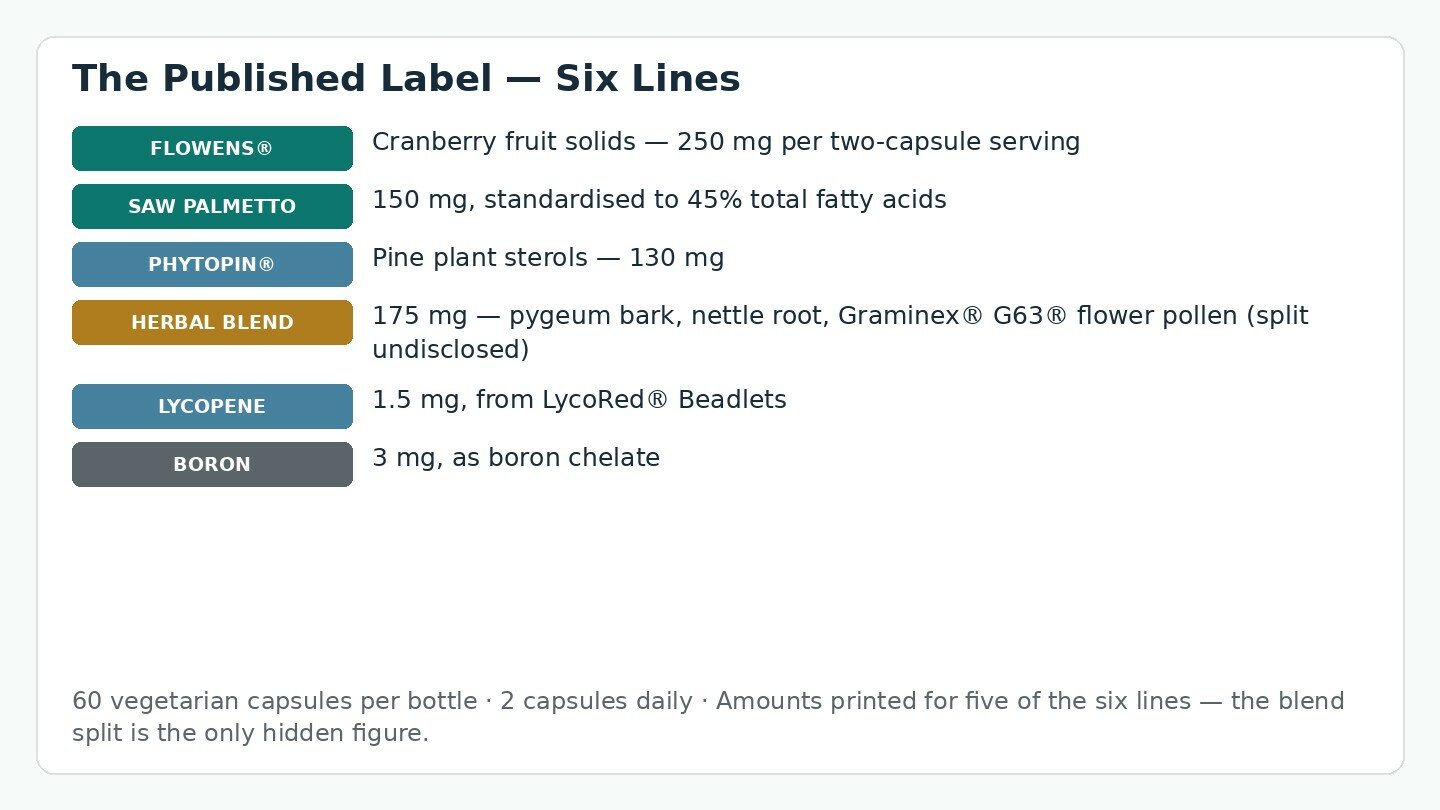
In the prostate supplement aisle, simply printing a readable Supplement Facts panel with milligram amounts puts a brand ahead of many rivals. PrimeGENIX publishes its full label image, and that label rewards close inspection. No entry for PrimeGENIX Prostate Support exists in the NIH Dietary Supplement Label Database (which lists eight other PrimeGENIX labels, none of them this product), so the maker's own published panel serves as the label of record.
Reading all six lines in order shows both the formula's real merit and its weak spots. You get exact doses for five lines and a stated 45% total fatty acids standardisation for saw palmetto, with no percent Daily Value established for any line. You also see three significant limits right away: a 175 mg proprietary blend hiding three botanicals, a 150 mg saw palmetto dose that sits well below large-trial levels, and a tiny 1.5 mg dose of lycopene.
| Ingredient | Amount per serving | On the label |
|---|---|---|
| Flowens® Cranberry Fruit Solids (Vaccinium macrocarpon) (fruit) | 250 mg | Branded cranberry fruit solids; %DV not established |
| Saw Palmetto Extract (Serenoa repens) (dried fruits) | 150 mg | Standardised to 45% Total Fatty Acids; %DV not established |
| Phytopin® (Plant Sterols Complex, from Pine) | 130 mg | Pine-derived plant sterols complex; beta-sitosterol share not stated; %DV not established |
| Proprietary Herbal Blend | 175 mg | Pygeum (Pygeum africanum) (bark) Extract · Nettle (Urtica dioica) (root) · Graminex® G63® Flower Pollen Extract; individual amounts not stated |
| Lycopene (from LycoRed® Beadlets) | 1.5 mg | Branded beadlet preparation; %DV not established |
| Boron (as Boron Chelate) | 3 mg | Chelated trace mineral; %DV not established |
Flowens® Cranberry Fruit Solids
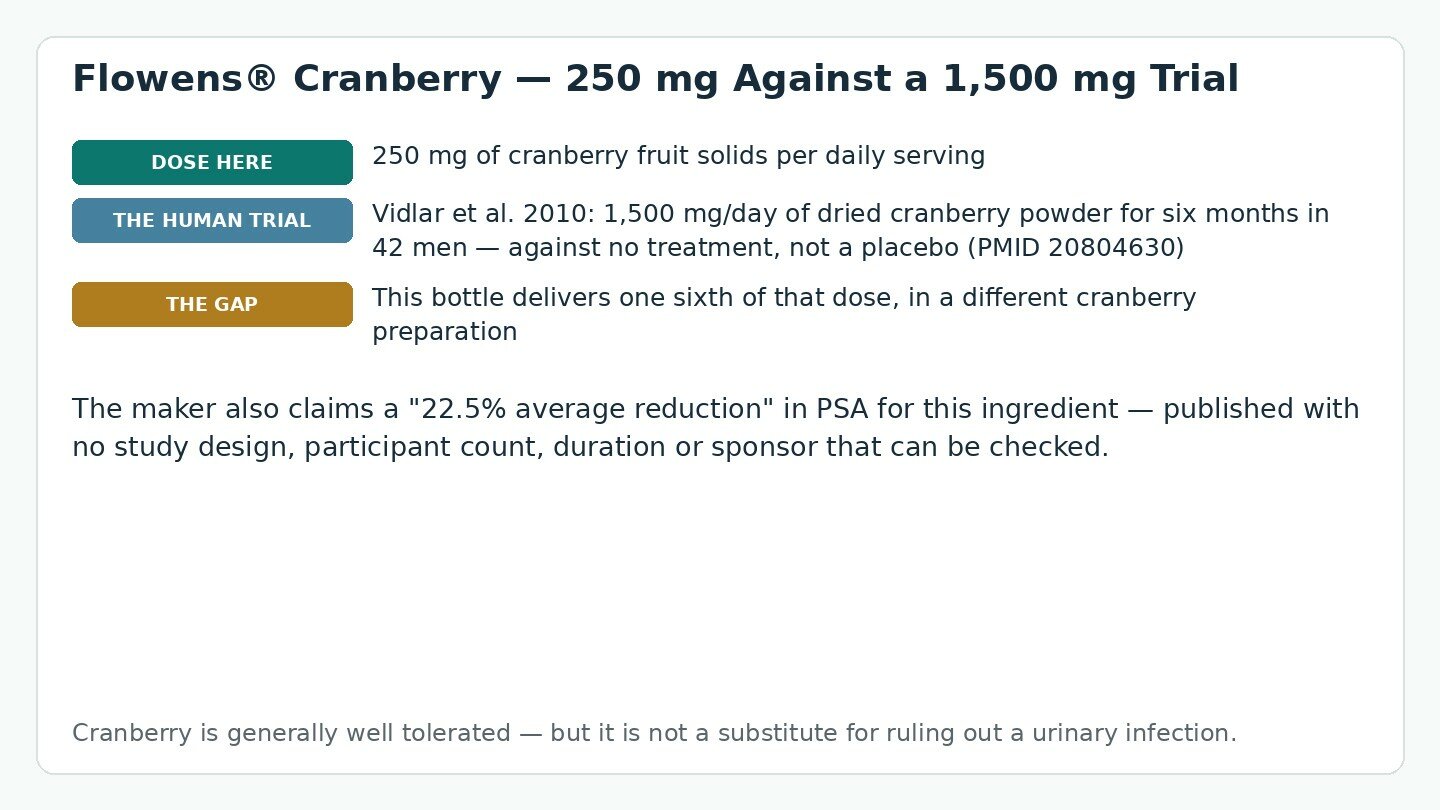
Flowens® is a branded cranberry fruit-solids ingredient derived from Vaccinium macrocarpon, supplied here at 250 mg per two-capsule serving. On the sales page, the maker assigns Flowens® the bacteria and urinary-tract half of its "dual-action" pitch. It also claims Flowens® "supports healthy PSA levels" with a "22.5% average reduction," and cites Flowens® in its FAQ as one of two ingredients dosed to match clinical studies.
The published record tells a much more cautious story. First, the maker publishes no inspectable study design, participant count, duration, or sponsor behind that 22.5% PSA reduction figure. Second, the one published human trial of cranberry for men's lower urinary tract symptoms gave 42 men (21 per group) 1,500 mg a day of dried cranberry powder for six months against a no-treatment control, not a placebo (Vidlar et al. 2010, PMID 20804630).
Those men reported improved symptom scores, quality of life, flow measures, and PSA measures. However, PrimeGENIX delivers one sixth of that 1,500 mg daily amount in a different cranberry preparation. Cranberry products are generally well tolerated in trials, though men with urinary symptoms should never rely on cranberry alone to rule out an infection.
Saw Palmetto Extract
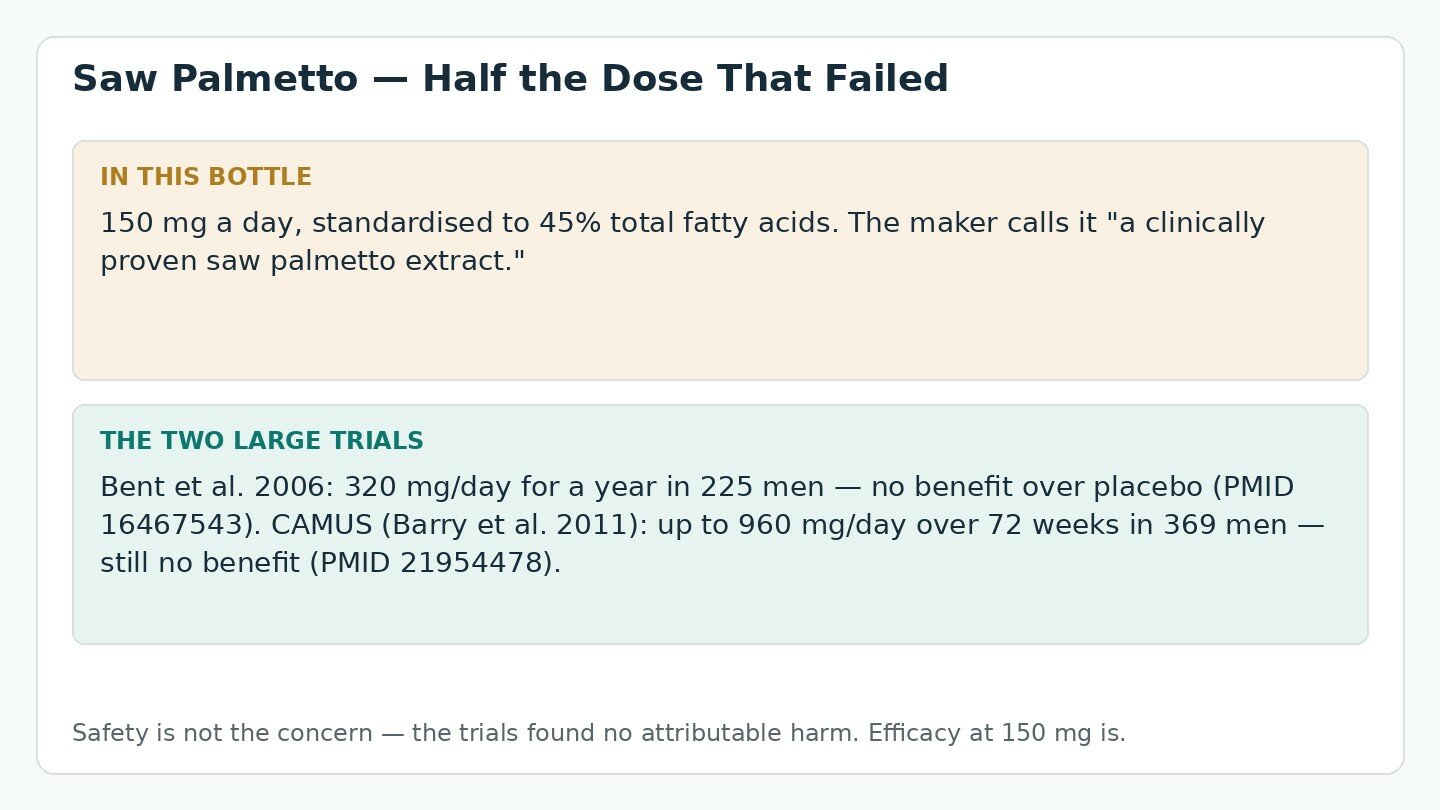
Saw palmetto extract comes from the dried fruits of Serenoa repens. PrimeGENIX includes 150 mg per daily serving, standardised to 45% total fatty acids. It is the best-known ingredient in prostate supplements, and the maker leans on it heavily, calling it "a clinically proven saw palmetto extract" while promising to reduce prostate enlargement and shrink a swollen prostate.
That claim collides directly with the two largest, most rigorous human trials ever run on saw palmetto. In a one-year double-blind trial of 225 men over age 49 with moderate-to-severe benign prostatic hyperplasia (BPH), 160 mg twice daily (320 mg/day) produced no significant difference from placebo on symptom scores, peak urine flow, prostate size, residual volume, or quality of life (Bent et al. 2006, PMID 16467543).
A second major trial — CAMUS, involving 369 men over 72 weeks — escalated saw palmetto up to 960 mg daily and still found no outcome better than placebo, with symptom scores shifting −2.20 on saw palmetto versus −2.99 on placebo (Barry et al. 2011, PMID 21954478). This bottle delivers 150 mg a day: half the Bent dose and under a sixth of CAMUS's top dose. CAMUS reported no attributable adverse effects, so safety is not the concern — efficacy at 150 mg is.
Phytopin® (Plant Sterols, from Pine)
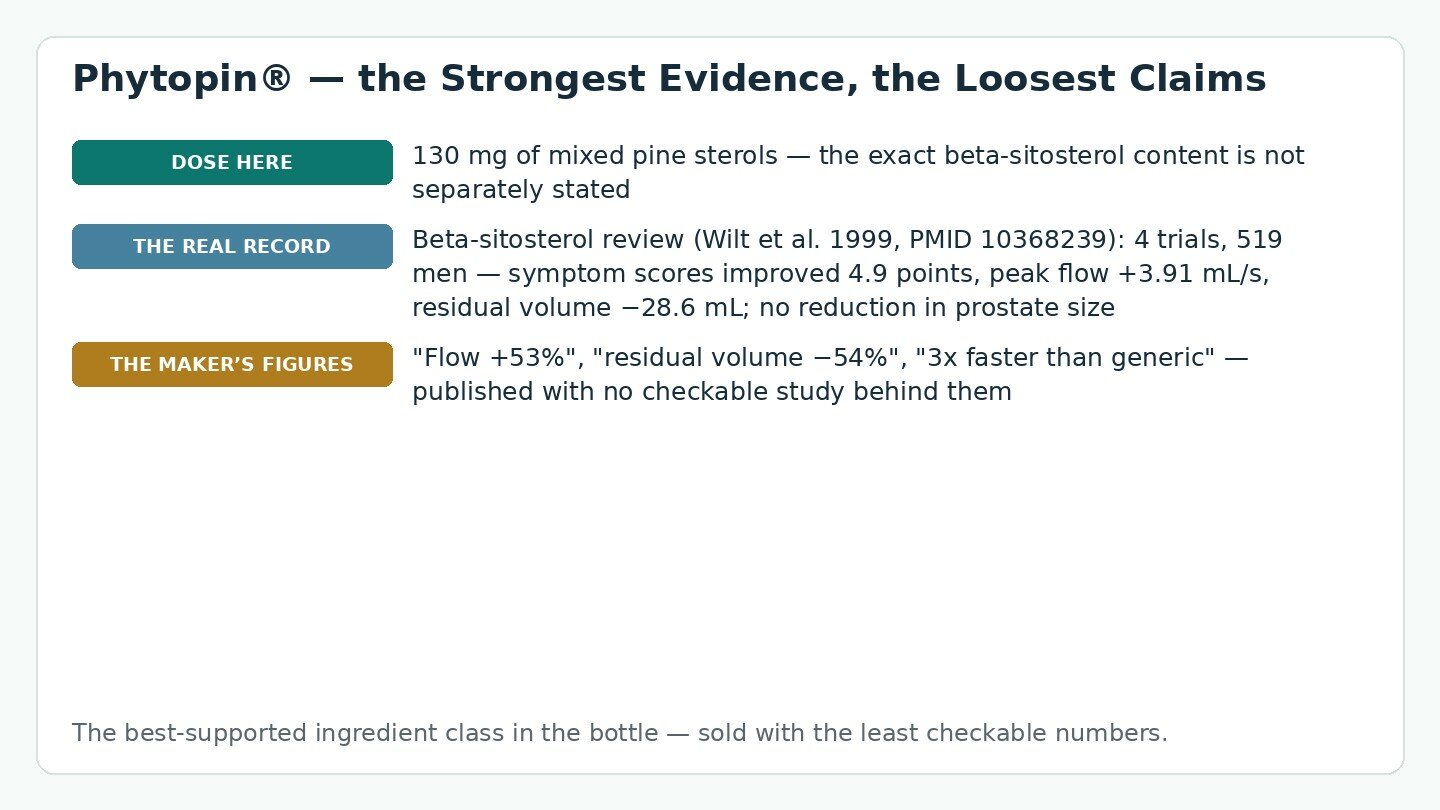
Phytopin® is a pine-derived plant sterols complex included at 130 mg per serving. The active compound behind plant-sterol prostate research is beta-sitosterol. On its sales page, the maker claims Phytopin® improves symptoms "3x faster than generic versions," increases urine flow by 53%, and cuts residual bladder volume by 54%, and names Phytopin® alongside Flowens® in its FAQ dose-match claim.
Beta-sitosterol actually carries the strongest human trial evidence in this entire bottle, though not for shrinking the prostate. A systematic review pooling four double-blind trials across 519 men over four to 26 weeks found that purified beta-sitosterol improved International Prostate Symptom Scores (IPSS) by 4.9 points, raised peak urine flow by 3.91 mL/s, and lowered residual volume by 28.6 mL versus placebo — while producing no reduction in prostate size (Wilt et al. 1999, PMID 10368239).
Two caveats apply to this label. Those trials used purified beta-sitosterol, whereas Phytopin® here is a 130 mg mixed pine-sterol complex whose exact beta-sitosterol content is not separately stated. In addition, the maker's +53%, −54%, and "3x faster" figures come with no checkable study. Sterol trials reported mild, mostly digestive side effects at low rates.
The Proprietary Herbal Blend: Pygeum, Nettle Root and Graminex® G63®
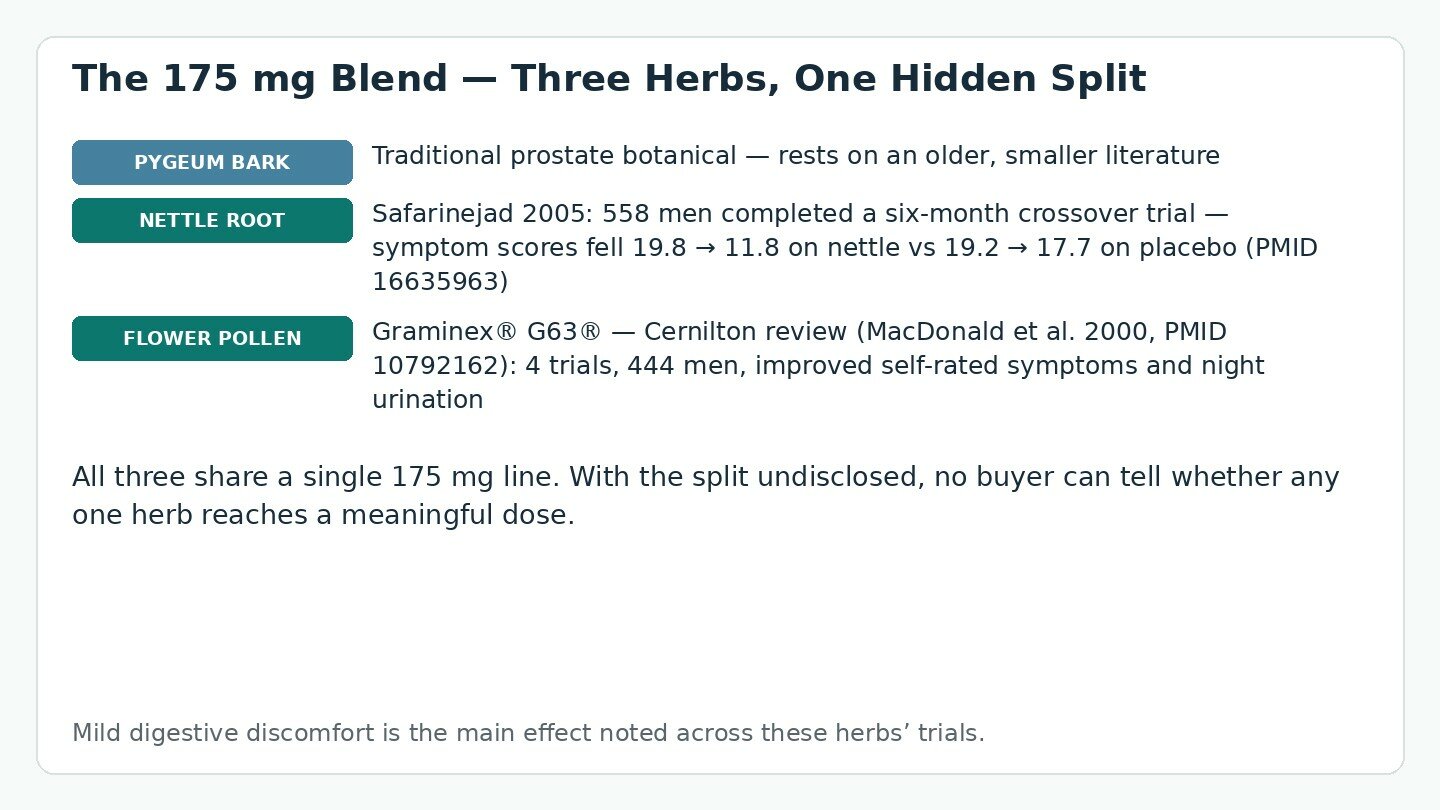
The fourth label line groups three traditional prostate botanicals into one 175 mg Proprietary Herbal Blend: pygeum bark extract (Pygeum africanum), stinging nettle root (Urtica dioica), and Graminex® G63® flower pollen extract. The maker markets Graminex® G63® as one of its four patented ingredients, while using all three herbs to support urinary flow and night-time comfort.
Two of these herbs have real human trial support on their own. For nettle root, a large single-centre, randomised, double-blind, placebo-controlled crossover trial in which 558 men completed six months saw IPSS drop from 19.8 to 11.8 on nettle versus 19.2 to 17.7 on placebo, with peak flow rising 8.2 versus 3.4 mL/s and residual volume falling from 73 to 36 mL (Safarinejad 2005, PMID 16635963). For flower pollen, a systematic review of four trials of Cernilton (444 men, 12–24 weeks) reported improved self-rated urinary symptoms and night urination versus placebo, though allocation concealment was unclear (MacDonald et al. 2000, PMID 10792162).
Pygeum rests on an older, smaller literature. Because all three sit inside one undisclosed 175 mg total, you cannot tell whether any single herb reaches a meaningful dose. Mild digestive discomfort is the main effect noted across trials of these herbs.
Lycopene (from LycoRed® Beadlets)
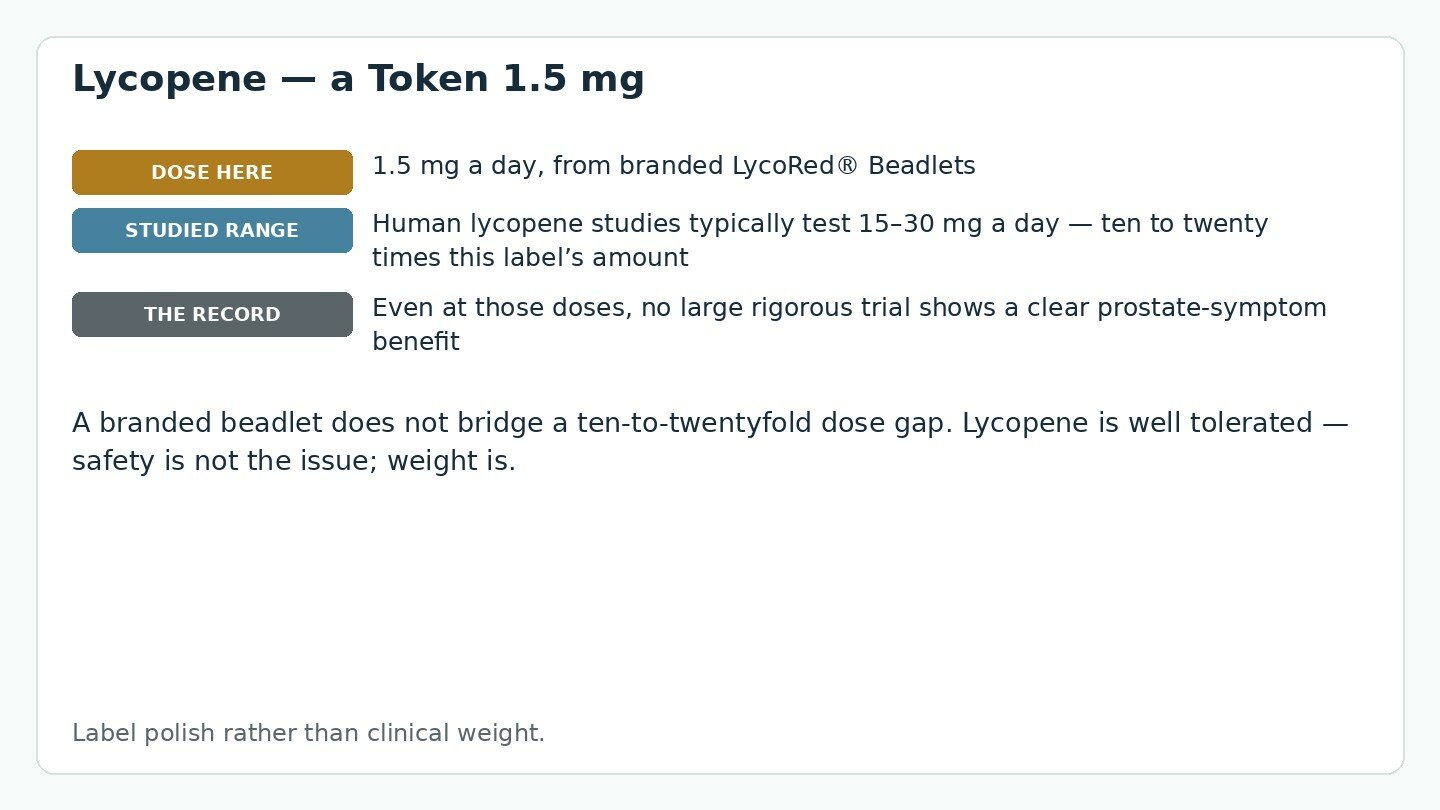
Lycopene is the red carotenoid antioxidant best known from tomatoes, delivered here as 1.5 mg from branded LycoRed® Beadlets. On the sales page, the maker counts LycoRed® as one of its four patented, clinically proven ingredients and positions lycopene as antioxidant and prostate-marker support inside the broader formula.
At 1.5 mg per day, however, the dose is a token inclusion. Human lycopene studies typically test 15 to 30 mg per day — ten to twenty times the amount printed on this label. Even at those much higher doses, the human literature for lycopene on urinary or prostate-enlargement symptoms is older and smaller, and no large, rigorous clinical trial shows a clear prostate-symptom benefit at any dose.
Using a branded beadlet ingredient does not bridge a tenfold-to-twentyfold dose gap. Lycopene is well tolerated at typical supplemental intakes, so safety is not an issue at 1.5 mg. As a reason to buy the bottle, though, this line adds label polish rather than clinical weight.
Boron (as Boron Chelate)
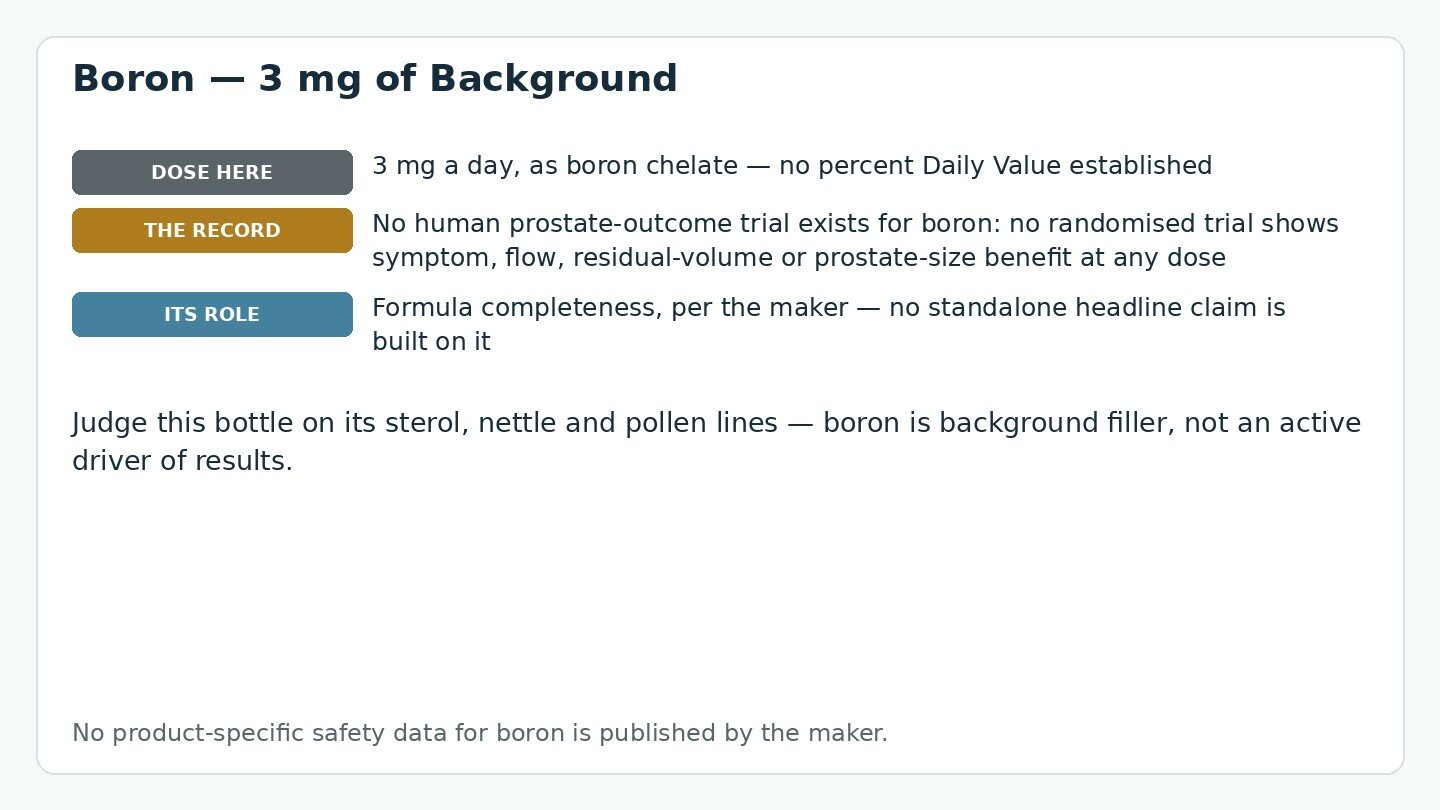
Boron is a trace mineral included on the final line of the Supplement Facts panel at 3 mg per serving, supplied as boron chelate. No percent Daily Value is established, and the maker includes it as part of its multi-ingredient men's prostate support blend rather than building a standalone headline claim around it.
When you check the clinical literature, the picture is brief and clear. No human prostate-outcome trial record exists for boron. There are no randomised trials showing that 3 mg of boron reduces enlarged-prostate urinary symptoms, improves peak urinary flow, lowers residual bladder volume, or shrinks prostate tissue.
Its presence in PrimeGENIX Prostate Support is about formula completeness rather than proven urinary benefit. At 3 mg daily, boron sits as a modest trace-mineral addition with no product-specific safety data published by the maker. Men comparing prostate labels should treat boron as background filler rather than an active driver of results, and judge this bottle on its sterol, nettle, and pollen lines instead.
The Label Audit: What the Sales Page Says vs What the Label Shows
A published Supplement Facts label is only useful if the sales page accurately describes what sits inside the bottle. When we compared PrimeGENIX's live sales page and store against its own published label image, four concrete contradictions stood out, alongside stray copy blocks copied from other PrimeGENIX products.
| Where you look | What you find |
|---|---|
| Sales page ingredient features | "Zinc & Selenium" featured twice as ingredients; gallery headed "15 Total Science-Backed Ingredients" |
| Published Supplement Facts label | Six label lines (eight named substances total); neither zinc nor selenium appears anywhere on the panel |
| Sales page saw palmetto copy | Called "a clinically proven saw palmetto extract" alongside prostate-shrinking headlines |
| Published label + large human trials | 150 mg/day on the label — half the 320 mg Bent dose and under a sixth of the 960 mg CAMUS dose, both null vs placebo |
| Sales page branded figures | +53% urine flow, −54% residual volume, "3x faster" (Phytopin®), and −22.5% PSA (Flowens®) with no study cited |
| Store pricing header and options | Header says "Buy Once from $40" against a $49 single bottle; $139 and $239 options never state a bottle count |
| Sales page body copy and footer | Calls the product "Prostate Complex" instead of "Prostate Support"; includes stray creatine and "ORDER YOUR BONE COMPLEX TODAY" copy |
1. Two Minerals That Are Not in the Bottle
Read the PrimeGENIX sales page from top to bottom and you will see "Zinc & Selenium" highlighted twice as ingredients in the formula. Both minerals are common staples in men's prostate supplements, so a buyer skimming the sales page has every reason to assume they are paying for them.
Turn to the maker's own published Supplement Facts label and neither mineral is there. Zinc does not appear on any of the six lines. Selenium does not appear on any of the six lines. The only mineral listed on the label is 3 mg of boron as boron chelate.
That is not a minor wording slip. Advertising two familiar prostate minerals that are completely absent from the bottle means buyers relying on the sales page instead of the Supplement Facts panel are misled about what they are swallowing.
2. "15 Ingredients" vs Six Label Lines
The sales page presents an ingredient gallery under the bold heading "15 Total Science-Backed Ingredients." That figure signals an expansive, comprehensive formula compared with simpler three- or four-ingredient prostate blends.
Count the actual published label and the maths breaks down immediately. The Supplement Facts panel contains six lines in total: Flowens® cranberry, saw palmetto extract, Phytopin® pine sterols, the Proprietary Herbal Blend, lycopene, and boron. Even if you unpack the three named herbs inside the 175 mg blend — pygeum bark, nettle root, and Graminex® G63® flower pollen — the label lists eight named substances in total.
The page reaches "15" only by counting items that the published label does not list, including the missing zinc and selenium. Coupled with the page's stray creatine block and Bone Complex banner, it points to poorly checked sales copy rather than a 15-ingredient bottle.
3. "Clinically Proven" Saw Palmetto
Saw palmetto is the ingredient most buyers recognise first, and the sales page calls PrimeGENIX's version "a clinically proven saw palmetto extract" standardised to 45% fatty acids. Alongside that claim sit headline promises to "Reduce Prostate Enlargement" and "Shrinks Swollen Prostate."
Two facts dismantle that framing. First, the two largest, best-designed human trials of saw palmetto — Bent et al. 2006 (PMID 16467543) at 320 mg a day and Barry et al. 2011 (PMID 21954478) at up to 960 mg a day — both found saw palmetto no more effective than placebo on urinary symptoms or prostate size. Second, this bottle delivers just 150 mg a day, half of the lower failed dose.
Even the maker's own FAQ quietly steps back from saw palmetto. Its dose-match claim states that clinical studies used "the same amount of Flowens™ and Phytopin®" — naming two ingredients and leaving saw palmetto out.
4. Prices Without Pack Sizes
The final audit finding sits on the store page itself. At the top, the header advertises "Buy Once from $40," yet the single-bottle one-time purchase price listed below is $49. The only price below $49 is the $39 monthly subscription.
More importantly, the store lists two larger purchase options at $139 and $239 without stating anywhere on the maker's pages how many bottles either option includes. You cannot calculate the per-bottle price or the daily cost of the $139 or $239 options from the published store copy.
Buyers should never have to guess how many bottles arrive for $139 or $239. Until the maker states those bottle counts clearly in writing, the only verifiable prices on the store are the $49 single bottle and the $39 monthly subscription.
The Evidence, Read Properly
Prostate supplements are often judged on bold percentages printed across a sales page. A fair audit works the other way around. We look first for a clinical trial of the finished formula, then weigh the best human trials for each separate ingredient at the actual dose and form printed on the bottle.
No Trial of This Finished Formula
No human clinical trial has tested PrimeGENIX Prostate Support as a finished product. There is no published study measuring urinary flow, night-time bathroom trips, residual bladder volume, or prostate size in men taking these two daily capsules.
In place of a product trial, the maker relies on three layers of ingredient-level messaging. First, its sales page makes broad prostate-shrinking and urinary-relief claims across the formula. Second, it prints branded-ingredient figures — +53% urine flow, −54% residual bladder volume, and "3x faster" symptom relief for Phytopin®, plus a 22.5% average PSA reduction for Flowens® — with no inspectable study design, participant count, duration, or sponsor attached.
Third, the maker's FAQ states that men in clinical studies taking "the same amount of Flowens™ and Phytopin®" reported better urination, less inflammation, and prostate shrinkage in a matter of weeks. Notice what that wording leaves out: it names only two ingredients and does not claim a dose match for saw palmetto, the herbal blend, lycopene, or boron.
Saw Palmetto: Two Large Rigorous Trials Found No Benefit
Saw palmetto is the headline botanical on the sales page, yet it holds the weakest human trial record in this bottle. The two largest, best-controlled trials of saw palmetto both returned null results against placebo.
In a one-year, double-blind, placebo-controlled trial published in the New England Journal of Medicine, Bent et al. 2006 (PMID 16467543) tested 160 mg of saw palmetto extract twice daily (320 mg/day) in 225 men over age 49 with moderate-to-severe benign prostatic hyperplasia (BPH). At the end of the year, saw palmetto produced no significant difference from placebo on the American Urological Association Symptom Index (AUASI), maximal urine flow rate, prostate size, residual bladder volume, or quality of life.
Five years later, the CAMUS trial tested whether higher doses changed the outcome. Barry et al. 2011 (PMID 21954478), published in JAMA, randomised 369 men for 72 weeks and escalated saw palmetto up to 960 mg daily. Symptom scores shifted by −2.20 points on saw palmetto versus −2.99 points on placebo, and saw palmetto was no more effective than placebo on any secondary measure.
PrimeGENIX Prostate Support delivers 150 mg of saw palmetto extract a day, standardised to 45% total fatty acids. That is half the daily dose that failed in Bent et al. 2006 and under a sixth of the top dose that failed in CAMUS.
Beta-Sitosterol: Real Symptom Evidence, With a Preparation Gap
The strongest clinical support in this bottle sits behind plant sterols, specifically beta-sitosterol. A systematic review by Wilt et al. 1999 (PMID 10368239) pooled four double-blind, placebo-controlled trials covering 519 men over four to 26 weeks.
Across those trials, beta-sitosterol improved International Prostate Symptom Scores (IPSS) by a weighted mean difference of 4.9 points compared with placebo. It also raised peak urinary flow by 3.91 mL/s and cut residual bladder volume by 28.6 mL. Just as important, the review found that beta-sitosterol did not reduce prostate size.
Two gaps separate that review from PrimeGENIX's bottle. First, the reviewed trials tested purified beta-sitosterol preparations, whereas PrimeGENIX supplies 130 mg of Phytopin®, a mixed pine-sterol complex whose separate beta-sitosterol content is not printed on the label. Second, the Wilt pooled improvements (+3.91 mL/s flow and −28.6 mL residual volume) are the checkable benchmark — not the maker's +53% flow and −54% residual figures, which carry no verifiable study.
Cranberry: One Small Non-Placebo Trial at Six Times This Dose
Cranberry leads the label at 250 mg of Flowens® cranberry fruit solids, and the maker pairs it with urinary-tract bacteria claims and an unverifiable 22.5% PSA reduction figure. In the published literature, human evidence for cranberry in men's urinary symptoms is far thinner.
Vidlar et al. 2010 (PMID 20804630) studied 42 men with lower urinary tract symptoms, elevated PSA, a negative prostate biopsy, and chronic non-bacterial prostatitis. Twenty-one men received 1,500 mg a day of dried cranberry powder for six months, while 21 men served as a no-treatment control group with no placebo capsule.
The cranberry group reported improvements on IPSS, quality of life, urine flow measures, and PSA measures compared with untreated men. That is a small, non-placebo design, and PrimeGENIX delivers 250 mg of a different cranberry preparation — one sixth of the daily amount used in Vidlar et al. 2010.
Nettle Root, Flower Pollen and the Remaining Lines
Two herbs inside the 175 mg Proprietary Herbal Blend carry genuine human trial support. For stinging nettle root, Safarinejad 2005 (PMID 16635963) ran a prospective, randomised, double-blind, placebo-controlled crossover trial at a single centre, with 558 men completing six months. On nettle root, IPSS fell from 19.8 to 11.8 compared with 19.2 to 17.7 on placebo, peak flow rose by 8.2 versus 3.4 mL/s, and residual bladder volume dropped from 73 mL to 36 mL.
For flower pollen extract, MacDonald et al. 2000 (PMID 10792162) reviewed four trials of Cernilton (a rye-grass pollen extract) across 444 men over 12 to 24 weeks. Pollen extract improved self-rated urinary symptoms and night-time urination compared with placebo, although allocation concealment was unclear in all four trials. Graminex® G63® belongs to the same flower-pollen class, while pygeum bark rests on an older, smaller literature.
The catch is simple: pygeum bark, nettle root, and Graminex® G63® all share one undisclosed 175 mg line, so you cannot confirm whether any of the three reaches a studied dose. Rounding out the label, 1.5 mg of lycopene sits far below the 15 to 30 mg used in older, smaller lycopene trials, and 3 mg of boron has no prostate-outcome trial record at all.
How Long Does It Take to Work?
On its FAQ page, the maker says men in studies taking the same amounts of Flowens™ and Phytopin® noticed better urination, less inflammation, and prostate shrinkage "in just a matter of weeks." Because no checkable study accompanies those branded claims, buyers are better off looking at how long the published ingredient trials actually ran.
The published timelines are measured in months rather than days. The beta-sitosterol trials pooled by Wilt et al. 1999 (PMID 10368239) ran from four to 26 weeks. The flower-pollen trials reviewed by MacDonald et al. 2000 (PMID 10792162) ran 12 to 24 weeks, while both the nettle root trial (Safarinejad 2005, PMID 16635963) and the dried cranberry powder trial (Vidlar et al. 2010, PMID 20804630) ran six full months.
One bottle of PrimeGENIX Prostate Support holds 60 vegetarian capsules. At the label direction of two capsules a day, a single bottle lasts 30 days — enough for an early check, not enough for a full multi-month botanical trial.
That is where the guarantee maths help. Buying two bottles at $49 each ($98 total) covers 60 full days of daily use, fitting inside the maker's 67-day money-back guarantee. Because the written terms allow you to return both the unused portion and empty containers for a refund minus shipping, mark your delivery date, track your stream and night-time trips, and decide by about day 55 so any return arrives before day 67.
Is It Safe?
The first thing to notice about safety is the maker's silence. Across its entire sales page and published Supplement Facts label image, PrimeGENIX publishes no warnings, no exclusions, no drug-interaction cautions, and no side-effect list. Its only safety assurances are "100% natural ingredients" and "no reported side effects."
No product-specific safety study has been conducted on PrimeGENIX Prostate Support. That does not mean the ingredients look dangerous on paper. Across the published human trials of its individual components, tolerability has been generally good.
In the 72-week CAMUS trial, Barry et al. 2011 (PMID 21954478) escalated saw palmetto to 960 mg daily — more than six times the dose in this bottle — and reported no attributable adverse effects. Similarly, trials of beta-sitosterol, nettle root, flower pollen, and cranberry powder have generally shown benign safety profiles in adult men.
Still, "natural" never means you can skip medical common sense. Urinary symptoms such as a weak stream, straining, urgency, and frequent night-time trips overlap with conditions that need a doctor's diagnosis, including urinary tract infection, bladder retention, and prostate cancer screening. Any man already taking prescription prostate medication or blood-pressure medication should check with his doctor before adding a multi-ingredient prostate supplement.
Side Effects: What Is Actually Known
For PrimeGENIX Prostate Support as a finished formula, no adverse-event data is published anywhere because no human trial has tested it. When the maker writes "no reported side effects," that reflects an absence of published product data rather than a clinical guarantee that every user will tolerate the capsules without issue.
Looking at the published trials for the separate ingredients gives a realistic picture of what men experience. In trials of beta-sitosterol (Wilt et al. 1999, PMID 10368239), nettle root (Safarinejad 2005, PMID 16635963), flower pollen extract (MacDonald et al. 2000, PMID 10792162), and cranberry powder (Vidlar et al. 2010, PMID 20804630), reported side effects were mild, mostly digestive, and occurred at low rates.
Large saw palmetto trials tell a similar story. Both Bent et al. 2006 (PMID 16467543) and Barry et al. 2011 (PMID 21954478) recorded overall side-effect rates close to placebo, with CAMUS identifying no attributable adverse effects even at 960 mg a day. Lycopene at 1.5 mg and boron at 3 mg sit at low supplemental intakes, though again no finished-formula safety testing exists. Taking the two daily capsules with food is a practical habit if your stomach is sensitive to herbal extracts.
When a Doctor Comes First
PrimeGENIX Prostate Support is a dietary supplement, not a treatment for urinary retention, infection, or prostate disease. Certain symptoms are a doctor's territory the same day, never a supplement's: being unable to urinate at all, seeing blood in your urine, developing a fever with pelvic or back pain, or noticing urinary symptoms that worsen quickly. Even without those red flags, persistent enlarged-prostate symptoms deserve a proper medical workup — including PSA testing and a physical examination — rather than a second bottle. Where treatment is needed, doctors can discuss proven prescription drug classes, including alpha blockers that relax the prostate and bladder neck to improve urine flow, and 5-alpha-reductase inhibitors that shrink enlarged prostate tissue over months.
Is It a Scam?
No. PrimeGENIX Prostate Support is not a scam. It is a real supplement from an established company, Leading Edge Health, sold with a published Supplement Facts label naming doses for five of its six lines and backed by written 67-day guarantee terms.
Calling a product "not a scam," however, is a low bar. The legitimate criticisms of PrimeGENIX Prostate Support sit in the clear gaps between its sales copy and its own records. Calling 150 mg of saw palmetto "clinically proven" after two major placebo-controlled trials failed at 320 mg and up to 960 mg daily is marketing overreach. Printing +53% urine flow, −54% residual bladder volume, and −22.5% PSA figures with no checkable study behind them is also overreach.
The page-versus-label errors add to that frustration. Advertising "Zinc & Selenium" twice when neither mineral appears on the label, claiming "15 Total Science-Backed Ingredients" against six label lines, leaving stray creatine and Bone Complex copy on the sales page, and listing $139 and $239 options without stating bottle counts all point to sloppy oversight on a real product, not a fake one.
The product is sold direct via the maker's official website, where the verified single-bottle price, subscription discount, and written 67-day refund policy apply. Judge it by the actual label in front of you, not the headline claims surrounding it.
Price and Packs
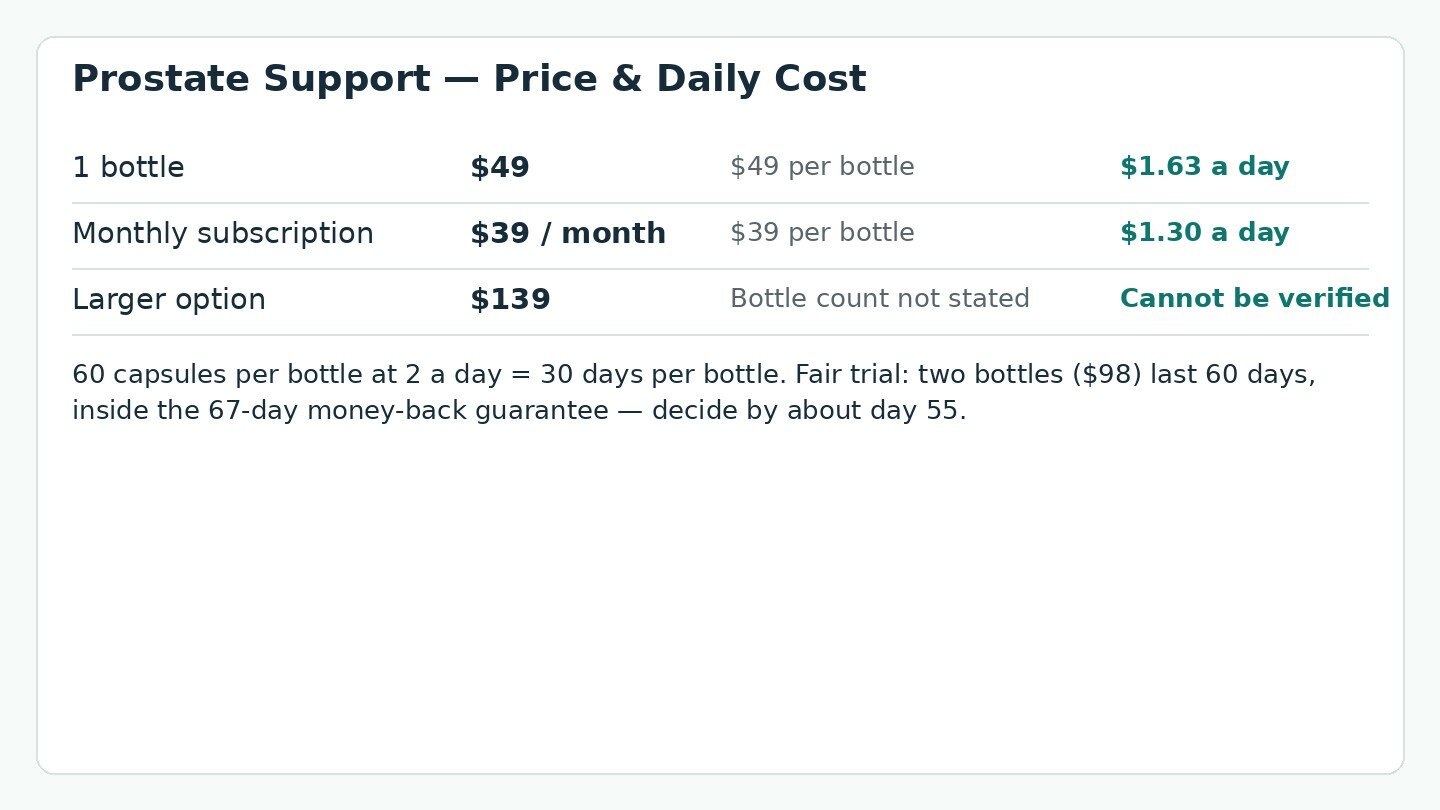
Checking the maker's live store reveals a clear split between two fully verifiable prices and two larger options that omit a basic piece of information. Every figure below comes directly from the maker's official store, read in November 2026.
| Option | Total | Per bottle | Cost per day |
|---|---|---|---|
| 1 bottle | $49 | $49 | $1.63 |
| Larger option | $139 | Bottle count not stated by the maker | Cannot be verified |
| Largest option | $239 | Bottle count not stated by the maker | Cannot be verified |
| Monthly subscription | $39 | $39 | $1.30 |
Source: the maker's official store (verified November 2026). Daily cost is calculated at the label dose of 2 capsules per day (30 servings per bottle).
Notice two pricing issues on the store page right away. First, the header advertises "Buy Once from $40," even though the one-time single-bottle price below it is $49. Second, the $139 and $239 options ask you to spend well over $100 without stating anywhere on the maker's pages how many bottles arrive in the box.
The verifiable maths belong strictly to the $49 single bottle ($1.63 a day) and the $39 monthly subscription ($1.30 a day, saving $10 per bottle, with free shipping in the USA and Canada and anytime cancellation). If you want to test the product without guessing on unlabelled bundles, settle the exact bottle count with the maker before choosing either the $139 or $239 option. Keep in mind that the 67-day guarantee covers up to two opened bottles' worth of trial (60 days at $98 for two single bottles), with both the unused portion and empty containers returnable minus shipping.
Purchase Options
PrimeGENIX Prostate Support is sold direct via the maker's official website. Ordering directly through the maker's store is where the verified $49 single-bottle price, the $39 monthly subscription terms, and the written 67-day money-back guarantee apply.
Before placing an order, run through three quick checks:
- Use the subscription only if you stay on it: At $39 per bottle ($1.30 a day) with free shipping in the USA and Canada and anytime cancellation, the monthly subscription is the cheapest verified route if a trial works well for you.
- Verify missing bottle counts first: Do not guess how many bottles come with the $139 or $239 options. Ask the maker to confirm the exact bottle count in writing before selecting either one.
- Mark your delivery date on the calendar: The 67-day refund clock runs from delivery, and you must return both empty containers and any unused product minus shipping. Plan to decide whether the formula earns a keep by about day 55.
How It Compares
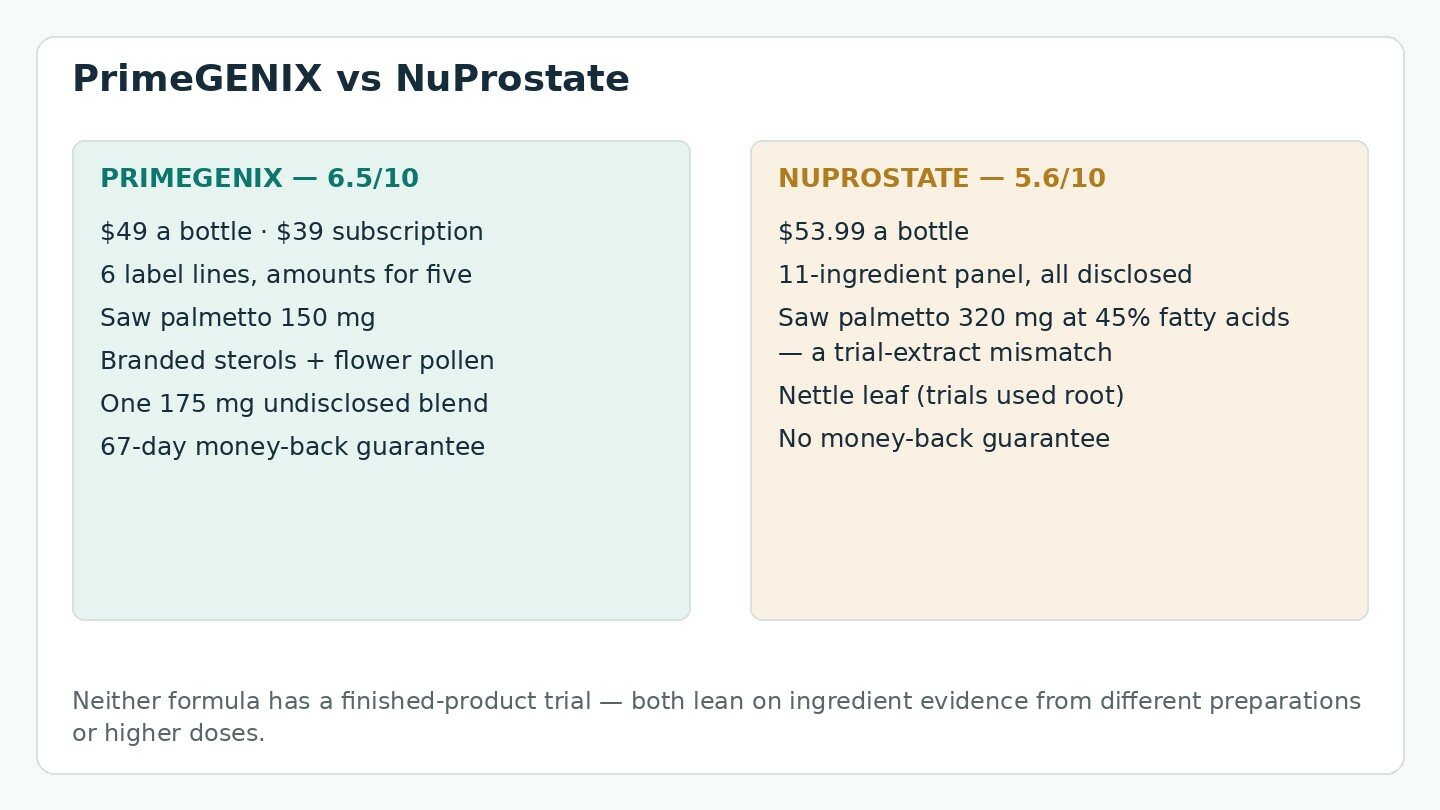
Within our prostate supplement reviews, the natural comparison point is NuProstate. Both are daily multi-ingredient formulas aimed at men's urinary comfort, and neither has been tested in a finished-product clinical trial.
| Product | Our score | Formula | Price |
|---|---|---|---|
| PrimeGENIX Prostate Support | 6.5/10 | 6 label lines, amounts for five, one 175 mg blend | $49 |
| NuProstate | 5.6/10 | A multi-ingredient prostate formula whose own review found a trial-extract mismatch | $53.99 |
The trade-off between the two is straightforward: PrimeGENIX Prostate Support costs less ($49 versus $53.99, or $39 on subscription), publishes clear milligram amounts for five of its six label lines, and carries the stronger beta-sitosterol and flower-pollen literature behind its supporting botanicals. Even so, both formulas lean on ingredients whose best human evidence comes from different preparations or higher doses than what sits in the bottle, and neither product has a clinical trial of itself.
Who Should Buy It — and Who Should Skip It
PrimeGENIX Prostate Support works best when you treat it as a partially transparent sterol-and-botanical trial rather than a miracle prostate shrinker. Here is where the line falls.
Who Should Buy PrimeGENIX Prostate Support
- Men with mild-to-moderate urinary symptoms seeking a published label: If you want a natural daily formula that prints doses for five of its six lines and includes branded pine sterols and flower pollen, this label beats blind proprietary competitors.
- Buyers who audit doses before paying: Men who prefer checking ingredient amounts against the literature — rather than trusting vague blend totals — can verify most of what sits inside each two-capsule serving.
- Shoppers willing to test inside the 67-day guarantee: If you are comfortable tracking symptoms over 60 days across two bottles ($98) and deciding by day 55, the written return policy limits your downside to shipping.
Who Should Skip It
- Anyone expecting saw palmetto to shrink the prostate: Two large placebo-controlled trials found no benefit over placebo at 320 mg and up to 960 mg daily — two to six times this bottle's 150 mg dose — and beta-sitosterol did not shrink prostate size either.
- Men with severe or red-flag urinary symptoms: Inability to urinate, blood in the urine, fever with pelvic or back pain, or rapidly worsening symptoms require a doctor first, never a supplement.
- Buyers who demand 100% dose disclosure: If you refuse to pay for any proprietary blend, note that 175 mg of this formula groups pygeum bark, nettle root, and flower pollen without stating individual amounts.
- Anyone buying specifically for zinc or selenium: Despite appearing twice on the sales page, neither mineral is actually on the Supplement Facts label.
Frequently Asked Questions
Does PrimeGENIX Prostate Support actually work?
No clinical trial has tested PrimeGENIX Prostate Support as a finished formula, so no study proves what this exact bottle delivers. Looking at the individual ingredients, beta-sitosterol, stinging nettle root, and flower pollen extract carry real — if older, smaller, or single-centre — human trial support for urinary symptoms (Wilt et al. 1999, PMID 10368239; Safarinejad 2005, PMID 16635963; MacDonald et al. 2000, PMID 10792162). However, the headline saw palmetto sits at half a failed dose, and none of these ingredients are proven to shrink the prostate.
Why is the saw palmetto only 150 mg?
The maker does not explain why its label supplies 150 mg a day of saw palmetto extract (standardised to 45% total fatty acids) instead of the higher doses tested in major clinical studies. In two large placebo-controlled trials, saw palmetto performed no better than placebo at 320 mg daily for one year (Bent et al. 2006, PMID 16467543) and up to 960 mg daily over 72 weeks (Barry et al. 2011, PMID 21954478). Tellingly, the maker's own FAQ dose-match claim names only Flowens™ and Phytopin®, leaving saw palmetto out.
What is Phytopin® — and are the 53% and 54% figures real?
Phytopin® is a pine-derived plant sterols complex included at 130 mg per daily serving. Its active compound class is beta-sitosterol, which improved symptom scores (−4.9 IPSS points), peak flow (+3.91 mL/s), and residual volume (−28.6 mL) — without reducing prostate size — in a systematic review of four double-blind trials on purified beta-sitosterol (Wilt et al. 1999, PMID 10368239). The maker attributes +53% urine flow, −54% residual bladder volume, and "3x faster" relief to Phytopin®, but publishes no checkable study design, participant count, duration, or sponsor to verify those numbers.
What is Flowens® — and does cranberry help men's urinary symptoms?
Flowens® is a branded cranberry fruit-solids ingredient from Vaccinium macrocarpon, dosed at 250 mg daily in this bottle. The maker pitches it for urinary-tract bacteria and claims a "22.5% average reduction" in PSA, though no checkable study accompanies that figure. In published human research, the one cranberry trial for men's lower urinary tract symptoms gave 42 men 1,500 mg daily of dried cranberry powder for six months against a no-treatment control rather than a placebo (Vidlar et al. 2010, PMID 20804630). This bottle provides one sixth of that amount in a different preparation.
What is hidden in the 175 mg proprietary blend?
The fourth line of the Supplement Facts panel lists a 175 mg Proprietary Herbal Blend combining pygeum bark extract (Pygeum africanum), stinging nettle root (Urtica dioica), and Graminex® G63® flower pollen extract. Because the label prints only the 175 mg total, individual doses for those three herbs are undisclosed. That gap matters because nettle root showed strong results in a large single-centre trial (Safarinejad 2005, PMID 16635963) and pollen extract improved symptoms across four small trials (MacDonald et al. 2000, PMID 10792162), while pygeum rests on an older, smaller literature.
Is it safe — and why does the maker list no warnings?
The maker does not explain why its sales page and published label omit warnings, exclusions, and interaction notices, relying solely on "100% natural ingredients" and "no reported side effects." No safety study exists for this finished product. In individual ingredient trials, beta-sitosterol, nettle, pollen, and cranberry produced mild, mostly digestive effects at low rates, and the CAMUS trial recorded no attributable adverse effects for saw palmetto even at 960 mg daily (Barry et al. 2011, PMID 21954478). Men on prostate or blood-pressure medications, or with red-flag symptoms, should consult a doctor first.
PrimeGENIX Prostate Support or NuProstate — which should I buy?
PrimeGENIX Prostate Support scores 6.5/10 at $49 per bottle ($39 on monthly subscription), ahead of NuProstate at 5.6/10 and $53.99. PrimeGENIX costs less, discloses exact amounts for five of its six label lines, and includes branded pine sterols and flower pollen backed by older or smaller human trials. NuProstate's review flagged a trial-extract mismatch. Still, neither supplement has been tested in a finished-product trial, and both rely on ingredients whose best clinical evidence comes from different preparations or higher doses than what each bottle delivers.
Where can I buy it — and why don't the pack prices say how many bottles they contain?
PrimeGENIX Prostate Support is sold direct via the maker's official website, where the verified $49 single bottle, the $39 monthly subscription (with free shipping in the USA and Canada), and the written 67-day guarantee apply. The store also offers larger tiers at $139 and $239, yet nowhere on the maker's pages does it state how many bottles either tier contains. The site offers no explanation for that omission, so confirm the exact bottle count with the maker in writing before selecting either larger option.
PrimeGENIX Prostate Support — Our Score: 6.5/10
Score: 6.5/10 · Sub-scores: Ingredients 7.0 · Evidence 5.0 · Safety 6.5 · Value 6.0 · Best for: Men who want a prostate formula whose headline doses are printed on a published label, with branded sterol and pollen ingredients, judged inside a 67-day guarantee · Main caution: The headline saw palmetto is 150 mg — half the dose that showed no benefit over placebo in two large trials; the maker's 53%, 54% and 22.5% ingredient figures come with no study that can be checked, and 175 mg of the formula is an undisclosed blend · Fair trial: Two bottles ($98) — at two capsules a day they last 60 days, inside the 67-day guarantee; decide by about day 55 so a return arrives in time
Sources & Method
This review is based on the maker's official sales page and store (read November 2026), the maker's published Supplement Facts label, and the published human clinical literature cited throughout — including Bent et al. 2006 (PMID 16467543) and Barry et al. 2011 (PMID 21954478) on saw palmetto, Wilt et al. 1999 (PMID 10368239) on beta-sitosterol, Vidlar et al. 2010 (PMID 20804630) on cranberry, Safarinejad 2005 (PMID 16635963) on stinging nettle root, and MacDonald et al. 2000 (PMID 10792162) on flower pollen extract. Scores follow the standard SuppChecked scoring method across ingredients, evidence, safety, and value.
Last reviewed: November 2026
