
- Quick Answer
- Bark, Extract, Yohimbine: Three Different Things Sold as One Word
- What the Evidence Actually Belongs To
- The Label Problem
- The Risk File
- Common Effects: The Stimulant Cluster
- Serious Events: What the Reports Show
- Interactions: The Medicines That Collide
- Who Should Not Touch It
- The Regulatory Split
- If It Is in Your Pre-Workout or Male Formula
- Frequently Asked Questions
- Is yohimbe the same as yohimbine?
- Does yohimbe work for erectile dysfunction?
- How much yohimbine is in yohimbe bark supplements?
- Can yohimbe raise blood pressure?
- Is yohimbe safe with antidepressants?
- Is there a safe dose of yohimbe?
- Why is yohimbe banned in some countries?
- Read This Next
Quick Answer
Split the word in two and most of the confusion disappears. "Yohimbine" is a single, standardised drug that was tested for erectile dysfunction in the 1990s and beat placebo modestly. "Yohimbe" is tree bark, sold as a supplement, and it has never been through a comparable trial.
What the supplement version does deliver is unpredictability. Independent testing of 49 US brands found anywhere from no detectable yohimbine to 12.1 mg in a single serving — a full drug-level dose — with most labels giving no accurate amount at all.
The risk file, unlike the benefit file, is well documented. Poison-centre records link these products to racing hearts, blood-pressure spikes and anxiety severe enough to need hospital care. Our verdict: this is a drug wearing a supplement label, and it should be read that way.
Bark, Extract, Yohimbine: Three Different Things Sold as One Word
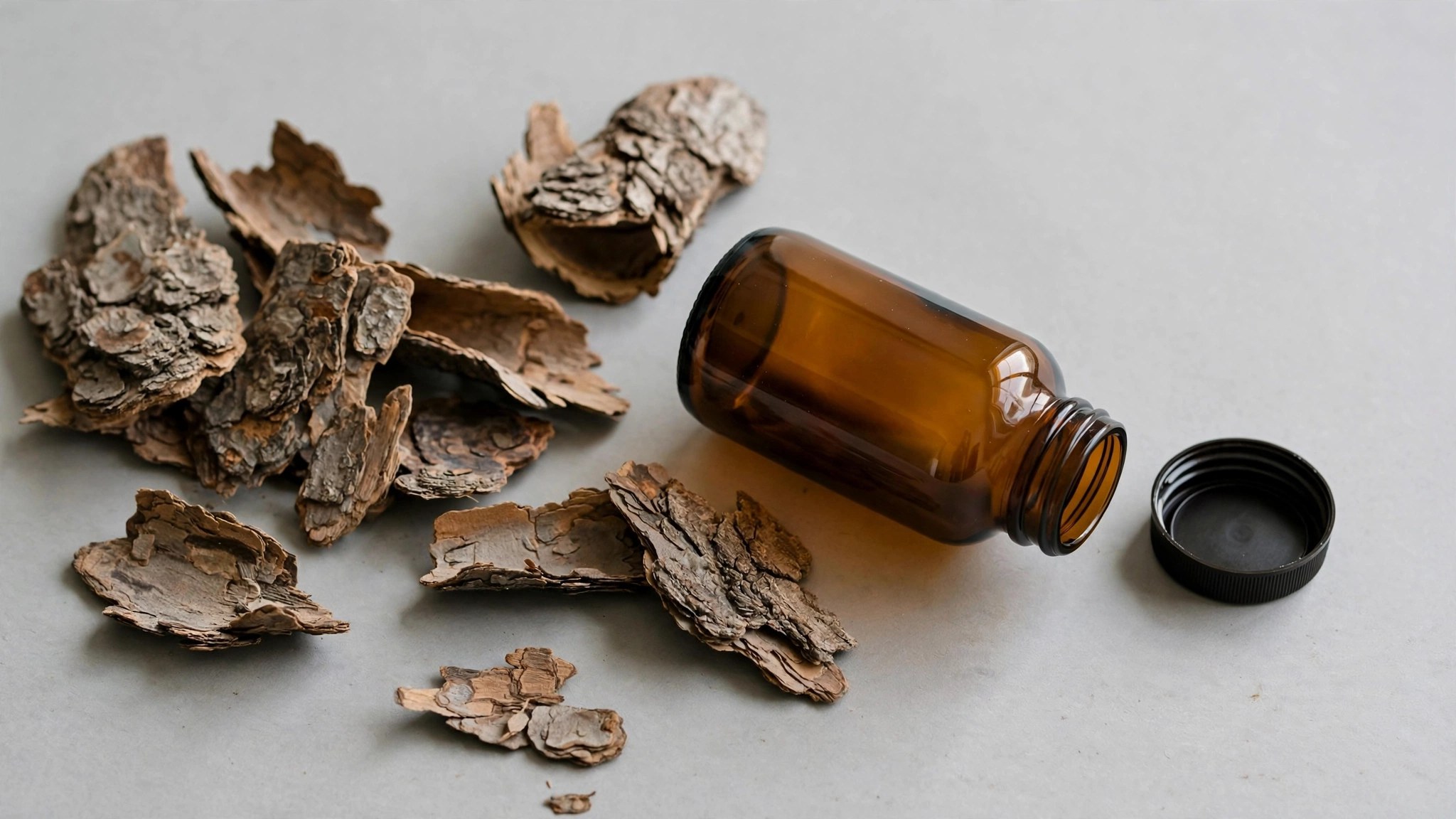
Yohimbe is the bark of Pausinystalia yohimbe, an evergreen tree native to central and western Africa. The bark has a long traditional history as an aphrodisiac, and it contains a mixture of alkaloids — yohimbine, rauwolscine and corynanthine among them.
Yohimbine is just one of those alkaloids, isolated and purified. It blocks alpha-2 adrenergic receptors, which releases the brakes on the sympathetic nervous system. That single mechanism explains both the hoped-for erection effect and most of the side effects.
Yohimbine hydrochloride is that purified alkaloid made into a medicine: a manufactured salt, standardised so every tablet carries a known dose. It was prescribed for erectile dysfunction, and it is the form used in the clinical trials discussed below.
A bark extract sits in a different world. "Standardised to 8% yohimbine" describes one batch assay, not a guaranteed dose in your capsule. The underlying plant material varies, and — as the testing section shows — the finished products vary even more.
The distinction is not pedantry, because yohimbine has a narrow comfort zone. Too little does nothing at all. Too much produces the stimulant overload described in the risk file below. A product category that cannot state its dose cannot stay inside that zone on purpose.
What the Evidence Actually Belongs To
The core evidence is a 1998 meta-analysis by Ernst and Pittler in the Journal of Urology. It pooled seven randomised, placebo-controlled trials of yohimbine monotherapy for erectile dysfunction. Men on yohimbine had higher odds of reported improvement than men on placebo (odds ratio 3.85, 95% confidence interval 2.22 to 6.67).
Read that result at its correct weight. The trials were small, their doses ran from 15 to 30 mg of yohimbine a day, and success was mostly self-reported improvement rather than a measured endpoint. They also predate modern ED medicines, which reset what "works" means.
Serious adverse reactions in those trials were, in the authors' words, infrequent and reversible. That reassurance belongs to supervised drug dosing in selected patients. It does not transfer to an unlabelled dose in a supplement blend.
History underlines the point. Once PDE5 inhibitors arrived, yohimbine quietly left the standard treatment pathway for erectile dysfunction. It survives at scale mainly in supplements — the one setting where its dose is not controlled.
For the bark and its extracts, the evidence file is essentially empty. NCCIH states there is very little research in people on yohimbe as a dietary supplement, and not enough evidence for definite conclusions about its effectiveness for any condition. The Natural Medicines database likewise rates the bark's evidence as insufficient to judge.
The same applies to the other uses on the labels. Yohimbe is promoted for athletic performance, weight loss and mood, and NCCIH's position covers all of them: there is not enough research to say whether the supplement is helpful for any of these conditions either.
Notice what kind of evidence would settle this and does not exist: a single modern trial of a standardised bark extract, at a stated dose, against placebo. The bark has been sold for decades without anyone producing it.
So the honest summary is lopsided. A modest, old, drug-level benefit on one side; an untested botanical product on the other. Any page that quotes the drug trials while selling you the bark is spending evidence it does not have.
The Label Problem
In 2015, Cohen and colleagues at Harvard Medical School and the University of Mississippi bought 49 brands of yohimbe or yohimbine supplements from seven major US retailers and assayed them in the laboratory. What they found is the single most important fact in this article.
Measured yohimbine per recommended serving ranged from none detected to 12.1 mg across the 49 brands. For scale, the prescription trials above used 15 to 30 mg a day. The strongest supplement serving was, on its own, a pharmaceutical dose.
The labels rarely helped a buyer judge that. Only 11 of the 49 brands stated how much yohimbine the product contained. Where an amount was stated, the measured content ran from 23% to 147% of the figure printed on the label.
Safety information fared worse. Only 2 of the 49 brands — 4.1% — gave consumers both an accurate quantity and information about known adverse effects. Roughly one in five brands mentioned no side effects at all.
There was a stranger finding underneath. Natural bark extract should contain rauwolscine and corynanthine alongside yohimbine, yet 39% of the brands contained neither. The authors concluded the yohimbine in those products was likely synthetic or highly refined — not simply bark in a capsule.
In the authors' reading, some of those products may not merely be mislabelled but unlawful. Synthetic yohimbine is a drug ingredient, and US law does not permit it to be sold as a dietary supplement ingredient. Yet the missing companion alkaloids in 39% of brands pointed to exactly that: refined or synthetic yohimbine standing in for bark.
The raw material starts variable before any of this. A companion analysis by Raman and colleagues of 12 samples of commercial yohimbe bark — the material manufacturers actually buy — found the quantity and quality of its yohimbine to be extremely variable.
Label failure here is not a new discovery, either. Dutch drug-information pharmacists reported in the BMJ that a product labelled as 500 mg of yohimbe bark extract per tablet contained only caffeine and no yohimbine at all when they analysed it.
Put together, the assay record describes a dosing lottery. The same word on three different labels can mean nothing, a trace, or a full drug dose — and the label usually cannot tell you which ticket you bought.
The Risk File
Common Effects: The Stimulant Cluster
Yohimbine's effects follow its mechanism. Blocking alpha-2 receptors increases sympathetic activity, so the predictable effects are stimulant effects: faster heart rate, higher blood pressure, anxiety, tremor, headache, dizziness, nausea and broken sleep. NCCIH's fact sheet lists the same cluster.
How often do these show up outside trials? The best quantified record comes from the California Poison Control System review by Kearney and colleagues. The reviewers identified 238 cases between 2000 and 2006 involving adults who were symptomatic after taking a yohimbine-containing product.
Among those 238 reported cases, gastrointestinal distress appeared in 46% of cases, tachycardia in 43%, anxiety or agitation in 33%, and hypertension in 25%. These are shares of people who became unwell enough to reach a poison centre — not rates among everyone who takes yohimbe.
Two details in that dataset deserve emphasis. First, 98.7% of the cases involved herbal products rather than the prescription drug. Second, reported cases climbed steadily, from 1.8 cases per 10,000 adult exposures logged by the system in 2000 to 8.0 per 10,000 in 2006.
The anxiety effect is consistent enough that researchers have used yohimbine in laboratory studies precisely because it can provoke anxiety responses. A compound used as a research tool for inducing unease deserves respect when it turns up in a casual pre-workout.
Serious Events: What the Reports Show
Compared with the average substance exposure in the same poison-centre system, yohimbine cases were significantly more likely to involve severe outcomes (odds ratio 5.81, 95% confidence interval 4.43 to 7.64) and to need care at a health facility (odds ratio 2.35, 95% confidence interval 1.82 to 3.04).
Beyond the poison-centre data, NCCIH notes that yohimbine has been associated with cardiac arrhythmia, blood-pressure problems, heart attacks and seizures. These come from reports and case literature rather than trials, so treat them as documented events, not as measured risks with a denominator.
The case literature shows the extremes. A report in the Journal of Medical Toxicology describes a man who took yohimbe extract and developed an erection that would not subside, eventually requiring a surgical shunt procedure in an operating room.
Other case accounts describe seizures and loss of consciousness after a bodybuilder ingested 5 grams of yohimbine — hundreds of times a typical serving. Overdose cases do not describe normal use, but they mark where the dose-response curve ends.
Interactions: The Medicines That Collide
The interaction map matters because the men most likely to meet yohimbe — in male formulas and pre-workouts — are often already medicated. Start with antidepressants. NCCIH states plainly: do not combine yohimbe with monoamine oxidase inhibitors, and it urges caution with tricyclic antidepressants.
Blood-pressure medicines interact in both directions. Yohimbine pushes blood pressure up, against the purpose of treatment. It can also directly reverse clonidine, an antihypertensive that works through the very alpha-2 receptors yohimbine blocks, as Dutch pharmacists warned in the BMJ letter cited above.
Stimulants stack. Caffeine and other pre-workout stimulants push heart rate and blood pressure the same way yohimbine does, so a blend can deliver a combined load neither ingredient would produce alone. Drug references add tyramine-rich foods to the caution list for the same blood-pressure reason.
For SSRI antidepressants specifically, the regulator warnings name MAO inhibitors and tricyclics rather than SSRIs. That is not a clearance. Additive agitation and blood-pressure effects make any antidepressant combination a question for your prescriber or pharmacist, not a self-experiment.
Who Should Not Touch It
Health Canada's advisory is the bluntest official summary: yohimbine should only be used under the supervision of a healthcare practitioner, and unauthorised products may cause serious reactions particularly in people with high blood pressure or heart, kidney or liver disease.
To that list, add anyone with an anxiety or panic disorder — anxiety and agitation featured in a third of the poison-centre cases, and the drug's stimulant action points the same way. NCCIH also advises people with psychiatric conditions and kidney problems to avoid it.
It is not for children, and NCCIH judges oral yohimbe potentially unsafe during pregnancy and breastfeeding. If any line of this section describes you, the evidence audit ends here: do not take it.
The Regulatory Split
Why is this on open shelves in the United States at all? Because US law treats supplements as a category of food. Federal law does not require a supplement to be proven safe or effective before it is sold; the burden of catching problems falls afterwards.
One boundary does exist: NCCIH notes it is illegal in the US to market an over-the-counter yohimbine product as a treatment for erectile dysfunction without FDA approval. Yohimbine the drug is regulated as a drug; yohimbine the "supplement ingredient" largely is not.
Other regulators drew the line earlier. In Canada, yohimbine is a prescription drug, not an authorised over-the-counter natural health product, and Health Canada has seized unauthorised yohimbine products from retailers.
Yohimbine is likewise prescription-only in the United Kingdom and Australia, and a number of European states prohibit yohimbe bark in food supplements. NCCIH summarises the pattern in one sentence: because of inaccurate labelling and the potential for serious side effects, yohimbe supplements have been restricted or banned in many countries.
The asymmetry is the lesson. The same molecule that requires a prescription conversation in Toronto or London sits in US pre-workouts with no dose on the label. Regulation, not chemistry, is what changes at the border.
If It Is in Your Pre-Workout or Male Formula
You may already be taking yohimbe without choosing to. It appears in pre-workouts, fat burners and male-performance blends, sometimes under its own name and sometimes as rauwolscine — also labelled alpha-yohimbine — a sibling alkaloid from the same bark with the same stimulant logic.
The poison-centre data hint at how it is actually used: among the 238 California cases, 27.7% of users took it for sexual enhancement, 9.2% for weight loss and 7.6% for stimulant effects. The workout and fat-loss uses are not fringe; they are core use cases.
The specific trap is the proprietary blend. A label may list "yohimbe bark extract" inside a blend with only the total blend weight shown. Given the assay range — nothing to 12.1 mg per serving — a blend listing tells you the ingredient is present and nothing about your dose.
This is also why the standard advice to "start with half a serving" fails here. Halving an unknown dose still leaves an unknown dose. Titration only works when the number on the label means something, and the assay record says it usually does not.
Practical label reading, then: scan for yohimbe, yohimbine HCl, rauwolscine and alpha-yohimbine before anything else in a stimulant product. If the product also contains caffeine, treat the combination, not each ingredient, as the dose your heart will experience.
Frequently Asked Questions
Is yohimbe the same as yohimbine?
No. Yohimbe is the tree and its bark; yohimbine is one alkaloid inside that bark; yohimbine hydrochloride is the purified, standardised drug form made from it. The three words are used interchangeably on labels, which is exactly how drug evidence gets attached to bark products.
Does yohimbe work for erectile dysfunction?
The drug showed a modest benefit in seven small 1990s trials. The supplement has never been trialled for ED, and regulators who reviewed the file — NCCIH among them — conclude the evidence is insufficient for any condition. If ED is the problem, it also deserves a medical workup: it can be an early sign of cardiovascular disease.
How much yohimbine is in yohimbe bark supplements?
Nobody can tell you for a given bottle — that is the finding. Across 49 tested US brands, a serving contained anywhere from no detectable yohimbine to 12.1 mg. Only 11 brands even printed an amount, and measured content ran from 23% to 147% of the printed figure.
Can yohimbe raise blood pressure?
Yes — it is one of its most consistent effects, and it follows from the mechanism: blocking alpha-2 receptors increases sympathetic activity. Hypertension was recorded in 25% of the 238 symptomatic cases in the California poison-centre review, and blood-pressure problems are on NCCIH's association list.
Is yohimbe safe with antidepressants?
With MAO inhibitors, regulators say do not combine it at all; with tricyclic antidepressants, NCCIH urges caution. SSRIs are not named in those warnings, but additive stimulation and blood-pressure effects make any antidepressant pairing a prescriber question. Never adjust an antidepressant to make room for a supplement.
Is there a safe dose of yohimbe?
No safe dose has been established for the supplement. The drug trials used 15 to 30 mg of pure yohimbine a day, in selected patients, under supervision. A supplement serving might contain none of that or a drug-level amount, and the label usually cannot tell you which — which is the problem in one sentence.
Why is yohimbe banned in some countries?
Because regulators elsewhere weighed the same two facts in this article — labels that cannot be trusted and a side-effect record that includes heart attacks and seizures — and classified the alkaloid as a medicine. Canada treats yohimbine as prescription-only and has seized unauthorised products; the US supplement framework has not followed.


Last reviewed: October 2026. This article is educational and is not medical advice.
