
- Quick Answer
- Our Findings
- Why You Should Trust This Review
- Our Verdict
- How We Scored It
- What Is GenF20 Algae Calcium?
- The Ingredients
- Vitamin D3
- Calcium from Aquamin®
- Magnesium from Aquamin®
- The Organic Vegan & Red Algae Blend
- Citrus Bioflavonoids
- Vitamin K2 (MK-7)
- The Label Audit: Two Weeks on the Sales Page, Twelve Weeks in the Study
- 1. The Timeline: Two Weeks Promised vs. Twelve Weeks Studied
- 2. The Vitamin K2 Line: 85 mg Printed vs. 180 Micrograms Studied
- 3. The Hero Dose: 2,400 mg Tested vs. an Unpublished Blend Split
- The Evidence, Read Properly
- How Long Does It Take to Work?
- Is It Safe?
- Side Effects: What Is Actually Known
- When a Doctor Comes First
- Is It a Scam?
- Price and Packs
- Purchase Options
- How It Compares
- Who Should Buy It — and Who Should Skip It
- Who Should Buy GenF20 Algae Calcium
- Who Should Skip It
- Frequently Asked Questions
- Does GenF20 Algae Calcium actually work?
- How long does it take to work — is it really two weeks?
- How much Aquamin is in each serving?
- What does the "85 mg" Vitamin K2 line mean — is that the real amount?
- How much calcium do you get per day — and how close is that to the daily limit?
- Is algae calcium safe — who should not take it?
- GenF20 Algae Calcium vs AlgaeCal — what is the difference?
- Where can I buy it — is it on Amazon?
- Sources & Method
- Read This Next
SuppChecked is an independent supplement review site. When you buy a product through links on our pages, we may earn a commission at no extra cost to you. Every score, price, and product claim on this page is checked against the maker's official records and the published scientific literature, and brands never pay to change our scores.
Shoppers looking at GenF20 Algae Calcium usually fall into two camps. One group wants a plant-based calcium supplement with clear nutrient amounts printed on the bottle instead of a limestone-derived tablet. The other group has seen the maker's headline promise of joint pain relief in just two weeks and wants to know if that claim holds up.
This review checks both sides against primary records. We read the maker's printed Supplement Facts panel, bottle back, and official store pages side by side with the published human research the maker cites. What comes out is a real formula with genuine mineral amounts, paired with three concrete gaps between the sales copy, the printed label, and the science.
Quick Answer
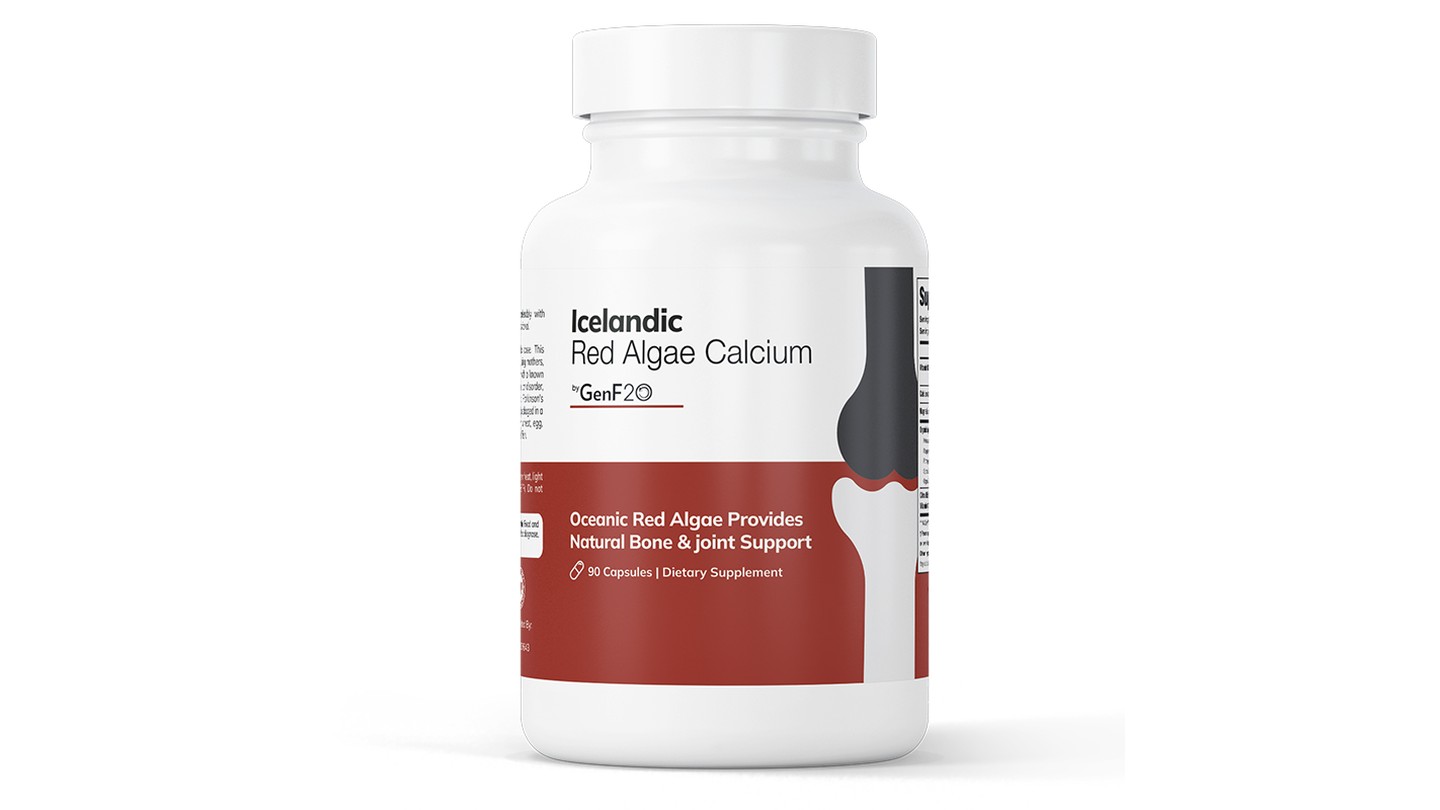
GenF20 Algae Calcium scores 6.0/10. It is a plant-based calcium formula built on Aquamin®, a trademarked mineralized red algae. The label prints exact amounts for calcium, magnesium, vitamin D3, and citrus bioflavonoids.
Three specific label and evidence gaps hold the score down. First, the maker promises joint relief in two weeks, yet the Aquamin study it cites ran 12 weeks and reports no two-week outcome. Second, the printed Vitamin K2 line reads 85 mg, which appears misprinted against the microgram doses used in human research. Third, the algae sits inside a 3,535 mg blend of 12 ingredients with no split published, so the exact Aquamin dose cannot be checked.
A single bottle costs $59.95 with a 67-day money-back guarantee. Best for: adults who want plant-based calcium with printed main nutrient amounts and will judge results over a real 12-week timeline.
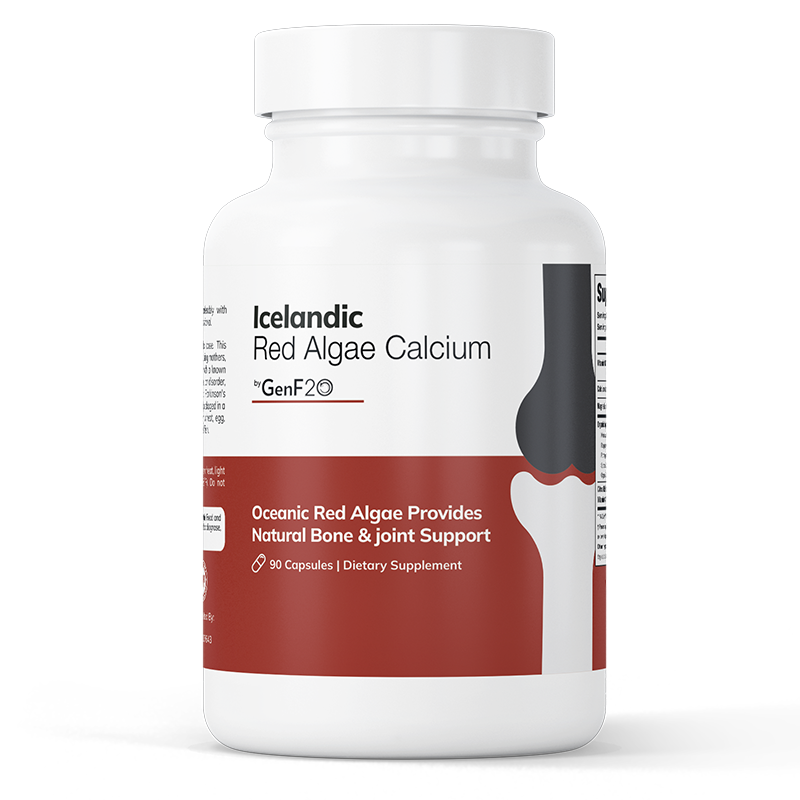
GenF20 Algae Calcium — Our Score: 6.0/10
Score: 6.0/10 · Sub-scores: Ingredients 7.0 · Evidence 5.0 · Safety 6.5 · Value 6.0 · Best for: Adults who want a plant-based calcium with the main nutrient amounts printed on the label, and who will judge it over the study's real 12-week timeline inside the guarantee window · Main caution: The maker promises relief in two weeks, but the Aquamin study it cites ran 12 weeks, was a small pilot whose groups differed at baseline, and tested the ingredient — not this formula; the label also misprints the Vitamin K2 amount, and the algae share sits unpublished inside a 3,535 mg blend · Fair trial: Two bottles ($59.95 each) — the guarantee covers the first two opened bottles inside 67 days, while the cited study ran 12 weeks, so judge by about day 60
Our Findings
What we like
- Main nutrient amounts are printed on the label: You can see exact serving figures for calcium (1,000 mg), magnesium (96 mg), vitamin D3 (800 IU), and citrus bioflavonoids (500 mg) before you buy.
- A named, trademarked algae source: The calcium and magnesium come from Aquamin®, a mineralized Icelandic red algae, rather than an unnamed marine powder.
- Human pilot trials exist for the core ingredient: Aquamin has published human pilot studies in knee osteoarthritis, plus a longer 24-month postmenopausal study looking at blood lipids and cardiovascular outcomes.
- Written, standard guarantee terms: Leading Edge Health publishes a 67-day money-back guarantee that covers the first two opened bottles along with any unopened bottles returned on time.
What gives us pause
- The two-week promise contradicts the 12-week study: The sales pages promise pain-free joints in two weeks, while the Frestedt trial cited for Aquamin ran 12 weeks and reported no 14-day result.
- The Vitamin K2 line is misprinted: The Supplement Facts panel prints 85 mg of Vitamin K2 (MK-7), roughly 470 times the 180-microgram daily dose studied in human bone trials.
- The red algae dose is hidden inside a blend: Mineralized red algae is grouped with 11 fruit and vegetable powders in a 3,535 mg blend with no split, so you cannot confirm whether it matches the 2,400 mg trial dose.
- Zero cautions printed for a full-dose calcium product: Neither the Supplement Facts panel nor the visible bottle back prints directions or warnings, and the sales page claims zero adverse effects despite known calcium risks.
- Cure language on the sales pages: The maker uses phrases like "Cure your joint pain," which oversteps what any dietary supplement can legally or scientifically claim.
Why You Should Trust This Review
For this review, we read the maker's printed Supplement Facts panel and bottle back, the maker's official store, formula and guarantee pages, and the published trial reports themselves — Frestedt et al. 2008 (PMID 18279523) and Frestedt et al. 2009 (PMID 19187557) — and every score, price and figure in this review traces back to one of those records.
Our Verdict
GenF20 Algae Calcium earns 6.0/10. That middle-of-the-pack score reflects a split verdict. On the positive side, Leading Edge Health built a real plant-based calcium tablet around Aquamin® and printed full daily amounts for calcium, magnesium, and vitamin D3. Buyers who specifically avoid limestone-derived calcium carbonate get a straightforward mineral base without guessing the headline calcium dose.
The main drag on the score is the gap between the sales claims and the science. No clinical trial has tested this finished bottle. The human research on Aquamin itself is pilot-grade, short, and clouded by baseline differences between study groups. Worse, the maker's two-week relief promise directly misstates the 12-week study it cites, while the printed Vitamin K2 amount appears off by a factor of hundreds.
The bottom line is simple: treat GenF20 Algae Calcium as a premium-priced algae calcium supplement, not a two-week joint cure. If you decide to test it, plan your trial around the guarantee maths. Buy two bottles at $59.95 each to match the two-opened-bottle limit. Because the 67-day guarantee closes before the cited study's 12 weeks (84 days) finish, mark your delivery date and make your keep-or-return call by about day 60.
How We Scored It
We score every supplement on SuppChecked against four core areas: Ingredients, Evidence, Safety, and Value. Each sub-score below comes directly from checking the printed bottle label, the published clinical trials, and the live order-page terms.
| Criterion | Score |
|---|---|
| Ingredients | 7.0 |
| Evidence | 5.0 |
| Safety | 6.5 |
| Value | 6.0 |
Ingredients — 7.0/10: The formula earns credit for naming its trademarked algae source, Aquamin®, and printing clear serving amounts for calcium (1,000 mg), magnesium (96 mg), vitamin D3 (800 IU), and citrus bioflavonoids (500 mg). It loses points for two avoidable label flaws. First, the 3,535 mg organic blend hides the exact share of red algae behind 11 fruit and vegetable powders. Second, the Vitamin K2 (MK-7) line prints "85 mg," an apparent unit or figure error that leaves buyers unable to verify the real dose.
Evidence — 5.0/10: No human trial has tested the finished GenF20 Algae Calcium formula for joint comfort or bone density. The maker relies on two small Aquamin pilot trials in knee osteoarthritis—one with 50 completers and a published baseline-imbalance caution, and another with just 14 completers during a partial pain-reliever taper. On top of that thin base, the maker's headline promise of relief in two weeks contradicts the 12-week study it cites, and no bone-density trial backs the bottle's bone framing.
Safety — 6.5/10: Every named ingredient is a conventional nutrient or common plant powder, and the daily doses of calcium (1,000 mg), magnesium (96 mg), and vitamin D3 (800 IU) sit within normal supplemental ranges on their own. The score drops because the Supplement Facts panel and bottle back print zero cautions or drug-interaction warnings for a full-dose calcium tablet. Even more concerning, the sales page claims "zero adverse effects," which clashes directly with large-scale calcium trial data showing a measurable kidney-stone risk.
Value — 6.0/10: At $1.67 to $2.00 per day across the official pack ladder, GenF20 Algae Calcium carries a steep premium compared with generic calcium carbonate or calcium citrate tablets. It sits in the price tier of branded algae calcium formulas rather than everyday minerals. The 67-day money-back guarantee is written and genuine, which protects a cautious buyer, but the return window closes roughly two and a half weeks before the cited study's 12-week mark.
What Is GenF20 Algae Calcium?
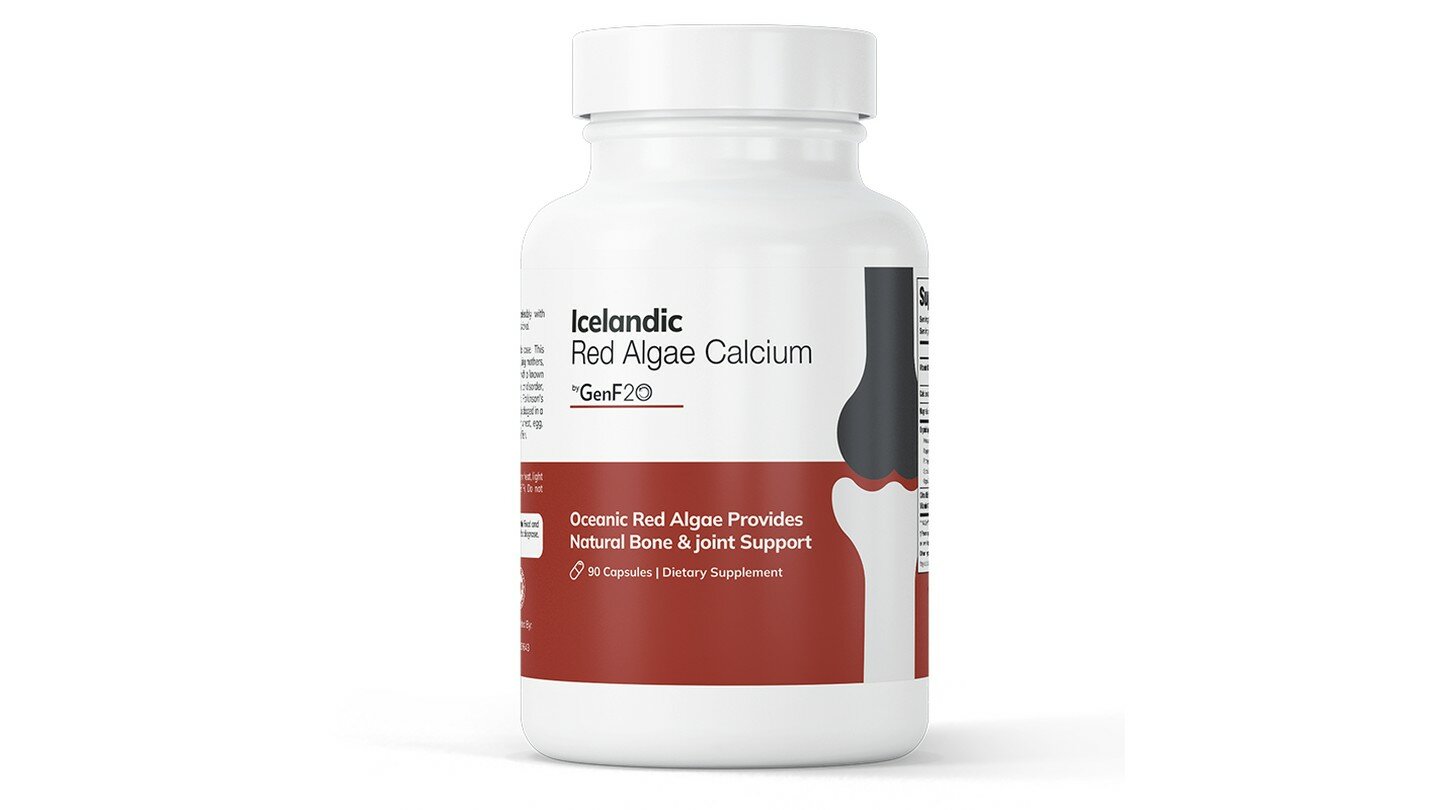
GenF20 Algae Calcium at a Glance
- Our score: 6.0/10
- Brand: GenF20 Algae Calcium (maker's name: Icelandic Red Algae Calcium)
- Company: Leading Edge Health
- Product type: Plant-based calcium supplement — 90 tablets
- Primary purpose: Marketed for joint pain relief first and bone strength second
- Formula: Aquamin® Icelandic red algae (1,000 mg calcium) with magnesium 96 mg, vitamin D3 800 IU, citrus bioflavonoids 500 mg, vitamin K2 (MK-7) and a 3,535 mg organic blend
- Clinical research: No trial of the finished product; the cited study tested the Aquamin ingredient (pilot trial, 12 weeks)
- Research limitation: The maker promises results in two weeks, but the cited trial ran 12 weeks with 50 completers and baseline differences between its groups; the blend's algae share is unpublished
- Recommended use: 3 tablets once daily
- Money-back guarantee: 67 days — first two opened bottles plus unopened ones, received within 67 days of delivery
GenF20 Algae Calcium—sold by Leading Edge Health under the bottle name Icelandic Red Algae Calcium—is a plant-based calcium supplement built around Aquamin®, a mineralized marine algae harvested off the coast of Iceland. Instead of quarried limestone calcium carbonate, the tablets pair red algae minerals with vitamin D3, vitamin K2 (as MK-7), citrus bioflavonoids, and a blend of 11 fruit and vegetable powders. Each bottle holds 90 tablets, which provides 30 daily servings when taken as directed on the sales pages: three tablets once per day.
Most algae calcium brands lead with bone density first and mention joints as a side note. Leading Edge Health flips that order. The official pages pitch this formula primarily to adults aged 40 and older dealing with stiff, aching joints, with bone strength positioned as the secondary benefit. The maker frames Aquamin® as a "highly bioavailable" mineral source and presents the formula as "100% all-natural" and plant-based.
That positioning comes with aggressive sales copy that needs careful separation from verified fact. On its store pages, the maker tells readers the tablets can "Cure your joint pain," calls the formula the "most effectively designed supplement for pain relief," promises you can "See results in just two weeks," and states that it "Works with zero adverse effects!" Those are the maker's own claims—not proven medical outcomes—and testing them against the printed label and published trials is the core of the rest of this review.
The Ingredients
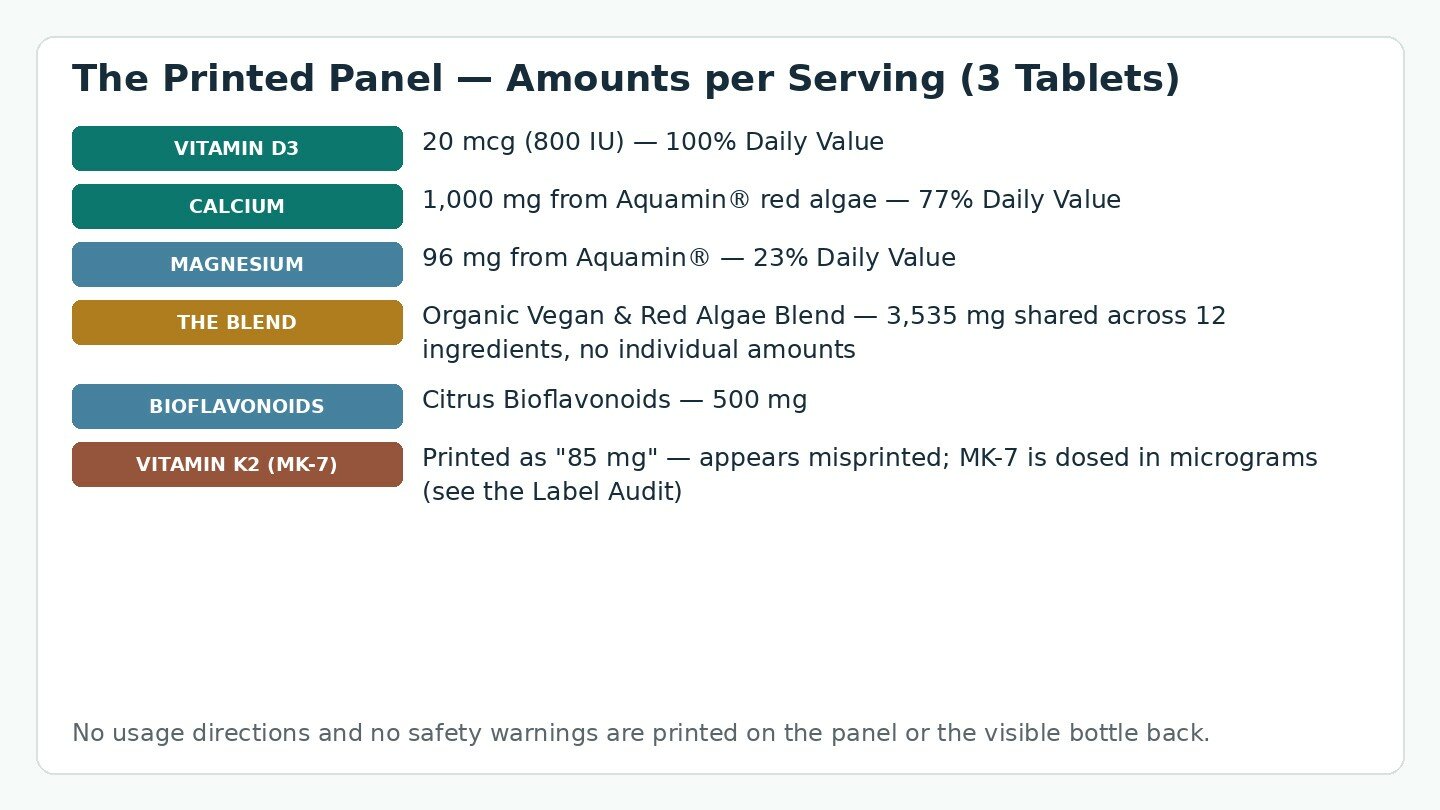
A close read of the printed Supplement Facts panel and bottle back reveals a mixed transparency record. On the plus side, Leading Edge Health prints exact serving amounts for its core nutrients: vitamin D3, calcium, magnesium, and citrus bioflavonoids. Many multi-ingredient supplements in this catalogue hide almost every active inside proprietary blends, so seeing 1,000 mg of calcium and 800 IU of vitamin D3 stated outright is a clear positive.
Where disclosure breaks down is in the bottom half of the panel and around the label margins. The 3,535 mg Organic Vegan & Red Algae Blend bundles 12 separate ingredients together under one total weight with zero individual split. Because mineralized Icelandic red algae sits inside that shared total alongside 11 fruit and vegetable powders, no buyer can verify how many milligrams of raw Aquamin® each three-tablet serving actually delivers.
Two further label omissions stand out. First, the Vitamin K2 (MK-7) line prints "85 mg," a figure that appears misprinted in either unit or number when compared against standard microgram dosing. Second, neither the Supplement Facts panel nor the visible bottle back prints usage directions or safety warnings—a notable gap for a product supplying 1,000 mg of elemental calcium per serving. Buyers only find the three-tablet daily routine and basic medical cautions by reading the separate sales pages.
| Nutrient | Amount per serving (3 tablets) | % Daily Value |
|---|---|---|
| Vitamin D3 | 20 mcg (800 IU) | 100% |
| Calcium (from Aquamin®) | 1,000 mg | 77% |
| Magnesium (from Aquamin®) | 96 mg | 23% |
| Organic Vegan & Red Algae Blend | 3,535 mg | ** |
| Citrus Bioflavonoids | 500 mg | ** |
| Vitamin K2 (MK-7) | 85 mg* | ** |
Table notes: ** Daily Value not established. * Printed verbatim as "85 mg" (Vitamin K2 MK7 from Natto) on the maker's Supplement Facts panel; this unit or figure appears misprinted against standard microgram MK-7 dosing—see The Label Audit below.
Vitamin D3
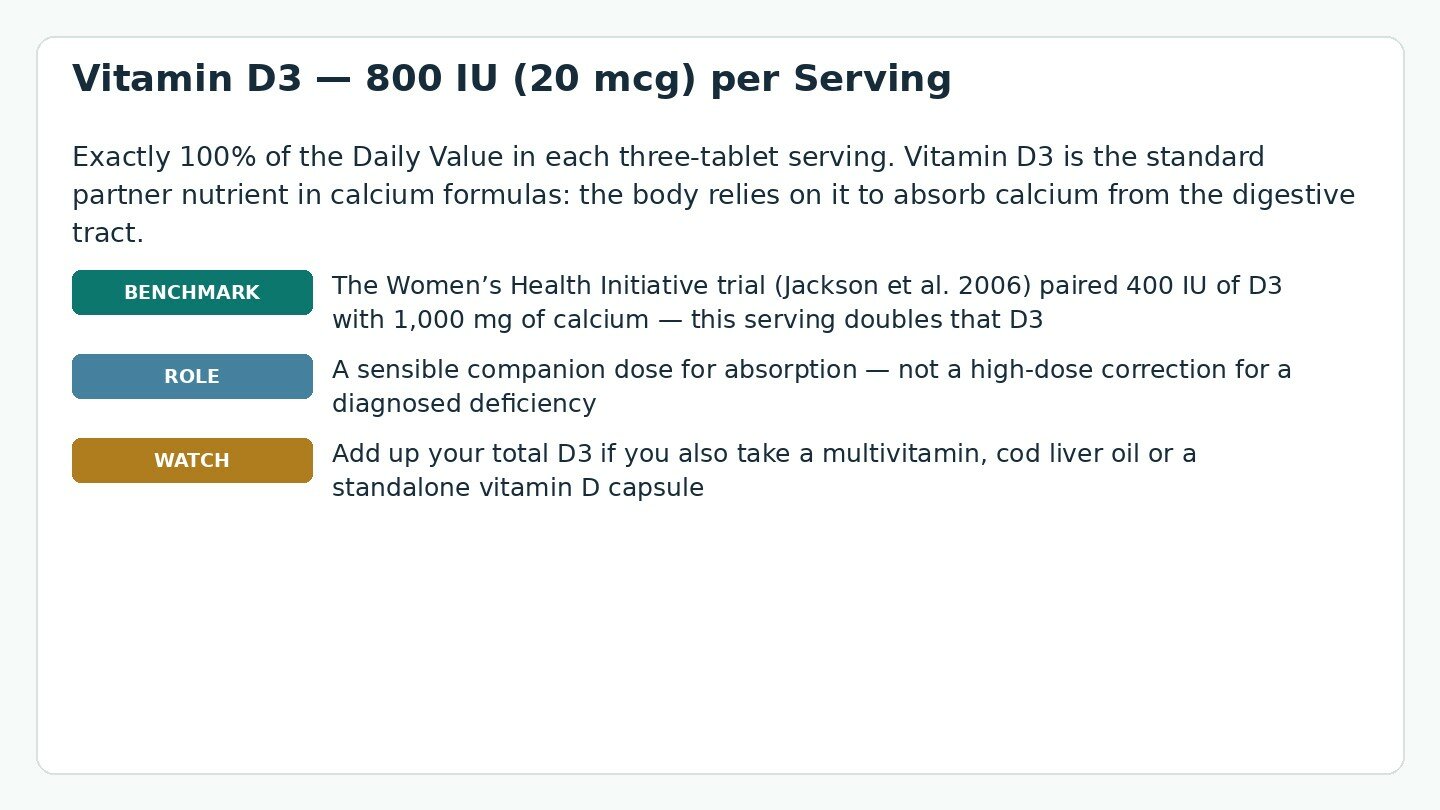
GenF20 Algae Calcium supplies 20 mcg (800 IU) of vitamin D3 per three-tablet serving, which hits exactly 100% of the standard Daily Value. Vitamin D3 is the standard partner nutrient in bone and calcium formulas because the body relies on it to absorb calcium from the digestive tract. Without adequate vitamin D, swallowing a large daily dose of calcium delivers less mineral where the body can use it.
At 800 IU, the dose is practical and unremarkable. It sits above the 400 IU of vitamin D3 paired with 1,000 mg of calcium in the large Women's Health Initiative trial (Jackson et al. 2006, PMID 16481635), while staying well inside routine daily intake ranges. It is enough to serve as a sensible companion to the tablet's calcium without acting as a high-dose correction for a diagnosed vitamin D deficiency.
For most healthy adults, 800 IU of vitamin D3 carries a low risk of side effects on its own. Still, check your total daily intake if you already take a multivitamin, cod liver oil, or a standalone vitamin D capsule, and ask a doctor for a blood test if you suspect a deficiency.
Calcium from Aquamin®
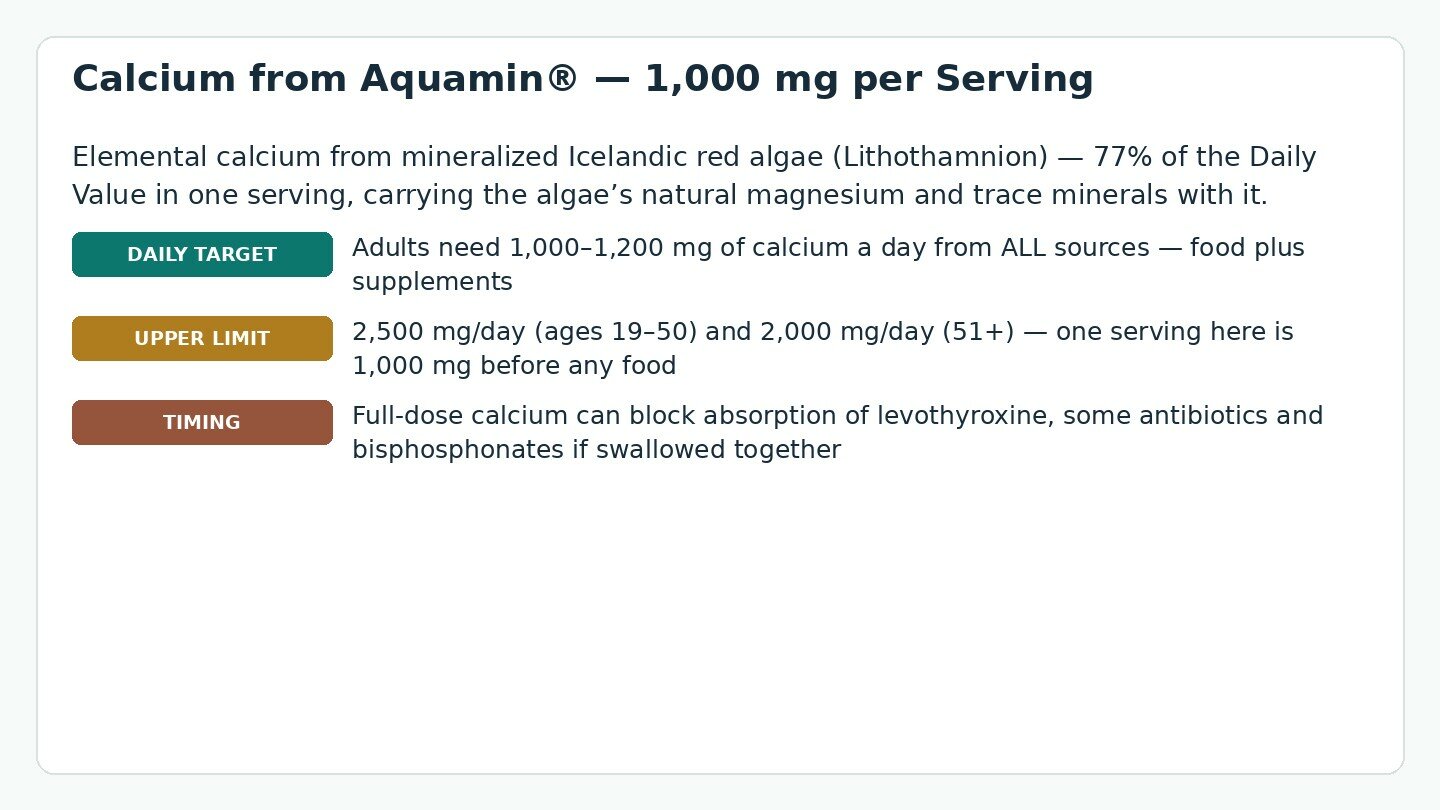
Each three-tablet serving delivers 1,000 mg of elemental calcium (77% Daily Value) sourced from Aquamin®, a mineralized red algae from the Lithothamnion genus. That single serving provides a full daily supplemental calcium load. Because the mineral comes from calcified marine algae rather than crushed limestone, the same natural mineral matrix also carries the tablet's magnesium and trace minerals.
Where buyers need to pay close attention is total daily intake. Standard adult recommended intakes for calcium sit at 1,000 to 1,200 mg per day from all sources combined. Meanwhile, the established tolerable upper intake level is 2,500 mg per day for adults aged 19 to 50, and it drops to 2,000 mg per day from age 51 onward—counting both food and supplements together.
Getting 1,000 mg from one supplement leaves less headroom once milk, yogurt, fortified plant milks, leafy greens, or a daily multivitamin are counted. Full-dose calcium tablets can also block the absorption of prescription medicines like levothyroxine, certain antibiotics, and bisphosphonates if swallowed at the same time, so check timing with a doctor or pharmacist first.
Magnesium from Aquamin®
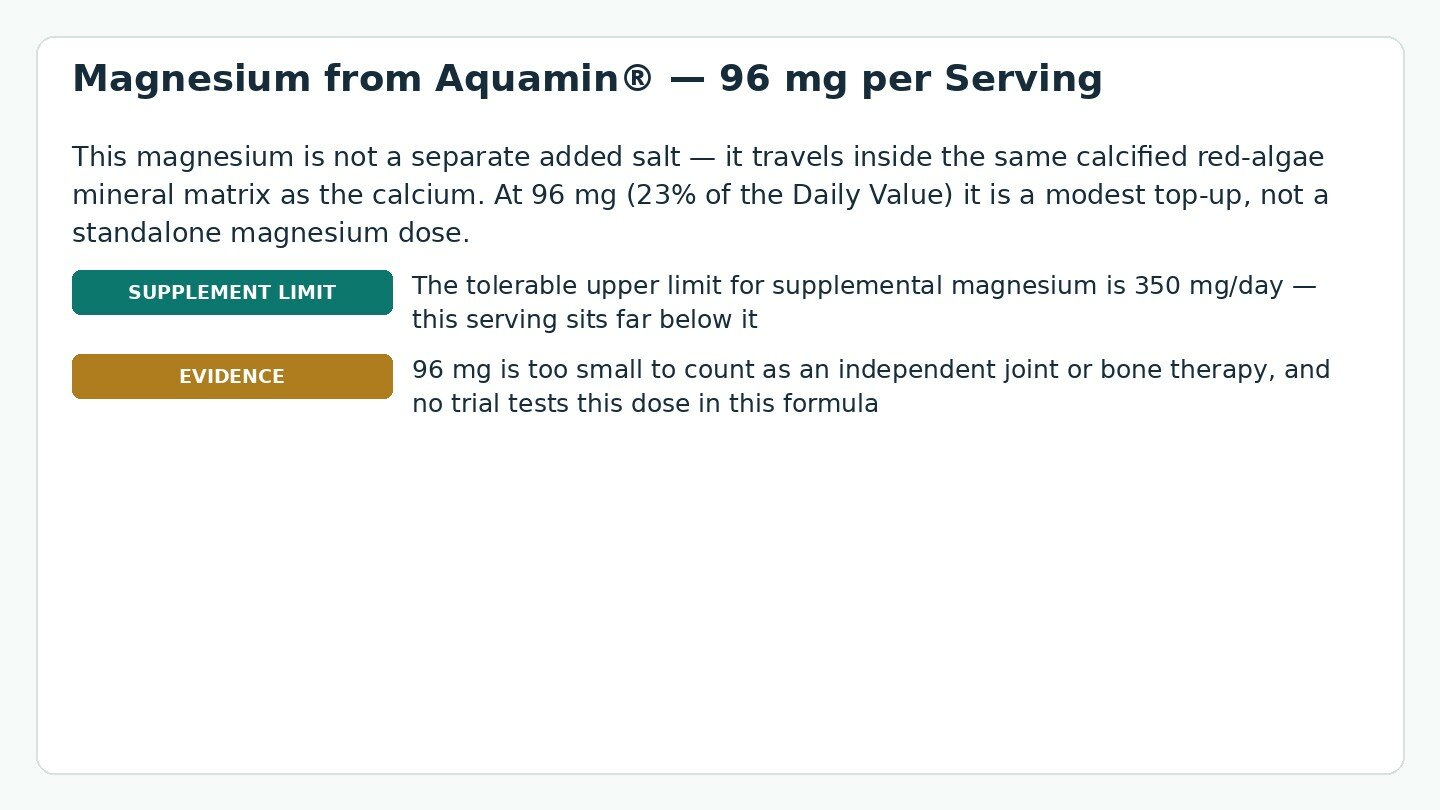
The Supplement Facts panel lists 96 mg of magnesium per serving, which covers 23% of the Daily Value. Like the calcium, this magnesium comes directly from the Aquamin® red algae mineral matrix rather than from a separate synthetic magnesium salt added later in the formula. It travels alongside the calcium as part of the naturally mineralized seaweed structure.
At 96 mg, this is a modest top-up rather than a standalone magnesium supplement. For perspective, the tolerable upper intake level for supplemental magnesium in adults is 350 mg per day—a limit this formula sits well below. That low share keeps the risk of magnesium-driven loose stools low for most users taking only this bottle.
On the evidence side, 96 mg is too small to count as an independent joint or bone therapy on its own, and no trial tests this exact dose inside this finished formula. Think of it as a helpful mineral companion that narrows a mild dietary gap without replacing a targeted magnesium regimen if your doctor ever recommends one.
The Organic Vegan & Red Algae Blend
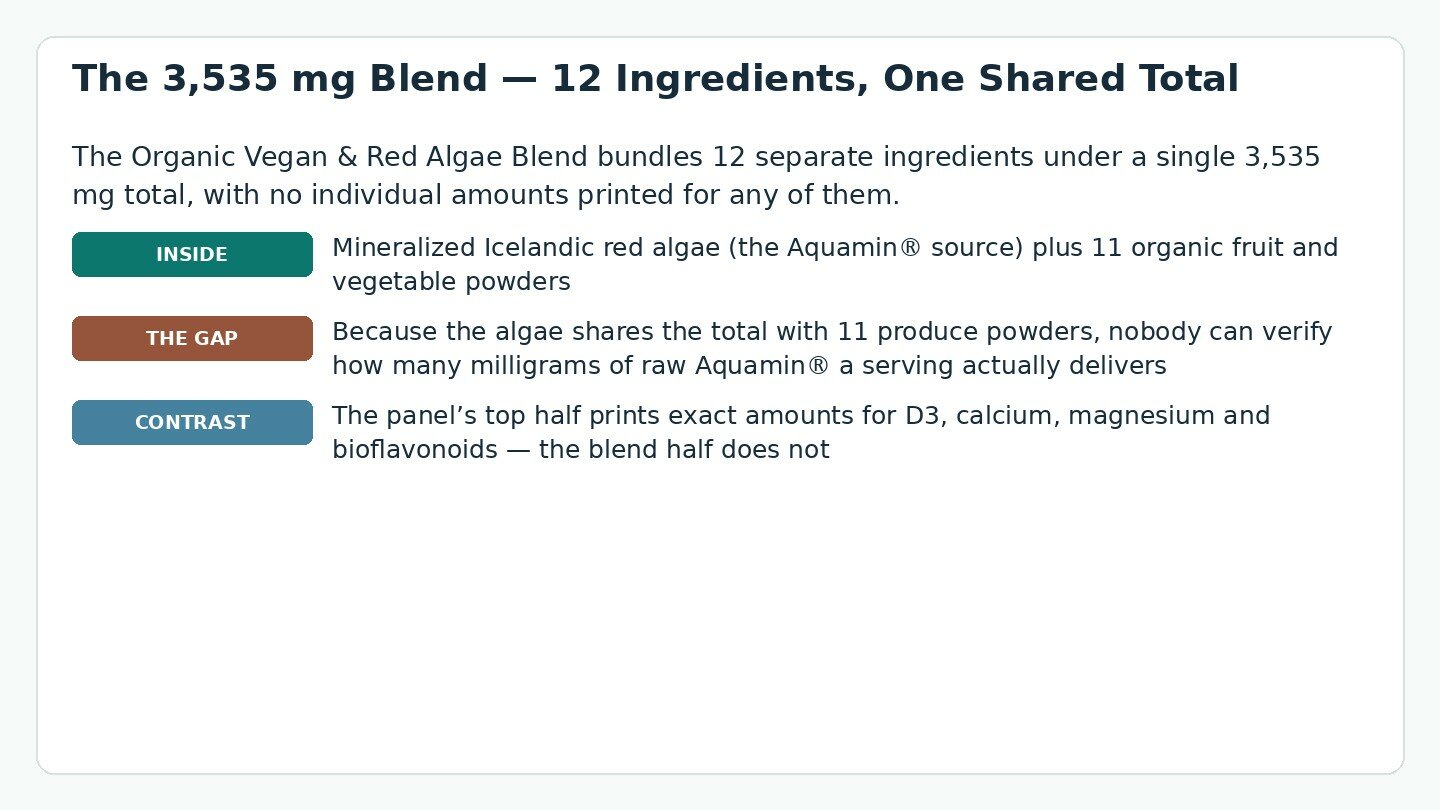
By weight, the largest line on the label is the 3,535 mg Organic Vegan & Red Algae Blend. It lists 12 components in order: mineralized Icelandic red algae first, followed by strawberry, raspberry, blueberry, cherry, pomegranate, cranberry, broccoli, tomato, carrot, spinach, and kale. No Daily Value is established, and no individual weights are printed for any of the 12 ingredients.
Because the internal split is unpublished, you cannot verify how much of that 3,535 mg comes from the red algae and how much comes from the 11 fruit and vegetable powders. A small pinch of dried kale looks identical on a proprietary blend line to a full gram. That blind spot means none of the 11 produce powders can be checked against any studied human dose.
More importantly, this blend is where the core trial-dose question lives. The Frestedt pilot study cited by the maker tested 2,400 mg of Aquamin per day. Because this blend hides the algae's exact share, the label cannot confirm whether three tablets match that studied amount—a gap we unpack in The Label Audit below.
Citrus Bioflavonoids
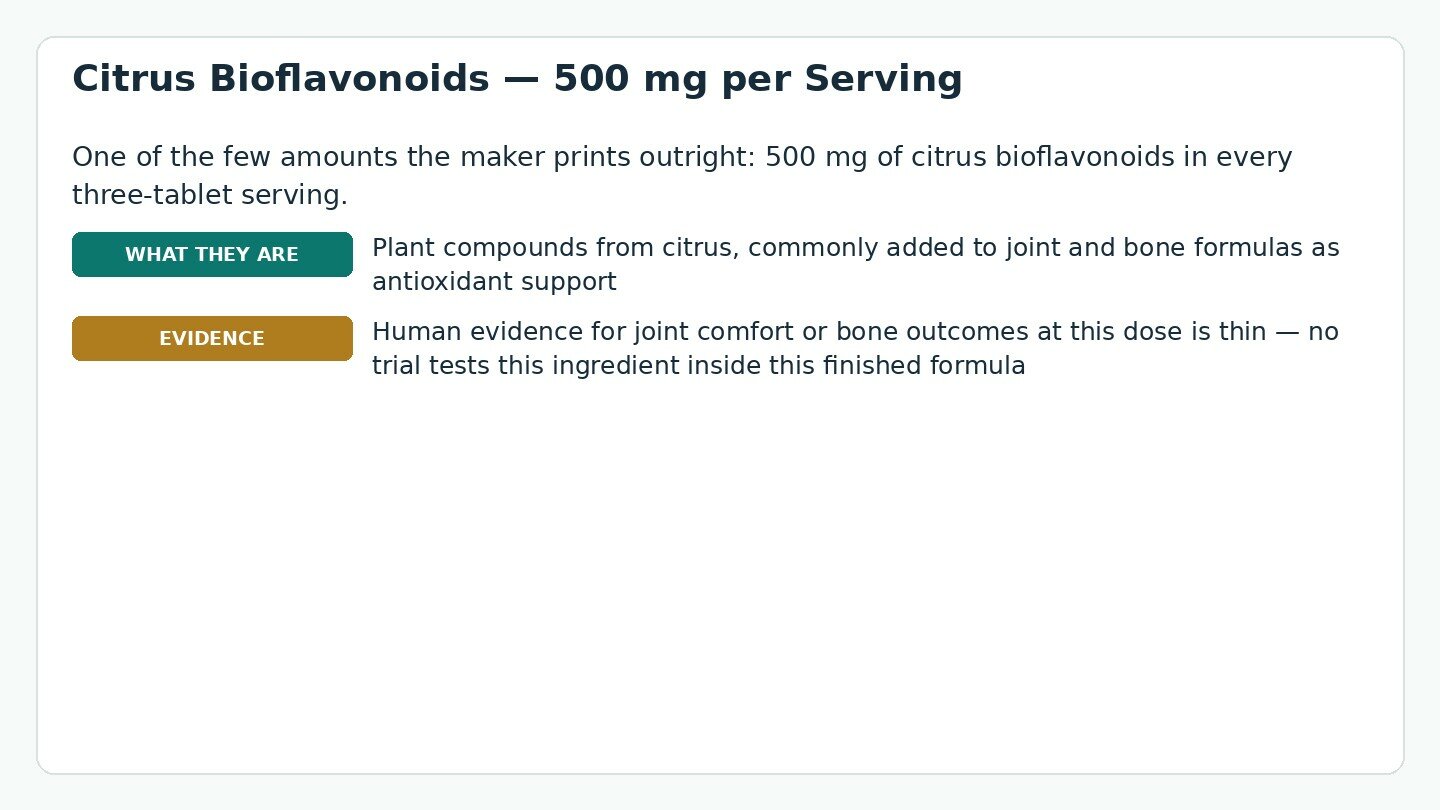
Each serving includes 500 mg of citrus bioflavonoids, with no established Daily Value. Bioflavonoids are plant compounds found naturally in citrus peels and pulp. Unlike the fruit and vegetable powders inside the organic blend, Leading Edge Health lists citrus bioflavonoids on its own line with a clear milligram amount.
Even with the dose printed, the clinical record for this ingredient in a joint or bone supplement is thin. There is no verified human trial record showing that 500 mg of citrus bioflavonoids relieves osteoarthritis joint pain or increases bone mineral density. It is best read honestly as a supporting plant addition rather than an evidence-backed driver of the product's main promises.
From a safety standpoint, citrus bioflavonoids are common dietary plant compounds, though no product-specific safety study has tested them in combination with Aquamin® and high-dose calcium. Anyone taking prescription medications should still review the complete label with a clinician before starting daily use.
Vitamin K2 (MK-7)
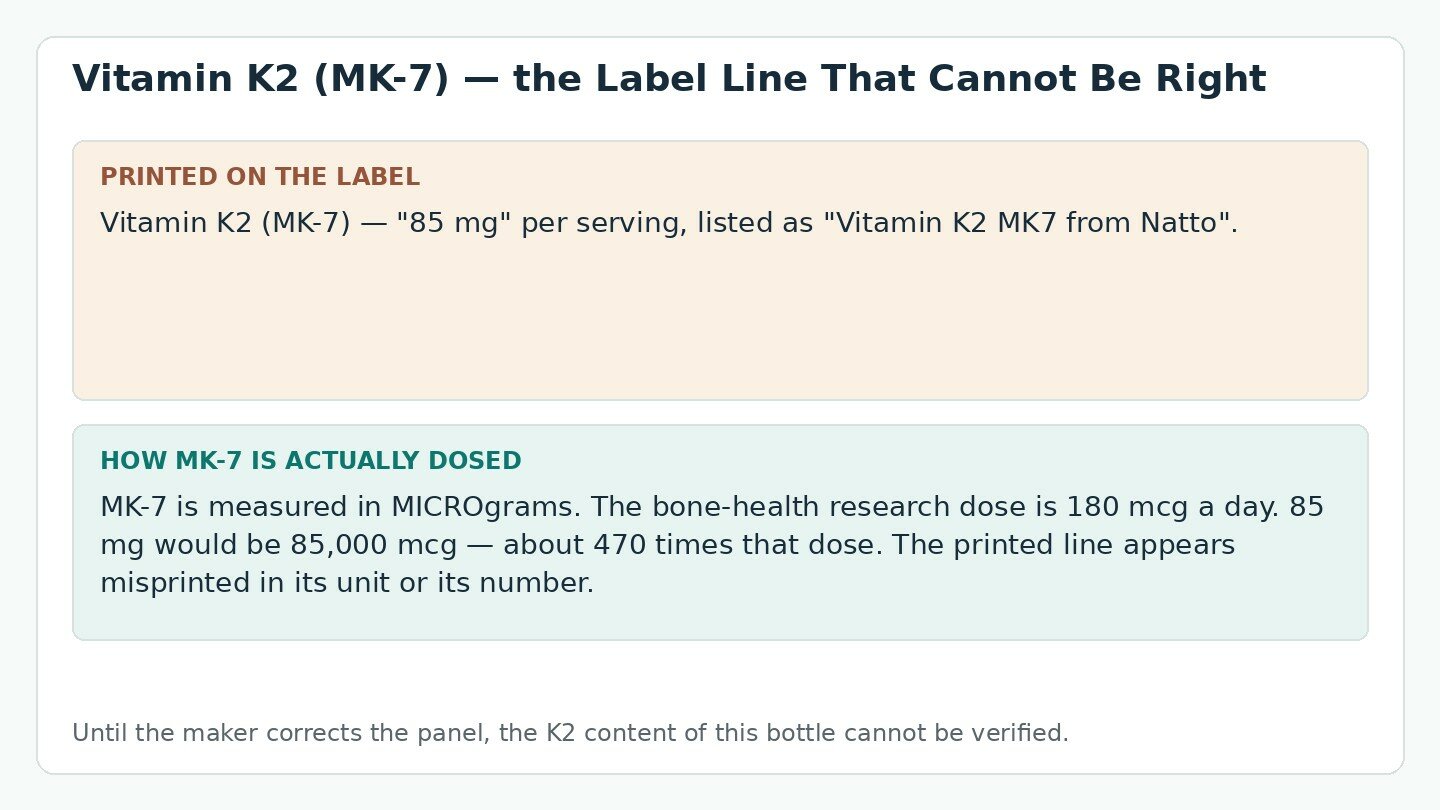
The final line on the Supplement Facts panel reads Vitamin K2 (MK7 from Natto) at 85 mg per serving. The maker's sales pages describe MK-7 as the most effectively absorbed form of vitamin K2. In bone-health formulas, vitamin K2 is commonly paired with calcium and vitamin D3, and a three-year human trial in 244 healthy postmenopausal women found that MK-7 slowed age-related bone density decline at the lumbar spine and femoral neck (Knapen et al. 2013, PMID 23525894).
Here is the problem: that benchmark trial used 180 micrograms per day—not milligrams. Eighty-five milligrams equals 85,000 micrograms, which is roughly 470 times the studied clinical dose. Either the unit or the number on the printed label is wrong. We report "85 mg" strictly as the bottle prints it, and flag clearly that a buyer cannot know the true K2 dose from this panel.
That error also matters for safety. Vitamin K directly counteracts the blood thinner warfarin, so anyone taking warfarin must speak with their doctor before using any vitamin K2 product—a caution covered in full in the safety section below.
The Label Audit: Two Weeks on the Sales Page, Twelve Weeks in the Study
When you lay the maker's sales pages beside the printed Supplement Facts panel and the published clinical literature, three concrete discrepancies jump off the page. None of them require guesswork or speculation. Each one is a direct mismatch between a specific claim on the official site and the primary record behind it.
| What the maker says | What the record shows |
|---|---|
| Promises "pain-free joints in just two weeks" and describes its cited study as a 14-day result. | The cited Aquamin study (Frestedt et al. 2008, PMID 18279523) ran 12 weeks (84 days) and reports no 14-day outcome. |
| Printed Supplement Facts panel lists Vitamin K2 (MK-7 from Natto) at 85 mg per serving. | Published human MK-7 bone research uses 180 micrograms/day (Knapen et al. 2013, PMID 23525894)—roughly 470× less than 85 mg; the unit or figure appears misprinted. |
| Cites the 2,400 mg/day Aquamin pilot study as evidence for this formula's joint claims. | The label never states an Aquamin milligram dose; red algae sits inside a 3,535 mg blend of 12 ingredients with no split published. |
1. The Timeline: Two Weeks Promised vs. Twelve Weeks Studied
The sharpest disconnect is the timeline. On its official pages, Leading Edge Health tells buyers to expect "pain-free joints in just two weeks" and frames its cited Aquamin research around a 14-day result. For someone living with daily knee or hip stiffness, a two-week turnaround is a powerful hook.
The actual study the maker points to tells a completely different story. That trial—conducted at the Minnesota Applied Research Center and published in Nutrition Journal—ran for 12 full weeks, not two (Frestedt et al. 2008, PMID 18279523). Nowhere in that published report is a 14-day pain-relief outcome established.
That 10-week gap is not a minor wording slip. It directly shapes how a buyer judges whether the product worked—and it collides with the maker's 67-day money-back guarantee. Anyone expecting relief at day 14 is set up for disappointment, while anyone waiting the full 12 weeks (84 days) of the cited study runs 17 days past the return deadline.
2. The Vitamin K2 Line: 85 mg Printed vs. 180 Micrograms Studied
The second gap sits right on the bottle's Supplement Facts panel. The bottom nutrient line prints Vitamin K2 (MK7 from Natto) at 85 mg per three-tablet serving. Both the maker's hosted Supplement Facts graphic and the bottle-back photo carry that exact figure.
In human nutrition research, MK-7 is measured in micrograms, not milligrams. The three-year randomized, placebo-controlled trial showing slower bone loss in 244 postmenopausal women used 180 micrograms per day (Knapen et al. 2013, PMID 23525894). Because one milligram equals 1,000 micrograms, a printed figure of 85 mg equals 85,000 micrograms—roughly 470 times the studied daily dose.
We do not silently rewrite the label to "85 mcg" because an independent reviewer cannot guess what the factory actually put inside the tablet. The unit could be misprinted, or the number itself could be wrong. Either way, a buyer reading this bottle cannot verify the real Vitamin K2 dose before swallowing it, which is a real quality-control red flag on a premium supplement.
3. The Hero Dose: 2,400 mg Tested vs. an Unpublished Blend Split
The third gap is the classic proprietary-blend problem. Both Frestedt pilot studies that Leading Edge Health points to dosed Aquamin at 2,400 mg per day (Frestedt et al. 2008, PMID 18279523; Frestedt et al. 2009, PMID 19187557). The 24-month postmenopausal lipid and cardiovascular follow-up study also used 2.4 grams (2,400 mg) of Aquamin per day, supplying 800 mg of calcium (Cronin et al. 2016, PMID 26669430).
Look at the GenF20 Algae Calcium label, and you will never find a milligram figure for Aquamin®. Instead, "Mineralized Icelandic Red Algae" is listed as the first of 12 components inside the 3,535 mg Organic Vegan & Red Algae Blend. The other 11 slots are filled by strawberry, raspberry, blueberry, cherry, pomegranate, cranberry, broccoli, tomato, carrot, spinach, and kale.
Because the calcium line says 1,000 mg from Aquamin®, the algae clearly makes up a substantial chunk of that 3,535 mg blend. Still, without a published breakdown, no buyer can confirm the exact Aquamin weight or check whether the serving matches, falls short of, or exceeds the 2,400 mg daily trial dose. Neither the algae dose nor any of the 11 fruit and vegetable doses can be verified from the label.
None of these three findings mean the formula is fake or empty on its main mineral lines. The printed amounts for calcium (1,000 mg), magnesium (96 mg), and vitamin D3 (800 IU) are real, standard numbers. What these three gaps do is expose exactly where a buyer's expectations get distorted: how fast it works, how much K2 is actually inside, and whether the headline algae dose matches the studies cited to sell it.
The Evidence, Read Properly
No published human trial has tested the finished GenF20 Algae Calcium tablet. Every study behind this product evaluates a single ingredient—either Aquamin® mineralized red algae, Vitamin K2 (MK-7), or standard calcium plus vitamin D3. Reading each trial with its full design attached shows what the research actually supports and where the sales pages stretch it.
The primary study the maker cites is a double-blind, placebo-controlled pilot trial run at the Minnesota Applied Research Center in adults with moderate-to-severe knee osteoarthritis (Frestedt et al. 2008, PMID 18279523, NCT00452101). Seventy people were randomized and 50 completed 12 weeks across four arms: glucosamine sulfate (1,500 mg/day), Aquamin (2,400 mg/day), a combination of both, or placebo. Within-group scores improved in the Aquamin arm (walking distance +101 feet, or +7%) and the glucosamine arm (+56 feet, or +3.5%), while the combination arm and placebo did not improve. Although WOMAC pain changed over time across groups (p=0.009), the authors explicitly cautioned that baseline pain (p=0.0039) and stiffness (p=0.013) differed significantly between groups, so between-group comparisons are fragile—meaning the maker's claim that red algae "outdid glucosamine in every measurable parameter" is not a valid finding of this paper.
A second pilot trial from the same research group tested 2,400 mg/day of Aquamin against placebo during a stepped withdrawal from non-steroidal anti-inflammatory drugs (Frestedt et al. 2009, PMID 19187557). Twenty-nine adults with knee osteoarthritis were randomized, 22 were treated, and only 14 completed the study. In the intention-to-treat analysis, overall WOMAC pain and symptom scores were not significantly different between groups, though passive and active knee extension range of motion and six-minute walking distance improved versus placebo after a 50% NSAID reduction. The maker's sales line that volunteers "didn't need pain killers anymore" overstates a partial, 50% dose reduction measured in 14 completers.
The longest human record for Aquamin comes from a secondary analysis of a 24-month double-blind trial in 300 postmenopausal women taking 800 mg of calcium per day as 2.4 grams of Aquamin (with or without short-chain fructooligosaccharides) compared with a maltodextrin control (Cronin et al. 2016, PMID 26669430). Total cholesterol and LDL cholesterol were lower in both Aquamin groups at 24 months, with no significant treatment effect on HDL cholesterol, triglycerides, body composition, or blood pressure. At a four-year follow-up, researchers saw no significant difference in diagnosed cardiovascular conditions between groups. That trial gives useful long-term exposure context for the ingredient, but it is not a joint-pain or bone-density proof for this bottle.
On the bone-strength side, no clinical trial backs the maker's bone framing for this specific formula, and the store pages cite unnamed studies and an uncited "Harvard" reference rather than a finished-product study. For real-world context on a 1,000 mg daily calcium dose, the landmark Women's Health Initiative trial followed 36,282 postmenopausal women taking 1,000 mg of calcium (as carbonate) plus 400 IU of vitamin D3 daily for about seven years (Jackson et al. 2006, PMID 16481635). Hip bone mineral density rose by 1.06%, but hip fractures were not significantly reduced (hazard ratio 0.88, 95% CI 0.72–1.08), while kidney stones increased significantly (hazard ratio 1.17, 95% CI 1.02–1.34).
| Study | Design & Sample | Dose & Duration | Key Finding & Main Limit |
|---|---|---|---|
| Frestedt et al. 2008 (PMID 18279523) | Double-blind pilot RCT; 70 randomized, 50 completed; knee OA | Aquamin 2,400 mg/day; 12 weeks (4 arms) | Within-group gains in Aquamin and glucosamine; combination arm null; baseline group imbalance limits between-group claims. |
| Frestedt et al. 2009 (PMID 19187557) | Double-blind pilot RCT; 29 randomized, 14 completed; NSAID taper | Aquamin 2,400 mg/day vs placebo | WOMAC scores not significantly different; range of motion and walk improved after a 50% NSAID cut in 14 completers. |
| Cronin et al. 2016 (PMID 26669430) | 24-month DBPC secondary analysis; 300 postmenopausal women | 2.4 g Aquamin (800 mg Ca/day) ± FOS; 4-year follow-up | Lower LDL and total cholesterol at 24 months; no CV signal at 4 years; not a joint or bone-density trial for this product. |
| Jackson et al. 2006 (PMID 16481635) | WHI RCT; 36,282 postmenopausal women | 1,000 mg calcium + 400 IU D3/day; ~7 years | Hip BMD +1.06%; hip fractures not significantly reduced; kidney stones increased (HR 1.17). |
Taken together, Aquamin® has more published human data than most ingredients in this catalogue. Even so, the joint evidence remains pilot-grade, short, and one step removed from this bottle—especially since the label never proves its blend delivers the 2,400 mg daily trial dose.
How Long Does It Take to Work?
Ignore the two-week headline on the sales page. The only human joint-comfort timeline in the published record is the 12-week duration of the Frestedt 2008 pilot trial (PMID 18279523). No clinical evidence supports expecting meaningful joint relief at day 14.
If your interest is bone support rather than joint stiffness, the timeline stretches even further. Measurable changes in bone mineral density happen slowly and are tracked over months and years, not weeks. The Vitamin K2 (MK-7) bone trial ran for three full years (Knapen et al. 2013, PMID 23525894), and large calcium-plus-vitamin-D trials follow participants for several years.
That timeline creates a practical wrinkle with the refund policy. Leading Edge Health backs GenF20 Algae Calcium with a 67-day money-back guarantee from delivery, covering the first two opened bottles plus any unopened bottles received back before day 67 (shipping excluded). Because 12 weeks equals 84 days, the cited study runs 17 days past the return window. A fair, low-risk trial is two bottles ($59.95 each) with a clear decision by about day 60, leaving a one-week shipping buffer if you decide to send the empty containers back.
Is It Safe?
The maker's sales pages state that GenF20 Algae Calcium "Works with zero adverse effects!" and neither the Supplement Facts panel nor the visible bottle back prints a single safety warning. That presentation does not match the established clinical record for full-dose calcium supplements. No safety trial has evaluated this finished formula.
The first check is your total daily calcium intake from food and supplements combined. Standard adult recommended intakes sit at 1,000 to 1,200 mg per day. The tolerable upper intake level is 2,500 mg per day for adults aged 19 to 50, and it drops to 2,000 mg per day from age 51 onward. Because three tablets of GenF20 Algae Calcium deliver 1,000 mg before you eat a single meal, dairy, fortified plant milks, leafy greens, or a multivitamin can quickly push older adults toward that 2,000 mg ceiling.
The second check is kidney-stone risk. In the Women's Health Initiative trial of 36,282 postmenopausal women, taking 1,000 mg of supplemental calcium plus 400 IU of vitamin D3 daily raised kidney stone incidence by 17% (hazard ratio 1.17, 95% CI 1.02–1.34; Jackson et al. 2006, PMID 16481635). Anyone with a history of kidney stones should speak with a doctor before adding a 1,000 mg calcium tablet.
Drug interactions require just as much care. Supplemental calcium can bind to several prescription drugs in the gut and reduce how much your body absorbs, including:
- Levothyroxine: Thyroid hormone tablets need strict time separation from calcium supplements.
- Certain antibiotics: Calcium can interfere with absorption when swallowed together, reducing how well the antibiotic works.
- Bisphosphonates: Prescription bone medications must be spaced carefully away from calcium tablets per your prescriber's instructions.
- Warfarin: Vitamin K directly opposes warfarin's blood-thinning effect, and because this label misprints Vitamin K2 as "85 mg," warfarin users cannot verify the true vitamin K dose and must clear this product with a clinician first.
Separate from the bare bottle panel, the maker's own store pages note standard exclusions: people under 18, pregnant or nursing women, and anyone taking prescription medication should consult a doctor before using the product.
Side Effects: What Is Actually Known
Full-dose calcium supplements follow a well-documented side-effect pattern. At 1,000 mg of elemental calcium per day, the most common everyday complaints are constipation, bloating, and general digestive discomfort. Splitting tablets across meals or drinking plenty of water helps some people, though this product's sales pages list directions simply as three tablets once daily.
At population scale, the primary documented serious risk of daily supplemental calcium is kidney stones, as measured in the 36,282-woman WHI trial (Jackson et al. 2006, PMID 16481635). In the two short Aquamin pilot trials, overall adverse-event profiles did not differ significantly between the Aquamin and control groups (Frestedt et al. 2008, PMID 18279523). Still, a 12-week pilot with 50 completers—and a second pilot with 14 completers—cannot rule out uncommon or long-term side effects, and the tablet's magnesium dose (96 mg) sits well under the 350 mg supplemental limit where loose stools typically appear.
When a Doctor Comes First
GenF20 Algae Calcium is a dietary supplement, not a medical treatment for osteoarthritis, osteopenia, or osteoporosis. If you have persistent joint or bone pain, have suffered a fragility fracture from a minor fall, or have been diagnosed with low bone density, a medical check comes first. A doctor can test your vitamin D level, order a bone-density scan, and discuss clinically proven prescription bone therapies—such as bisphosphonates and other approved bone-medicine classes—when a supplement alone is not enough to protect against fractures.
Is It a Scam?
No. GenF20 Algae Calcium is a legitimate, physical dietary supplement sold by Leading Edge Health, an established supplement company. It carries a printed Supplement Facts panel with real, verifiable mineral amounts (1,000 mg of calcium, 96 mg of magnesium, and 800 IU of vitamin D3), uses a named trademarked red algae source (Aquamin®), and comes with written 67-day refund terms.
Calling it a scam misses the real issue. What buyers should push back against is aggressive marketing overreach sitting on top of a real formula. Promising "pain-free joints in just two weeks" from a 12-week pilot study, using "Cure your joint pain" language on sales pages, claiming "zero adverse effects," hiding the Aquamin share inside a 12-ingredient blend, and letting an "85 mg" Vitamin K2 misprint stay live on the label are all fair grounds for skepticism.
Leading Edge Health sells the product direct through its official website rather than through open third-party retail shelves. That direct channel makes price checks straightforward and ensures eligible orders stay covered by the written guarantee, provided you buy with clear eyes about what the evidence actually shows.
Price and Packs
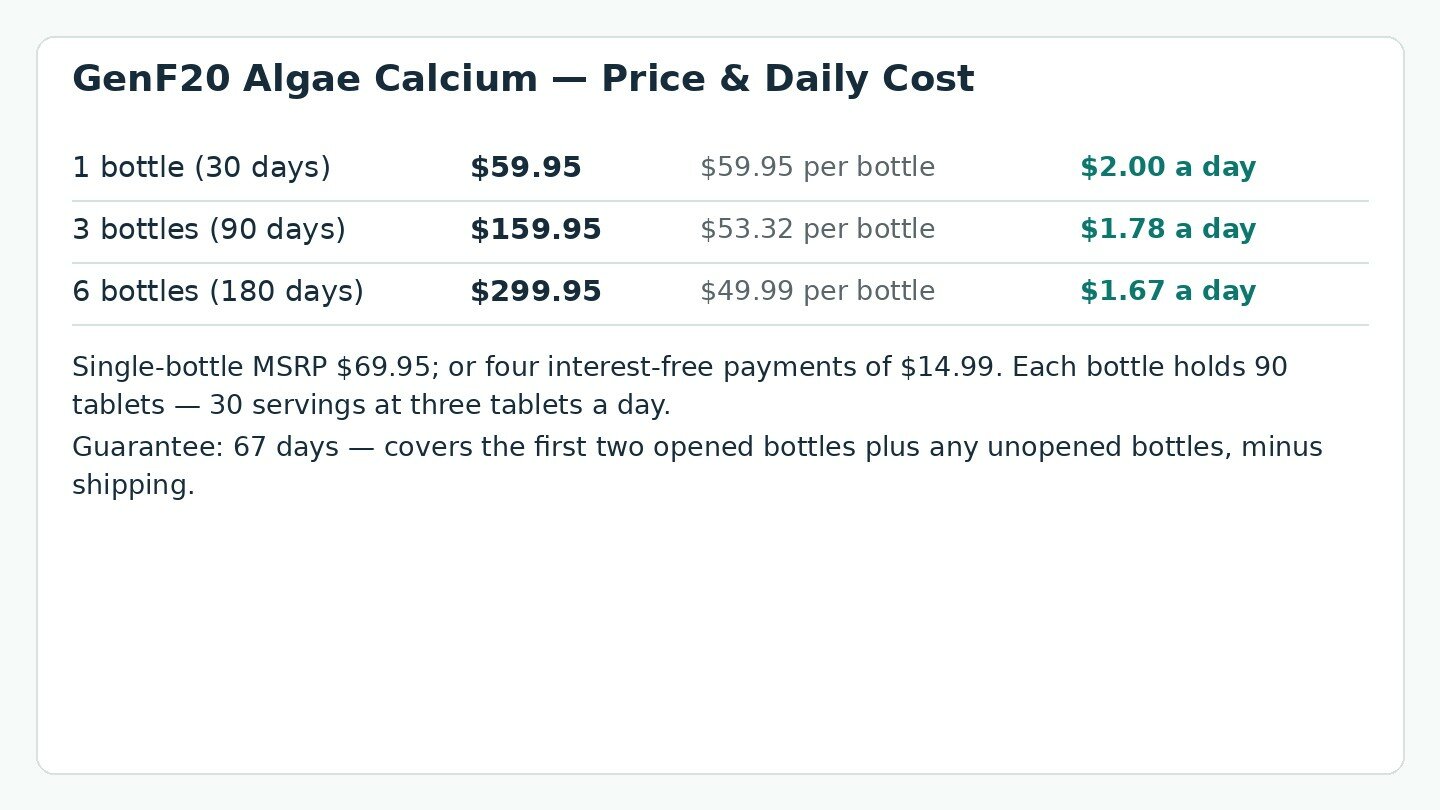
Each bottle of GenF20 Algae Calcium holds 90 tablets, which provides 30 daily servings at the recommended three tablets per day. The maker lists a single-bottle MSRP of $69.95 and sells direct across three pack tiers, with an installment option of four interest-free payments of $14.99 on the single bottle.
| Pack | Total | Per bottle | Cost per day |
|---|---|---|---|
| 1 bottle (30 days) | $59.95 | $59.95 | $2.00 |
| 3 bottles (90 days) | $159.95 | $53.32 | $1.78 |
| 6 bottles (180 days) | $299.95 | $49.99 | $1.67 |
At $1.67 to $2.00 per day, GenF20 Algae Calcium is expensive compared with plain drugstore calcium carbonate or calcium citrate tablets. You are paying branded algae-calcium pricing—funding the Aquamin® marine source, added vitamin D3, citrus bioflavonoids, vitamin K2, and the 11-item organic fruit-and-vegetable blend. Whether that markup makes sense depends on how strongly you prefer a plant-based algae source over conventional limestone minerals.
Purchase Options
GenF20 Algae Calcium is sold direct via the official website. Ordering directly is where the verified pack pricing above applies and where Leading Edge Health honors its written 67-day money-back guarantee—covering the first two opened bottles plus any unopened bottles received within 67 days of delivery, minus shipping.
Before placing an order, run three quick checks:
- Start with one or two bottles: Two bottles ($59.95 each) align directly with the guarantee's two-opened-bottle limit without locking in extra upfront cash.
- Save the six-bottle pack for repeat orders: The $299.95 six-pack drops daily cost to $1.67, but only makes sense after you confirm you tolerate the tablets and want to keep taking them.
- Mark your delivery date: Plan to make your keep-or-return call by about day 60 so returned bottles reach the warehouse before the 67-day cutoff.
How It Compares
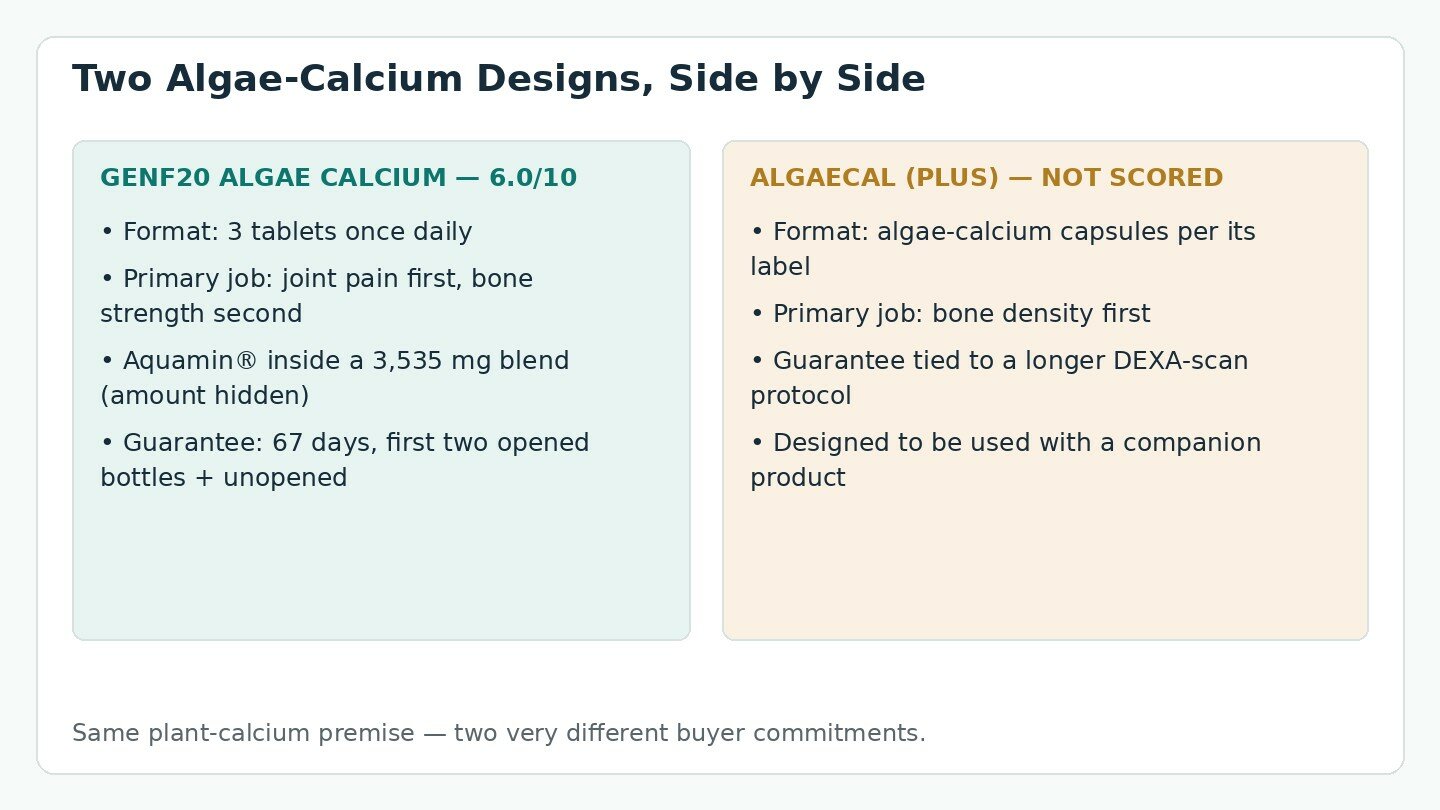
Shoppers researching plant-based marine calcium almost always compare GenF20 Algae Calcium with AlgaeCal (Plus). Both formulas center on calcified marine algae rather than quarried limestone, but they are designed around opposite primary goals and very different guarantee structures.
| Product | Our score | Format | Primary job |
|---|---|---|---|
| GenF20 Algae Calcium | 6.0/10 | 3 tablets once daily | Joint pain first, bone strength second |
| AlgaeCal (Plus) | Not scored by us | Algae calcium capsules per its label | Bone density first |
That contrast shapes how each product fits a buyer. GenF20 Algae Calcium targets adults over 40 looking for joint comfort first and bone support second, packs its Aquamin® inside a 3,535 mg organic produce blend, and uses a conventional 67-day satisfaction guarantee. AlgaeCal (Plus)—which SuppChecked has not scored—targets bone mineral density first and ties its refund promise to a longer bone-density protocol using DEXA scan results alongside its companion product. Same plant-calcium premise, two very different buyer commitments.
Who Should Buy It — and Who Should Skip It
Who Should Buy GenF20 Algae Calcium
- Plant-based-only calcium shoppers: Adults who specifically want algae-sourced calcium (Aquamin®) rather than limestone-derived calcium carbonate or synthetic salts.
- Label readers who want main mineral amounts printed: Buyers who appreciate seeing exact figures for calcium (1,000 mg), magnesium (96 mg), vitamin D3 (800 IU), and citrus bioflavonoids (500 mg) right on the panel.
- Patient triers who ignore the two-week hook: People willing to test the formula over the real 12-week study timeframe—using two bottles and deciding by about day 60 inside the 67-day guarantee.
- Adults with room in their daily calcium budget: Shoppers whose diet leaves clear space for a 1,000 mg supplement without exceeding the 2,000 mg/day adult upper limit from age 51 onward.
Who Should Skip It
- Anyone buying for the two-week promise: No published study backs 14-day joint relief, and no supplement can "cure" joint pain.
- Anyone already near the daily calcium limit: If dairy, fortified foods, or another supplement already supply most of your daily calcium, adding 1,000 mg risks overshooting the 2,000 mg/day ceiling.
- People on interacting medications without medical clearance: Anyone taking warfarin, levothyroxine, certain antibiotics, or bisphosphonates needs a doctor or pharmacist to review vitamin K exposure and dose spacing first.
- Anyone with diagnosed osteoporosis expecting a medical substitute: Low bone density and fragility fractures require medical evaluation and proven prescription options, not an over-the-counter tablet alone.
- Strict dose verifiers: Buyers who refuse to purchase a supplement when the exact Aquamin® milligram weight is hidden in a blend and the Vitamin K2 line is misprinted.
Frequently Asked Questions
Does GenF20 Algae Calcium actually work?
No clinical trial has tested this finished product. The maker cites two small pilot studies of Aquamin® (2,400 mg/day) in knee osteoarthritis. In Frestedt et al. 2008 (PMID 18279523, 50 completers, 12 weeks), Aquamin and glucosamine arms improved within their groups, but baseline group differences weakened between-group comparisons and the combination arm did not improve. In Frestedt et al. 2009 (PMID 19187557, 14 completers), WOMAC scores were not significantly different, though range of motion and walking improved after a 50% NSAID reduction. For bones, it provides 1,000 mg of calcium and 800 IU of vitamin D3, without a finished-product bone trial.
How long does it take to work — is it really two weeks?
No published evidence supports the maker's two-week relief promise. The Aquamin joint study the maker cites ran for 12 weeks (84 days) and reported no 14-day outcome (Frestedt et al. 2008, PMID 18279523). Bone mineral changes, when they occur with calcium, vitamin D, or K2, are measured over months and years rather than weeks. Because the 67-day guarantee ends before week 12, buyers testing the formula should plan on two bottles and decide by about day 60.
How much Aquamin is in each serving?
The exact milligram amount of Aquamin® is not published on the bottle. The Supplement Facts panel states that three tablets provide 1,000 mg of elemental calcium and 96 mg of magnesium from Aquamin®. However, the raw mineralized Icelandic red algae sits inside a 3,535 mg Organic Vegan & Red Algae Blend shared with 11 fruit and vegetable powders with no individual split. Because of that missing breakdown, you cannot confirm whether one serving matches the 2,400 mg/day dose used in the Frestedt trials.
What does the "85 mg" Vitamin K2 line mean — is that the real amount?
Both the maker's hosted Supplement Facts panel and the bottle-back photo print Vitamin K2 (MK7 from Natto) as 85 mg per serving. That line appears misprinted in either the unit or the figure. Human bone research doses MK-7 in micrograms—180 micrograms per day over three years in Knapen et al. 2013 (PMID 23525894). Eighty-five milligrams equals 85,000 micrograms, roughly 470 times that studied dose. Because we cannot guess what is inside the tablet, buyers cannot verify the real K2 dose from the label.
How much calcium do you get per day — and how close is that to the daily limit?
One daily serving of three tablets supplies 1,000 mg of elemental calcium, or 77% of the Daily Value. Standard adult recommended intakes are 1,000 to 1,200 mg per day from food and supplements combined. The tolerable upper intake level is 2,500 mg per day for adults aged 19 to 50, dropping to 2,000 mg per day from age 51 onward. Taking 1,000 mg in supplement form leaves less room for dairy, fortified foods, and multivitamins, so adults over 50 should tally their food intake first.
Is algae calcium safe — who should not take it?
Despite the sales page's "zero adverse effects" claim and the absence of warnings on the label panel, full-dose calcium carries documented risks. In the WHI trial of 36,282 postmenopausal women, 1,000 mg calcium plus 400 IU vitamin D3 raised kidney stone risk (hazard ratio 1.17; Jackson et al. 2006, PMID 16481635). Calcium can also impair absorption of levothyroxine, certain antibiotics, and bisphosphonates, while vitamin K interacts with warfarin. The maker's sales pages also advise under-18s, pregnant or nursing women, and people on prescription medications to consult a doctor first.
GenF20 Algae Calcium vs AlgaeCal — what is the difference?
Both products rely on marine algae calcium instead of limestone, yet they take opposite approaches to positioning and guarantees. GenF20 Algae Calcium (6.0/10 on SuppChecked) uses three tablets once daily, markets joint pain relief first and bone strength second, and offers a standard 67-day satisfaction guarantee. AlgaeCal (Plus)—which SuppChecked has not scored—comes in capsules per its label, targets bone density first, and ties its guarantee to a DEXA-based bone-density protocol alongside its companion product.
Where can I buy it — is it on Amazon?
GenF20 Algae Calcium is sold direct through the official website rather than through verified third-party marketplaces. Buying direct is where the verified pack prices apply—$59.95 for one bottle (with a four-payment $14.99 interest-free option), $159.95 for three bottles, and $299.95 for six bottles. Direct orders are also what qualify for Leading Edge Health's written 67-day money-back guarantee covering the first two opened bottles plus unopened bottles returned within 67 days of delivery.
GenF20 Algae Calcium — Our Score: 6.0/10
Score: 6.0/10 · Sub-scores: Ingredients 7.0 · Evidence 5.0 · Safety 6.5 · Value 6.0 · Best for: Adults who want a plant-based calcium with the main nutrient amounts printed on the label, and who will judge it over the study's real 12-week timeline inside the guarantee window · Main caution: The maker promises relief in two weeks, but the Aquamin study it cites ran 12 weeks, was a small pilot whose groups differed at baseline, and tested the ingredient — not this formula; the label also misprints the Vitamin K2 amount, and the algae share sits unpublished inside a 3,535 mg blend · Fair trial: Two bottles ($59.95 each) — the guarantee covers the first two opened bottles inside 67 days, while the cited study ran 12 weeks, so judge by about day 60
Sources & Method
This review is based on the maker's printed Supplement Facts panel and bottle back, the official store formula, pricing, and guarantee pages (read November 2026), and the published clinical trials cited above: Frestedt et al. 2008 (PMID 18279523), Frestedt et al. 2009 (PMID 19187557), Cronin et al. 2016 (PMID 26669430), Knapen et al. 2013 (PMID 23525894), and Jackson et al. 2006 (PMID 16481635). Every product is graded using the standard SuppChecked scoring method across Ingredients, Evidence, Safety, and Value, based strictly on verified label and clinical records.
Last reviewed: November 2026
