
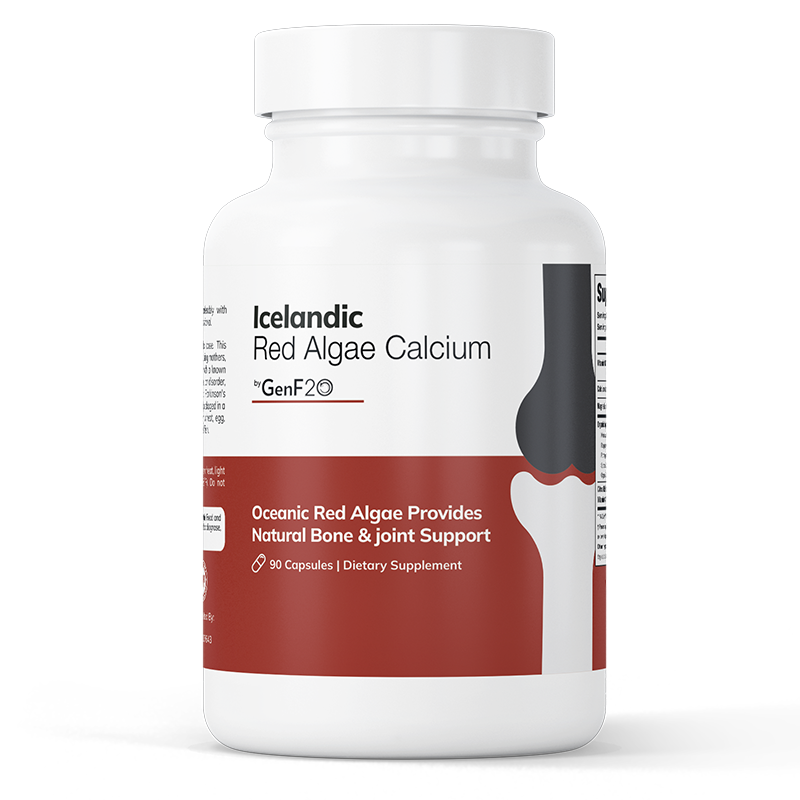
Affiliate disclosure: This article contains affiliate links. If you buy through a link on this page, we may earn a commission paid by the manufacturer, at no extra cost to you. That never changes what we publish — and here it means leading with the finding this comparison actually produces: the absorption contest between calcium forms is marketed with numbers almost nobody publishes. The algae product we sell, GenF20 Algae Calcium , claims its calcium "absorbs much better" than regular calcium — and publishes no absorption figures and no citations behind that claim. This page compares the three forms on what can genuinely be checked: source, label disclosure, dose burden, and the comfort questions each label does or does not answer.
Quick Answer: Three Sources, One Unproven Headline
Calcium carbonate and calcium citrate are the two conventional supplemental forms — the "regular calcium" this category defines itself against. Algae calcium is the plant-based challenger: calcium drawn from mineralised red algae, sold on the argument that a food-form mineral, arriving with the other minerals in the algae, is handled by the body more naturally than a conventional compound. That argument may or may not be right — the point of this page is that the maker of the algae product we sell does not publish the figures that would settle it. Its page states that plant-based red algae calcium "absorb[s] into the bones much better" than regular calcium and "does not get flushed out by the body like the other types," and presents that as a research consensus — with no percentages, no study citations and no head-to-head data printed. Judge the three forms, then, on their auditable differences. Those are real, and they follow.
The Absorption Claim, Stated Exactly as Far as It Goes
Absorption is the word this category sells on, so it deserves the audit first. When a maker claims superior absorption, the checkable versions of that claim would be fractional-absorption measurements — the share of an ingested dose the body takes up — ideally measured head-to-head between forms, in people, at the doses sold. GenF20's maker publishes none of that. What it publishes is the qualitative claim quoted above, plus a general invocation of a Harvard-published critique of conventional calcium absorption — invoked, in its pages, in general terms, without figures a reader can follow to a source. Its bone claims rest on the same pattern: "the takeaway from clinical studies" is summarised (red algae calcium improves bone and mineral density, bone strength, bone calcium content, bone turnover) with the studies not named . The one study the maker does describe concretely — a double-blind, placebo-controlled comparison of red algae against placebo and glucosamine in volunteers with knee pain, performed at the Minnesota Applied Research Center and published in the Nutrition Journal — measured joint pain and mobility over 14 days. It is not an absorption study, and it publishes no sample size, doses or effect sizes in the maker's account. So the absorption headline of the algae category, on the only algae label we audit, is an assertion. We print it as the maker's claim, and we do not upgrade it to a finding.
These statements have not been evaluated by the Food and Drug Administration. This product is not intended to diagnose, treat, cure, or prevent any disease. This article is educational and is not medical advice.
What Actually Differs: Source and Company
Strip the absorption claim away and real differences remain. Source: algae calcium begins as a mineralised sea plant — GenF20's is Aquamin® Icelandic red algae — so the calcium arrives as part of a whole mineral matrix. The maker publishes what that matrix delivers per daily serving: 1,000 mg of calcium and 96 mg of magnesium from the algae itself , alongside Vitamin D3 (20 mcg / 800 IU), Vitamin K2, citrus bioflavonoids (500 mg) and a 3,535 mg organic fruit-and-vegetable-and-algae blend. Conventional carbonate and citrate products are single-compound formulas by design: the calcium salt is the product, and whatever else is in the bottle was added to it, item by item. Neither architecture is self-evidently superior — but they are genuinely different formulations philosophies, and only one of them publishes its full component list in the case we audit: every GenF20 component carries an amount (with two caveats our review flags — the big blend's internal split is unpublished, and its Vitamin K2 amount is printed as "85mg," a unit we record as printed and treat as a probable maker typo, since MK-7 is a microgram-dosed ingredient).
Dose Burden and the Routine You Will Actually Keep
Absorption percentages, even where they exist, describe a dose taken. The prior question is whether the dose gets taken — daily, for the months bone questions run on. Here the comparison is mundane and decisive. GenF20's routine is three pills, once a day, taken together — one decision, one moment, no schedule to reconstruct. Conventional products vary by brand and label, and the honest way to compare them is on the labels themselves: elemental calcium per serving (not the compound weight in the product name), servings per day, pills per serving, and the total against the daily value — GenF20's serving is 1,000 mg, stated by its maker as 77% of the daily value. A form you tolerate and remember beats a form with a better brochure. Which brings the comparison to comfort.
Comfort: The Questions Each Label Answers — and Doesn't
Digestive comfort is where calcium forms earn their reputations in practice, and it is also where published guidance is thinnest. The practical checks are label questions, and this page will not pretend they are study results. Directions: read each product's stated directions before buying — the label, not the category's folklore, tells you how its maker intends it taken, and makers' directions differ. Your own pattern: if a previous calcium product disagreed with you, the useful record is which form and what dose — information your pharmacist can work with when you switch forms. And the maker's own paperwork: on comfort and caution generally, GenF20's maker publishes the least possible — no warnings or exclusions section at all, and a complete safety position consisting of "we are not aware of any adverse effects," reasoned from the formula being natural. Nothing on kidney stones or hypercalcemia, nothing on medication timing — the standard interaction territory for calcium — nothing on pregnancy or under-18s. Whatever form you choose, choose it knowing that a calcium label's silence about your medication is not an all-clear; it is an unasked question, and pharmacists answer those for a living.
The Bottom Line
Algae calcium vs carbonate vs citrate resolves, on published evidence, into a shorter contest than the marketing suggests. On absorption : the algae claim is real ink and no numbers — the maker of GenF20 Algae Calcium (Our Score 7.0/10 ) asserts superiority and publishes no fractional figures, no citations and no head-to-head data, so the headline advantage is unverified on its own page. On source and disclosure : the algae product is a whole-matrix formula with every component amount published — the strongest paperwork in this comparison, and a standard any conventional label can be held to. On routine and comfort : three pills once a day, against whatever schedule and tolerance a conventional label sets for you — a comparison to run on labels and your own history, not on category folklore. Buy the form whose label you can audit and whose routine you will keep; treat any absorption percentage quoted without a study behind it — including ours, if we ever printed one — as decoration. Readers comparing the two algae calciums head-to-head can continue to our GenF20 Algae Calcium vs AlgaeCal comparison.
Disclaimer: This article is for general information only and is not medical advice. Always consult a qualified healthcare professional before starting any supplement, especially if you have a medical condition or take prescription medication.
Last reviewed: October 2026