
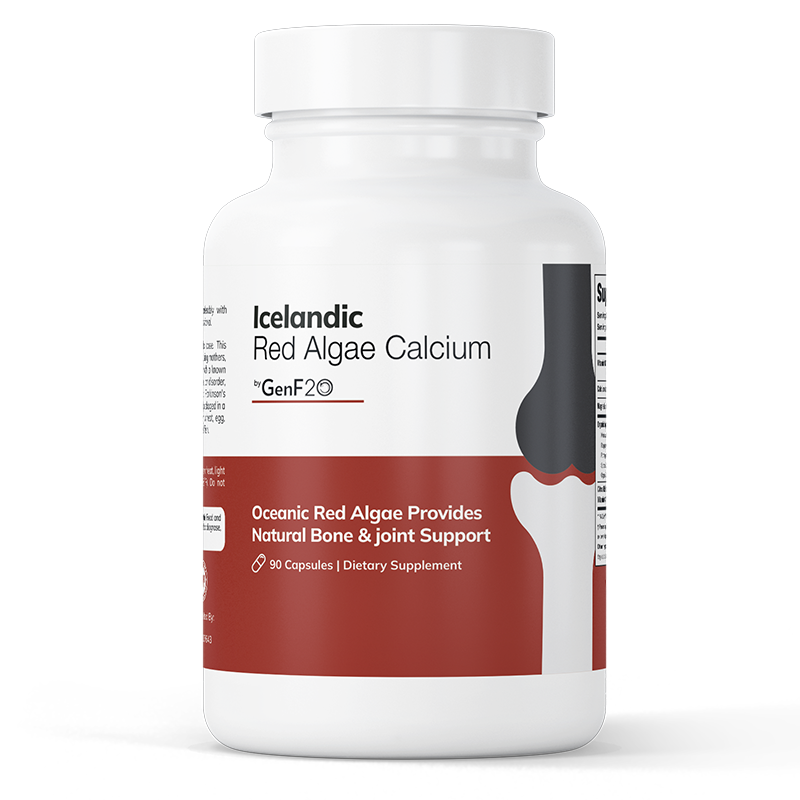
Affiliate disclosure: This article contains affiliate links. If you buy through a link on this page, we may earn a commission paid by the manufacturer, at no extra cost to you. That never changes what we publish — and here it means answering the title question as a method rather than a magic number. Calcium needs are set per person — by age and sex in official dietary guidance — and this page works from the figures the makers themselves publish, because a supplement decision is really an arithmetic decision: what your food already provides, plus what a label adds. The one calcium product we sell, GenF20 Algae Calcium , is a full-dose formula, and its own label arithmetic below shows why the total matters more than the bottle.
Quick Answer: Start From the Daily Value on the Label
Adult calcium needs are expressed in official guidance as a daily target that varies by age and sex — there is no single honest number for "adults," and any page that prints one without those qualifiers is rounding your physiology. The working tool every buyer already has is the percent daily value (%DV) printed on supplement labels, which expresses a serving against the standard daily yardstick. Worked example, from a real label: the maker of GenF20 Algae Calcium publishes 1,000 mg of calcium per daily serving, stated as 77% of the daily value — arithmetic on the maker's own figures puts that daily-value yardstick at roughly 1,300 mg. So the practical method is: find your personal target (your clinician, pharmacist or official dietary guidance for your age and sex), estimate what your diet supplies, and read any supplement as a percentage of the yardstick — not as an isolated milligram count.
Step One: Your Target Is Personal, Not Generic
Calcium recommendations are built as RDAs — recommended dietary allowances — and they are stratified: men and women are not assigned identical targets across the lifespan, and the target changes with age. That is why this page does not print a single "adults need X mg" figure: the honest version of the answer lives in the official tables for your bracket, and the authoritative place to read yours is the dietary-guidance source your clinician works from, or a direct question at your next appointment or pharmacy visit. What a supplement store's page can do — and what the rest of this article does — is teach you to combine that target with label figures correctly, because that combination, not the target alone, is where buyers go wrong: they compare a bottle against a headline number and forget that food was already paying part of the bill.
Step Two: Food Pays First — Count It Before You Supplement It
Every calcium target is a total intake target: food and supplements together, not a supplement dose. Calcium arrives through the diet all day — dairy is the source most people name first, but fortified foods and a range of ordinary eating contribute — and whatever that total is, it counts against the same daily yardstick before a single pill is opened. The practical consequence is that two people holding the same bottle can need opposite decisions. A person whose diet is calcium-poor has a genuine gap for a supplement to fill. A person whose diet already runs near the target has little gap — and for them, a full-dose product is not topping up a shortfall but stacking on top of sufficiency. This is also why more is not a free good: official guidance sets upper limits as well as targets, and the space between your personal target and the upper limit is the only space a supplement should occupy. Before buying anything, spend three honest days noticing what your diet actually contains; the estimate does not need to be precise to separate "clear gap" from "probably covered."
Step Three: Read the Label as a Percentage, Not a Headline
Supplement labels advertise milligrams because milligrams sound substantial. The figure that makes a label comparable is the percentage beside them. GenF20 Algae Calcium's published serving — three pills taken together once a day — provides, per the maker's own FAQ: calcium 1,000 mg (77% DV) , magnesium 96 mg (23% DV), and Vitamin D3 20 mcg / 800 IU (100% DV), alongside 500 mg of citrus bioflavonoids and a 3,535 mg organic red-algae blend. Read as percentages, that serving is more than three-quarters of the standard daily yardstick in a single dose. That is a legitimate design for someone with a large dietary gap — and an oversized one for someone whose food already covers most of the yardstick, because the label's 77% does not shrink to fit your diet; your total simply rises past it. Full-dose products demand the food audit of step two. Partial-dose products exist precisely for the top-up case, and the %DV column is how you tell one design from the other in ten seconds, on any shelf.
These statements have not been evaluated by the Food and Drug Administration. This product is not intended to diagnose, treat, cure, or prevent any disease. This article is educational and is not medical advice.
The Questions a Full-Dose Label Does Not Answer for You
A calcium label that prints its amounts — and GenF20's maker, to its credit, prints every component amount, which is rare in this catalog — still leaves the personal questions open, and this maker's page leaves more of them open than it should. It publishes no warnings or exclusions at all : nothing on kidney stones or hypercalcemia, nothing on medication timing or interactions — the standard questions that surround calcium supplementation — and nothing on pregnancy or under-18s. Its complete safety content is an FAQ answer: "We are not aware of any adverse effects of Icelandic Red Algae," together with the reasoning that since all ingredients are natural, the formulation has none. A maker's lack of awareness is not a dosage guide. If you take prescription medication, have a history of kidney stones, or manage any condition where calcium balance is clinically watched, your personal target — and whether a 77%-of-daily-value serving belongs in it — is a clinician's call, and no label's percentage column can make it for you.
The Bottom Line
How much calcium do adults actually need? A personal daily target, set by age and sex in official guidance; met first by food; and topped up — only up — by supplements sized in percentages of the daily value. GenF20 Algae Calcium (Our Score 7.0/10 ) is the full-dose end of that design space: 1,000 mg and 77% of the daily value per serving, every amount published, under a 67-day guarantee — the right shape for a documented dietary gap, and more than the job requires for a reader whose plate already does the work. Run the three steps in order — target, food, label percentage — and the bottle's role decides itself. Readers whose interest in this maker is the wider anti-aging system rather than a mineral formula can continue to our GenF20 Plus review.
Disclaimer: This article is for general information only and is not medical advice. It is not a personal intake recommendation. Always consult a qualified healthcare professional about your own calcium needs, especially if you have a medical condition or take prescription medication.
Last reviewed: October 2026
