
- Quick Answer
- The Three Products Sold as "At-Home Tests"
- 1. Saliva kits
- 2. Finger-prick dried blood spot kits
- 3. Order online, blood drawn at a laboratory
- The Benchmark: What a Clinical Test Actually Is
- Accuracy, Method by Method
- Saliva: the weakest claim in the category
- Finger-prick blood spot: a real blood test with a wider error band
- The six-kit comparison study — and what it actually measured
- The Error That Isn't the Kit's Fault
- Why One Low Home Reading Proves Nothing
- When a Home Test Is Good Enough — and When It Isn't
- How to Get the Least-Wrong Home Result
- Frequently Asked Questions
- How accurate is a saliva testosterone test?
- Is a finger-prick test as accurate as a venous blood test?
- When should I collect the sample?
- Can one home test diagnose low testosterone?
- What does CLIA-certified mean for a home test?
- How much do home testosterone tests cost?
- Read This Next
Quick Answer
"At-home testosterone test" is not one product. It is three different products sharing a name, and their accuracy is not in the same league.
Saliva kits are the weakest option we reviewed. They estimate only the free fraction, at concentrations where measurement error is largest, and research correlations with blood values are modest.
Finger-prick blood-spot kits are the reasonable middle. Mailed to a real laboratory and measured properly, blood-spot testosterone can track venous blood closely — with wider room for error than a clinic draw.
The third product is not really a home test at all. You order online, attend a laboratory, and a professional draws venous blood. Its accuracy is simply clinical accuracy.
One rule overrides everything else in this article. No single home result — from any of the three — can diagnose low testosterone. Diagnosis requires symptoms plus two low morning blood tests, confirmed on separate days.
The Three Products Sold as "At-Home Tests"
Marketing puts these under one label because they share a checkout page. What reaches the laboratory, however, is completely different in each case — and the sample decides the accuracy ceiling.
1. Saliva kits
You spit into a tube, sometimes several times across a day, and post it to a laboratory. Saliva contains only the unbound, "free" fraction of testosterone, so a saliva kit never measures your total level.
That free fraction is roughly 2–3% of the testosterone in blood. The laboratory is therefore measuring a very small signal, where contamination, collection method and assay noise all loom larger.
Saliva reports also give you less to work with. There is no total testosterone, no SHBG and no LH — the supporting values a clinician uses to judge whether a low reading is real and where it comes from.
2. Finger-prick dried blood spot kits
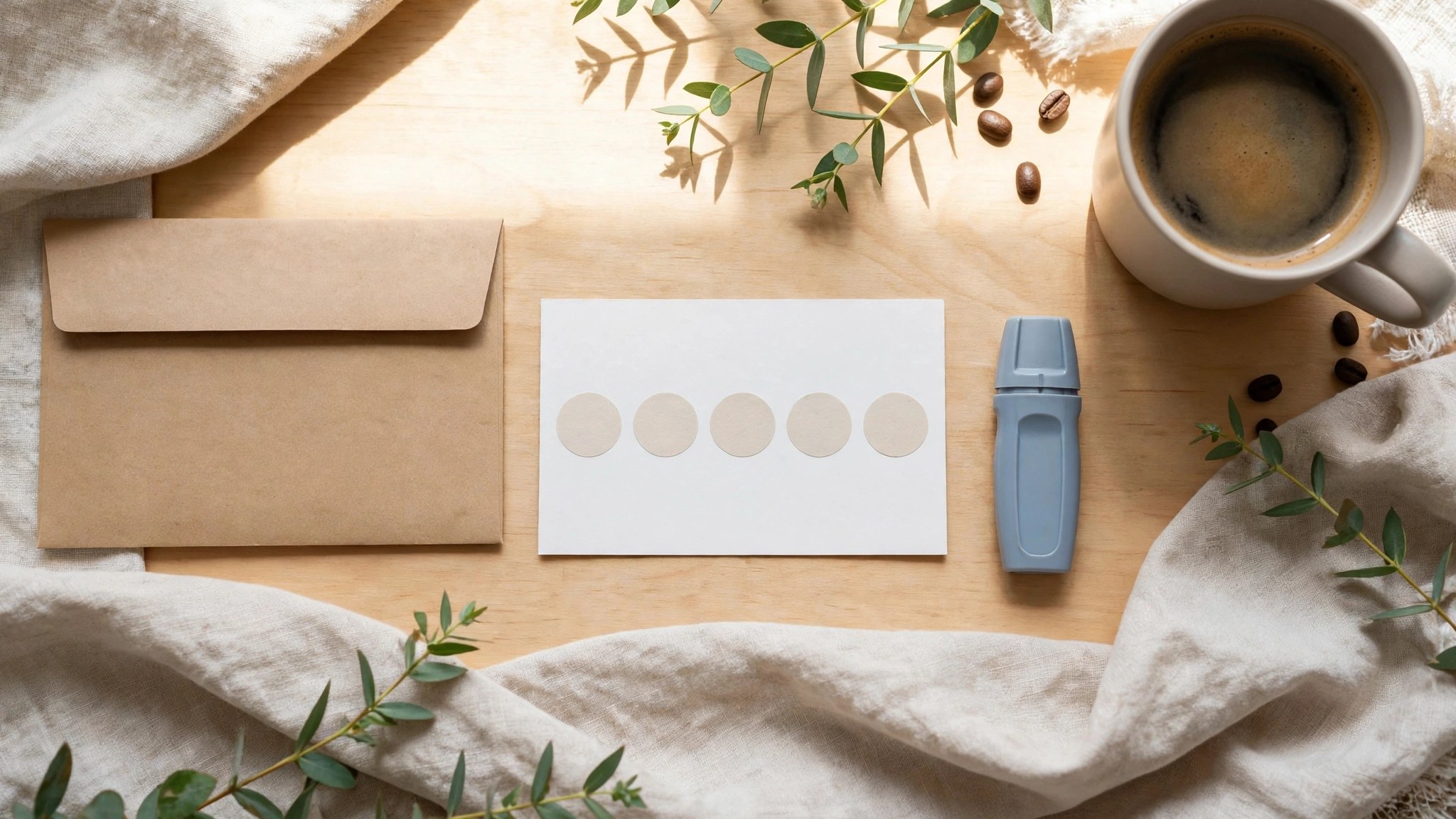
You lance a fingertip, let drops of blood fall onto marked circles on a card, let it dry, and mail the card. The laboratory punches out a disc and measures testosterone from whole blood.
This is a genuine blood measurement, usually of total testosterone. Its weak points are not the concept but the collection: you are the phlebotomist, and nobody checks your technique.
The dried format is the point of the product. A dried spot is stable in the post in a way a tube of liquid blood is not, which is what makes mail-in blood testing practical at all.
3. Order online, blood drawn at a laboratory
Here the "home" part is only the ordering. A phlebotomist draws blood from a vein, exactly as in any clinic visit, and the same kinds of laboratories analyse it.
Judging this product's accuracy is therefore the wrong question. The real questions are which assay the laboratory uses, and whether you follow the same timing rules a clinic would impose.
Whichever of the three you buy, read the report's reference range before the number. Ranges differ between providers, and a result one service flags as normal can sit below the cutoff another service prints on the same page.
The Benchmark: What a Clinical Test Actually Is
Before grading home kits, we need the standard they are graded against. In clinical testing, testosterone is measured in serum from a venous sample, by immunoassay in most routine laboratories.
The reference method is liquid chromatography–tandem mass spectrometry (LC-MS/MS). It is slower and more expensive than immunoassay, and it is what other methods are ultimately judged against.
Immunoassays are faster and cheaper, but historically they disagreed with each other — sometimes badly. That disagreement is the reason a formal standardisation programme exists at all.
The US Centers for Disease Control and Prevention runs that programme, called Hormone Standardization (HoSt). Certified testosterone assays must show a mean bias within ±6.4% of the CDC reference method, checked with blinded samples every quarter. The CDC publishes the list of certified assays.
Performance goals derived from biological variation aim for a total measurement error under roughly 16.7% for testosterone. In clinical-laboratory comparisons, validated assays are generally reported to land within about 20% of reference-method values.
So the clinical benchmark looks like this: a good standardised assay sits within a few percent of the reference. An ordinary validated assay is expected within roughly a fifth. Keep those two numbers in mind for what follows.
One more benchmark feature matters. Clinical diagnosis does not rest on the assay alone: guidelines pair the number with symptoms, a morning fasting sample, and a repeat test. A home kit has to be judged against that whole process.
The low end deserves a specific warning, because it is where every diagnosis is decided. Testosterone immunoassays are least accurate at low concentrations — precisely the range around the 300 ng/dL cutoff where a result changes management.
That is why two laboratories can both be "clinical" yet disagree on a borderline sample if one assay is standardised and the other is not. When you order a venous test yourself, the assay behind it is worth asking about.
Accuracy, Method by Method
Saliva: the weakest claim in the category
Saliva testing rests on an attractive idea: only free testosterone passes into saliva, so saliva should mirror the fraction that matters. The idea survives; the measurement mostly does not.
In a critical evaluation using LC-MS/MS (Fiers and colleagues, 2014), salivary testosterone in men correlated with true free testosterone — measured by equilibrium dialysis — at only r = 0.71 with careful passive-drool collection.
With a cotton collection device, the same study found a correlation of just r = 0.43 in men. The researchers also found testosterone binding to saliva proteins, which pushes saliva readings above true free levels.
That was research-grade mass spectrometry under controlled conditions. Consumer saliva kits generally rely on immunoassays, a less specific technology, and on collection by an unsupervised user at a kitchen table.
Earlier matched-sample work points the same way. In 40 young adults, saliva testosterone correlated only modestly with serum values in the 20 men studied, while blood-spot results correlated strongly (Granger and colleagues, 2002; PubMed).
Our verdict: saliva is acceptable for spotting large within-person trends in research settings. As the basis for deciding whether your testosterone is low, it is the weakest evidence money can buy in this category.
Daily life adds problems the studies did not have to solve. Eating, brushing your teeth, or minor gum bleeding before collection can all contaminate a saliva sample, and blood in saliva carries blood-level testosterone with it.
Saliva also misbehaves in monitoring. Reviews of alternatives to serum testing note that salivary testosterone runs routinely above physiological levels in men using standard transdermal testosterone doses, without matching any clinical measure — a warning against treating saliva numbers as interchangeable with blood.
Some saliva protocols try to compensate by collecting several samples across a day and averaging them. Averaging smooths the daily rhythm, but it cannot repair a measurement that is imprecise at the assay level — it averages the error, too.
Finger-prick blood spot: a real blood test with a wider error band
Dried blood spot measurement has something saliva lacks: direct validation against venous blood. In a 2024 validation study (Analytical Science Advances), a blood-spot LC-MS/MS assay tracked paired venous serum closely, with a correlation of R² = 0.9875 across samples from 20 volunteers.
The same validation reported precision below 10% coefficient of variation, and checked the known blood-spot complications: haematocrit differences and matrix effects. Under laboratory conditions, the method held up well.
Two cautions keep us from calling that "as good as a venous test". First, correlation is not agreement: two methods can correlate beautifully while individual results still differ enough to matter near a cutoff.
Second, the validation used properly collected spots. At home, the errors are yours: a half-filled circle, a second drop layered over a dried first one, blood milked from a squeezed finger, a card mailed in summer heat.
Each of those is a recognised collection problem, and none of them appears on your report. The report shows a number with two decimal places of confidence the process may not have earned.
Our verdict: a blood-spot kit from a laboratory using mass spectrometry is a reasonable screening tool. Treat its result as an estimate with a wider margin than the printed number suggests — especially near diagnostic cutoffs.
Haematocrit — the proportion of your blood that is red cells — is the technical wrinkle worth knowing. It changes how blood spreads on the card, so the same testosterone level can yield slightly different amounts of sample per punch.
Good blood-spot laboratories correct for haematocrit or design around it, as the 2024 validation did. It is one more reason the laboratory behind a kit matters more than the branding on the box.
The panel is the other limit. Most blood-spot kits report total testosterone alone, or a small bundle. Free testosterone and SHBG — often the values that explain a confusing total — are frequently absent or calculated rather than measured.
The six-kit comparison study — and what it actually measured
One study dominates every online argument about home-test accuracy, so we read it in full. It is quoted as showing that six home kits varied by 26.3–40.8% in men, and deviated from clinical results by an average of 194%.
The paper is real: Boots and colleagues, Fertility and Sterility, 1998. The researchers ran serum samples from 36 men and 15 women through six commercially available testosterone assay kits, and compared them with an established in-house method.
In samples from men, results varied between 26.3% and 40.8% depending on which kit measured them. On average, kit results deviated from the in-house reference method by 194% in men's samples, and by 67% in women's samples.
Disagreement was worst in samples with the lowest SHBG levels — the binding protein that interferes with immunoassays. The authors concluded that commercial-kit testosterone measurement had limited utility without better standardisation.
The SHBG detail deserves a second look, because it has not gone away. Immunoassays must free testosterone from its binding proteins before measuring it, and they do this imperfectly — which is why abnormal SHBG still troubles assay accuracy today.
Now the limits, because they change what the study proves. These were 1998 laboratory immunoassay kits, not today's mail-in services. The study predates CDC standardisation and modern LC-MS/MS home-kit laboratories entirely.
No equivalent modern head-to-head study — putting the current consumer kits side by side against standardised venous testing — appears in the published literature we searched. Anyone quoting 194% as a measurement of a kit you can buy today is citing a different era.
What the study does establish is narrower and still important: unstandardised testosterone immunoassays can disagree with each other by margins large enough to flip a diagnosis. The assay behind a result matters as much as the sample.
The Error That Isn't the Kit's Fault
Suppose the assay were perfect. A home result could still mislead you, because testosterone itself will not sit still — and home testing removes every control a clinic uses to manage that.
Time of day. Testosterone peaks in the early morning and falls through the day. In a Boston study of 66 men (Brambilla and colleagues, 2009), levels in men aged 30–40 were 20–25% lower at 4 p.m. than at 8 a.m.
The same study found 17 men who recorded at least one below-300 ng/dL reading after midday — yet every one of them measured normal on all three of their pre-midday visits. An afternoon home test can manufacture a "low" result.
The daily swing shrinks with age: by around 70, the morning-to-afternoon difference in that study was about 10%. But "smaller" is not "gone", and home kits rarely enforce collection time at all.
Day-to-day variation. Your level also moves between days for no reason you did anything about. In 132 men aged 30–79, two measurements on the same man differed by more than 18–28% about half the time (Brambilla and colleagues, 2007; PubMed).
In about a quarter of paired measurements in that study, the difference exceeded 27–54%. The authors' conclusion was blunt: one sample is generally not sufficient to characterise a man's hormone levels.
Food, illness and the week you've had. Guidelines specify a fasting morning sample because eating — particularly glucose — temporarily suppresses testosterone. A kit collected after breakfast starts with a self-inflicted handicap.
Acute illness suppresses testosterone for days to weeks, and guidelines advise against diagnostic testing during or just after an illness. A kit cannot know you had flu last week; it will happily print the number.
Heavy drinking and short sleep pull levels down as well. Test during the worst week of your month and you have measured the week, not your baseline.
Night-shift workers face a version of the same trap. Their hormonal morning is when they wake, not when the clock says so — a sample taken after a shift, at the end of their waking day, is an afternoon sample in disguise.
Add these biological swings to the assay error from the previous section, and a single home result carries two stacked layers of uncertainty. That arithmetic — not snobbery about clinics — is why diagnosis is built differently.
Why One Low Home Reading Proves Nothing
The diagnostic standard is set by the Endocrine Society's clinical practice guideline (Bhasin and colleagues, 2018). It recommends diagnosing hypogonadism only in men with consistent symptoms and unequivocally low testosterone concentrations.
The guideline specifies how the level must be established: a fasting morning total testosterone, measured with an accurate and reliable assay — then confirmed by repeating the morning fasting measurement on a separate occasion.
Note what a home kit cannot supply. It cannot assess your symptoms. It cannot judge whether a result is "unequivocally" low or merely borderline, where assay error and daily variation do the most damage.
And a kit result is, by design, a single measurement. The guideline's entire structure — two mornings, fasting, symptoms alongside — exists because the data in the previous section show what single numbers are worth.
There is also a threshold problem. The commonly used cutoff sits near 300 ng/dL, exactly the region where immunoassay disagreement and biological variation are largest relative to the value itself.
A man whose true morning level is 330 ng/dL can plausibly receive a home result under 300 — or over 400 — without anything being "wrong" with him or, necessarily, with the kit.
The error also runs the other way. A comfortable-looking home number in a man with persistent symptoms is not an all-clear either: a non-fasting or late sample, read generously, can hide the level a proper morning test would show.
So read a low home result as a question, not an answer. It is a reasonable prompt to get a proper venous test. It is not a diagnosis, and it is not a basis for buying treatment. Our guide to what actually causes low testosterone explains what a real workup looks for next.
When a Home Test Is Good Enough — and When It Isn't
The honest answer to "are home tests accurate?" is "accurate enough for what?" The table below is our grading, applying the evidence above to the jobs men actually buy these kits for.
| The job | Blood-spot kit | Saliva kit | Our call |
|---|---|---|---|
| Curiosity check, no symptoms | Reasonable | Weak | A blood-spot screen is defensible; treat the number as approximate |
| Tracking your own trend over time | Reasonable, same kit and conditions | Weak | Only compare like with like: same method, same time of morning |
| A result near the 300 ng/dL borderline | Not sufficient | Not sufficient | Confirm with a morning venous test before drawing any conclusion |
| Symptoms plus a treatment decision | Not sufficient | Not sufficient | Clinical diagnosis: two fasting morning venous tests, per the guideline |
| Questions about free testosterone or SHBG | Usually not offered properly | Not reliable | Needs a clinical panel — see free vs total testosterone, explained |
| Monitoring prescribed testosterone therapy | Only if your clinician accepts it | No | Saliva can read far above serum on gels; follow your prescriber's method |
The pattern in the table is consistent. The closer the decision gets to diagnosis or treatment, the less any home kit — however well made — is the right instrument.
The mirror-image mistake is also common: a normal home result used to close the question. Symptoms such as fatigue and low libido have many causes, and a mid-range number from a screening kit does not rule any of them in or out.
If symptoms persist, the correct next step is a clinical conversation — with or without a home result in hand. The kit was never the appointment; at best, it is a reason to book one.
How to Get the Least-Wrong Home Result
If you use a home kit despite everything above, the conditions under which you collect matter more than the brand you bought. Follow them like a protocol:
- Collect in the morning, shortly after waking, before eating — the closest a home kit gets to the guideline's fasting-morning standard.
- Collect on an ordinary week: no recent illness, no heavy drinking the night before, no all-nighter.
- Follow the kit's instructions exactly — fill each circle fully, let it dry untouched, do not layer a second drop.
- Post the sample promptly, the same day if possible, and avoid leaving it in heat.
- Repeat it on a second morning before believing a low result.
- If you track a trend, keep everything constant: same brand, same time, same conditions.
Then read the report with the right questions. Does it name the laboratory? Does it say which method — mass spectrometry or immunoassay — produced the number? Does it give a reference range and the units?
One label deserves a clear-eyed read: CLIA. It means the laboratory meets US federal quality standards for its tests. It is a genuine mark, but it is not a guarantee that this particular assay is accurate — it certifies the laboratory's processes, not each individual result.
Home kits typically cost $49–99, plus shipping in some cases. That is cheaper than a private venous panel, and the convenience is real. The question is not whether the kit is cheap — it is whether it can answer the question you are actually asking.
Results usually arrive in ng/dL in the US or nmol/L elsewhere. The conversion is 1 nmol/L ≈ 28.8 ng/dL, so 300 ng/dL is roughly 10.4 nmol/L. If a report's units do not match the reference range printed beside them, stop and check before reacting to the number.
Be suspicious of any kit whose marketing promises a diagnosis, a treatment recommendation or a "hormone health score" from a single number. Those are interpretations no assay can support on its own.
Frequently Asked Questions
How accurate is a saliva testosterone test?
Not very, for the decision that matters. Under controlled research conditions with mass spectrometry, saliva correlated with true free testosterone at only r = 0.71 for passive-drool samples, and r = 0.43 with a cotton collection device. Consumer immunoassay kits, with unsupervised home collection, are unlikely to do better.
Is a finger-prick test as accurate as a venous blood test?
Close, not equal. A 2024 validation of a blood-spot LC-MS/MS method found a strong correlation with venous serum (R² = 0.9875) and precision under 10%. That was with properly collected spots in a laboratory — at home, collection error widens the margin, and most kits lack the full diagnostic panel.
When should I collect the sample?
In the morning, shortly after waking, before eating — the closest approximation to the clinical standard. An afternoon sample can read 20–25% lower than a morning one in younger men, and can produce a below-300 ng/dL result in a man who is normal every morning.
Can one home test diagnose low testosterone?
No. Clinical diagnosis requires symptoms plus two fasting morning venous measurements, per the Endocrine Society guideline. A single home result — from any method — is at most a prompt to get that proper workup.
What does CLIA-certified mean for a home test?
It means the laboratory meets US federal quality standards for its testing processes. It is a genuine mark of laboratory quality, but it does not certify that this particular assay is accurate, and it says nothing about the sampling conditions at home.
How much do home testosterone tests cost?
Typically $49–99, sometimes plus shipping. That compares with a private venous panel — but the cheaper price buys a different product: a screening estimate, not a diagnostic result.


Last reviewed: October 2026. This article is educational and is not medical advice.
