
- Quick Answer: How Do Scars Heal, and How Long Does It Take?
- What Happens in the First Phase of Healing?
- What Is Built During the Proliferation Phase?
- Why Does Remodelling Take Months, Not Days?
- What Does the ~28-Day Renewal Cycle Actually Mean?
- How Do Scar Types Differ?
- What Can a Scar Cream Realistically Do — and What Can't It?
- Where Does Dermefface FX7 Fit That Ceiling?
- When Should a Scar See a Dermatologist Instead?
Affiliate disclosure: This article contains affiliate links. If you buy through a link on this page, we may earn a commission paid by the manufacturer, at no extra cost to you. That never changes what we publish — and here it means explaining, before any product is mentioned, why no cream can remove a scar: healing closes a wound and remodels what closed it, over months, and a topical works only at the surface of skin that is already closed. A page that skips that biology to sell you a tube is hoping you will not ask how scars actually heal. This page answers it.
A scar is not a stain on the skin. It is the finished repair job — tissue your body built quickly, under emergency conditions, to close a breach — and it behaves differently from the skin it replaced for the rest of its life. That single fact explains almost everything people find frustrating about scars: why they look different, why they change slowly, why some keep growing, and why the honest promise of any cream is improvement at the surface, never erasure. This page walks through the phases of healing in plain language, what the roughly 28-day skin renewal cycle does and does not mean for a scar, the main scar types and why one of them plays by different rules, and where the realistic ceiling of a topical product sits.
Quick Answer: How Do Scars Heal, and How Long Does It Take?
A wound heals in overlapping phases: bleeding is stopped and the area is defended and cleared (inflammation), new tissue and collagen are built to fill and close the gap (proliferation), and then that repair tissue is slowly reorganised and strengthened over the following months (remodelling). The surface skin renews itself on a cycle of roughly 28 days — the figure scar-cream makers, including Dermefface FX7's, build their timelines around — but the deeper scar tissue underneath remodels for many months, sometimes a year or more. That is why a closed scar can keep softening and fading long after it looks "healed," and why any topical is judged over a course of months, not weeks. A cream can only ever work on closed skin, at surface level; it cannot rebuild the deeper architecture, and it cannot remove a scar.
What Happens in the First Phase of Healing?
The opening phase — haemostasis, running straight into inflammation — begins the moment the skin is broken. Blood vessels constrict and a clot forms to seal the breach: haemostasis, literally stopping the blood. The clot becomes the scab, and underneath it the clean-up begins. The area goes red, warm, swollen and sore — the familiar signs of inflammation — because blood flow increases and defence cells move in to kill bacteria, clear debris and dead tissue, and signal for repairs. This phase is uncomfortable by design, and it is not a malfunction: a wound that cannot mount it cannot heal properly. It typically dominates the first several days. For scars, the practical point is simple: this is a wound, not yet a scar, and nothing topical aimed at scars belongs on it. Scar products, without exception in honest labelling, start only once the surface is fully closed.
What Is Built During the Proliferation Phase?
Proliferation is the construction phase, and it is where the scar's raw material is laid down. New tiny blood vessels grow into the area to supply it. Cells called fibroblasts move in and produce collagen — the structural protein of skin — along with the other components of a temporary scaffolding that fills the gap. New surface skin grows across from the wound edges to close it over. This new tissue is built for speed, not fidelity: the collagen is laid down in a hurry and in a less organised pattern than the woven basket-weave of uninjured skin, and the repair tissue contains no sweat glands, no hair follicles and initially fewer of the elastic fibres that let normal skin stretch. That is the deep reason a scar looks and feels different — paler or darker, firmer, sometimes raised, sometimes shiny — and why it is typically less strong and less supple than what it replaced. The scar is not failed skin; it is emergency skin, and the next phase is the long attempt to improve it.
Why Does Remodelling Take Months, Not Days?
Remodelling is the slow phase, and it runs on a completely different clock from the phases before it. Over the following weeks and months, the hurried collagen of the proliferation phase is gradually broken down and rebuilt in a better-organised arrangement, cross-linked and strengthened, while excess blood vessels retreat and the scar flattens, softens and fades toward the surrounding skin tone. The wound's strength climbs gradually over this period rather than arriving all at once. This phase can continue for a year or longer, and during it a scar is genuinely still changing — which cuts both ways. It means patience is rational: a scar at six weeks is a draft, not a verdict, and judging any treatment at that point judges it mid-sentence. It also means time itself is an active ingredient in every scar success story, including the ones told about creams: some of what improves over a three-month course of anything would have improved over three months of nothing, and honest pages — ours included — should say so.
These statements have not been evaluated by the Food and Drug Administration. This product is not intended to diagnose, treat, cure, or prevent any disease. This article is educational and is not medical advice.
What Does the ~28-Day Renewal Cycle Actually Mean?
Separately from the deep remodelling, the surface layer of skin — the epidermis — is in constant turnover: new cells are produced at its base and migrate upward, flattening as they go, until they are shed from the surface. That journey is commonly put at roughly 28 days in younger adults, and it slows with age. This is the cycle scar-cream marketing leans on, and it is worth being precise about what it can support. Epidermal turnover explains why a cream applied twice daily is working with a moving surface — each cycle presents fresher surface cells — and why the maker of Dermefface FX7 states its expectation in those terms: the maker says the cream works alongside the skin's natural 28-day regeneration cycle, with first changes beginning around four weeks — roughly one cycle — and a committed course of three to six months. Read that honestly: one cycle is when change can begin to show at the surface, not when a scar is finished. The surface renewing every month does not rebuild the disorganised collagen underneath on the same schedule; that is the months-long remodelling above. Any product that converts "28-day cycle" into "gone in 28 days" has confused the wallpaper with the wall.
How Do Scar Types Differ?
"Scar" covers several different outcomes of the same healing process, and they do not respond alike:
- Flat, maturing scars — the ordinary result of a cut, scrape or surgical incision that healed without complication. Often red and slightly raised at first, then flattening and fading through remodelling. This is the type with the most room for ordinary improvement over time.
- Acne scars — a mixed family. Some are discolouration left after inflammation, which behaves more like a surface problem; others are textural — pitted or indented where tissue was lost beneath the surface. That distinction matters: a surface-acting cream has a plausible job against the first kind and a very limited one against a physical dent in the skin's structure.
- Hypertrophic scars — raised, firm scars that stay within the boundary of the original wound. They are the repair overshooting on quantity within its own borders, and they can soften somewhat over a long remodelling period.
- Keloid scars — the rule-breaker. A keloid grows beyond the original wound's edges, behaves more like a benign overgrowth than a settling repair, tends to keep going rather than maturing, and can return after removal. Keloids are a medical problem, not a cosmetic one — and, notably, the maker of Dermefface FX7 excludes them itself: its pages state that treatment of keloid scars should be discussed with your doctor, and keloids are not among the scar types the cream claims to address. When even the manufacturer draws that line, believe it.
- Surgical scars — incision scars follow the same phases, with depth set by the surgery; the maker's own timeline for Dermefface FX7 puts deep surgery or injury scars at the long end of its range — at least six months — against three to four months for minor surface scars.
What Can a Scar Cream Realistically Do — and What Can't It?
Here is the ceiling, stated before any product specifics. A topical cream acts where it is applied: on closed skin, at and near the surface. Within that limit, a well-formulated cream has plausible, modest jobs — supporting the surface environment while remodelling proceeds, and addressing surface-level appearance over repeated renewal cycles. Outside that limit, the honest list of can'ts: a cream cannot reorganise deep scar collagen back into uninjured skin's architecture; cannot restore glands, follicles or full elasticity to scar tissue; cannot fill a pitted scar from above; cannot switch off a keloid; and cannot remove a scar — a point our FAQ on the category makes at length in Dermefface FX7, Answered , alongside the old-scar and surgical-scar questions people actually ask. If any of those is the outcome you need, the route is a dermatologist — who has procedures a tube does not — not a stronger cream.
Where Does Dermefface FX7 Fit That Ceiling?
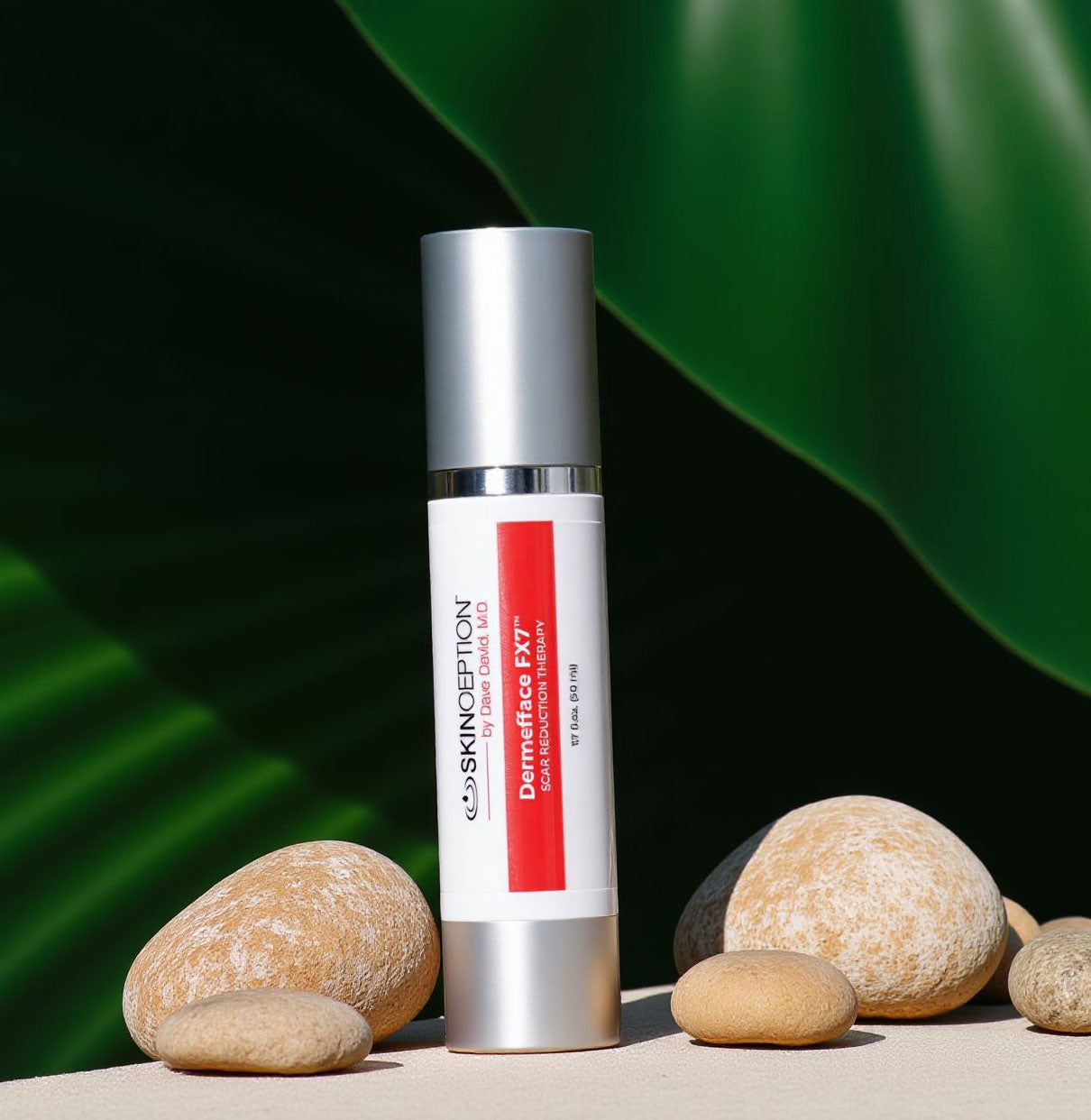
Dermefface FX7 ($59.95, Our Score 7.0/10) is the scar cream we carry, and it is a fair worked example of both the category's strengths and its limits. In its favour: the maker publishes a full ingredient list, gives real application guidance — a thin layer over the scar and surrounding skin, twice daily, morning and evening, only once the wound is fully closed and dry with stitches or staples removed — and states an honest timeline in print: changes beginning around four weeks, a minimum 90-day commitment, three to four months for minor surface scars and at least six for deep ones. Its 90-day guarantee, per the maker's own retail FAQ, is long enough to cover a fair first course. Against it, and disclosed on its review page: the evidence is entirely ingredient-level — supplier studies and laboratory collagen figures — with no trial of the finished cream, and the maker's best-known ingredient study used niacinamide at 5% while the maker's detailed formula lists it at 2%. Our scar cream buying guide turns those checks — scar type first, ingredient honesty, guarantee maths — into a checklist you can apply to any product, and our guide to what to look for in an anti-aging cream covers the wider label-reading skills this category shares.
When Should a Scar See a Dermatologist Instead?
Book the professional, rather than another tube, if any of these apply: the scar is growing beyond the original wound's edges , or is thick, raised and still enlarging months later — the keloid pattern; it is painful, itchy in a way that is worsening, or restricting movement — for example tightening across a joint; it reopens, weeps or shows signs of infection ; it appeared or changed without a clear injury to explain it, or an existing scar changes colour, shape or feel; it is a pitted acne scar whose depth is the actual problem; or it troubles you enough that surface-level improvement would not answer the need. A dermatologist can assess scar type properly and discuss the procedural options that exist beyond topicals. That is not a counsel of despair about creams — it is the same division of labour as everywhere else in health: the right tool for the layer the problem actually lives in.
The bottom line: a scar is emergency repair tissue, improved by a remodelling process that runs for months after the surface — renewing roughly every 28 days — has long looked finished. Match your expectations to that biology: judge any cream over a full course of three to six months, credit time itself with part of any improvement, expect surface-level change rather than removal, and treat keloids, growing scars and movement-limiting scars as a dermatologist's territory from the start.
Disclaimer: This article is for general information only and is not medical advice. Always consult a qualified healthcare professional before starting any supplement, especially if you have a medical condition or take prescription medication. Individual results vary, and no result is guaranteed.
Last reviewed: October 2026