
- Quick Answer: Do Scar Creams Work, and How Long Do They Take?
- Scar-Type Triage: The Answer Depends on Your Scar
- What Is in It — Including the Two-Formula Problem
- The Evidence: Ingredient Studies, One Dose Gap, No Cream Trial
- How Long Before You See Results — and How to Use It
- Is It Safe for Sensitive Skin?
- Price, the 90-Day Guarantee — Legit or Worth It?
- Frequently Asked Questions
- Our Verdict
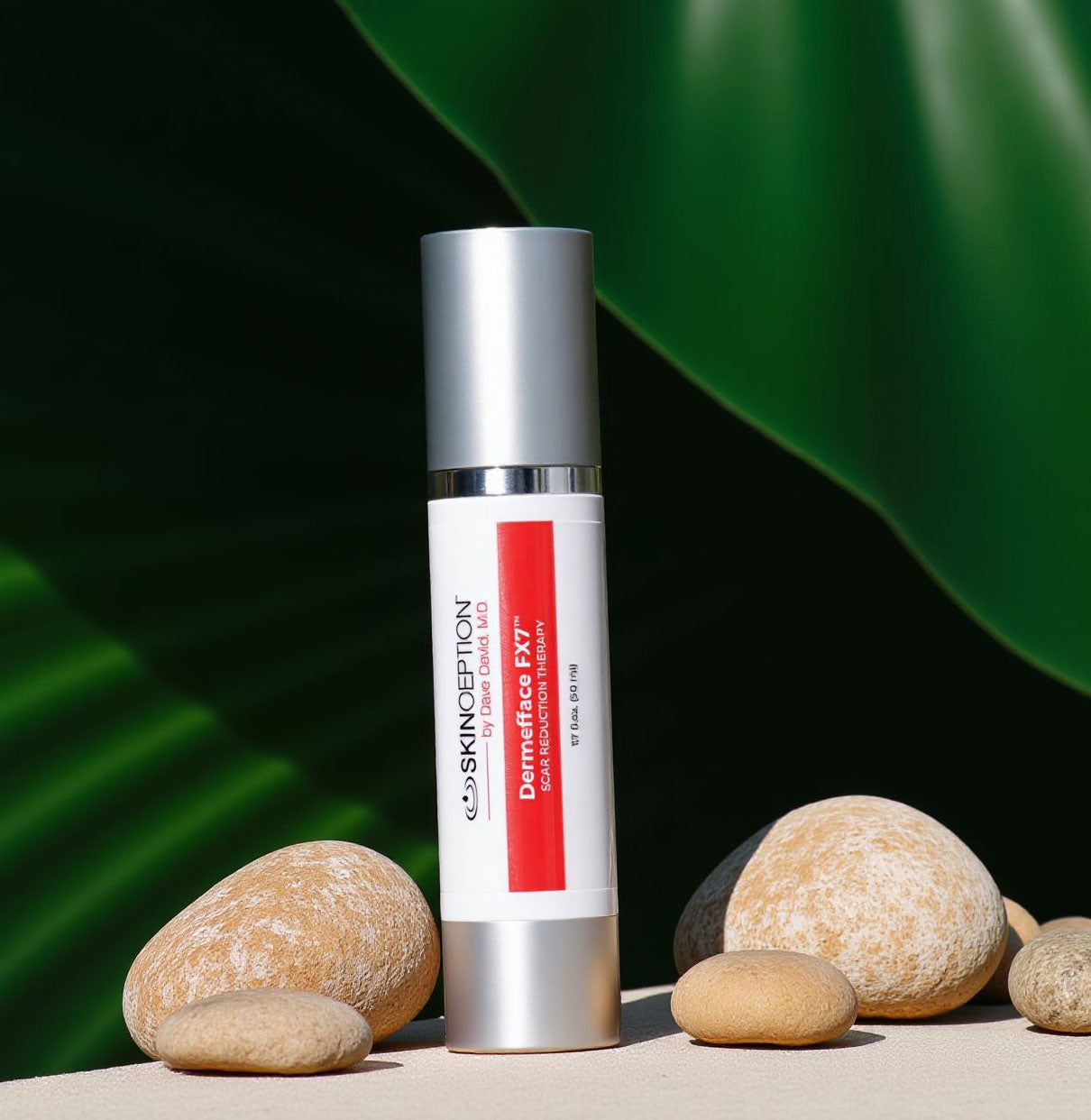
Affiliate disclosure: This article contains affiliate links. If you buy through a link on this page, we may earn a commission paid by the manufacturer, at no extra cost to you. That never changes what we publish — and here it means answering the scar-cream questions in the order of scepticism people actually bring to them: do these creams work at all, what about my kind of scar, and will anything actually remove it? Dermefface FX7 — Skinception's "Scar Reduction Therapy" cream — is the audited example, earning an Our Score of 7.0/10 in our review.
Quick Answer: Do Scar Creams Work, and How Long Do They Take?
What it is: a twice-daily topical cream for acne, burn, surgery and other scars, built to work with the skin's 28-day regeneration cycle. Do scar creams work? The honest category answer is "modestly, and it depends on the scar" — the evidence for every cream in this category, this one included, is ingredient-level, and no finished-cream trial exists here. What this maker does better than most: a full ingredient list, published active concentrations in its retail material, and an honest printed timeline. How long: the maker expects first changes beginning around four weeks, with a committed course of three to six months depending on the scar. Price and guarantee: $59.95 for one pump (about a month), with a 90-day guarantee per the maker's retail FAQ.
Scar-Type Triage: The Answer Depends on Your Scar
The generic question "does scar cream work?" dissolves into four specific ones, and the maker's own material answers them differently:
- New and still-developing scars — the maker's home ground. It positions the cream for both established and still-developing scars, working through the final skin-remodelling phase: fast-tracking healing, pushing scarred cells to the surface to be sloughed away, and increasing production of normal skin cells to replace them — on the skin's natural 28-day regeneration cycle.
- Old scars — asked about constantly ("does it work on old scars?"). The maker lists established scars within its positioning, but its own timeline stretches with scar age and depth — at least six months for deep surgery or injury scars — and no study it cites isolates old scars as a group. Expectation-setting matters more here than anywhere: remodelling an old scar is the slowest version of an already slow job.
- Pitted acne scars — the hardest case, and the one to be most careful with. A pit is missing tissue volume, not just discoloured or raised surface; a surface cream's mechanism (remodelling, cell turnover, hydration) addresses texture and colour at the surface. The maker lists acne scars among the types it addresses — but a buyer with deep pitting should hear plainly that no cream in this category publishes evidence of refilling lost volume, and this one is no exception.
- Surgical scars — within the maker's listed types, with its clearest practical rule: begin only once the wound is fully closed and dry, with stitches or staples removed. Never on an open wound.
And the exception the maker itself states: keloid scars are excluded — treatment of keloids, the maker says, should be discussed with your doctor. Does it completely remove scars? No — and no cream does. The maker's own promise is that scars will fade; "reduction" is the product's middle name, not removal. Any page promising complete removal is telling you what you want to hear; the realistic best case is a scar that is flatter, paler and less noticeable than the one you started with.
What Is in It — Including the Two-Formula Problem
Dermefface FX7 does more homework than most scar creams: a complete INCI list on the brand page, and — in the maker's retail material — the concentration of each branded active: Symglucan 10%, Pentavitin 5%, Dl-Panthenol 5%, Vitalayer 3%, Pro-Coll-One+ 2%, Niacinamide 2% and Allantoin 0.5%, summarised by the maker as "7 clinically proven active ingredients, 10 potent antioxidants, and 5 super moisturizers." Then the problem our review flags in full: the maker's brand page and retail page currently print two different formulas. The brand page (skinception.com) lists Aqua, Dimethicone, Panthenol, Hexapeptide-9, Allantoin, rosehip seed oil and base ingredients — none of the named branded actives. The two lists cannot both describe the current bottle; the overlap both share is panthenol and allantoin. Until the maker reconciles them, treat the brand page as the formula of record and the retail percentages as the maker's detailed — possibly previous — formulation. A cream asking $59.95 a month owes its buyers one formula, printed consistently.
The Evidence: Ingredient Studies, One Dose Gap, No Cream Trial
Every result the maker cites is ingredient-level. The collagen figures — type I collagen production up 1190% (Pro-Coll-One+) and type III up 1257% (Vitalayer) — come from ingredient-supplier testing, including work in cultured human fibroblasts: laboratory numbers, not cream-on-scar results. The one named human trial (Vitalayer's supplier, Silab) tested that single ingredient at 3%, twice daily for 56 days, on 25 female volunteers with an average age of 60 — and measured wrinkles and skin moisture, not scars. Panthenol's 30% faster superficial-wound healing comes from a 1987 study at 5% concentration.
The niacinamide dose gap is the cleanest example of how to read this category, so here it is in full. The maker's retail page cites an eight-week study in which 5% niacinamide produced a "noticeable" or "significant" decrease in hyperpigmentation for 89% of participants — and lists the formula's niacinamide, on the same page, at 2%. The study supports the ingredient at more than twice the strength the formula states. Whether 2% performs the same is not something the maker's material establishes — and that pattern (study dose above formula dose, quietly) is the single most common evidence trick in skincare. This maker at least prints both numbers where an auditor can find them; most do not. The benchmark question readers raise — how do creams compare with silicone gel, the category's most-studied topical format? — is one the maker's pages never address: no silicone comparison appears anywhere in its material, and the brand formula's own dimethicone (a silicone) is listed without any such framing. We note the absence rather than score a comparison the maker never made. For how we read skincare claims generally, see Does Collagen Cream Actually Work? and What to Look for in an Anti-Aging Cream — the same audit habits apply, and this product's Skinception sibling is Kollagen Intensiv, compared in Collagen Cream vs Supplements.
How Long Before You See Results — and How to Use It
The maker's routine, from its FAQ: a thin layer over the scar and the skin immediately surrounding it, smoothed gently until fully absorbed, twice daily — morning and evening — and it may be worn under makeup. Start only once the wound is closed and dry with stitches or staples removed. The maker's timeline, stated in print: results begin in as little as four weeks; a minimum 90-day commitment; three to four months for minor surface scars; at least six months for deep surgery or injury scars. One pump lasts about 30 days applied to a single scar area, per the maker's retail FAQ — so price a course, not a pump: $129.95 for three pumps, $199.95 for six.
Is It Safe for Sensitive Skin?
This is the one safety area where the maker gives real guidance: for sensitive skin, it recommends patch-testing a small amount on the arm or jaw line before full application, and states it has received no complaints to date. The closed-wound rule and the keloid exception (both above) complete the exclusion list — no other exclusions (age, pregnancy, interactions) are stated on the maker's pages. The cream is manufactured in the USA to cGMP standards, per the maker. A topical with stated limits, a stated patch test and no risky actives on either published list is a better safety page than most of this batch manages — which is a comment on the batch as much as on the cream.
These statements have not been evaluated by the Food and Drug Administration. This product is not intended to diagnose, treat, cure, or prevent any disease. This article is educational and is not medical advice.
Price, the 90-Day Guarantee — Legit or Worth It?
One pump is $59.95; three pumps $129.95; six $199.95. The guarantee needs its source stated: the brand page promises fading but prints no day count; the 90-day term comes from the maker's own retail FAQ — try it for 90 days and return within 97 days of purchase for a full refund of the product price, minus shipping (for multi-container orders, return the first three empty containers plus all additional unopened containers; refunds limited to one order per customer). Older third-party listings citing 67 days are contradicted by the maker's current FAQ. Ninety days covers a full first course for most scar types — the longest guarantee in this batch. Is it legit, and is it worth it? A real maker (Skinception, Leading Edge Health), a published INCI list and disclosed concentrations — not scam-shaped. Worth it depends on your scar type (see the triage above) and on accepting the course price, not the pump price, as the real number. Buy through the Buy from Official Website button on our review page so the guarantee applies.
Frequently Asked Questions
Does Dermefface FX7 really work for scars? Its evidence is ingredient-level — supplier studies and in-vitro figures, with no trial of the finished cream. The maker's transparency (full INCI, printed concentrations, honest timeline) is above category average; the proof standard is the category's usual one.
Can I use it on pitted acne scars? The maker lists acne scars among the types it addresses. Set expectations by mechanism: a cream works on surface texture and colour; deep pitting is lost volume, and no published evidence here shows a cream restoring it.
How do I use it? Thin layer, scar and surrounding skin, twice daily, once the wound is fully closed — full routine in the section above.
Our Verdict
Dermefface FX7 scores 7.0/10 in our review — Ingredients 7.5, Evidence 5.5, Safety 7.5 and Value 5.5 on the product page's sub-scores. The honest summary: a scar cream that publishes more than its competitors — full INCI, active concentrations, a realistic timeline, real exclusions — and still cannot escape its category: ingredient-level evidence, a headline study run at more than double its formula's strength, and two conflicting formula lists on its own maker's pages. Buy it, if you buy it, for a newer or surface scar, on a course-length budget, inside the longest guarantee in this batch.
Disclaimer: This article is for general information only and is not medical advice. Always consult a qualified healthcare professional before starting any supplement, especially if you have a medical condition or take prescription medication. Individual results vary, and no result is guaranteed.
Last reviewed: October 2026
