
- Quick Answer: Do HGH Supplements Work — and What Are They Really?
- What Is HGH, and Why Does It Fall With Age?
- If the Bottle Contains No HGH, What Is in It?
- What Does "Secretagogue" Mean?
- HGH Injections vs Supplements: How Are They Different?
- What Does GenF20 Plus Claim — in the Maker's Own Words?
- What Can You Honestly Expect, and How Long Does It Take?
- Who Should NOT Use HGH-Positioned Supplements?
Affiliate disclosure: This article contains affiliate links. If you buy through a link on this page, we may earn a commission from the manufacturer at no extra cost to you. That relationship never changes what we say here — and this article exists to correct the biggest misunderstanding in this entire category, including about products we sell.
So, do HGH supplements work? Before that question can be answered honestly, a more basic one has to be cleared up: the products sold as "HGH supplements" — pills, sprays and powders with names built around human growth hormone — do not contain any human growth hormone at all. Not a trace. What they actually contain is a blend of amino acids and plant extracts, sold on the idea that they might nudge your body into releasing a little more of its own growth hormone. That is a very different claim from the one the label design hints at.
Quick Answer: Do HGH Supplements Work — and What Are They Really?
An over-the-counter "HGH supplement" is not a hormone product. Real human growth hormone is a prescription-only drug, given by injection, under medical supervision. The supplements in this category — including GenF20 Plus, the best-known one we carry — are nutritional formulas built from amino acids such as L-arginine and L-glutamine, plus ingredients like GABA and Alpha GPC. They are marketed as "secretagogues": substances intended to support your pituitary gland's own release of growth hormone. Whether they meaningfully do that in healthy adults is unproven — the evidence is thin and mixed, and no supplement here has been shown to reproduce the effects of actual hormone therapy. Anyone who tells you a capsule works "just like HGH injections" is misrepresenting both products.
What Is HGH, and Why Does It Fall With Age?
Human growth hormone (HGH, also called somatotropin) is a hormone your body makes itself, in the pituitary gland — a pea-sized gland at the base of the brain. It is released in pulses, not a steady stream. In childhood it drives growth; in adults it continues to support muscle, bone, metabolism and body composition — much of it indirectly, by signalling the liver to produce IGF-1, the compound used as a stand-in measurement for growth hormone activity.
Two facts about natural HGH explain most of this category's marketing — and its limits:
- Your biggest daily release happens in deep sleep. The largest growth hormone pulses of the day are tied to the first period of deep, slow-wave sleep at night. Poor sleep literally shrinks the body's main natural HGH window — which is why some formulas in this category include ingredients like GABA, associated with sleep.
- Production falls steadily with age. Output peaks around puberty and declines progressively from early adulthood onward, alongside the age-related loss of deep sleep. This is part of why these products are marketed to adults over 35 or 40. But "levels fall with age" is not the same as "a supplement can restore them" — that second step is where the evidence gets weak.
If the Bottle Contains No HGH, What Is in It?
Open the label of a typical product here and you will find some combination of these — none of which is growth hormone:
- Amino acids: L-arginine, L-glutamine, L-glycine, L-lysine, L-tyrosine, L-ornithine and others — the core of nearly every formula, chosen for their role in the signalling that prompts the pituitary to release growth hormone.
- GABA (gamma-aminobutyric acid): included in many formulas, typically positioned around relaxation and sleep.
- Alpha GPC: a choline compound; in the GenF20 Plus system it comes in the accompanying oral spray, not the tablets.
- Botanicals and glandular powders: ingredients such as astragalus root extract, Tribulus terrestris, deer antler velvet, colostrum and "anterior pituitary powder" appear on labels in this category.
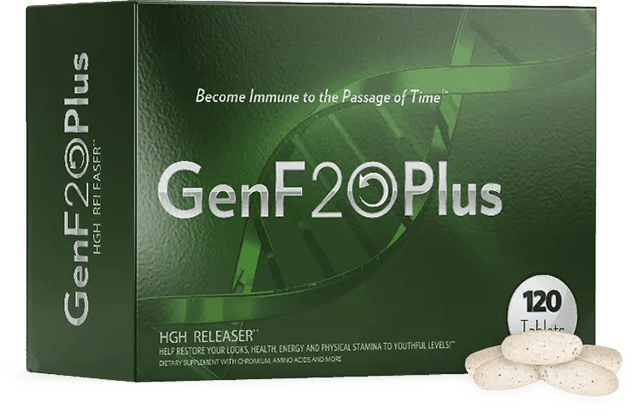
GenF20 Plus, for example, is a two-part system: tablets listing amino acids (L-arginine, L-glutamine, L-glycine, L-lysine, L-tyrosine, GABA, L-ornithine and others) alongside astragalus, Tribulus, colostrum, deer antler velvet and pituitary powder, plus a spray built around Alpha GPC with ingredients like Mucuna pruriens. One thing is obvious from that label: even the ingredient with "pituitary" in its name is a powdered gland ingredient in a tablet — it is not, and cannot deliver, human growth hormone. Growth hormone is a protein; swallowed in a pill, it would simply be digested like any other protein. That is precisely why the real pharmaceutical version is injected.
These statements have not been evaluated by the Food and Drug Administration. Dietary supplements are not intended to diagnose, treat, cure, or prevent any disease.
What Does "Secretagogue" Mean?
"Secretagogue" is the medical word for any substance that causes a gland to secrete — release — another substance. A growth hormone secretagogue, then, is something intended to prompt the pituitary to release growth hormone the body makes itself. In medicine the term covers specific prescription and research compounds; in supplement marketing it is used much more loosely, for amino-acid blends said to support the same release process.
The word matters because it quietly changes the claim being made. A secretagogue does not give you growth hormone; at most, it aims to coax your own gland into releasing more of what it already produces. That is a modest, indirect mechanism, and how much oral amino-acid blends actually trigger in healthy adults remains an open question.
HGH Injections vs Supplements: How Are They Different?
Because the two share a name, they are constantly confused:
- Real HGH (somatropin) is an actual growth hormone drug, identical to the hormone your pituitary makes. It is prescription-only, given by injection, supervised by a doctor, and approved for specific diagnosed conditions — chiefly growth hormone deficiency. It is not approved as an anti-aging treatment for healthy adults, it is expensive, and it carries real risks and monitoring requirements.
- "HGH supplements" are over-the-counter dietary supplements of amino acids and botanicals — no hormone of any kind. They need no prescription because they are not drugs, and are not FDA-approved to treat any condition.
Same two words on the shelf, entirely different products. A supplement is not a substitute for treatment of a diagnosed deficiency, and no honest seller should suggest otherwise. If you are a healthy adult, injections are not an approved or casual option either — which is exactly the gap this supplement category markets itself into.
What Does GenF20 Plus Claim — in the Maker's Own Words?
GenF20 Plus's maker, Leading Edge Health, positions the product the way this whole category does: as an "HGH releaser" — a formula intended to support the body's own production rather than supply the hormone itself. To the maker's credit, its own materials describe a releaser, not the hormone — the confusion comes mostly from the shelf name and third-party hype.
The headline evidence the maker points to is a clinical study it highlights, measuring participants' IGF-1 levels — the standard stand-in marker for growth hormone activity. That is how the maker frames its case, and it should be read at exactly that strength: it is the maker's own study claim, presented by the maker, in support of its own product. A single study promoted by the company selling the product is a starting point for a decision — not independent confirmation, and not what turns an amino-acid formula into growth hormone therapy. The related tablet formula from the same maker, GenFX, is positioned the same way.
What Can You Honestly Expect, and How Long Does It Take?
If you try a product in this category with clear eyes, set expectations like this: nothing happens overnight, and nothing dramatic should be expected at all. These formulas are used daily, over months — the honest timeline is two to three months of consistent use before judging anything. The changes users typically describe, when they describe any, are gradual and subjective: sleep quality, daytime energy, recovery, a general sense of vitality. Objective transformations — the kind real hormone therapy is monitored for — are not a reasonable expectation from an amino-acid supplement.
Now the limitations, stated plainly, because this site would rather lose a sale than mislead you. Honest limitations: no supplement in this category has been proven to restore youthful growth hormone levels, reverse aging, or reproduce the measured effects of prescription somatropin. The evidence that oral amino-acid blends meaningfully raise growth hormone output in healthy adults is weak and inconsistent, and the finished products have far less evidence than their ingredient lists suggest. Aging, and the loss of deep sleep that comes with it, keeps working in the other direction. The most defensible claim here is nutritional support for a natural process — and the most powerful genuine levers on that process remain unglamorous: deep sleep, exercise, and body composition. The same expectation rules apply across this site's hormone topics, as our guide to how long testosterone boosters take to work explains, and our article on whether collagen cream actually works.
Who Should NOT Use HGH-Positioned Supplements?
Some people should stay away from this whole category, or talk to a doctor first:
- Anyone with a current or past cancer diagnosis. Growth hormone and IGF-1 are growth signals; experimenting with anything marketed around them without an oncologist's input is not sensible.
- People with diabetes or blood-sugar problems. Growth hormone interacts with glucose metabolism — even prescription HGH is flagged for effects on blood sugar — so diabetics should not use products in this category without medical advice.
- Anyone under 18. These products are for adults; a still-developing endocrine system is not a place for hormone-adjacent experimentation.
- Women who are pregnant or nursing. Safety is not established.
- Anyone on prescription medication, or with a diagnosed hormone disorder. Speak to your doctor first — and if you have symptoms of actual growth hormone deficiency, the right step is testing and medical care.
The bottom line: "HGH supplements" are amino-acid formulas with an outsized name. Bought with honest expectations — daily use, months not days, subtle at best, no hormone inside — they are a legitimate personal choice. Bought as a shortcut to what prescription growth hormone does, they will disappoint you every time. If the honest version still interests you, the full ingredients and the maker's own study description are on the GenF20 Plus product page — order via the Buy from Official Website link to stay under the maker's own terms.
Disclaimer: This article is for general information only and is not medical advice. The products discussed are dietary supplements, not drugs; they are not intended to diagnose, treat, cure, or prevent any disease, and their claims have not been evaluated by the FDA. Consult a qualified healthcare professional before using any supplement, especially if you have a medical condition or take prescription medication.
Last reviewed: October 2026
