
- Quick Answer: What Can a Collagen Cream Do, and What Can It Not Do?
- Why Do People Say Collagen Cream Is a Myth?
- So Why Does Skin Feel Smoother After a Collagen Cream?
- What Should You Look for on a Collagen Cream's Label?
- How Long Before You Can Judge a Collagen Cream Fairly?
- Collagen Cream or Collagen Supplement — Which Does What?
- Honest Limitations: What No Collagen Cream Can Do
Affiliate disclosure: This article contains affiliate links. If you buy through a link on this page, we may earn a commission from the manufacturer at no extra cost to you. That relationship never changes what we say here — and in this article, what we say includes some things the makers of collagen creams would probably rather we left out.
Few skincare questions are asked as often, or answered as dishonestly, as this one: does collagen cream work? The jars promise firmer, younger-looking skin; the skeptics call the whole category a myth. The honest answer sits in between, and it starts with a simple fact about size. A collagen cream can genuinely make skin feel smoother, softer, and better hydrated. What it cannot do is deliver collagen into the layer of skin where your own collagen lives. Below, we explain why — and how to judge any collagen cream fairly once you know that.
Quick Answer: What Can a Collagen Cream Do, and What Can It Not Do?
The short version: a collagen cream works on the surface of the skin, not underneath it. Applied regularly, it can hydrate the outer layer, form a light protective film that slows water loss, and make fine lines look temporarily softer because well-hydrated skin reflects light more evenly. Skin often feels firmer to the touch for the same reason a dry sponge feels different from a damp one.
What it cannot do is top up the collagen in your dermis — the deeper layer that gives skin its structure. The collagen molecule is simply too large to get there through intact skin, and any cream, at any price, faces the same physical limit. If marketing implies the collagen in the jar becomes the collagen in your face, that claim does not survive basic skin science.
Note: a collagen cream is a cosmetic product. It is not a drug, it is not FDA-approved to treat wrinkles or any skin condition, and cosmetic claims are not held to the same evidence standard as medicines.
Why Do People Say Collagen Cream Is a Myth?
The skepticism comes from a well-established principle in dermatology known as the 500 Dalton rule. A Dalton is a unit of molecular weight. In a widely cited 2000 analysis, dermatologists Bos and Meinardi reviewed decades of absorption data and concluded that compounds larger than about 500 Daltons generally cannot pass through the skin's outer barrier, the stratum corneum. Nearly every substance known to be absorbed through skin falls under that line.
Now consider collagen. In its natural form, a single collagen molecule weighs roughly 300,000 Daltons — about 600 times the limit. It is a huge triple-helix protein, built like a rope. Expecting it to slip through the skin barrier is like expecting that rope to pass through a keyhole.
"But my cream says hydrolyzed collagen," you might say. Hydrolyzed collagen is collagen broken into smaller fragments called peptides — typically around 1,000 to 5,000 Daltons. Smaller, yes, but still two to ten times above the 500 Dalton threshold. Smaller is not the same as small enough. This is why dermatologists say topical collagen stays on the surface: it is not a matter of brand quality or price. It is physics.
So Why Does Skin Feel Smoother After a Collagen Cream?
If the collagen never gets in, why does skin so often feel better within days of using one of these creams? Because surface effects are real effects — they are just different from the structural change the marketing hints at.
Collagen and its hydrolyzed fragments are good at holding water. Sitting on the skin, they act as humectants and film-formers: they draw in moisture and lay down a thin film that reduces the water your skin loses to the air. Hydrated surface skin is plumper, smoother, and less flaky, and fine lines — which look deeper when skin is dry — appear softened. Studies of hydrolyzed-collagen moisturizers have found exactly this pattern: measurable improvements in surface hydration and smoothness with regular use. That is a legitimate cosmetic benefit. It is also temporary: stop applying the cream, and the effect fades with the film and the extra moisture.
There is a second, more modest possibility worth stating honestly. Some creams pair collagen with smaller signal peptides designed to nudge the skin's own collagen-making cells. The evidence is mixed and ingredient-specific, and it applies to the peptides, not to the collagen itself — one reason the label matters more than the word "collagen" on the front of the jar.
What Should You Look for on a Collagen Cream's Label?
Since the headline ingredient does the surface work, judge a collagen cream the way you would judge a quality moisturizer — by everything around it. Practical label-reading guidance:
- Supporting peptides. Look for named peptides in the ingredient list, not just "collagen." A formula built around specific peptides is making a more precise claim than one relying on collagen alone.
- Antioxidants such as vitamins C and E. These help defend existing collagen from free-radical damage — a realistic goal for a cream.
- Proven moisturizing partners. Humectants like glycerin and emollients that support the skin barrier do much of the day-to-day work you will actually feel.
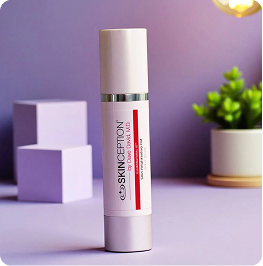
- A named maker and a published ingredient list. Brands that print the full label — for example, Skinception, the Leading Edge Health brand behind Kollagen Intensiv, which formulates its cream with collagen alongside peptides and vitamins — are easier to evaluate than anonymous jars with vague "proprietary blends."
- A money-back guarantee. Because results are surface-level and individual, a guarantee (Kollagen Intensiv is sold with one) says more about a maker's confidence than any before-and-after photo.
For a direct comparison, see our guide to collagen cream vs collagen supplements.
How Long Before You Can Judge a Collagen Cream Fairly?
Not overnight, and not after a weekend. Your skin's surface renews on a cycle of roughly 28 days in younger adults, stretching to 40 days or more with age. A cream can only show what it does as new surface cells arrive, so a fair trial is weeks of consistent use — typically at least 8 to 12 weeks, applied as directed — before you conclude anything.
During that time, judge the things a cream can plausibly affect: Does skin stay comfortable and hydrated through the day? Do fine lines look softer in the morning? Take a photo in the same light at the start and at week eight; memory is a generous reviewer, and photographs are stricter. If nothing has changed by then, the honest conclusion is that this formula is not doing much for you — whatever the jar promised.
Collagen Cream or Collagen Supplement — Which Does What?
These are different tools that share a word, and confusing them causes most of the disappointment in this category. A collagen cream works from the outside in, but only reaches the surface: hydration, comfort, and the temporary appearance of smoother skin. An oral collagen supplement works from the inside out: its peptides are digested and absorbed through the gut — a route that does not face the 500 Dalton skin barrier — and several clinical trials have reported modest improvements in skin elasticity and hydration after a few months of daily use, though the research is younger and partly industry-funded.
Neither replaces the collagen your body makes; at best, each supports appearance in its own way. If your goal is surface comfort and a smoother look today, a cream is the direct tool. If your goal is longer-term support for skin from within, that is the supplement's territory. Some people use both, with appropriately modest expectations of each.
Honest Limitations: What No Collagen Cream Can Do
We sell a collagen cream through this site, and we would rather you bought it with clear eyes than with inflated ones. So, plainly:
- No cream rebuilds deep collagen. The collagen in the jar stays on the surface. Nothing applied to intact skin restores the dermal scaffolding that age and sun exposure break down.
- No cream replaces sunscreen. Ultraviolet exposure is the single biggest external driver of collagen breakdown. Daily sun protection protects more collagen than any cream can pretend to add.
- No cream replaces retinoids. Retinoids are small enough (around 300 Daltons) to cross the barrier, and they carry the strongest topical evidence for stimulating collagen production. If you use one product class for that purpose, it is that one — ideally with a dermatologist's guidance.
- Effects stop when you stop. The smoothness a collagen cream provides is rented, not owned. It lasts exactly as long as the routine does.
So, does collagen cream work? As a way to deliver collagen into your skin: no, and any brand implying otherwise is leaning on a myth. As a well-formulated moisturizer that hydrates the surface, softens the look of fine lines, and supports firmer-feeling skin with regular use: yes, within those honest limits. If that is what you want, the full details — ingredient positioning, guarantee, and pricing — are on our page for Skinception Kollagen Intensiv, where the Buy from Official Website link keeps any purchase under the maker's own terms. Read it the way you read this article: looking for what the product can actually do.
Disclaimer: This article is for general information only and is not medical advice. Kollagen Intensiv and the other products mentioned are cosmetics, not drugs; they are not intended to diagnose, treat, cure, or prevent any disease or skin condition, and their claims have not been evaluated by the FDA. If you have a skin condition or concerns about your skin, consult a qualified dermatologist.
Last reviewed: October 2026
