
- Quick Answer: What Can 'Releaser' Honestly Mean?
- What Are HGH Injections, Legally and Medically?
- What Is an HGH Releaser, Mechanistically?
- What Do the Injection Studies Prove — and What Don't They Prove?
- Why Does Releaser Marketing Borrow Injection Results?
- What About Athletic Performance and Drug Testing?
- What Does the Audited Releaser Shelf Actually Look Like?
Affiliate disclosure: This article contains affiliate links. If you buy through a link on this page, we may earn a commission paid by the manufacturer, at no extra cost to you. That never changes what we publish — and in this category it means drawing the line this page is named for, even about products we sell: a "releaser" supplement contains no human growth hormone, is not a weaker form of the injection, and cannot borrow the injection's study results as its own.
Few words in supplement marketing do more quiet work than "releaser." Stand an HGH releaser next to prescription HGH injections and the shared letters — HGH — do the persuading: the drug has decades of medical study behind it, dramatic measured effects in deficient patients, and a price and prescription barrier to match. The supplement has a similar name, no prescription, and a much smaller price. The implication writes itself: same hormone story, easier door. This page takes that implication apart, piece by piece — what each product legally is, what each one claims to do inside the body, what the famous injection studies actually measured, and why releaser marketing leans on them so heavily. It ends with the audited releaser shelf in this store, scores included, so the comparison finishes where a buyer actually stands.
Quick Answer: What Can 'Releaser' Honestly Mean?
It can mean exactly one thing: a dietary supplement — typically amino acids and botanicals — that is intended to nudge your pituitary gland into releasing more of the growth hormone your body already makes. It cannot mean that the product contains HGH (it contains none), that it delivers HGH (swallowed HGH protein would simply be digested, which is precisely why the real drug is injected), that it is proven to raise growth hormone meaningfully in healthy adults (that remains unproven for oral blends), or that it reproduces injection results (no releaser study shows that). Prescription HGH is a regulated drug for diagnosed deficiency. A releaser is a supplement built around a mechanism claim. The word is honest only when it is read as a claim about intent — "designed to prompt a release" — and dishonest the moment it is read as a result.
What Are HGH Injections, Legally and Medically?
Real human growth hormone — somatropin — is an actual hormone drug, identical to the hormone your pituitary gland makes. In the United States it is prescription-only , given by injection, supervised by a doctor, and approved for specific diagnosed conditions, chiefly growth hormone deficiency. It is not approved as an anti-aging treatment for healthy adults, it is expensive, and it carries real risks and monitoring requirements — which is exactly why it is dispensed the way it is. Our legal explainer, Can You Buy HGH Over the Counter? , gives the plain answer its title promises: no, real HGH cannot be bought over the counter, and anything on a shelf that seems to say otherwise is something else wearing the name.
That legal status is not a technicality around the edges of this comparison — it is the comparison. A product that could legally be sold without a prescription, to anyone, as a dietary supplement, is by definition not the prescription hormone drug. The releaser format is precisely what keeps these products on the supplement shelf rather than the prescription one, as the maker of the audited example below states plainly about its own product: it contains no actual or synthetic HGH.
What Is an HGH Releaser, Mechanistically?
The mechanism claim is indirect by design. A releaser supplies no hormone. Instead, its ingredients — amino acids such as L-arginine, L-glutamine, L-glycine, L-lysine, and L-ornithine are the core of nearly every formula in this category, alongside ingredients like GABA and botanicals — are positioned as signals that support the pituitary's own release of growth hormone. In the category's vocabulary, these are "secretagogue" formulas: substances intended to prompt a gland to secrete what it already produces.
Two honest limits attach to that story, and both come from our own category explainer, HGH Supplements Explained . First, the body's largest growth hormone pulses are tied to deep sleep and, in releaser dosing schedules, to exercise — real rhythms that formulas time themselves around, but rhythms the body already runs without a capsule. Second, how much oral amino-acid blends actually trigger in healthy adults remains an open question: the evidence is thin and mixed, and no supplement in this category has been shown to reproduce the effects of actual hormone therapy. A releaser aims at a nudge. Whether the nudge is measurable, let alone visible, is the unproven step.
These statements have not been evaluated by the Food and Drug Administration. Dietary supplements are not intended to diagnose, treat, cure, or prevent any disease.
What Do the Injection Studies Prove — and What Don't They Prove?
This is the section releaser marketing most hopes you skip, so here is the worked example from the audited maker's own "medical proof" page. The maker of HyperGH 14x cites, as background on HGH itself:
- A 1990 New England Journal of Medicine study — men over 60 given HGH by injection for six months, with measured changes the maker reports as 8.8% more lean body mass, 14.4% less adipose tissue, and 7.1% thicker skin.
- A 2010 European Journal of Endocrinology paper — on ten years of GH replacement in GH-deficient elderly adults. Again: the hormone itself, given as replacement, to people diagnosed as deficient.
Read those citations at exactly their strength. They are real evidence — about injected hormone, at pharmaceutical doses, in older or deficient men, under medical supervision . They establish what growth hormone can do when it is actually delivered into the body in drug quantities. They establish nothing about whether an oral amino-acid blend raises growth hormone at all, nothing about how much it might raise it if it does, and nothing about whether a small, indirect nudge — even a real one — produces drug-scale changes in body composition. Every step between "injections changed lean mass in deficient men" and "this capsule will change your physique" is a step the cited studies do not contain.
The maker, to be fair, presents these studies as background on HGH itself, and states repeatedly that its product contains no HGH. The borrowing happens one layer down, in how the category is sold and summarised elsewhere: injection numbers quoted beside a supplement bottle, with the route, the population, and the deficiency quietly dropped. When you see a dramatic percentage attached to a releaser, ask which product, which route, and which people produced it. On this category's proof pages, the answer is almost always: a different product, by injection, in patients.
Why Does Releaser Marketing Borrow Injection Results?
Because it has to, if it wants drama. A releaser's own evidence file is thin by construction — finished-product trials are rare in this category, and ingredient-level claims are modest. Injection research is the nearest source of large, precise, journal-published numbers attached to the words "growth hormone." Borrowing them solves a marketing problem: it lets a page about a supplement be filled with measurements of a drug, while the product's own unmeasured status stays in the background.
The defence against it is not cynicism about the studies — the injection studies are legitimate medicine. The defence is labelling. Background is background. The moment background is allowed to stand in for a product trial, the reader has been given the drug's résumé and the supplement's price tag, and invited to merge them. Our product audits refuse the merge on principle, including for products on our own shelf: the HyperGH audit counts those citations under "background on HGH itself," scores the product's Evidence at 5.0/10 accordingly, and states that no trial of the finished product is claimed. Our side-effects companion, HGH Supplement Side Effects , applies the same separation to risk: the supplements do not carry the drug's risk profile — and "not the drug" is still not the same as "proven safe," because supplements are not safety-tested like drugs before they reach the shelf.
What About Athletic Performance and Drug Testing?
Releasers are marketed hardest at exactly the readers with the most to lose from a careless purchase: people who train, compete, and may be tested. Frame this carefully, the way our audited FAQ frames it. On performance: the maker's stated aims for its bodybuilding-positioned system are lean muscle, fat loss, bigger results from the same workouts, and faster recovery — presented as flowing from increased growth hormone release. No study of that product measures any of those outcomes. An aim is not a result, and a mechanism story is not a performance trial.
On testing, the honest position is a gap, stated as a gap: the maker publishes no guidance at all on sport testing. Tested athletes should treat that silence seriously — check the actual formula, which in the audited example includes glandular and deer antler velvet ingredients, against their own federation's rules with their governing body, and not take a supplement page's word for eligibility. A product being legally sold as a supplement says nothing about whether every ingredient in it is permitted in a given competition, and "contains no HGH" is not a testing clearance. If your eligibility matters, the governing body is the only authority that counts, and this category's makers have not done that homework for you.
What Does the Audited Releaser Shelf Actually Look Like?
End where a buyer stands: three releaser systems from the same maker family, audited to the same rubric, scoring very differently — which is itself the lesson. The word "releaser" is shared. The paperwork is not.
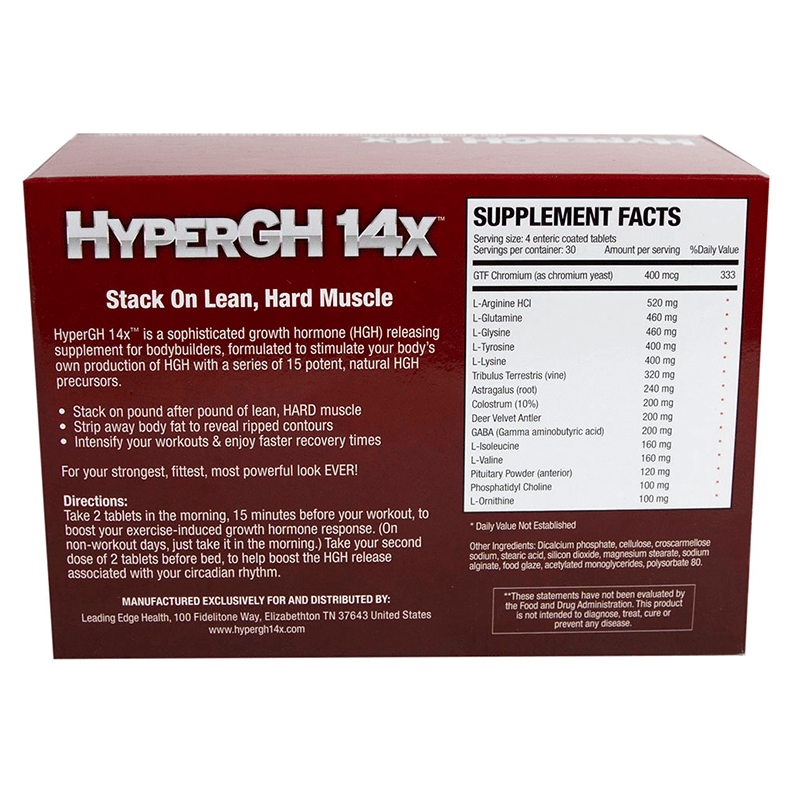
- HyperGH 14x — Our Score: 6.5/10. A two-part system for bodybuilders: capsules plus an oral spray, taken as 2 capsules twice a day plus 3 sprays twice a day — morning or pre-workout, and before bed. Its strength is transparency: all 15 capsule ingredients carry published amounts summing to 4,040 mg/day (L-arginine 520 mg and L-glutamine 460 mg lead the list). Its audit findings are equally specific: the maker's own homepage and order page describe the same capsules as "930 mg total per day" — a direct conflict with its formulation page; the spray publishes no amounts at all, including for its headline ingredient; the price, $69.95 for the one-month package, appears only at the order stage; and the 67-day guarantee covers two boxes of a program the maker recommends running for six months. The spray's headline claim rests on a single 2008 conference abstract for Alpha GPC — an acute, during-workout measurement with no design or participant details given. Our HyperGH 14x, Answered page works through the full file.
- GenF20 Plus — Our Score: 9.0/10. The shelf's evidence leader, and the exception that shows what "some evidence" looks like in this category: the maker reports a 12-week double-blind study of the complete system — tablets plus spray — in which 31 people taking the system were among 61 participants, with IGF-1, the standard stand-in marker for growth hormone activity, reported up 28%. Read it at its strength: one small, company-run study, measuring a blood marker rather than visible outcomes, never independently replicated. That still puts it ahead of every sibling here — which says as much about the category as about the product.
- GenFX — Our Score: 7.5/10. The simpler, cheaper door into the same maker family: a once-named amino-acid tablet formula (L-lysine, L-arginine, L-ornithine, L-glycine, L-glutamine), starting at $49.95, with a 67-day guarantee. Its limits are documentation limits: the maker does not publish ingredient amounts, and we found no published clinical trial of GenFX itself. Named company, real guarantee, untested formula — a legitimate product and an unproven one, at the same time.
Same word on all three labels. A conflicted but fully dosed formula, a marker study, and no study at all underneath it. That spread is why "releaser" can never be a verdict — only a description of intent, to be followed immediately by: whose paperwork, which amounts, what evidence, what guarantee?
The bottom line: injections are a prescription hormone drug with real studies in diagnosed patients and real risks to match. Releasers are hormone-free supplements claiming to nudge your own production, with evidence that ranges — on our own audited shelf — from one small marker study down to none. Neither fact makes the other product's results transferable. If the honest version of a releaser still interests you, buy it as what it is: a months-long personal trial, judged against a baseline you wrote down before you started, inside a guarantee window you have actually read.
Disclaimer: This article is for general information only and is not medical advice. The products discussed are dietary supplements, not drugs; they are not intended to diagnose, treat, cure, or prevent any disease, and their claims have not been evaluated by the FDA. Consult a qualified healthcare professional before using any supplement, especially if you have a medical condition or take prescription medication.
Last reviewed: October 2026
