
- Quick Answer: Does Fertility Factor 5 Improve Sperm Count, and How Long Does It Take?
- What a Semen Analysis Actually Measures
- Does It Work? The Evidence, Ingredient by Ingredient
- Fertility Is Not Libido: The Distinction This Product Is Bought On
- How Long Does It Take? The Spermatogenesis Clock — and the Guarantee Trap
- How Do You Use It — and the Food Questions
- Side Effects, and Who Should Not Use It
- Price, Packs and the 67-Day Guarantee
- Frequently Asked Questions
- Our Verdict
Affiliate disclosure: This article contains affiliate links. If you buy through a link on this page, we may earn a commission paid by the manufacturer, at no extra cost to you. That never changes what we publish — and here it means answering the fertility questions with the one tool that actually settles them: a semen analysis, on the timeline sperm production actually runs on. Fertility Factor 5 earns an Our Score of 8.0/10 in our review. Below is what that score rests on — and the guarantee trap built into this product that most pages never mention.
Quick Answer: Does Fertility Factor 5 Improve Sperm Count, and How Long Does It Take?
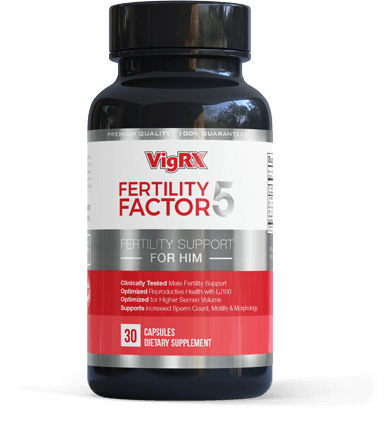
What it is: a once-daily male fertility supplement from Leading Edge Health (VigRX brand family), built around LJ100 — a patented Tongkat Ali extract — at 200 mg a day, the same dose used in the fertility study the maker cites. Does it improve sperm count? The evidence is ingredient-level: a study of 75 men given 200 mg of LJ100 daily is the core of the maker's case, and there is no trial of the finished five-ingredient formula. How long: the maker recommends at least 3 months, judged by a semen analysis — sperm production is a months-long cycle, and there is no honest shorter answer. Price and guarantee: $69 for one month; $169 for three; $299 for six — with a 67-day guarantee that closes before the 3-month judging point.
What a Semen Analysis Actually Measures
Fertility Factor 5 is positioned for men — and couples — trying to conceive where male-factor issues are the obstacle, and it aims at the three parameters a semen analysis reports. Count (concentration): how many sperm per millilitre. Motility: what proportion are moving, and moving forward. Morphology: what proportion are normally shaped. The maker's stated aims map onto them directly — improve sperm count, morphology and motility, support spermatogenesis (sperm production) — plus secondary aims of increasing semen volume and supporting libido and sexual function. This framing matters because it defines the only honest way to judge the product: not by how you feel in week two, but by whether those three numbers move on a repeat analysis. Couples often arrive here from the volume side of the question; our dedicated explainer, Can a Semen Volume Supplement Improve Fertility?, separates volume from fertility properly, and How Much Semen Is Normal? covers what the analysis's volume figure means.
Does It Work? The Evidence, Ingredient by Ingredient
The core of the case is LJ100, and the product's best feature is a dose match. The maker states Fertility Factor 5 contains "the same amount of LJ100 as in this clinical trial": 200 mg per daily serving. The fertility study behind it — 75 men given 200 mg of LJ100 daily, with semen parameters measured at the 3-month mark and, per the brand site, 11 spontaneous pregnancies reported across 6 months — tested the hero ingredient at the dose in the bottle. A separate double-blind, placebo-controlled study of 26 men covers LJ100's sexual-function side. That is stronger ingredient-level evidence than this category usually has.
Now the limits, in the open. There is no trial of Fertility Factor 5 itself — every study tested a single ingredient, and the maker does not claim otherwise. The maker's own pages also disagree about the fertility trial: the brand site reports a semen analysis at 3 months and 11 spontaneous pregnancies across 6 months, while the maker's corporate page says the study ran nine months and states different outcome figures (15% of partners impregnated). We take the brand page as primary, but the conflict is the maker's and it is unresolved on their own sites. And one further study the maker's retail page cites — 109 men, published in eCAM — used 300 mg of LJ100 daily; the product provides 200 mg, so that study's dose does not match the bottle. Around the hero sit four supporting ingredients with their own fertility literature — Panax Ginseng, Zinc, Selenium and BioPerine (a patented black pepper extract included to increase nutrient bioavailability, particularly of selenium and zinc) — but the maker publishes no full Supplement Facts panel, so their amounts cannot be verified: its zinc is described as a "clinically proven dose" without the dose, and its selenium amount can only be guessed at from a corporate-page remark implying 70 mcg. Named, yes; checkable, no.
Fertility Is Not Libido: The Distinction This Product Is Bought On
One of the most observed questions about this product — "can it help with low libido?" — mixes two different shelves. Libido is desire: how interested you feel. Fertility is production: count, motility, morphology. A man can have a perfectly healthy libido and poor sperm parameters, or the reverse, and the fixes are different products. Fertility Factor 5 is marketed around the production side — that is its name, its hero ingredient's fertility study, and its judging tool (the analysis). The maker's stated aims do include supporting libido and sexual function, and LJ100 has its placebo-controlled sexual-function study — but if desire is your actual problem, this is the wrong bottle, and if sperm parameters are the problem, a libido product is the wrong one for you. Its shelf-mates make the split concrete: Semenax is the volume-and-intensity formula, Volume Pills is volume-led, and Fertility Factor 5 is the only one of the three aimed at the analysis.
How Long Does It Take? The Spermatogenesis Clock — and the Guarantee Trap
Sperm are not made overnight. Spermatogenesis — the production cycle from stem cell to mature sperm — runs roughly 74 days, with transport time on top, which is why every serious timeline in this area is measured in months: the sperm in an analysis today reflect production decisions your body made a season ago. The maker's guidance matches the biology: start with at least a 3-month supply and have a semen analysis after at least 3 months — a measurable endpoint, which is rare and creditable in this category.
Then the trap, stated plainly because the maker does not state it: the guarantee is 67 days, and the judging point is 3 months. The refund window closes roughly three weeks before the earliest date at which the maker itself tells you results can be assessed. Follow the maker's own protocol and you will judge this product after your refund right has expired. That does not make the product bad — its evidence structure is genuinely above category average — but it changes the buying decision: the 3-month pack at $169 ($56 per bottle) is the rational purchase precisely because you are committing to the full timeline unprotected, and anyone unwilling to make that commitment should not start. Your practical decision point inside the guarantee is day 60 — the last moment a refund is available — but be honest with yourself that at day 60 the biology has not finished speaking yet.
How Do You Use It — and the Food Questions
Use: the maker describes Fertility Factor 5 as a once-daily supplement — and does not state the exact number of capsules per day anywhere on its product pages. Check the bottle directions when it arrives, and note the gap before you buy if precise dosing matters to you; a fertility product that doesn't publish its own serving size is an odd omission. Food: readers ask what to eat to improve sperm count, and the honest answer is that diet is the background this whole category stands on — our guide to foods that support sperm count covers it properly. A capsule is not a substitute for that layer; at best it is an addition to it. And the question that follows men into every fertility search — does frequent masturbation reduce sperm count? — is answered in full in Does Masturbation Lower Sperm Count?: short version, it affects the volume of a given sample, not your underlying production.
Side Effects, and Who Should Not Use It
The maker publishes no exclusion list, no age limit and no medication cautions for Fertility Factor 5. Its stated safety position is that the ingredients are all-natural and that the product "has no known adverse side effects." Treat that the way we do in the review: a gap, not a reassurance. Male fertility problems can have medical causes — hormonal, anatomical, genetic — that no supplement addresses, and a semen analysis that comes back poor is diagnostic information a fertility specialist should see. If you are undergoing fertility treatment, taking medication, or have a diagnosed condition, talk to your doctor or fertility specialist before using this or any fertility supplement. Couples who have been trying for a year (or six months if the female partner is over 35) without conceiving should be in that conversation anyway, supplement or not.
These statements have not been evaluated by the Food and Drug Administration. This product is not intended to diagnose, treat, cure, or prevent any disease. This article is educational and is not medical advice.
Price, Packs and the 67-Day Guarantee
One month is $69 (MSRP $79); three months $169 ($56 per bottle); six months $299 ($50 per bottle). The guarantee in the maker's terms: try it for up to 60 days and return the containers within 67 days of receiving your order for a refund of the product purchase price, excluding shipping and handling. Given the timeline analysis above, the 3-month pack is the sensible starting point if you have accepted the commitment it represents. Buy through the Buy from Official Website button on our review page so the guarantee applies. Is it a scam or legit? It is a real formula from a named maker, with a studied hero ingredient at a matched dose, a written guarantee and specific, checkable citations — and a guarantee window misaligned with its own evidence timeline, plus four unpublished ingredient amounts. "Legit product, imperfect paperwork" is the accurate verdict.
Frequently Asked Questions
Does Fertility Factor 5 contain testosterone or hormones? No hormone ingredient is listed. The formula is LJ100 (Tongkat Ali extract), Panax ginseng, zinc, selenium and BioPerine, marketed around sperm count, morphology and motility — not hormone replacement.
How can I improve my sperm count and motility in general? The levers with real support are unglamorous: the food layer linked above, not smoking, moderating alcohol, avoiding excessive heat, and time — any change takes a full production cycle (~74 days plus) to show in an analysis. A supplement like this one is an addition to that list, not a replacement for it, and a poor analysis deserves a specialist's reading.
Our Verdict
Fertility Factor 5 scores 8.0/10 in our review — Ingredients 8.0, Evidence 8.5, Safety 7.5 and Value 7.5 on the product page's sub-scores. The honest summary: a fertility formula built the right way round — a hero ingredient at its studied dose, a measurable endpoint, named supporting ingredients — with no finished-formula trial, four unverifiable amounts, and a guarantee that expires before its own judging date. Buy it, if you buy it, as a committed three-month experiment judged by a semen analysis, on the 3-month pack, knowing the refund window will not be there at the end of it.
Disclaimer: This article is for general information only and is not medical advice. Always consult a qualified healthcare professional before starting any supplement, especially if you have a medical condition or take prescription medication. Individual results vary, and no result is guaranteed.
Last reviewed: October 2026
