
Affiliate disclosure: This article contains affiliate links. If you buy through a link on this page, we may earn a commission paid by the manufacturer, at no extra cost to you. That never changes what we publish — and here it means answering this question the way the evidence requires, even though we sell a volume supplement: it is not a fertility treatment, and this page will not pretend otherwise.
Can a semen volume supplement improve fertility? It is an understandable question. Volume products are marketed with vague language about male performance, couples trying to conceive are searching for anything that might help, and the two topics sit next to each other on the shelf. But they are not the same topic, and treating a volume supplement as a fertility aid costs the one thing a trying couple cannot spare: time. Here is what the evidence actually supports, stated as plainly as we can state it.
Quick Answer: Can a Semen Volume Supplement Improve Fertility?
There is no evidence that any semen volume supplement improves fertility or pregnancy rates. The best-known product in this category, Semenax, has a maker-run clinical study behind it — but that study measured semen volume, not conception. It was not a fertility trial, and no pregnancy outcomes were its endpoint. Fertility depends mainly on the sperm themselves: how many there are, how well they swim, and how many are normally shaped. Volume is the fluid that carries them. If you and your partner have been trying for 12 months without success — or 6 months if your partner is 35 or older — the right next step is a semen analysis, not a supplement.
Why Isn't Volume the Same as Fertility?
Because most of what a volume supplement aims at is not sperm. The seminal vesicles contribute the largest share of ejaculate fluid — around 60 to 70 percent — and the prostate most of the rest; sperm make up only a small fraction of the total. Fertility lives in that small fraction: sperm concentration, motility and morphology are what a semen analysis weighs most heavily, and research consistently finds volume a weak predictor of fertility by comparison. A man can have modest volume with excellent sperm, or generous volume with poor sperm. Increasing the fluid does nothing, by itself, to change the number, movement or shape of the sperm inside it — and it is the sperm that conceive.
What Did the Semenax Study Actually Show?
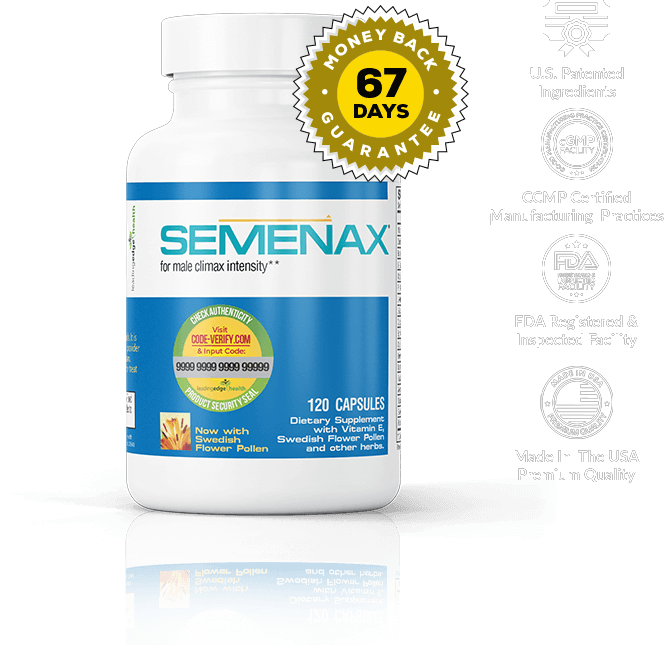
Semenax is the volume formula we carry, from Leading Edge Health, and it has more evidence behind it than most of its category — which is exactly why its limits are worth stating precisely. According to the maker, Semenax was tested in a randomized, double-blind, placebo-controlled study run by Vedic Lifesciences: 63 men aged 30 to 60 took Semenax or a placebo for two months. The reported headline result was that significantly more men taking Semenax achieved an increase in semen volume of 20 percent or more than men on placebo (p=0.0008).
Read that at its exact strength. The study measured one thing: volume. It did not measure pregnancy rates, and it was not designed to show that anyone conceived who otherwise would not have. It was also one small study, run for the maker, whose full results have not been independently replicated. As volume evidence, it is genuinely encouraging. As fertility evidence, it does not exist — and any page that converts "more volume in a two-month study" into "better chances of a baby" is adding a step the research never took.
These statements have not been evaluated by the Food and Drug Administration. This product is not intended to diagnose, treat, cure, or prevent any disease. This article is educational and is not medical advice.
Could More Volume Ever Help Conception?
There is one narrow line of reasoning worth airing honestly, because it is the strongest version of the case. If a man's volume is very low, fewer sperm are delivered in total — so, in theory, raising genuinely low volume could deliver more sperm. That is reasoning, not evidence: it has not been tested as a route to pregnancy, and it collapses the moment you look at why volume is very low in the first place. The causes are usually mechanical or medical — semen diverted into the bladder (retrograde ejaculation), a partly blocked duct, or a prescription medicine's effect. A supplement cannot reopen a duct, redirect flow out of the bladder, or cancel a drug's effect. And for the far more common situation — normal-range volume with sperm that are few, slow, or abnormally shaped — extra fluid changes nothing at all. The theoretical exception points to a doctor, not to a bottle.
When Should a Couple Get a Semen Analysis Instead?
On the standard timeline, without waiting for a supplement trial to run its course: after 12 months of trying without success, or 6 months if your partner is 35 or older, both partners should be evaluated. A semen analysis measures volume alongside sperm concentration, motility and morphology, under standardised conditions — it answers, in one test, the question a volume product cannot. Some situations argue for going sooner: a sudden drop in volume, pain or blood in the semen, "dry" orgasms with cloudy urine afterwards, or very low volume from the start. Our companion guide on why semen volume is low walks through those causes and warning signs in full.
The timing point deserves emphasis, because it is the real cost in this decision. A fair trial of a volume supplement runs about two months — the length of the maker's own study. For a man pursuing volume as a goal in itself, that is a reasonable experiment, and Semenax's 67-day money-back guarantee covers it. For a couple already at the 12-month mark, those same two months spent "seeing if it helps fertility" are spent on a product with no fertility evidence, while a test that would give real answers waits. Same product, same two months — entirely different value depending on which goal is actually yours.
The bottom line: a semen volume supplement is a volume product. The one real study behind the category's best-known formula measured volume, in 63 men, over two months — not fertility, and not pregnancies. If stronger orgasms and a larger ejaculate are your goals, judge the product on those terms. If a baby is the goal, start with a semen analysis: it is the only step on this page that measures the thing you actually care about.
Disclaimer: This article is for general information only and is not medical advice. Always consult a qualified healthcare professional before starting any supplement, especially if you have a medical condition or take prescription medication. Individual results vary, and no result is guaranteed.
Last reviewed: October 2026
