
Affiliate disclosure: This article contains affiliate links. If you buy through a link on this page, we may earn a commission from the manufacturer at no extra cost to you. That never decides what we write — this comparison includes honest limits for the cream we sell as well as for the supplements we don't.
It is one of the most common — and most confused — comparisons in skincare: collagen cream vs collagen supplements. The two formats reach your skin by completely different routes — one is rubbed onto the surface, the other is swallowed and digested — and that difference in route decides what each one can realistically do. Below, we explain how each format works, what published research found for the oral form, and how to choose based on your goal rather than on marketing.
Quick Answer: Collagen Cream vs Collagen Supplements — Which Does What?
A collagen cream works on the surface of the skin. It hydrates the outer layer and leaves a light film that makes skin feel smoother and fine lines look temporarily softer — but its collagen cannot pass through the skin barrier into the deeper layers. An oral supplement takes the opposite route: it is digested first, so it never crosses the skin barrier at all. Trials of oral collagen report modest improvements in measured skin hydration and elasticity after roughly 8 to 12 weeks of daily use — though the research has real weaknesses, covered below. Neither format rebuilds deep collagen, erases wrinkles, or reverses sagging. Choose the cream for surface comfort and a smoother look today; choose the supplement for slower, whole-body support — with modest expectations.
How Does a Collagen Cream Work?
Your skin's outer layer, the stratum corneum, is designed to keep large molecules out. Dermatology has a rule of thumb for this, set out by Bos and Meinardi in Experimental Dermatology in 2000: a compound generally needs a molecular weight under about 500 Daltons to be absorbed through skin. Nearly every substance known to be absorbed falls under that line.
Collagen does not come close. In its native form, a single collagen molecule weighs roughly 300,000 Daltons — about 600 times the limit — and intact skin does not let it through to the dermis, the deeper layer that gives skin its structure. "But my cream says hydrolyzed collagen," you might point out. Hydrolyzed collagen is collagen broken into smaller fragments — typically around 1,000 to 5,000 Daltons. Smaller, yes, but still several times above the 500 Dalton threshold: smaller is not the same as small enough.
So what does a collagen cream actually do? The collagen and its fragments sit on the surface and act as humectants and film-formers: they hold water against the skin and slow water loss to the air. Hydrated surface skin is plumper and smoother, and fine lines — which look deeper when skin is dry — appear softer. Studies of hydrolyzed-collagen moisturizers have measured exactly this pattern: better surface hydration and smoothness with regular use. A genuine cosmetic benefit — but a temporary one: stop applying the cream, and the effect fades with the film and the extra moisture. We go deeper on this in our full guide to whether collagen cream actually works.
How Do Oral Collagen Peptides Work?
A supplement faces no skin barrier. Swallowed collagen is broken down during digestion into amino acids and very small peptides. Most of it is used like any other dietary protein — but research shows that some of the smallest fragments, two- and three-amino-acid peptides, can be absorbed intact through the gut, and these fragments have been detected in skin tissue. That is a biologically plausible route for a supplement to support skin from the inside — a route a cream does not have.
What have the trials found? Several systematic reviews and meta-analyses have pooled the randomized trials (hydrolyzed peptides, taken daily) and reported improvements in instrument-measured skin hydration and elasticity, with the most consistent results appearing after about 8 to 12 weeks. That is the positive version, as far as it goes.
Now the honest version, because it matters for your wallet. The same reviews flag serious weaknesses: the trials vary widely and disagree with each other (high heterogeneity), follow-up is short, reporting is often incomplete, and industry involvement in the research is frequent. One 2025 meta-analysis noted that the apparent benefits were markedly weaker — or not statistically significant at all — in the highest-quality studies and in those not funded by the collagen industry. And when researchers stress-tested the findings, the outcomes for wrinkle reduction and dermal density — the structural changes people actually hope for — did not hold up. The fairest summary: oral collagen probably offers modest support for skin hydration and elasticity over a few months; it is not proven to rebuild skin structure or remove wrinkles.
Note: collagen supplements are dietary supplements and collagen creams are cosmetics. Neither is a drug, neither is FDA-approved to treat wrinkles or any skin condition, and their claims are not held to the evidence standard required of medicines.
Which Should You Choose?
For fine lines: a cream gives you a surface effect you can see the same day — well-hydrated skin reflects light more evenly, feels smoother, and fine lines look softer. It does not change the line itself, and the effect lasts only while you keep using it. A supplement, if it helps fine lines at all, works slowly and modestly over months — and wrinkle outcomes were the least robust finding in the oral research. If your real goal is stimulating new collagen production, neither format here is the strongest tool; retinoids carry that evidence, ideally with a dermatologist's guidance.
For overall skin support: the supplement is the only one of the two that reaches beyond the surface, because it works systemically, through digestion and the bloodstream. If you want general support for hydration and elasticity across your whole body — not just where you apply a cream — that is the supplement's territory, judged over 8 to 12 weeks and with modest expectations. The cream's role is local and immediate: comfort, moisture, and appearance where you put it.
Can You Use Both?
Yes. The two formats do not conflict — one works on the surface, the other from inside — and some people use both, with modest expectations of each. If you do combine them, keep the judging rules straight: the cream can be judged on comfort and appearance within days; the supplement deserves a full 8 to 12 weeks before you conclude anything. And if either product irritates your skin, stop using it.
What Should You Check Before Buying Either?
Since the headline ingredient does less than the marketing implies in both formats, judge products by their transparency and terms:
- A published, complete ingredient list. For a cream, look at everything around the collagen — supporting peptides, antioxidants such as vitamins C and E, and proven moisturizing partners such as glycerin do much of the work you will actually feel. For a supplement, check that the collagen source and amount per serving are stated plainly.
- No proprietary-blend fog. Brands that name ingredients and amounts are easier to judge than anonymous jars and powders with vague blends and miracle language.
- A money-back guarantee. Because results are modest and individual in both formats, a written guarantee says more about a maker's confidence than any before-and-after photo.
- The maker's official store. Buying from the official source is the standard protection against counterfeit or expired product, and it is where guarantee terms actually apply.
Whichever format you choose, it is worth reading our guide to how to buy supplements safely online and avoid counterfeits before you order, so you can spot fake or unsafe sellers.
Honest Limitations: What Neither One Can Do
We sell a collagen cream through this site, and we would rather you understood both formats plainly than bought either with inflated expectations:
- Neither rebuilds deep collagen. The cream's collagen stays on the surface; the supplement's evidence supports, at most, modest improvements in hydration and elasticity — not rebuilding of the dermal scaffolding that age and sun break down.
- Neither replaces sunscreen. Ultraviolet exposure is the single biggest external driver of collagen breakdown. Daily sun protection defends more collagen than any cream or powder can claim to add.
- Neither substitutes for retinoids. Retinoids are small enough (around 300 Daltons) to cross the skin barrier, and they carry the strongest topical evidence for stimulating collagen production. If you use one product class for that purpose, it is that one.
- Neither erases wrinkles or lifts sagging skin. Any product — cream, powder, or otherwise — promising that is promising something the evidence does not support.
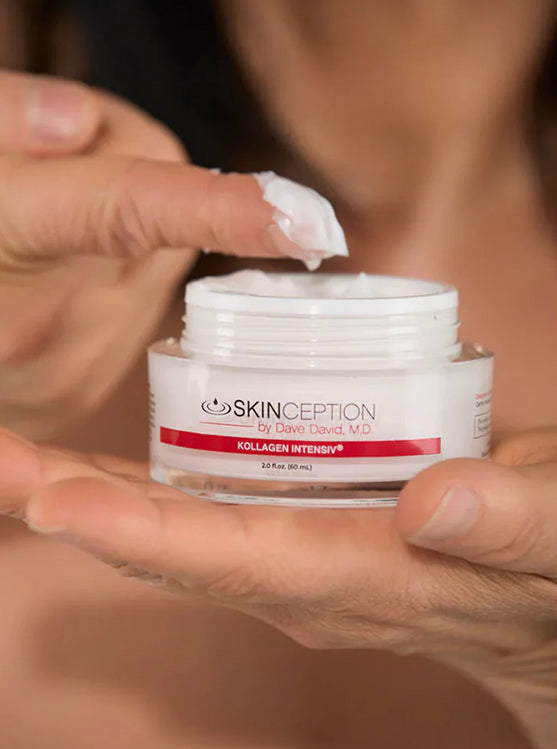
The cream is a surface tool: hydration, comfort, and a temporarily smoother, softer look where you apply it. The supplement is a slow, systemic one: plausible, modest support for hydration and elasticity over months. If the cream's job description is the one you want, the full details of the cream we carry — Skinception Kollagen Intensiv, a Leading Edge Health cream formulated with collagen alongside peptides and vitamins and sold with a money-back guarantee — are on its product page, where the Buy from Official Website link keeps any purchase under the maker's own terms. Read it the way you read this article.
Disclaimer: This article is for general information only and is not medical advice. The products mentioned are cosmetics or dietary supplements, not drugs; they are not intended to diagnose, treat, cure, or prevent any disease or skin condition, and their claims have not been evaluated by the FDA. If you have a skin condition or concerns about your skin, consult a qualified dermatologist.
Last reviewed: October 2026
