
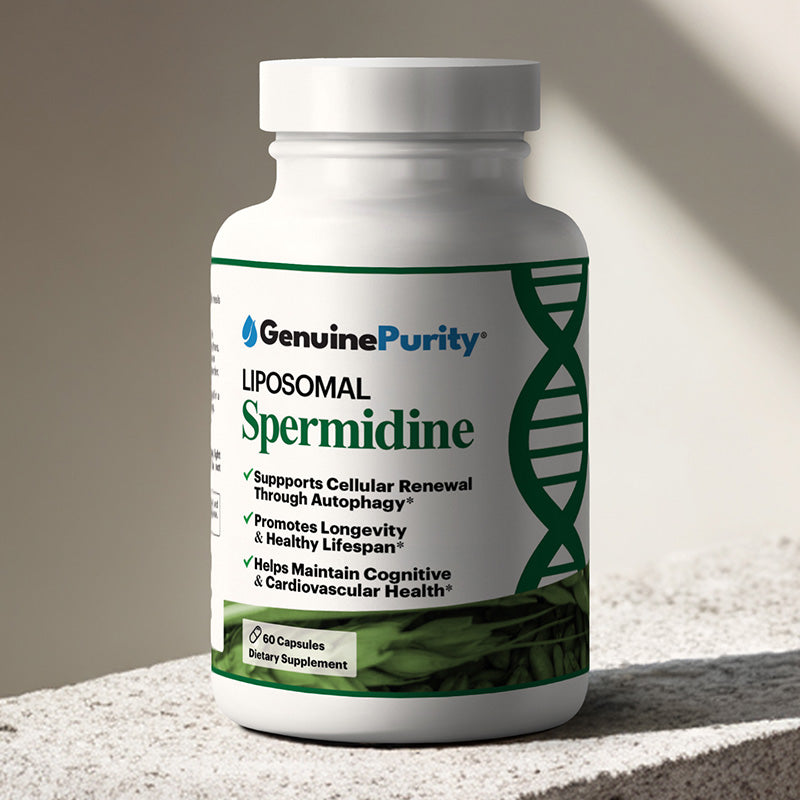
Affiliate disclosure: This article contains affiliate links. If you buy through a link on this page, we may earn a commission paid by the manufacturer, at no extra cost to you. We sell the capsule in this comparison — GenuinePurity Spermidine (Our Score 6.5/10), 8 mg a day at $59 a bottle — so read the food case below knowing it is made by a store that profits if you reject it. The food case happens to be strong at the dose the human trial used, and this page says so.
Quick Answer: Food Covers the Trial Dose; Capsules Sell a Bigger One
Whether food is "enough" depends entirely on which target you pick. The only spermidine dose with a completed human trial behind it is about 1 mg a day (the SmartAge wheat-germ dose), and that much is realistically reachable from the plate — the longevity forums' standard advice is literally a daily tablespoon of wheat germ. The label doses of 8–10 mg are a different project: reachable from food only by scaling every source up many times over, with calories and effort attached. Capsules sell certainty and size of dose; food sells the studied amount at grocery prices. Neither route has a proven human outcome — the full dose analysis is in Spermidine and Autophagy: The Dose Problem.
The Forum Thread That Starts With Food
Ask the internet's longest-running longevity community where to get spermidine and the first answer is a grocery list. A LongeCity thread titled "What are the good reliable sources of Spermiddine?" draws this top reply: "One heaping tablespoon of wheatgerm daily will boost your intake drastically; eat sauerkraut, kimchi, mushrooms." A companion thread ("Spermidine source?") shows the same instinct from the buyer's side — posters hunting for a reliable supply discovered a market mostly selling lab-grade powders in bulk, and circled back to food. This matters because the community is not anti-supplement; it is the same forum culture that engineers fisetin absorption and per-kilogram pulse doses. On spermidine specifically, its accumulated custom is food-first, and the reasons are arithmetic rather than ideology.
Where Spermidine Lives in Food
Spermidine is made by every living cell, so it turns up across the food supply — but concentrated in a short list. Wheat germ is the standout common source, and the one the trial itself used as its delivery vehicle. Aged cheeses accumulate it as they mature. Mushrooms are a meaningful source. Fermented foods — sauerkraut, kimchi, and fermented soy such as natto — carry it from their bacterial cultures, and legumes and whole grains contribute smaller amounts across a normal diet. Two honest caveats govern any list like this: the spermidine content of a given food varies with variety, fermentation and storage, so any per-100-gram table you meet elsewhere should be read as an estimate, not a measurement of your plate; and the richest sources bring dietary baggage — wheat germ means gluten, aged cheese means calories, sodium and saturated fat, natto means a flavour many people never acquire. Food is not a clean delivery system. It is a diet.
The Two Targets: 1 mg vs 8–10 mg
The comparison turns on which number you are aiming at. Aim at ~1 mg — the SmartAge level — and the food route is almost trivially workable: the forum's tablespoon of wheat germ is calibrated to roughly that territory, a handful of mushrooms or a portion of aged cheese makes a real contribution, and an ordinary varied diet is already supplying spermidine before you optimise anything. Aim at 8–10 mg and the plate fights back. The thread's most-quoted piece of arithmetic, from a poster working through the cheese route, makes the point better than any table: "To get 25 mg of spermidine, you'd have to eat 120 grams of aged cheddar. Almost 500 calories." We print that as what it is — one forum member's much-repeated calculation, not an audited figure — but its shape is not in dispute: label-level dosing from food alone means eating several times the plausible amount of the richest sources, every day, indefinitely. At that point the capsule is not competing with food; it is competing with a second job.
What the Capsule Buys
GenuinePurity's capsule is, pointedly, the food source concentrated: its spermidine is derived from wheat germ extract, standardised to a measured 8 mg a day (two capsules, with food), at a stated 99% purity that the maker holds consistently across its pages, backed by published third-party Certificates of Analysis. What that $59 (or $39 a month on subscription) purchases is certainty — a known dose, every day, with no cooking, no calories and no fermentation lottery — plus a dose eight times the trial's, which the buyer should want only with the caveat from our dose analysis attached. The capsule's own paperwork gaps travel with it: the maker does not publish the bottle's capsule count, so the routine's exact monthly cost cannot be verified from its page, and its guarantee is stated as 97 days on the product page and 90 in its landing-page FAQ. And one food-route consideration survives the switch: a wheat-germ-derived capsule is still wheat for anyone whose issue is gluten — the maker's pages carry no gluten or wheat-allergy warning either way.
| Food route | GenuinePurity capsule | |
| Realistic dose | ~1 mg/day with mild effort (wheat germ, mushrooms, aged cheese, ferments) | 8 mg/day, measured and standardised |
| Dose certainty | Low — content varies by food, batch and preparation | High — stated 99% purity, published CoAs |
| Daily effort | Ongoing — shopping, preparation, dietary fit | Two capsules with food |
| Baggage | Calories, sodium, gluten (wheat germ), acquired tastes | Price; unpublished capsule count; 97-vs-90-day guarantee conflict |
| Cost shape | Grocery prices; near-zero marginal cost at trial-level intake | $59/bottle; packs ~$43–53/bottle; subscription $39/month |
| Evidence anchor | The ~1 mg trial dose was itself a wheat-germ extract | No human trial at 8 mg |
The Honest Unknowns
Three gaps close the file. First, dose-matching has never been tested: no trial compares food-source and capsule spermidine at the same dose, so claims that one "absorbs better" are marketing, whichever direction they point. Second, the outcome is unproven on both routes — the trial anchor establishes that ~1 mg is the dose researchers chose to test, not that it delivers a longevity benefit; the capsule's eightfold dose inherits that uncertainty and adds its own. Third, food content is a moving target: fermentation, ageing and storage move the numbers, which is the capsule's one clean win. Readers who want the mechanism and the dose curve before choosing a route should read Spermidine and Autophagy: The Dose Problem; spermidine's place among the wider anti-aging shelf is covered in our Best Anti-Aging Supplements Compared roundup.
These statements have not been evaluated by the Food and Drug Administration. This product is not intended to diagnose, treat, cure, or prevent any disease. This article is educational and is not medical advice.
Frequently Asked Questions
Can I get enough spermidine from food?
Enough for what is the operative question. Enough to match the ~1 mg a day used in the best-known human trial: yes, realistically — wheat germ is the forum's and the trial's own vehicle. Enough to match an 8–10 mg label dose: only by eating the richest sources in quantities most people will not sustain.
Which food has the most spermidine?
Wheat germ is the standout common source — the reason a single daily tablespoon is the community's standard advice. Aged cheeses, mushrooms and fermented foods (sauerkraut, kimchi, natto) follow. Exact contents vary too much by batch and preparation for any table to be more than an estimate.
Is a tablespoon of wheat germ really a strategy?
It is the leading answer in the longevity community's own sourcing thread (the reply other members marked in agreement), and it is calibrated to the trial-level dose rather than the label-level one. As a way to eat spermidine at roughly the studied amount, it is the most defensible food move in this article.
Why buy the capsule at all, then?
For a measured dose without the dietary work — and, for some buyers, for the 8 mg dose itself. The first reason is solid; the second rests on an untested assumption that more is better, which no human trial currently supports.
The Practical Verdict
If your target is the dose with a human trial behind it, eat first: a tablespoon of wheat germ and a diet that already includes mushrooms, aged cheese and fermented foods puts you in the studied territory for grocery money, and no capsule maker — ours included — can show you a human result above that line. If your target is a standardised daily dose with published purity testing and zero kitchen effort, the capsule is a legitimate convenience, bought with its paperwork gaps noted in our GenuinePurity Spermidine review. What neither route can honestly sell you is a proven outcome; the difference between them is dose, certainty and effort — in that order.
Disclaimer: This article is for general information only and is not medical advice. Always consult a qualified healthcare professional before starting any supplement, especially if you have a medical condition or take prescription medication.
Last reviewed: October 2026
