
- Quick Answer: What Does NMN Research Actually Show?
- What Is NAD+, and Why Does It Matter?
- Why Does NAD+ Decline With Age?
- What Are NMN and NR? The Precursor Idea
- What Does the Human Research Show — as Far as the Audited Record Goes?
- What Is Only Animal Data?
- What About Experience Reports and Forum Stories?
- What Does the GenuinePurity Product Itself Check Out On?
- What Can't NMN Research Say Yet?
Affiliate disclosure: This article contains affiliate links. If you buy through a link on this page, we may earn a commission paid by the manufacturer, at no extra cost to you. That never changes what we publish — and in the longevity category it means separating, claim by claim, what comes from human research, what comes only from animals, and what comes from people posting experiences online. Those are three different kinds of evidence, and this page will not let them borrow each other's authority.
NAD+ is one of the most talked-about molecules in aging research, and NMN is one of the most talked-about supplements built on it. The pitch is easy to follow: NAD+ matters for cellular energy, NAD+ falls with age, so take a precursor, rebuild NAD+, and support healthier aging. Each step in that sentence deserves a different level of confidence, though — and supplement pages tend to present all of them at the same volume. This article slows the pitch down, then sorts the research record the way our audit forced us to sort it: human data here, animal data there, experience reports in a third pile that proves the least of all.
Quick Answer: What Does NMN Research Actually Show?
The audited record, stated plainly: NAD+ is a real and important coenzyme, and its decline with age is the premise this category is built on — the NMN maker we audit cites a 2020 article for the claim that by middle age NAD+ levels are half of youthful levels. NMN is a precursor: a molecule the body uses to make NAD+. Beyond that, the paperwork thins quickly. The maker of GenuinePurity NMN calls its 250 mg dose "clinically studied" without publishing trial details, prints journal quotations about NMN in general rather than about its finished product, and takes its headline lifespan figure — boosting NAD+ extended lifespan by 30% — from a study in mice , as the maker itself states. No trial of the finished product is described on the maker's pages. What the research "actually shows," at a checkable level, is a plausible mechanism and an ingredient under study — not a demonstrated anti-aging outcome in healthy humans taking this product.
What Is NAD+, and Why Does It Matter?
NAD+ (nicotinamide adenine dinucleotide) is a coenzyme — a helper molecule that enzymes throughout the body depend on to do their work. In textbook terms, it is central to how cells produce and manage energy, shuttling electrons in the metabolic reactions that turn food into usable cellular fuel. The maker of the NMN product on our shelf lists the processes it positions NAD+ as supporting: cellular energy, cell signalling, immune function, circadian rhythm regulation, and autophagy support. Read that list at the strength it deserves: a molecule being involved in a process is not the same as a supplement improving that process in a person.
That distinction runs through everything below. NAD+ biology is genuine science. The leap from "this coenzyme is important" to "this capsule will make you feel younger" crosses several unproven steps: that swallowing a precursor raises NAD+ meaningfully in the tissues that matter, that raising it changes outcomes a person can feel or a clinician can measure, and that the change is large and durable enough to matter. The research record, as published in the material we can audit, does not complete that chain.
Why Does NAD+ Decline With Age?
The decline is the category's founding fact, so it is worth stating exactly as far as our sources state it — and no further. The maker frames it this way: "According to a 2020 article published in Integrative Medicine: A Clinician's Journal, by middle age our NAD+ levels are HALF of our youth." We report that as the maker's cited position, not as a number this site has independently measured.
The general textbook picture is that NAD+ levels fall as the balance between making it and using it shifts with age: the body keeps consuming NAD+ in ongoing cellular processes, while the pathways that replenish it become less effective. That is as specific as we will be here, because the maker material publishes no detailed mechanism account to check figures against — and inventing precise percentages is exactly the failure this page exists to avoid.
What Are NMN and NR? The Precursor Idea
Your body makes NAD+ rather than taking it in directly as a finished supplement ingredient in this category, so the products on the shelf are precursors — building-block molecules the body converts into NAD+. Two dominate the market:
- NMN (β-Nicotinamide Mononucleotide) — the precursor in the product we sell. In the maker's own framing, it is "a precursor your body uses to make NAD+."
- NR (nicotinamide riboside) — the other commercial NAD+ precursor, sold by other makers. This store stocks no NR product, so there is no NR label here for us to audit.
Because both end at the same destination, buyers reasonably ask which is better. Our comparison, Is NMN Better Than NR? , gives the answer the paperwork supports: we found no head-to-head human trial of NMN against NR in any maker's material we audit. Until that trial exists in published form, "which precursor wins" is a marketing question, not an answered one. What can be compared today is documentation: dose stated or hidden, purity stated or vague, testing published or promised.
These statements have not been evaluated by the Food and Drug Administration. Dietary supplements are not intended to diagnose, treat, cure, or prevent any disease.
What Does the Human Research Show — as Far as the Audited Record Goes?
Here the page has to be careful, because "human research" in NMN marketing often blurs three different things. Sorted out, the record contains:
- A dose claim without its study. The maker states its 250 mg amount "has been clinically studied and shown to boost NAD+," but gives no trial design, participant count, duration, or sponsor anywhere on its pages. An uncheckable claim should be weighted as a claim, not as data.
- Journal quotations about the ingredient, not the product. The maker's pages print quotations from journals about NMN generally — that NMN can elevate NAD+ levels, can rapidly increase cellular NAD+ concentration, and was effective in reversing mitochondrial dysfunction associated with aging in the work quoted. Those are selected quotations about the molecule. They are not trials of the GenuinePurity product, and they arrive without the designs or populations needed to judge how far they transfer to a healthy adult buying a capsule.
- A maker's summary of the safety record. The maker states NMN "has been studied in culture cells, laboratory mice and even humans with no adverse side-effects." That is the maker's summary across cells, animals, and humans — not a guarantee for any individual reader, which is why the same maker publishes consult-your-physician guidance (see below).
- No finished-product trial. No trial of GenuinePurity NMN itself is described on the maker's pages. The product — this molecule, at this dose, in this liposomal form — has no published human outcome trial in the material we can audit.
So what does human research "show"? At the checkable level: the ingredient has a study record the maker summarises as showing no adverse effects, and this product's dose claim arrives without its evidence attached. What it does not show, in any paperwork available to us, is that taking this product produces a measured anti-aging outcome in healthy people. Anyone who needs that sentence to be stronger should wait for evidence that is stronger.
What Is Only Animal Data?
The single most-quoted number in this product's marketing belongs in this section, where the maker itself puts its origin: the "boosting NAD extended lifespan by an astonishing 30%" figure comes from a study in mice. It is not a human result, and not a result for this product. Mice are not small humans — their lifespans and doses do not scale tidily to people — and a lifespan result in mice is, at most, a reason researchers find a pathway interesting.
Animal data has a legitimate role: it is how pathways get discovered and human studies get justified. Its illegitimate role is the one to watch for on sales pages, where a mouse number printed large, with the word "mice" printed small, quietly becomes a human promise. When you see a dramatic percentage attached to NAD+ or NMN, the first question is always the species. Our NMN, Answered page makes the same separation for dose, timing, and timeline questions.
What About Experience Reports and Forum Stories?
The third pile is the one readers actually swim in: posts and threads — Reddit experience reports are the example our cluster research names explicitly — in which people describe feeling more energy, sleeping better, or noticing nothing at all on NMN. These reports are not worthless: they tell you what taking the product feels like and what disappointments look like. What they cannot do is establish that NMN caused anything. There is no control group in a forum thread, no blinding, no baseline measurement, and a strong selection effect — people with something to report post more than people with nothing to report. Expectation alone produces felt changes, especially in the categories NMN is bought for — energy, sleep, mood — where day-to-day variation is large.
Read experience reports as consumer reporting, not research. The moment a sales page converts "people on a forum felt younger" into evidence that a product works, it has moved a story into the wrong pile.
What Does the GenuinePurity Product Itself Check Out On?
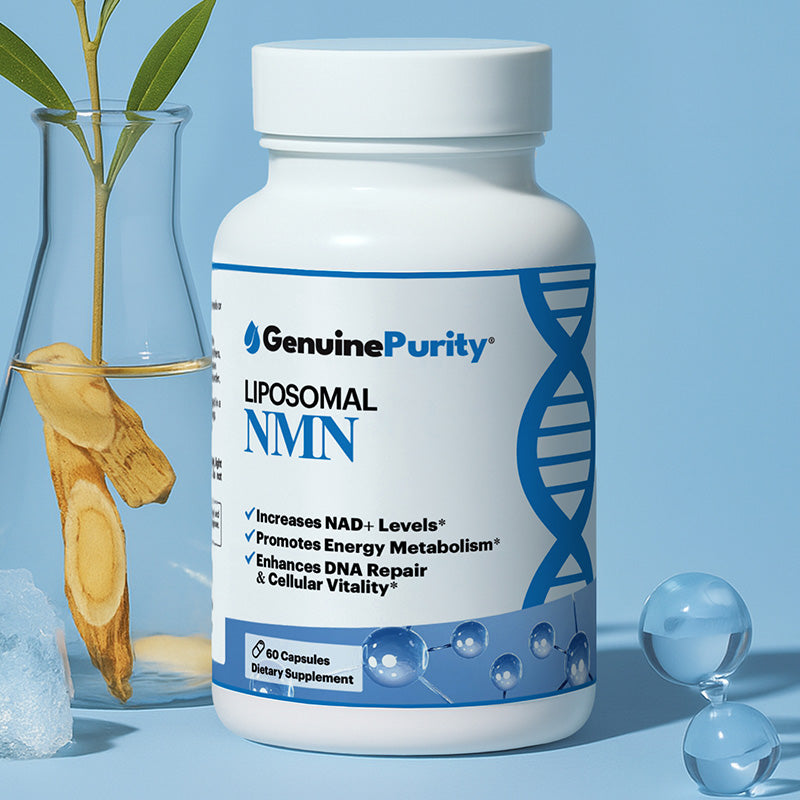
Stripped of outcome promises, the product has a genuinely checkable formula sheet — which is why it earns Our Score: 7.5/10 despite an Evidence sub-score of 6.0/10. GenuinePurity NMN is a single-ingredient liposomal NMN supplement, priced at $69 for one bottle, with a 97-day money-back guarantee that actually covers the maker's own 90-day evaluation window. Each capsule contains 250 mg of NMN at a stated 96% purity , third-party tested, with a published batch report quoting 96.4% potency and a full excipient list — no proprietary blend. The liposomal positioning is the maker's differentiator: NMN encapsulated in a phospholipid complex the maker says protects it from stomach acid, with comparative absorption figures of "up to ~95%" for liposomal versus "closer to ~10%" for standard capsules — figures the maker itself labels as comparative, not health outcomes.
And the audit finding every buyer should know: the maker's own pages conflict on the daily dose. The landing page directs one capsule daily — 250 mg — preferably with meals, and calls 250 mg the clinically studied dose. The maker's store pages describe two capsules daily — 500 mg. Same capsule, two stated doses, which also doubles or halves the true monthly cost. Following our house rule, the landing page prevails. But the conflict is the maker's, and it should not exist. Our NMN Buying Guide turns that finding into a general method: seven label checks — dose consistency first — for any NMN or NR bottle, including ours.
On safety, the maker publishes real cautions: ask your physician before starting any supplement, particularly if you take prescription medication or are pregnant, and consult your provider if you take blood thinners or have specific medical conditions. Its "start feeling younger in 2 weeks" line, by contrast, is marketing phrasing, not a measured endpoint — the 90-day window is the timeline to plan around.
What Can't NMN Research Say Yet?
The honest list, in one place: it cannot say NMN extends human lifespan — the lifespan figure is a mouse study. It cannot say this finished product improves energy, cognition, strength, or sleep in healthy humans — no trial of the product is published. It cannot say NMN beats NR — no head-to-head human trial exists in the audited material. It cannot even say whether the intended daily dose of the best-documented retail example is 250 mg or 500 mg — the maker says both. And it cannot say what long-term daily use does, because the published record the maker points to is short-term and ingredient-level.
None of that makes NMN a scam or NAD+ a fiction. It makes NMN what it honestly is in the current paperwork: a well-defined molecule, a real pathway, an ingredient under study — and a category selling certainty it has not yet earned. For the alternative theory on the same shelf, see GenF20 Plus : a multi-ingredient "releaser" system, a completely different claimed pathway, with its own evidence limits.
The bottom line: buy NMN, if you buy it, as a well-documented bet on a mechanism — a disclosed 250 mg dose, stated purity, published batch testing, and a guarantee that covers the trial window — not as a demonstrated outcome. The moment a page tells you the aging question is settled in humans by this research, it has stopped describing the research.
Disclaimer: This article is for general information only and is not medical advice. Always consult a qualified healthcare professional before starting any supplement, especially if you have a medical condition or take prescription medication. Individual results vary, and no result is guaranteed.
Last reviewed: October 2026
