
- Quick Answer: What Is the Real Difference Between OTC Pills and Viagra?
- How Does Viagra Actually Work?
- How Do OTC Male Enhancement Supplements Differ?
- How Do the Side Effects Compare?
- How Do the Costs Compare?
- Can Either One Add Size?
- What Is "Herbal Viagra" — and Why Is It the Worst of Both Worlds?
- So Which One Is Actually for You?
Affiliate disclosure: This article contains affiliate links. If you buy through a link on this page, we may earn a commission paid by the manufacturer, at no extra cost to you. That never changes what we publish — and in a comparison against a prescription drug, it means stating plainly where the drug is simply stronger and better proven than anything we sell, because pretending otherwise would make this page worthless to you.
"Can I just take an over-the-counter pill instead of Viagra?" is one of the most searched questions in men's health — and one of the most badly answered, usually by pages pretending the two things are interchangeable versions of the same product. They are not. They differ in what they contain, how they work, how fast they act, what evidence stands behind them, and who they are actually for. This page compares them honestly, point by point.
Quick Answer: What Is the Real Difference Between OTC Pills and Viagra?
Viagra is a prescription drug with a single, proven active ingredient (sildenafil), taken on demand about 30–60 minutes before sex, which reliably improves the erection response for a few hours in most men with ED. OTC male enhancement pills are daily dietary supplements — blends of herbs and amino acids with no approved drug active — taken every day for gradual support of circulation and libido, with evidence that is mostly ingredient-level rather than product-level. Viagra does not raise desire and neither, credibly, does much else; neither product adds size. They are not two brands of the same idea. They are two different tools for two different situations, and choosing between them starts with knowing which situation is yours.
How Does Viagra Actually Work?
Viagra's active ingredient, sildenafil, belongs to a drug class called PDE5 inhibitors. In plain terms: during sexual arousal, the body releases nitric oxide in erectile tissue, which triggers a chemical messenger (cGMP) that relaxes smooth muscle and lets blood flow in. An enzyme called PDE5 breaks that messenger down. Sildenafil blocks PDE5, so the signal lasts longer and the blood-flow response to arousal is stronger and easier to maintain.
Three practical consequences follow, and all three are commonly misunderstood. First, it is on-demand: a dose is taken roughly 30 to 60 minutes before activity, and the helpful window lasts a few hours. Second, it requires sexual stimulation — it amplifies the body's response to arousal; it does not create an erection by itself, and nothing happens without that starting signal. Third, it does not increase desire: libido is untouched by the drug, which is why men whose problem is low desire rather than erection mechanics often find it disappointing. And one safety fact dominates all others: sildenafil is contraindicated with nitrates such as nitroglycerin — the combination can drop blood pressure dangerously — which is a central reason it is prescription-only, so a doctor screens for exactly that.
How Do OTC Male Enhancement Supplements Differ?
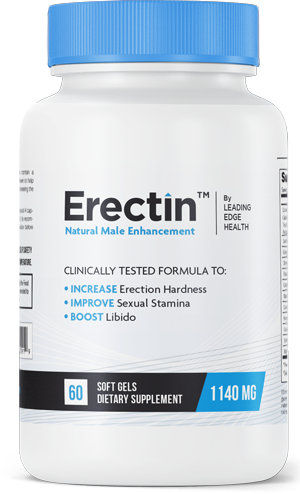
An OTC supplement contains no approved drug active at all. What it contains is a blend: blood-flow botanicals such as ginseng, ginkgo and hawthorn, the amino acid L-arginine, and libido herbs such as tribulus, maca and epimedium. The approach is the opposite of Viagra's in every respect — daily rather than on-demand, gradual rather than immediate, and aimed at general support of circulation and desire rather than a direct, targeted effect on the erection mechanism during a specific window.
The evidence gap is just as large as the mechanism gap. Sildenafil was proven in large clinical trials as a finished drug before it could be sold. For supplements, the evidence is mostly ingredient-level: studies of individual herbs, often at doses that do not match the bottle, with the finished formula itself never tested. There is one notable exception in the category: VigRX Plus has a published randomized, double-blind trial of the finished product — 78 men aged 25–50 with mild-to-moderate ED, 12 weeks, with erectile-function scores improving from about 16 to about 25 against a placebo group's 16 to 16.5. Even there, honesty requires the caveat we state on its own page: the trial used four capsules a day, double today's label dose of two tablets, so results at the current dose may be more modest. One decent trial at the wrong dose versus a drug proven at the dose sold — that is the real size of the evidence difference.
These statements have not been evaluated by the Food and Drug Administration. This product is not intended to diagnose, treat, cure, or prevent any disease. This article is educational and is not medical advice.
How Do the Side Effects Compare?
Viagra's side effects are well documented precisely because it was studied at scale. The common ones follow from its blood-vessel action: headache, facial flushing, indigestion, nasal congestion, dizziness, and a characteristic visual effect — a blue tint or increased light sensitivity — in a minority of users. They are usually mild and fade as the drug wears off, but the serious risks are real and known: the nitrate interaction above, caution alongside alpha-blockers and blood pressure medicines, and rare emergencies such as an erection lasting over four hours. The profile is stronger medicine with a stronger, better-mapped risk list.
Supplement side effects are usually milder — digestive upset and headaches are the typical complaints — but that sentence needs its honest second half: their risks are also far less studied. There is no equivalent trial programme cataloguing what a given blend does across thousands of men, and the interaction picture is murkier: ingredients such as ginkgo are flagged for caution with blood thinners, ginseng for possible effects on blood pressure and blood sugar, and L-arginine for additive blood-pressure lowering. "Gentler but less mapped" versus "stronger but fully mapped" is the accurate summary. Neither is risk-free, and for supplements the absence of a warning on the label is not evidence of the absence of risk.
How Do the Costs Compare?
The structures differ as much as the products. Viagra is priced per pill and per occasion: brand-name sildenafil was famously expensive, while generic sildenafil — chemically the same drug — has brought the per-dose cost down dramatically in recent years, though you also need the prescription, which may mean a doctor's visit or a telehealth consultation. A man who needs it twice a month pays for two doses; the meter runs per use.
Supplements are priced per month of daily use: an established formula such as VigRX Plus lists at $69 for a one-month box, with multi-box packs bringing the per-month cost down (three boxes at $177). The meter runs whether or not the occasion arises. Which structure is cheaper depends entirely on frequency — occasional need favours a per-dose drug; a daily-support routine is a standing monthly cost. The supplement side carries one financial protection the drug side does not: established makers sell with money-back guarantees (67 days in VigRX Plus's case), because a gradual product honestly asks you to fund a trial before you can judge it.
Can Either One Add Size?
No — and this is the shortest honest section on the page. Viagra produces a firmer erection by improving blood flow; a firmer erection can look and measure like your full natural size, sometimes for the first time in years, but the drug changes no anatomy. Supplements change no anatomy either, and no product in either category has credible evidence of permanent enlargement. Any OTC product whose advertising leads with size growth is disqualifying itself: it is promising the one thing it cannot possibly deliver, which tells you how to weight everything else it says.
What Is "Herbal Viagra" — and Why Is It the Worst of Both Worlds?
There is a third product in this comparison, and it is the one to actively avoid: the gas-station or online pill sold as "herbal Viagra" or a natural alternative with drug-like promises. The FDA has tested products in this space for years and repeatedly found them to contain hidden sildenafil or tadalafil — actual prescription drug ingredients, undeclared on the label, at unknown doses — alongside, in some cases, other unlisted substances.
Consider what that gives you: a real PDE5 drug's real risks, including the potentially dangerous nitrate interaction, without the prescription screening that exists to catch it, without a known dose, without quality control, and without a doctor who knows you are taking it. It combines the supplement market's weakest oversight with the drug's strongest dangers. If a product promises to work "in 30 minutes, just like the prescription," treat that promise itself as the warning: it is either lying, or it is an unlabelled drug. Both answers end the same way — do not take it.
So Which One Is Actually for You?
Work from the problem, not the product. If your erections are unreliable and you want a proven, on-demand effect for specific occasions, that is what PDE5 drugs exist for — see a doctor, get screened (especially for nitrates and heart risk), and use the real thing at a known dose, generic if cost matters. If your prescription situation rules those drugs out, that ruling applies with more force, not less, to anything promising similar effects over the counter.
If your difficulties are mild, your health is checked, and you prefer a daily, drug-free support routine judged over two to three months — ideally with a money-back guarantee underwriting the trial — that is the legitimate supplement use case, and VigRX Plus is the formula in that space with an actual trial to examine. And if your problem is mainly low desire, be aware that neither option targets it directly; that symptom has its own causes — hormonal, psychological, medication-related — and its own workup.
We go through that trial's numbers — and its dose caveat — in detail here: How Long Does VigRX Plus Take to Work?
One last case overrides all the others: if your erection problems are new, persistent or worsening, the right next step is neither product. Persistent ED is a recognised early warning sign of cardiovascular disease, and the appointment that checks that is worth more than any pill in this comparison, prescription or otherwise.
Disclaimer: This article is for general information only and is not medical advice. Always consult a qualified healthcare professional before starting any supplement, especially if you have a medical condition or take prescription medication. Individual results vary, and no result is guaranteed.
Last reviewed: October 2026
