
- Quick Answer: How Do You Buy Tongkat Ali Without Guessing?
- Check 1: Standardised Extract vs Raw Root Powder
- Check 2: Branded LJ100 vs Generic Tongkat Ali
- Check 3: The Dose Check — Does the Bottle Match the Study?
- Check 4: Contaminant and Heavy-Metal Testing — Ask What Is Published
- Check 5: Price Sanity — the Bottle, the Course, and the Guarantee
- Where Do Testosil and TestRX Sit in This Guide?
- Frequently Asked Questions
- Our Verdict
Affiliate disclosure: This article contains affiliate links. If you buy through a link on this page, we may earn a commission paid by the manufacturer, at no extra cost to you. That never changes what we publish — and here it means the worked example is the tongkat ali product we sell, VigRX Tongkat Ali (Our Score 7.5/10, Evidence 8.0), judged by the same checks we hand you — including the ones its own page leaves unanswered. Demand for tongkat ali belongs to the ingredient, not any brand, and two bottles can both say "tongkat ali" while having almost nothing checkable in common. These five checks tell them apart.
Quick Answer: How Do You Buy Tongkat Ali Without Guessing?
Run five checks. One: is it a standardised extract, or raw root powder — and does the label say which? Two: is the extract a named, branded extract you can identify — LJ100 is this guide's example — or a generic name with nothing behind it? Three: the dose check — does the daily amount match the dose used in the studies the maker cites? Most testosterone supplements fail this one; our worked example passes it exactly. Four: what testing is published — or is the page silent? Five: price sanity — a plainly stated price, a course cost you can work out, and a written guarantee that covers the trial.
Check 1: Standardised Extract vs Raw Root Powder
Start with the form of the ingredient, because "tongkat ali" on a front label can mean very different things in the capsule. At one end is raw root powder: ground root, where the label amount is an amount of plant material, and nothing tells you how concentrated any relevant fraction of that root is. At the other end is a standardised extract: the root extracted and prepared to a defined specification, so the ingredient is identified by more than a plant name and a weight.
The rule follows. A label giving you only a milligram figure for "tongkat ali" — no word "extract," no standardisation, no named specification — has told you the weight of something and the strength of nothing. Two such bottles at the same figure can be different products in every way that matters. So the first question is not "how many milligrams?" but "milligrams of what, exactly?" If the page cannot answer in writing, the dose comparisons in Check 3 are already impossible.
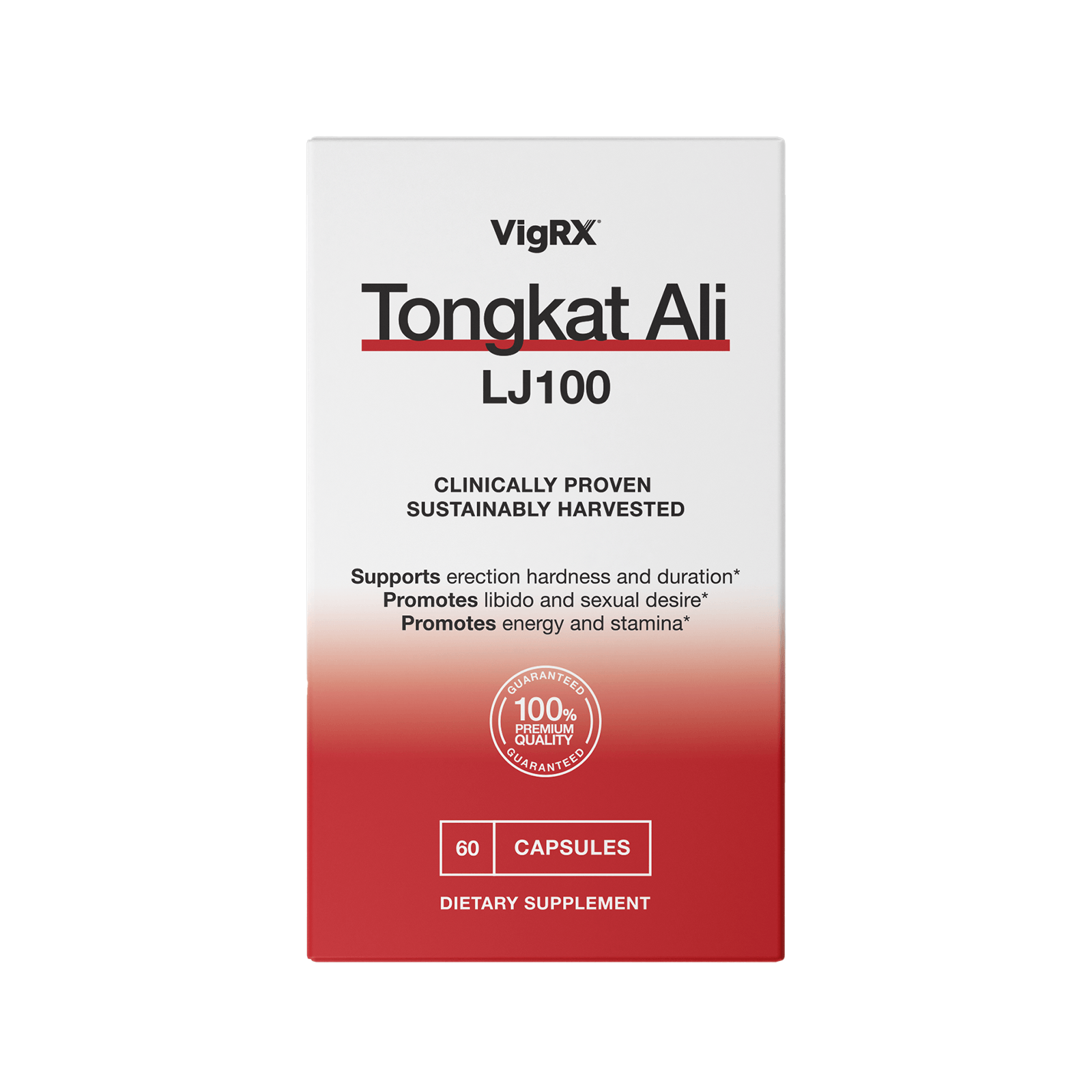
Our worked example passes this gate. VigRX Tongkat Ali is built on LJ100, which the maker describes as a patented, standardised extract of Eurycoma longifolia — tongkat ali's botanical name; tongkat ali is also called longjack, and they are the same plant.
Check 2: Branded LJ100 vs Generic Tongkat Ali
A branded extract is not automatically a better extract. What a brand name gives you is identifiability: a specified ingredient that studies can be run on, and that you can trace from a study page to a bottle. A generic "tongkat ali extract" gives you no such chain — no specification to check, and no way to know whether the extract in the bottle is the extract in any study the seller quotes.
Here is the LJ100 chain as the maker states it. The maker describes LJ100 as a collaboration between MIT and the Malaysian Government, patented for sexual dysfunction and male fertility. It states the extract has been "clinically-tested in 13 clinical studies," of which two are described on the product page. Treat "13" as an umbrella claim; the two detailed studies are the evidence a reader can weigh, and Check 3 weighs them. The maker positions the product for men experiencing age-related decline in sexual performance, and states it "can boost your testosterone and human growth hormone levels (HGH) in a natural way," linked to strength, lean muscle and sex drive. Those are the maker's claims: the testosterone side has trial detail behind it on the maker's page; the HGH side has no study behind it anywhere on the page.
The rest of the formula is short — four ingredients, no proprietary blend claimed: LJ100 plus vitamin B1, vitamin B6 and zinc. But the maker does not publish the B1, B6 or zinc amounts on its product page, and its one sentence about the zinc content is garbled to the point of being unusable. A full label exists on the physical bottle; the page does not carry those numbers. Note the pattern: the hero ingredient is fully specified, the supporting ones are not.
Check 3: The Dose Check — Does the Bottle Match the Study?
This is the most important check, and the simplest. Find the dose used in the studies the maker cites. Find the daily dose the bottle delivers. Compare them.
VigRX Tongkat Ali passes exactly, and the maker spells out the arithmetic: each capsule contains 100 mg of LJ100, the recommended serving is 2 capsules daily — 200 mg a day. Now the studies, as the maker reports them. In a study of 76 men with testosterone deficiency taking 200 mg of LJ100 for one month, the share with normal testosterone rose from 35% to almost 91%, with serum testosterone up 47% — the maker does not state whether that study was blinded or placebo-controlled, or who sponsored it. In a separate 12-week, placebo-controlled study of 26 men with mild erectile dysfunction, the LJ100 group scored significantly higher than placebo on five sexual-performance measures, with an 11% testosterone increase over the placebo group. Both studies tested LJ100, not this finished four-ingredient product — but both used 200 mg a day, and 200 mg a day is what the bottle delivers. Dose-to-study match: exact.
Run the same check across our shelf and its value shows. In Testosil ($69, 7.5/10), the headline ingredient is KSM-66 ashwagandha at 300 mg per serving — but the study behind it used 300 mg twice daily, 600 mg a day, so the studied amount is reached only at the maximum two-serving day. Same famous-ingredient structure, opposite dose-check result. The check also cuts the other way: our Fertility Factor 5 review notes a study its maker cites used 300 mg of LJ100 daily while that product provides 200 mg — its 200 mg fertility study matches, the 300 mg study does not. Run the arithmetic on every bottle, in both directions.
Check 4: Contaminant and Heavy-Metal Testing — Ask What Is Published
A concentrated botanical extract is exactly the kind of product where the testing question belongs. The check is a document question: does the maker publish third-party testing — identity, purity, heavy metals — with a certificate you can see, or a stated programme you could ask about? Or does the page say nothing?
On our worked example: the maker's product page publishes no testing programme, no certificate and no heavy-metal statement we can report. That is a documentation gap — not a finding that the product is contaminated, for which there is no evidence either. Alongside it, for a hormone-positioned product, the maker publishes no safety section at all — no warnings, exclusions or medication cautions. Elsewhere in this catalogue makers do state testing in writing — third-party testing, certificates of analysis referenced or on request — so the sentence can be written when a maker chooses to. Count a silent page as silent: not a clearance, not a condemnation, but a missing piece to weigh. If you take medication or have a hormone-related condition, consult your doctor before using a testosterone-positioned supplement — this one included.
These statements have not been evaluated by the Food and Drug Administration. This product is not intended to diagnose, treat, cure, or prevent any disease. This article is educational and is not medical advice.
Check 5: Price Sanity — the Bottle, the Course, and the Guarantee
Price sanity is not "cheapest wins." It is three plainer questions: is the single-bottle price stated plainly, what does the course the evidence needs actually cost, and does the guarantee cover that course?
Here: $59.95 for one bottle (MSRP $69.95), a 30-day supply at two capsules a day. Multi-bottle prices are not displayed on the maker's page, despite a prompt to upgrade to 3 bottles or more — price the bottle you can verify, and confirm any multi-pack total at checkout. The maker says trials ran a minimum of one month, and to expect results after about a month. The 67-day money-back guarantee — return the empty containers within 67 days, per the maker — comfortably covers that minimum; that fit is part of its Value sub-score of 7.0. A price far below the maker's own is a counterfeit signal, not a bargain.
Where Do Testosil and TestRX Sit in This Guide?
Only as shelf context, because tongkat ali buyers usually compare against the broader testosterone shelf. Testosil is the multi-ingredient alternative — 12 ingredients led by KSM-66 at a disclosed 300 mg per serving, $69, 7.5/10, with the dose caveat above and a lifetime guarantee as the merchant states it. TestRX is another established testosterone booster in the same line, worth weighing on price, ingredients and guarantee if a broader formula is what you want. Neither is a tongkat ali product. If your question is the ingredient itself, our Tongkat Ali, Answered post works through it question by question, and our audit of testosterone booster ingredients, checked one by one places tongkat ali against the rest of the category's evidence.
Frequently Asked Questions
What is LJ100, and is it better than generic tongkat ali? LJ100 is a patented, standardised Eurycoma longifolia extract, described by the maker as a collaboration between MIT and the Malaysian Government. A brand name alone does not prove "better"; what LJ100 gives you is identifiability — a specified extract the two detailed trials were run on, at a dose the VigRX bottle matches. A generic extract offers no such chain from study to bottle.
How much tongkat ali did the studies use? 200 mg of LJ100 a day, in both studies the maker details — the one-month study of 76 men with testosterone deficiency, and the 12-week placebo-controlled study of 26 men with mild erectile dysfunction. VigRX Tongkat Ali delivers exactly that: 100 mg per capsule, two capsules daily.
Does a higher milligram figure always mean a stronger product? No. Milligrams of raw root powder and milligrams of a standardised extract are not the same measurement — which is why Check 1 comes before any dose comparison. A larger number on an unspecified ingredient tells you less than a smaller number on a specified one.
Is VigRX Tongkat Ali third-party tested for heavy metals? The maker's product page publishes no testing programme, certificate or heavy-metal statement we can report. That is a documentation gap to weigh, as set out in Check 4 — not evidence about what is in any given bottle.
Our Verdict
The bottom line: buying tongkat ali well is mostly a paperwork exercise — form, brand, dose, testing, price. VigRX Tongkat Ali earns 7.5/10 — Ingredients 7.5, Evidence 8.0, Safety 7.0, Value 7.0 — because its hero ingredient is a specified, patented extract delivered at exactly the 200 mg daily dose its two detailed trials used. It is held there by everything around that core: an HGH headline with no study behind it, unpublished supporting amounts, no testing statement we can report, and no safety section at all. Buy it, if you buy it, for the LJ100 and the dose match — and run the same five checks on any cheaper bottle before deciding the premium was the expensive part.
Disclaimer: This article is for general information only and is not medical advice. Always consult a qualified healthcare professional before starting any supplement, especially if you have a medical condition or take prescription medication. Individual results vary, and no result is guaranteed.
Last reviewed: October 2026
