
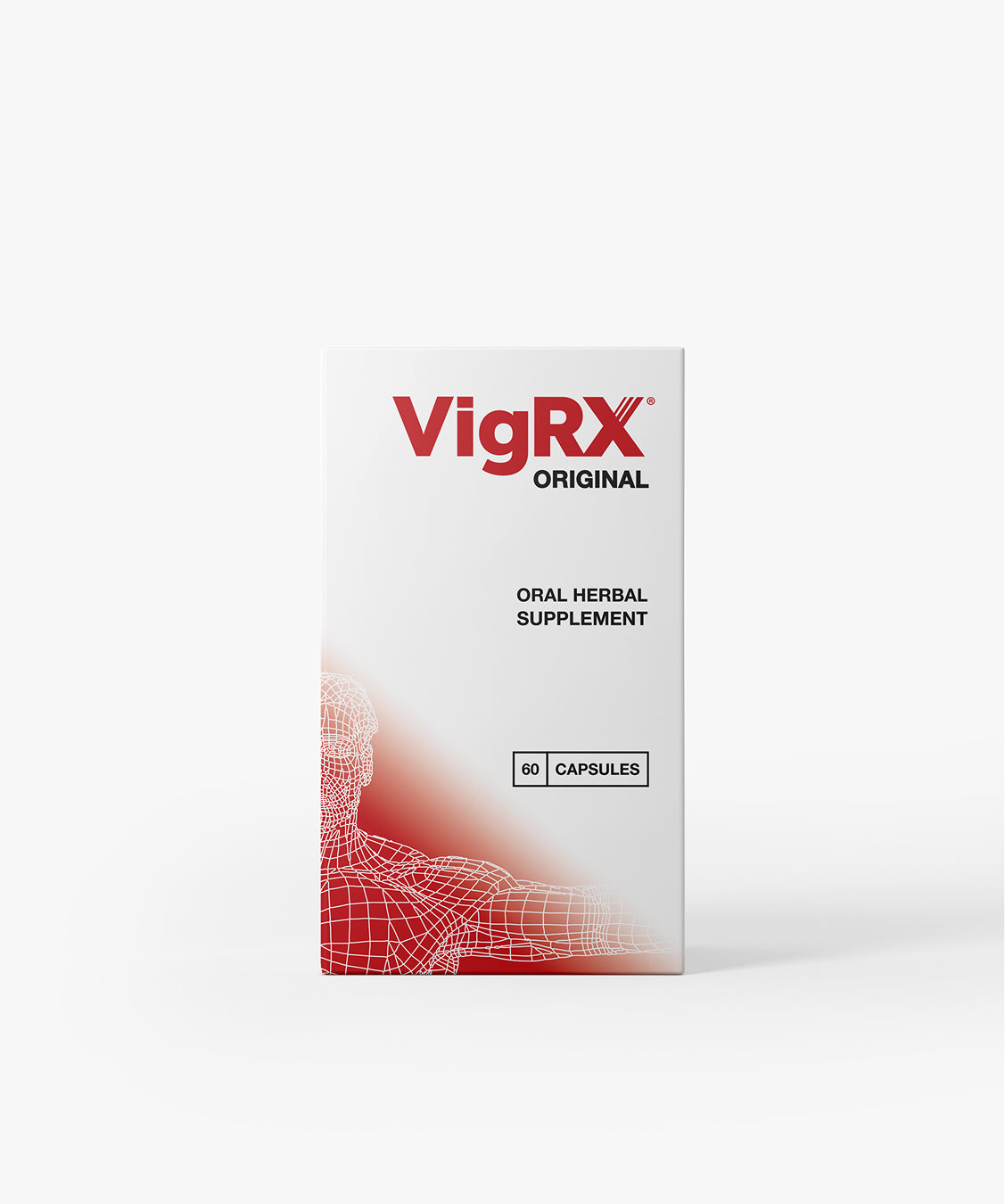
Affiliate disclosure: Our store sells both VigRX (the original) and VigRX Plus through affiliate links, and we may earn a commission whichever you buy, at no extra cost to you. We score them far apart — the original carries our 5.0/10, the Plus our 9.5/10 — and this comparison exists because the names invite a confusion the maker's own stores do little to prevent. Every fact below comes from the maker's own pages for each product, audited separately for our two reviews.
Quick Verdict
The extra money buys the one thing the original has never had: a study of the finished product. VigRX Plus was tested in an 84-day, double-blind, placebo-controlled trial in 78 men, with erectile-function results published — the strongest product-level file on our shelf. The original VigRX, on sale since 2001, has no trial of itself at all, despite a "Clinically Studied" bullet on its maker's page; every study its maker cites is about a single ingredient. The Plus also publishes its full eleven-ingredient formula, where the original's two maker pages cannot even agree on whether the formula has three ingredients or seven. What the extra money does not buy is a different guarantee, a different maker, or certainty — the Plus trial was maker-sponsored, run at twice today's labelled dose, and its decision window still closes at day 67. But on documentation, this is not a close comparison, and it is not priced like one either.
VigRX vs VigRX Plus at a Glance
| VigRX (original) | VigRX Plus | |
| Our score | 5.0/10 | 9.5/10 |
| On sale since | 2001 — the product the line "started right here" with | The successor; now the daily "Foundation" step in the maker's own routine |
| Price (single box) | $59.95 (maker's list $69.95) | $69; $59 per box on 3, $49 on 6 |
| Formula as published | 7 herbs on the maker's retail page; only 3 shown on its corporate page; no amounts, no Supplement Facts panel | 11 named ingredients, published as a complete formula list |
| Finished-product evidence | None. No trial of VigRX is named anywhere on the maker's pages | 84-day double-blind placebo-controlled trial, 78 men, results published |
| Dose paperwork | "Once-a-day"; capsules per day and per bottle not stated numerically | 2 tablets daily with meals — though the trial used 4 a day (see below) |
| Guarantee | 67 days | 67 days |
The Formulas: A Shared Core, a Wider Plus
Set the two published lists side by side and the relationship is clear. The original's fullest maker-published list — seven herbs from the maker's retail store — is Epimedium, Ginkgo, Asian Red Ginseng, Saw Palmetto, Muira Puama, Catuaba and Hawthorn. Every one of those seven appears in the Plus formula too. The Plus then goes wider: eleven named ingredients, adding Damiana, Tribulus Terrestris, Cuscuta and BioPerine to the shared core. Two paperwork contrasts matter more than the botany. First, agreement: the maker's corporate page for the original shows only three of its seven ingredients — a buyer reading the two maker pages side by side cannot confirm what the original contains, while the Plus formula is published completely and consistently. Second, depth: the original publishes no ingredient amounts and no Supplement Facts panel on either maker page; and the original's directions are the vaguest on our shelf — a "once-a-day dietary supplement" whose capsules per day and capsules per bottle are never stated numerically. The Plus is not perfect on dose paperwork either (its own label directs two tablets a day), but its formula, at least, is one document that agrees with itself.
The Evidence: A Trial vs a Bullet Point
Here is the whole comparison in one contrast. For the Plus, the maker cites a randomised, double-blind, placebo-controlled trial of the finished product: 78 men aged 25–50 with mild to moderate erectile dysfunction, over 12 weeks, published in a peer-reviewed journal in 2012. At the final reading, the average erectile-function score in the product group had risen from about 16 to about 25 on the standard IIEF scale, while the placebo group barely moved (about 16 to 16.5); desire and satisfaction scores also favoured the product. Its honest limits ride along in every page we publish: the trial dose was four tablets a day, twice today's label, the study was sponsored by the company behind the product, and it enrolled men under 50.
For the original, there is no equivalent paragraph to write. The maker's benefit list includes the words "Clinically Studied," and its retail page says the formula was created "using the very latest clinical trial results and medical studies" — but no trial of VigRX itself is named on either maker page. What is cited is ingredient-level: a ginkgo figure ("78% of men… reported significant improvement") from an unnamed study; a double-blind Korean red ginseng study with no size or duration published; a Muira Puama series from a Paris sexology institute. Studies of ingredients are the category's small change — every formula on this shelf has some — and they cannot do the one job the Plus trial does, which is measure the product a buyer actually swallows. "Clinically Studied," attached to a product with no clinical study of itself, is the single most misleading line in the original's file, and the reason its score sits where it does.
These statements have not been evaluated by the Food and Drug Administration. These products are not intended to diagnose, treat, cure, or prevent any disease. This article is educational and is not medical advice.
The Price Gap, Honestly Counted
On this store the gap is about nine dollars a box: $59.95 for the original against $69 for a single box of the Plus — and the Plus's published ladder erases even that at volume, falling to $59 a box on three and $49 on six, while the original's maker pages publish no multi-bottle totals at all. So the "extra money" framing deserves a correction of its own: at three boxes, the better-documented product costs the same per box as the original costs for one. What the single-box difference buys, itemised: a complete and consistent formula publication; the only finished-product trial either product has; a stated dose and a stated box count; and the formula the maker itself now builds its routine around — in the maker's current store, the daily "Foundation" step is the Plus, not the original, which the maker's own framing treats as the legacy product. What it does not buy: a longer guarantee (both are 67 days, with the same day-60 decision logic), a trial at the dose you will actually take (the study ran at double), or a warnings file worth the name on either side — the original's pages carry no warnings section at all, capped by a retail-store assurance that there are "no unwanted side effects to worry about because VigRX® is all natural," which we record as a maker's claim, not a finding.
Frequently Asked Questions
Is VigRX Plus just a stronger VigRX?
Not exactly. The Plus keeps all seven of the original's published herbs and adds four more ingredients, including BioPerine — but the meaningful upgrade is documentary, not botanical: a complete published formula and a placebo-controlled trial of the finished product, against no product trial at all for the original.
Has the original VigRX been clinically studied?
Not on anything its maker publishes. Its pages say "Clinically Studied," but every study actually cited is about an individual ingredient — ginseng, ginkgo, muira puama — not about VigRX. No trial of the finished original is named anywhere in the maker's material.
Why does the original still exist if the Plus is better documented?
It has been sold since 2001 under one of the category's most recognised names, at a slightly lower single-box price. Longevity is a commercial fact, not an evidence one — and in the maker's own current store, the Plus, not the original, is positioned as the daily foundation product.
Is the Plus trial's result what I should expect?
Expect less certainty than the headline. The trial's men took four tablets a day — double the current label dose — were under 50, and had mild to moderate problems; the study was maker-sponsored. It is real evidence, the best in this comparison by a distance, and it still is not a promise about any individual result.
Which one is better value?
At a single box, the original is cheaper by about $9. At three boxes, the Plus matches the original's per-box price while carrying a trial, a complete formula and a stated dose. On paperwork per dollar, the Plus wins at every quantity the maker publishes.
Final Verdict
Choose VigRX Plus for almost every reason except the last nine dollars. It is the documented successor: eleven published ingredients, an 84-day placebo-controlled trial of the finished formula, and the maker's own flagship position. Our score: 9.5/10. Buy it through the VigRX Plus page. Choose the original VigRX only as a budget experiment with the file open — a 2001 legacy formula whose maker publishes no amounts, no complete list on its corporate page, no warnings, and no trial of the product behind a "Clinically Studied" bullet its own citations contradict. Our score: 5.0/10, audited on the VigRX page. The extra money, in the end, buys the difference between a product that was measured and a product that was merely marketed — and at three boxes, it doesn't even cost extra.
Disclaimer: This article is for general information only and is not medical advice. Always consult a qualified healthcare professional before starting any supplement, especially if you have a medical condition or take prescription medication.
Last reviewed: October 2026
