
Affiliate disclosure: This article contains affiliate links. If you buy through a link on this page, we may earn a commission paid by the manufacturer, at no extra cost to you. That never changes what we publish — and here it means this guide leads with the things that actually help (most of which are free), and treats supplements, mentioned near the end, as the modest supporting option they honestly are, not as a fix you can buy for someone else's body.
If you found this page, you are probably not really searching for information about hormones. You are searching because the physical side of your relationship changed — gradually or seemingly all at once — and you miss it, and you miss her, and you may quietly be wondering whether she has stopped wanting you. This guide is written for you, the partner, because almost everything written on this topic is written for women, and the person on the other side of the bed is left guessing. Here is what is actually changing, what almost never helps, what genuinely does, and where the honest limits of every fix — including products — sit.
Quick Answer: Why Did Her Libido Change After Menopause?
Because menopause is not one change; it is a stack of them landing at once. Falling estrogen makes vaginal tissue thinner, drier, and slower to respond — so arousal takes longer and sex can shift from pleasurable to uncomfortable or outright painful. At the same time, hot flushes wreck sleep, broken sleep wrecks mood and energy, and desire is one of the first casualties of exhaustion. Add mood changes, body changes she may feel self-conscious about, medications that suppress libido, and two decades of life stress, and a lower sex drive is the predictable outcome — not a verdict on you, and not a choice she made. Understanding that stack is the single most useful thing on this page.
What Is Actually Changing in Her Body?
It helps to separate three systems that are easy to blur together, because each has a different answer:
- Desire — the interest itself. This is driven by hormones, sleep, mood, stress, relationship temperature, and plain energy. It commonly dips at menopause, and for many women it also becomes more responsive than spontaneous: instead of appearing out of nowhere, it arrives in response to closeness, touch, and feeling wanted. That is a change in pattern, not an absence.
- Arousal — the body's physical response. Estrogen decline means blood flow and lubrication respond more slowly. What used to take minutes can take considerably longer, and rushing that timetable is one of the most common ways couples accidentally make things worse.
- Comfort — whether sex physically feels good. Thinner, drier tissue can make intercourse sting, burn, or tear microscopically, and pain after the fact is common. Once sex has hurt a few times, the brain sensibly starts avoiding it — a low "libido" that is actually a pain-avoidance reflex. This is the most fixable item on the list and the most often missed.
Notice that only the first of those three is really about wanting. Many couples spend years arguing about desire when the actual problem is comfort — and comfort has practical answers.
What Definitely Does Not Help?
Partners usually reach for these with good intentions. They reliably backfire:
- Pressure and initiation-by-guilt. Comments about how long it has been, sulking after a no, or keeping score convert sex into an obligation with a deadline. Desire — especially responsive desire — does not grow under pressure; it retreats.
- Treating it as rejection of you. She knows her body changed. Being told, in words or in mood, that she has personally withdrawn something usually produces defensiveness and distance, not desire.
- Comparing. To how she was at 30, to other couples, to anything. The body that exists now is the one in the relationship.
- Going silent and distant. Withdrawing affection to match her withdrawal feels symmetrical, but it starves exactly the closeness that responsive desire feeds on.
- Secretly shopping for a fix for her. Presenting a partner with a libido product bought for her lands, almost always, as criticism in a box. If products enter the picture at all, they enter by her choice — more on that below.
What Genuinely Helps?
Nothing here is dramatic. That is rather the point: the couples who come through this well tend to do the unglamorous things consistently.
- Talk about it as a shared problem, not a complaint. "I miss being close to you, and I want us to figure this out together" opens a door that "we never have sex anymore" closes. Ask what has changed for her and what she misses — you may find she misses it too and assumed you had lost interest in her. That mutual misunderstanding is extremely common.
- Rebuild non-sexual touch. Affection that is not a prelude to anything — holding, massage, falling asleep in contact — rebuilds the physical familiarity that desire grows out of, without the pressure of an expected outcome.
- Slow the timetable down. More time, more touch, no rushing to intercourse. This is not a concession; it is how arousal physiology works for most women after 50.
- Use lubricant, liberally, as standard equipment. Not as a remark on her body — as the obvious tool for a known physical change, like reading glasses. Keep it at the bedside so it is logistics, not commentary.
- Broaden what counts as intimacy. Couples who quietly expand the menu beyond intercourse-or-nothing report far less frustration than couples holding one fixed definition and grieving it.
- Help with the load. Desire dies under exhaustion and resentment. Sleep disrupted by hot flushes, work, ageing parents, household weight carried unevenly — a partner who visibly shares the load is doing more for the couple's sex life than any aphrodisiac on the market. Unsexy, and true.
- Protect her sleep like it matters — because it does. The fan on her side, the lighter duvet, separate blankets so nobody's temperature preference wins: these small logistics are libido interventions in disguise. A woman who has slept is a different person from one who has been awake since 3 a.m. with night sweats, and very little desire survives chronic exhaustion.
- Stay visibly attracted, in ordinary ways. Compliments that expect nothing, noticing her, wanting her company — these sound too small to list, until you consider that many women quietly conclude their partner no longer sees them that way, and stop seeing themselves that way too. Being desired is itself a desire input at this stage of life.
What Are Her Medical Options — and Whose Call Are They?
Some of the most effective answers for the comfort side of this are medical, and they are hers to pursue with her own doctor — your role, if any, is encouragement and support if she wants it. For completeness, the options doctors commonly discuss include local (vaginal) estrogen in cream, tablet, or ring form, which treats the tissue changes directly at very low systemic doses; vaginal moisturisers used regularly for baseline comfort; and review of any medications that may be suppressing libido. Persistent pain, bleeding after sex, or symptoms that do not respond are reasons for a proper examination, not endurance. We set out the woman's side of this whole picture — causes, what helps, in what order — in our own guide to low libido in women after 40.
These statements have not been evaluated by the Food and Drug Administration. This product is not intended to diagnose, treat, cure, or prevent any disease. This article is educational and is not medical advice.
Where Do Supplements Honestly Fit?
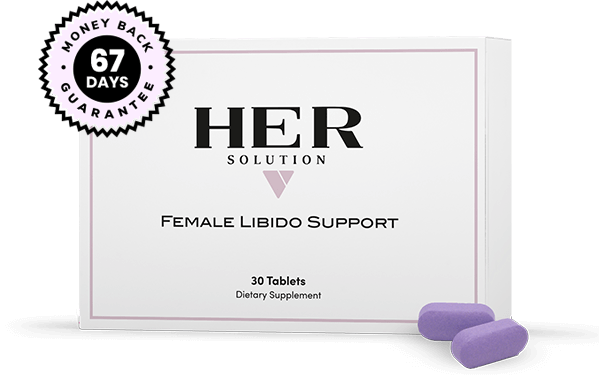
You will find daily formulas marketed to women over 40 for desire and arousal support — on our shelf, that is HerSolution and Provestra, both from the same maker. Here is the honest placement we would want someone to give us. The evidence behind such formulas is ingredient-level and modest: botanicals traditionally used for libido and arousal, studied individually in small studies at best, not products proven in large clinical trials to restore desire. They are not hormones, they do not reverse menopause, and — this distinction matters — a desire supplement does nothing for vaginal dryness or tissue pain, which are mechanical problems with mechanical answers (lubricant, moisturisers, local estrogen). A supplement is, at most, a supporting player for the desire layer of a three-layer problem.
And the relational rule from earlier stands: it has to be her purchase, made because she is interested — not your intervention. If she raises the topic, our review pages score both products openly, including their guarantees and limitations, so she can judge them on information rather than marketing.
How Do You Keep a Desire Gap From Becoming Distance?
Desire gaps exist in most long relationships at some point; menopause just gives this one a biological starting gun. What predicts whether a couple comes through it is rarely the size of the gap — it is whether the two people stay on the same team while it exists. Practically: keep talking in the "us" frame, keep affection alive without conditions, fix the comfort problem before arguing about the desire problem, and treat her doctor's appointments about this the way you would treat any health issue of hers — with interest and backup. If the gap becomes a source of real distress for either of you, a few sessions with a couples or sex therapist is not a defeat; it is the specialist version of everything in this article, and clinicians who do this work see this exact situation every day.
The bottom line: her libido changed because menopause changed her sleep, her comfort, her hormones, and her energy all at once — not because she stopped wanting you. Pressure widens the gap; patience, touch without an agenda, lubricant within reach, a shared load, and medical help for the comfort side close it. Fix comfort first, talk like teammates, and let any product be her choice with honest information in front of her. That is less dramatic than a miracle cure. It is also what actually works.
Disclaimer: This article is for general information only and is not medical advice. Always consult a qualified healthcare professional before starting any supplement, especially if you have a medical condition or take prescription medication. Individual results vary, and no result is guaranteed.
Last reviewed: October 2026
