
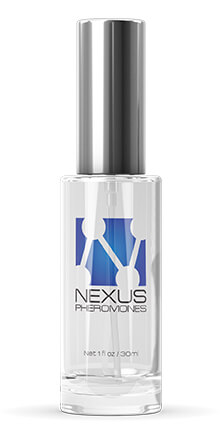
Affiliate disclosure: We sell Nexus Pheromones through our affiliate link and earn a commission if you buy it. Nexus is a fragrance — a cologne spray, not a supplement or a drug — and this page audits what is in the bottle the way we audit a supplement label: name by name, against what the maker actually publishes. The short version deserves the first paragraph: Nexus names seven pheromone compounds and publishes no concentration for any of them, no bottle size, and no full ingredient list — and the most-studied compound in this field, androstadienone, is not one of the seven. Our score for the product is 4.0/10.
Quick Answer
A pheromone spray is a scented alcohol-based spray carrying compounds claimed to act as human pheromones. In Nexus, the seven named compounds are androstenone, alpha-androstenol, androsterone, epiandrosterone, beta-androstenol, androstenedione and androstanone, in a faintly fragranced base, applied as 1–3 sprays to the neck and chest. That list of names is the entire published formula: the maker gives no amount, percentage or total pheromone content for any compound, does not publish the bottle's volume, and does not publish the full base ingredient list (alcohol, carrier, fragrance components). A buyer can verify what the bottle claims to contain. They cannot verify how much of any of it is in there — which, for a product whose whole premise is chemical signalling, is the fact that matters most.
The 7 Compounds, One by One
Here is the formula as the maker publishes it, with the role the maker assigns to each compound. Every role below is the maker's description, quoted or closely paraphrased — none of them is a demonstrated effect of this product, which has never been trialled.
- Androstenone — the lead name on the list, said by the maker to "signal dominance." It is a steroid compound found in human sweat, and the one with the sharpest natural scent of the group — which is one reason the formula carries a masking fragrance.
- Alpha-Androstenol — assigned "comfort and attraction": the mellower counterpart in the maker's framing, the compound meant to make the wearer seem approachable rather than dominant.
- Androsterone — assigned "masculinity," with what the maker describes as mood-elevating effects on women. It is a metabolite of testosterone present in human biology.
- Epiandrosterone — said by the maker to "may communicate youthfulness." Note the hedge in the maker's own wording; it is the least-explained name on the list.
- Beta-Androstenol — billed as the "icebreaker pheromone," the social-opener of the set in the maker's telling, related to the alpha form above with a different claimed role.
- Androstenedione — assigned heightened sexual responsiveness. A steroid precursor compound; its presence on a cosmetics-style label is a name, with no amount attached.
- Androstanone — the final name, assigned a "powerful, masculine effect" — the vaguest role description of the seven.
Read the list as a whole and two things stand out. First, the names are genuinely the standard cast of this category — these are the compounds pheromone products have listed for decades, and the maker's two pages agree on the list. Second, a list is all it is. In supplement terms this is a Supplement Facts panel with every amount blacked out — except that here there is no panel at all, and no regulatory format that would require one, because this is a fragrance. Whether a bottle holds studied quantities or homeopathic traces is something no buyer, reviewer or regulator can determine from anything the maker publishes.
The Compound That Isn't There
The formula's most important feature is an absence. Androstadienone — the single most-studied candidate human pheromone, the compound behind the 2005 study the maker leads its research case with — is not in Nexus. Not among the seven above, not under another name on the list. We take this apart in full in Androstadienone: The Most-Studied "Pheromone" — and Why It Isn't in Most Sprays; the short version is that the names on this formula (androstenone, androstanone, androstenedione) share a stem with androstadienone and nothing else. They are different molecules, and studies of one say nothing about any other. And the compound's own file hardly rescues the citation anyway: the strongest tests of androstadienone itself — a double-blind study and a pre-registered study of 170 people — found no effect on attractiveness perception or behaviour, as we lay out in Do Pheromone Colognes Actually Work? So the research story cites a molecule that is not in the bottle, for an effect that molecule itself failed to demonstrate under rigorous conditions. That is the complete research case minus the second citation, which tested an unnamed generic pheromone product on 38 men in 1998 — also, in every verifiable respect, not this spray.
What "Amplified a Thousand Times" Can't Tell You
The maker's loudest line is that this scent is the smell of healthy, fertile men "amplified A THOUSAND TIMES." A multiplier needs a base, and none is published: a thousand times an unstated concentration is still an unstated concentration. The same arithmetic emptiness runs through the practical facts. The maker says one application lasts roughly 8–10 hours and a bottle lasts roughly 30–60 days worn daily — a two-fold range for the bottle, with the bottle's volume itself unpublished, so even the number of sprays a buyer is purchasing is an estimate of an unknown. Add the missing base formula — the alcohol, carrier and fragrance components that make up nearly all of any spray's volume are nowhere listed — and the honest description of the product's published specification is: seven names, one masking fragrance, and marketing arithmetic with nothing underneath it. Our Ingredients sub-score for Nexus is 3.5/10, the lowest we have given in this batch, and this section is why.
What Is Published: The Commerce
To the maker's credit, the parts of the file that concern money are complete. The price ladder is published in full on its order page: $49 for one bottle (retail $59), $89 for two and $129 for three, with free USA shipping on the multi-bottle tiers and no subscription. The guarantee is a genuine 67 days, and its terms — use the entire bottle if you choose; a refund of monies paid minus shipping and handling if there is no distinct improvement in how women respond — are printed in the FAQ, along with the billing descriptor that will appear on a statement. Directions are published too: 1–3 sprays to pulse points such as the neck and chest, wearable under a regular cologne. A buyer knows exactly what they will pay, how to use it, and how to get a refund. What they do not know is what, in any measurable sense, they are spraying.
Safety: A Claim Where Guidance Should Be
For a product sprayed on the neck and chest and worn for 8–10 hours, the maker's complete published safety content is one sentence: there are no known side effects, and the product is made in an FDA-registered, cGMP-compliant facility. There is no skin-sensitivity guidance, no allergy or fragrance-sensitivity note, no avoid-contact advice — nothing. Facility credentials describe how a factory is run; they say nothing about whether a fragrance will irritate your skin or a partner's. We record the "no known side effects" line as what it is — a maker's claim, attached to a product with no published testing — and note that fragrance sensitivity is common enough that its absence from the page is a gap, not a reassurance.
Frequently Asked Questions
How much of each pheromone is in Nexus?
Nobody can tell you. The maker publishes no concentration, milligram figure or total pheromone content for any of the seven compounds, and does not even publish the bottle's volume. The formula, as published, is a list of names without a single number.
Does Nexus contain androstadienone?
No. Androstadienone — the most-studied candidate human pheromone and the subject of the 2005 study in the maker's research case — is not one of the seven compounds in Nexus. Androstenone, androstanone and androstenedione are different molecules that share a naming stem.
What else is in the bottle besides the seven compounds?
The maker mentions a faint masking fragrance. The full base ingredient list — alcohol, carrier, fragrance components — is not published on the maker's pages, so the complete contents cannot be stated.
How long does a bottle last?
The maker's FAQ estimates roughly 30–60 days worn daily, with one application lasting roughly 8–10 hours. Both figures are estimates around an unpublished bottle size and spray count.
Has Nexus itself been tested?
No trial of Nexus is cited anywhere. Its research case is the 2005 androstadienone study (a compound not in the formula) and a 1998 study of an unnamed generic pheromone product used by 38 men.
The Bottom Line
What is actually in a bottle of Nexus Pheromones (Our Score 4.0/10) can be stated in one sentence: seven named steroid compounds at unknown concentrations, in an undisclosed base, under a masking fragrance — sold with an honest price ladder and a real 67-day guarantee. If the scent itself appeals to you, that is a knowable purchase. If you are buying the chemistry, understand that the chemistry is the one part of the product the maker declines to specify — and that the field's most famous molecule, with its most famous study, is not in the bottle at all.
Disclaimer: This article is for general information only and is not medical advice. Nexus Pheromones is a fragrance product, not a dietary supplement or drug.
Last reviewed: October 2026
