
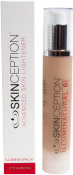
Affiliate disclosure: This article contains affiliate links. If you buy through a link on this page, we may earn a commission paid by the manufacturer, at no extra cost to you. That never changes what we publish — and here it means refusing both easy scripts: hydroquinone is not a poison to be frightened of, and "hydroquinone-free" is not a safety certificate to relax behind. The serum this store sells, Illuminatural6i, advertises the absence of hydroquinone as a headline virtue. This page examines what that absence does and does not establish, and where the genuine risks in this category actually sit.
Anyone researching dark-spot products meets the same fork in the road. On one side, hydroquinone: the ingredient dermatologists used for decades as the reference treatment for pigmentation, now surrounded by warnings. On the other, the brighteners — niacinamide, vitamin C derivatives, arbutins, kojic acid — marketed as the gentle, natural alternative. The marketing on both sides is louder than the facts. Here is the comparison with the volume turned down.
Quick Answer: What Is the Real Safety Difference?
Hydroquinone is a potent, single-purpose pigment suppressant with a long clinical history and a real, specific risk profile that calls for supervised, time-limited use — which is why access to it has been tightened in many countries. Cosmetic brighteners are milder, slower, multi-ingredient products whose individual ingredients have gentler profiles but whose finished formulas are rarely tested as a whole, and whose safety depends heavily on the maker's quality control. The largest documented danger in this category is neither: it is unregulated lightening products, some of which have been found to contain mercury or potent steroids — ingredients no legitimate cosmetic label would print. Supervision and product legitimacy are the safety questions. The ingredient name is only part of them.
What Hydroquinone Is, Without the Horror Stories
Hydroquinone works by suppressing the enzyme activity that produces melanin, and it does so more forcefully than any cosmetic brightener — which is precisely why it spent decades as the standard prescription answer to stubborn pigmentation, including melasma that cosmetics barely touch. That history matters for fairness: this is not a fringe chemical that slipped onto shelves; it is a medicine with a long record of supervised use.
Its cautions are also specific rather than mysterious. It commonly irritates — redness, dryness, stinging — especially at higher strengths or on sensitive skin. And with prolonged, unsupervised, high-strength use it has been associated with a paradoxical darkening condition called exogenous ochronosis, which is the main reason dermatology guidance treats it as a course, not a habit: defined strength, defined duration, professional oversight. Regulatory access has followed that logic — in many markets, including the United States, ordinary over-the-counter cosmetic sale has ended and it is effectively a clinician-supervised ingredient. The accurate summary is not "dangerous" or "safe." It is: effective, and dosed like a medicine because it behaves like one. Whether it suits your skin is a conversation for a doctor who can see the skin in question — not for this page, and not for a product label.
What "Brightener" Means — and What It Does Not Guarantee
The brighteners work by smaller nudges at several points in the pigment pathway rather than one forceful suppression, and their timelines reflect it: the maker of the serum we sell states first results at about four weeks and best results around 90 days, where a hydroquinone course is judged on a clinician's schedule. Their ingredient-level safety reputations are generally gentler. But three honest qualifications belong next to that word "gentler."
The finished product is seldom what was tested. The evidence behind brighteners is ingredient-level — studies of niacinamide or alpha-arbutin as components, in other vehicles, at stated concentrations. The serum on your shelf is a blend, frequently with no concentrations published at all, and its combined behaviour on your skin is not something the ingredient studies measured. "Natural" is a sourcing claim, not a safety finding. Botanical formulas still contain recognised sensitisers: the older published ingredient list for the serum we sell includes fragrance and phenoxyethanol, and its maker publishes no sunscreen guidance for a product used in daylight. And mild cuts both ways. A product too gentle to irritate may also be too gentle to change anything; the absence of risk and the absence of effect are neighbours. The maker's own safety line for this serum — "there are no known side effects" — is more absolute than the paperwork supports, and we record it as a claim, not a conclusion.
Where the Genuine Danger in This Category Sits
It sits off the legitimate shelf entirely. Skin lightening is a global market with a documented underbelly: unregulated creams — sold through informal channels, sometimes with no ingredient list or a false one — have repeatedly been found to contain mercury, a toxic metal that lightens skin while damaging kidneys and the nervous system, or potent corticosteroids never meant for cosmetic use, which thin skin and suppress its defences with continued application. Neither appears on an honest label; that is the point. The practical safety rules follow from where the risk actually is: buy identified products from identified makers through their official channels; treat any lightener with no full ingredient list, no maker you can name, or miraculous speed claims as the hazard it is; and regard "results in days" as a warning sign, not a feature — the maker of the serum we sell itself warns that promises of results in under 30 days should be looked at "with a VERY critical eye."
For reference, the brightener we sell states on both of its maker's published formula lists that it contains no synthetic hydroquinone, mercury, steroids or bleach. That free-from statement, attached to a named maker and an official store with a written guarantee, is the meaningful safety signal — not the word "natural" in the marketing.
These statements have not been evaluated by the Food and Drug Administration. This product is not intended to diagnose, treat, cure, or prevent any disease. This article is educational and is not medical advice.
The Bottom Line
Hydroquinone and cosmetic brighteners are not the strong-dangerous and weak-safe pair of the advertisements. Hydroquinone is the stronger tool, with risks that supervision and time limits exist to manage; brighteners are the slower tool, with gentler ingredients and thinner evidence, whose safety rests on the maker's honesty and quality control. For ordinary, stable dark spots, a legitimate brightener used patiently is the proportionate first step. For stubborn, patterned or worsening pigmentation — melasma above all — the proportionate step is a dermatologist, who can also tell you whether a supervised hydroquinone course belongs in your case. And for any mark that is new, changing or irregular, the answer is a doctor before either. Illuminatural6i (our score: 6.1/10) sits on the brightener side of that line, with its documentation problems — two published formulas, no concentrations, studies belonging to the older list — set out in full in our review and FAQ.
Disclaimer: This article is for general information only and is not medical advice. It does not recommend or advise against any prescription treatment. Always consult a qualified healthcare professional about pigmentation concerns and treatment choices. Individual results vary, and no result is guaranteed.
Last reviewed: October 2026