
- Quick Answer: Why Bioavailability Is the Whole Resveratrol Question
- What "Bioavailability" Means Here, in Plain Terms
- Form One: Loose Powder
- Form Two: The Standard Capsule
- Form Three: Liposomal Delivery — and What This Maker Actually Claims
- The Question Underneath All Three Forms
- Frequently Asked Questions
- The Bottom Line
Affiliate disclosure: This article contains affiliate links. If you buy through a link on this page, we may earn a commission paid by the manufacturer, at no extra cost to you. That never changes what we publish — and here it means examining the delivery claim of the one resveratrol product we sell, GenuinePurity Resveratrol, as closely as its rivals' — including the absorption number its maker does not publish for it.
Quick Answer: Why Bioavailability Is the Whole Resveratrol Question
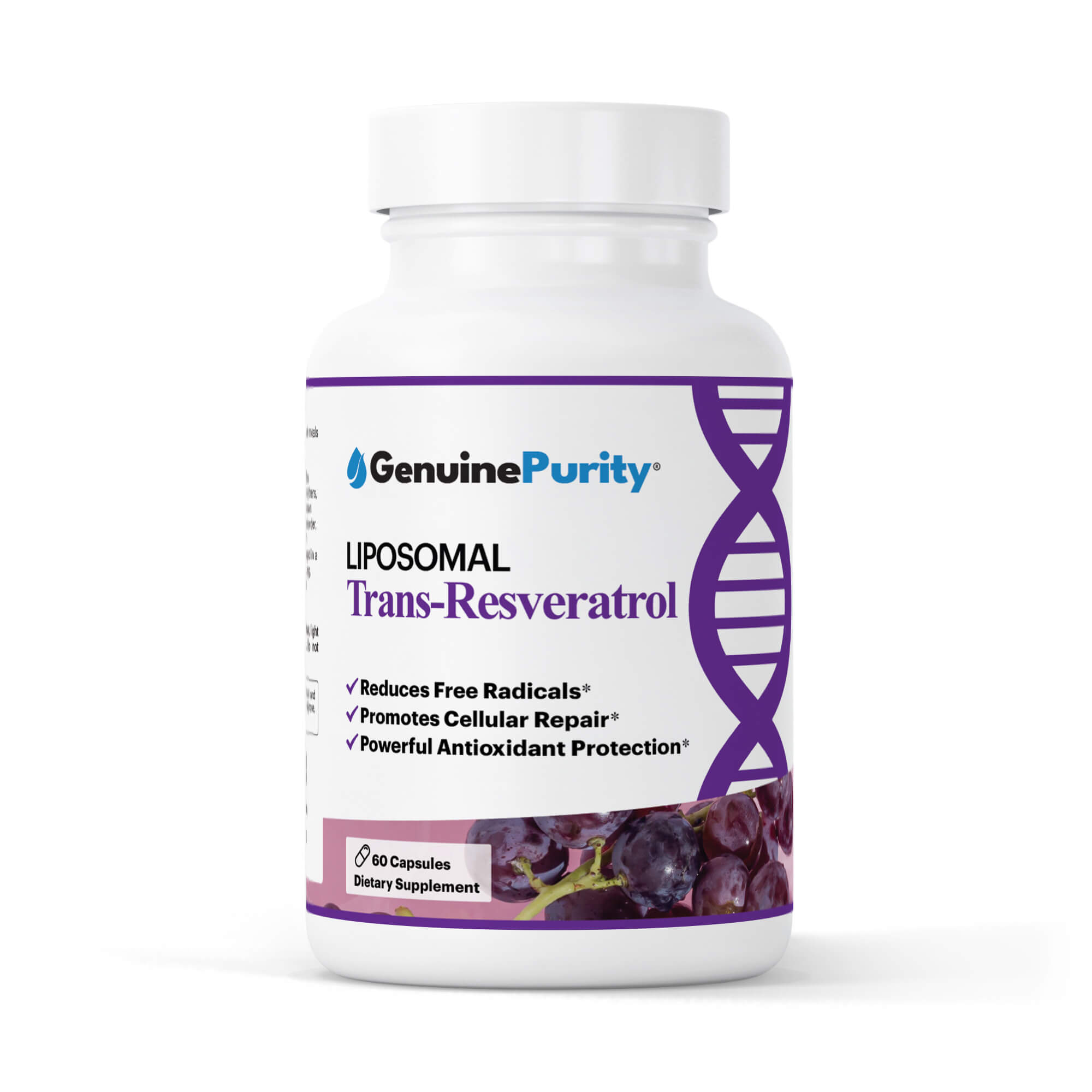
Resveratrol's problem has never been the molecule's reputation; it is what happens between the capsule and the bloodstream. The maker of the product we sell states the problem in its own words: standard resveratrol has "poor absorption," which is why its formula wraps the compound in a phospholipid layer — liposomal delivery — intended to shield it through digestion. Every resveratrol format on the market is an answer to that same problem, and they are not equal answers: loose powder leaves the dose and the digestion to you, a standard capsule standardises the dose but not the absorption, and a liposomal capsule claims to change the absorption itself. The honest caveat that governs this whole page: for the liposomal product we sell, the maker publishes no absorption figure at all — no percentage absorbed, no comparison study. What can be audited is the claim's structure, the ingredient list that carries it, and the dose. This page audits those.
What "Bioavailability" Means Here, in Plain Terms
Bioavailability is the share of what you swallow that survives digestion in a usable form. For resveratrol, three things decide it. First, the form of the molecule: resveratrol comes in isomers, and trans-resveratrol is the one the maker identifies as the active form — a label that says only "resveratrol," without stating how much of it is the trans isomer, leaves the active share unknown before delivery is even discussed. Second, survival through the gut: a compound that is broken down or poorly dissolved on the way through delivers a fraction of its label dose, whatever the label dose is. Third, the dose itself: delivery technology multiplies whatever is there — it cannot rescue a token amount, and it does not need to rescue an honest one. Keep those three separate, because marketing habitually merges them: "liposomal" answers the second question only.
Form One: Loose Powder
Powder is the oldest format and the least standardised. Its advantages are real but narrow: bulk powder is usually the cheapest route per gram, the buyer controls the serving size, and it can be mixed into food or drink. Its problems are the mirror image. The dose is whatever your scoop and your kitchen scale say it is — and small errors at the hundreds-of-milligrams scale are easy. There is no capsule shell and no delivery system of any kind between the powder and your digestive tract, so the absorption question is answered by default: the compound meets digestion unprotected. And a powder label can be the least informative of any format — total resveratrol per container, with the trans-resveratrol share and the source plant sometimes unstated. Powder suits a buyer who wants bulk economics and is willing to do their own measuring and their own label homework. It asks the most of the buyer and verifies the least.
Form Two: The Standard Capsule
The standard capsule fixes powder's dosing problem: a stated amount per capsule, a stated serving, a portable form. What it does not fix is the absorption problem the maker of our product describes. A conventional capsule delivers its contents into digestion in the ordinary way; the capsule shell itself is packaging, not technology. This is the format most resveratrol is sold in, and its labels vary enormously in what they disclose — the trans percentage, the source (the auditable products name Japanese knotweed root), and the per-serving amount are all checkable on a good label and absent on a poor one. Judge a standard capsule exactly as you would judge powder, minus the measuring: by what its label states, because the format itself adds nothing to delivery.
Form Three: Liposomal Delivery — and What This Maker Actually Claims
Liposomal delivery wraps the compound in phospholipids — the same class of fats cell membranes are made of — with the stated aim of shielding it through digestion and improving uptake. In the product we sell, that claim is not decorative: the capsule's published contents include a Phospholipid Complex (Sunflower Lecithin, Phosphatidylcholine), listed openly among the other ingredients — Vegetable Cellulose (the capsule), Microcrystalline Cellulose, Silicon Dioxide and Vegetable Stearate. A buyer can verify the delivery system's presence on the label. What a buyer cannot verify is its performance. The maker states the purpose — to shield the compound through digestion, because standard resveratrol absorbs poorly — and publishes no absorption percentage, no comparative figure and no delivery study for this product. That gap is worth seeing clearly, because the same maker is capable of publishing such figures when it wants to: for its NMN product, it prints comparative absorption figures (liposomal versus standard capsules) and labels them comparative. For its resveratrol, it prints none. The claim here is structural — a named phospholipid complex on a disclosed label — and it should be weighed as a plausible mechanism with unpublished performance, not as a measured result.
The Question Underneath All Three Forms
Delivery is the second question. The first is what is being delivered. The product we sell states 500 mg of trans-resveratrol per daily serving (two capsules), sourced from Japanese knotweed root — a dose and an isomer a buyer can hold any rival against. It also carries the imperfection we record wherever it appears: the maker's store page calls the product 99% pure, while its own landing page headlines 98% pure — both figures are the maker's, and it has not reconciled them. That conflict matters more to a bioavailability discussion than it might seem: a purity figure is a claim about how much of the capsule is the active isomer at all, and a maker that publishes two of them has left the first question — what is being delivered — less settled than its delivery technology suggests. Across all three formats, the buyer's order of operations is the same: trans-resveratrol amount first, purity second, delivery claim third.
These statements have not been evaluated by the Food and Drug Administration. This product is not intended to diagnose, treat, cure, or prevent any disease.
Frequently Asked Questions
Is liposomal resveratrol proven to absorb better? Not on anything its maker publishes for this product. The mechanism is stated — phospholipid encapsulation to shield the compound through digestion — and the phospholipid complex is genuinely on the label. But no absorption percentage or comparative study for this product appears on the maker's pages. Treat "liposomal" here as a disclosed formulation choice with an unmeasured effect size.
Does the format change how much I should take? The directed dose for the product we sell is 500 mg per daily serving — two capsules, preferably with food — whatever the format debate. A powder or standard capsule at a lower stated dose is not made equivalent by a delivery claim, and a delivery claim does not raise a low dose. Compare stated trans-resveratrol milligrams first.
What should I check on any resveratrol label? Four things: the trans-resveratrol amount per serving (not per container), a purity percentage, a named source, and a full ingredient list that shows any delivery system it advertises. Our GenuinePurity Resveratrol review (Our Score 7.5/10) shows one label that publishes all four — alongside the purity conflict its own pages create.
The Bottom Line
Powder gives you bulk and homework. A standard capsule gives you a standardised dose and ordinary digestion. A liposomal capsule gives you a stated delivery mechanism whose performance, in the one product we sell, the maker has not measured in print. Bioavailability is a real problem for resveratrol — its own makers say so — but a delivery claim is a promise about a process, and the auditable facts remain the older ones: how much trans-resveratrol, at what stated purity, from what source, at what dose. Start there, with any format, and let the technology argue for whatever is left.
Disclaimer: This article is for general information only and is not medical advice. Always consult a qualified healthcare professional before starting any supplement, especially if you have a medical condition or take prescription medication.
Last reviewed: October 2026
