
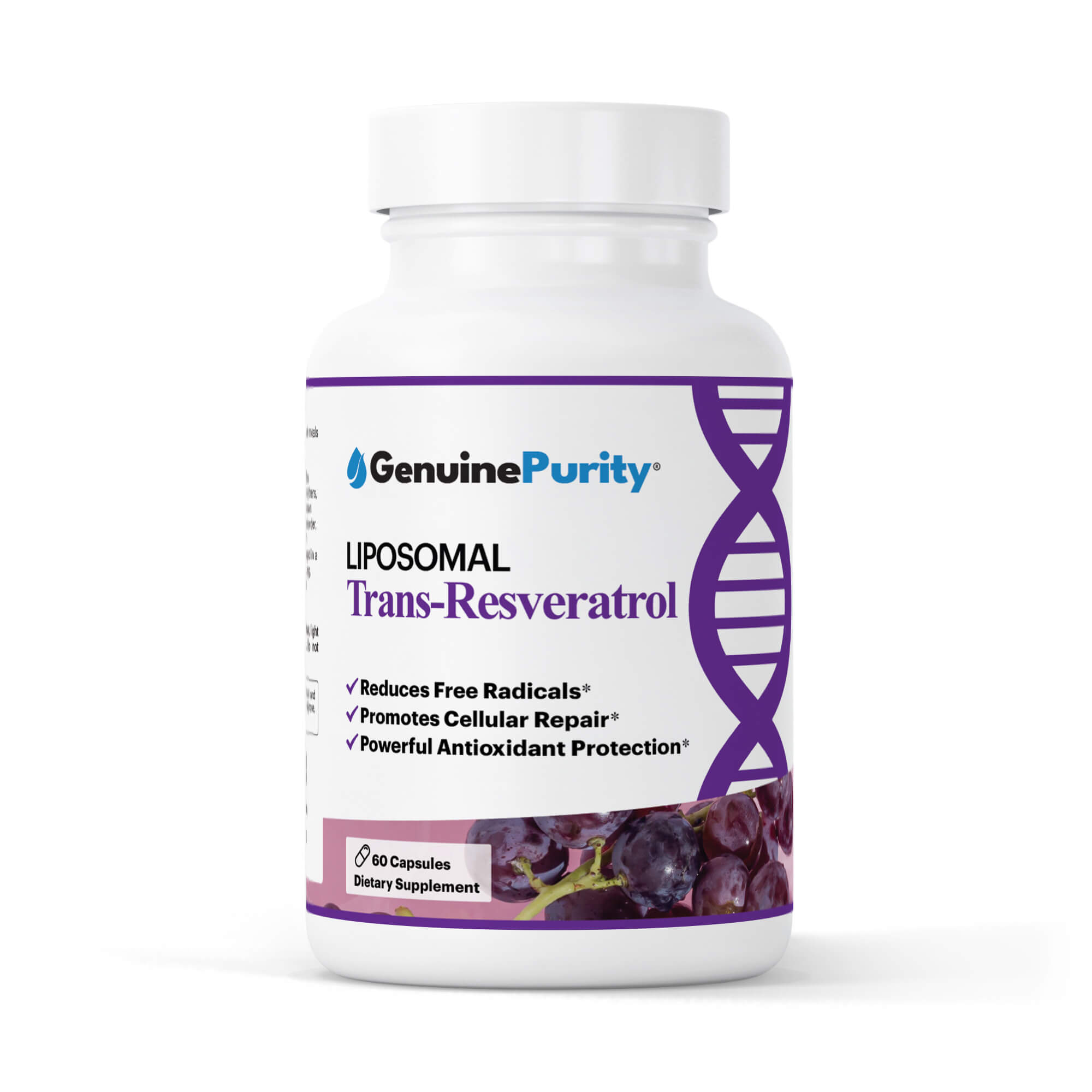
Affiliate disclosure: This article contains affiliate links. If you buy through a link on this page, we may earn a commission paid by the manufacturer, at no extra cost to you. That never changes what we publish — and on this topic it means saying plainly what the human evidence for the one resveratrol product we sell, GenuinePurity Resveratrol, actually consists of. It is thinner than the category's marketing suggests, and this page will not thicken it.
Quick Answer: The Human File Is Thin, and Mostly About Blood Sugar
Ask what human trials show about resveratrol and aging, and the documented answer — from the maker's own pages, which are the primary source for the product we sell — is this: no human trial of resveratrol for lifespan, healthspan or aging itself is described at all. What the maker actually prints is three journal quotations, every one of them about glycemic control — blood glucose and insulin resistance — with no trial designs, doses or participant counts attached. Beyond those, its human-evidence gesture is a reference to "recent human studies" on nitric oxide production that it does not name. Everything else in the aging pitch — SIRT1 activation, sirtuin pathways, cellular resilience — is mechanism language: statements about what the molecule interacts with, not measurements of what happened to people who took it. That is the whole file. The sections below lay it out piece by piece, because the gap between this file and the word "longevity" on the label is the most important fact on this page.
What an Aging Trial Would Have to Show
It helps to be precise about the missing thing. A human trial "for aging" would need people, time, and an aging outcome: lifespan itself (a trial measured in decades, which is why none exist for almost any supplement), or a validated healthspan measure — function, frailty, disease incidence — tracked over years against a placebo. Short of that, researchers and makers fall back on proxies: biomarkers, blood measures, mechanism markers. Proxies are not worthless, but they sit at a documented distance from the claim on the label. When a product is positioned for "lifespan/longevity" — as this one's maker positions it, in so many words, among its claimed supports — the question a buyer is entitled to ask is which rung of that ladder the evidence stands on. For resveratrol, on the paperwork its own maker publishes, the answer is: the proxy rung, and only partway up it.
What the Maker's Human Evidence Actually Consists Of
Three quotations, printed on the product's store page, all on the same subject. From European Endocrinology (2023, as the maker names it): resveratrol "has been shown to be effective in modulating blood glucose levels [and] decreasing insulin resistance." From Complementary Therapies in Medicine (2022): "Resveratrol supplementation contributes in improvement of glycemic control by reducing insulin resistance." From BMC Medicine Journal (2017): "Resveratrol supplementation may improve fasting plasma glucose, HOMA-IR, and insulin." Read them carefully and two things are true at once. They are real journal quotations about real human-relevant outcomes — blood-sugar control is a genuine component of metabolic aging, and a maker could honestly present them as such. And they are presented with no trial designs, no doses and no participant counts, so a reader cannot tell whether they summarise large trials or small ones, at the 500 mg this product delivers or at some other amount entirely. A quotation without its study is a claim with its evidence removed. We print them here as the maker prints them — attributed, and visibly incomplete.
The Unnamed Studies, and the Mechanism Language
The maker's one other gesture at human evidence is a sentence: "In recent human studies, resveratrol has been shown to promote nitric oxide production to enhance blood flow and support heart health." The studies are not named, dated or described. An unnamed study cannot be checked, weighed or distinguished from a press release, and we treat it accordingly — as marketing grammar, not evidence. The rest of the aging case on the maker's pages is mechanism: resveratrol "works within key signaling networks like SIRT1," with AMPK activation, endothelial function and BDNF among the stated pathways. Mechanism claims describe what a molecule touches in a pathway diagram. They are the beginning of a research programme, not the end of one: a compound can engage a longevity-associated pathway in principle and still do nothing measurable for a person, at a given dose, over a human timescale. The maker's own claimed-support list — healthy blood sugar, overall blood pressure, cognitive functions, lifespan/longevity, nitric oxide production, endothelial function, BDNF, joint pain, metabolism, immune system, energy — mixes the three rungs (one glycemic evidence file, several mechanism statements, and lifespan, for which no human evidence of any rung is presented) into a single undifferentiated list. This page's job is to un-mix it.
These statements have not been evaluated by the Food and Drug Administration. This product is not intended to diagnose, treat, cure, or prevent any disease.
What This Means for a Buyer
None of this makes the product we sell a dishonest one by the standards of its shelf — its label is unusually auditable, its dose is disclosed at 500 mg per daily serving, its source is named, its testing policy is stated, and its guarantee runs 97 days (our full review scores it 7.5/10). What it means is narrower and more useful: the aging claim is a bet, not a finding. A buyer of any resveratrol product is betting that a molecule with an interesting mechanism file and a modest, mostly glycemic human-evidence file will do something for them that has not been demonstrated in humans for aging itself. That bet may be worth $59 to you — $43 per bottle in the six-bottle pack, $39 on subscription — with a 97-day refund window under it. It should not be mistaken for a conclusion science has reached. The maker, to be fair to the paperwork, never prints a human aging trial it does not have; it simply lets the word "longevity" stand where the trial would go. Notice the substitution, price the bet accordingly, and the purchase is at least an honest one.
Frequently Asked Questions
Has resveratrol been shown to extend human lifespan? Not in any material the maker of the product we sell publishes — and no such trial is described on its pages. The human evidence it prints concerns blood-glucose control. Lifespan appears in its claimed-support list; it does not appear in its evidence.
What human outcomes does the maker's evidence actually cover? Glycemic ones: blood glucose modulation, insulin resistance, fasting plasma glucose, HOMA-IR and insulin — via three journal quotations (2023, 2022, 2017) printed without designs, doses or participant counts. A further claim about nitric oxide and blood flow cites "recent human studies" it does not name.
If the evidence is this thin, why do people buy it? Because the mechanism file is genuinely interesting, the ingredient has been studied for decades at the level the maker documents, and the purchase is refundable: the GenuinePurity Resveratrol guarantee runs 97 days. Buying a well-labelled bet with a refund window is a defensible decision. Believing the bet is a proven result is not.
The Bottom Line
What human trials actually show for resveratrol and aging, on the documented record, is: something modest about blood sugar, nothing about lifespan, and a mechanism story in between that marketing routinely presents as more than it is. Judge every resveratrol product — ours included — by whether its seller keeps those three piles separate. The ones that blur them are selling you the blur.
Disclaimer: This article is for general information only and is not medical advice. Always consult a qualified healthcare professional before starting any supplement, especially if you have a medical condition or take prescription medication.
Last reviewed: October 2026
