
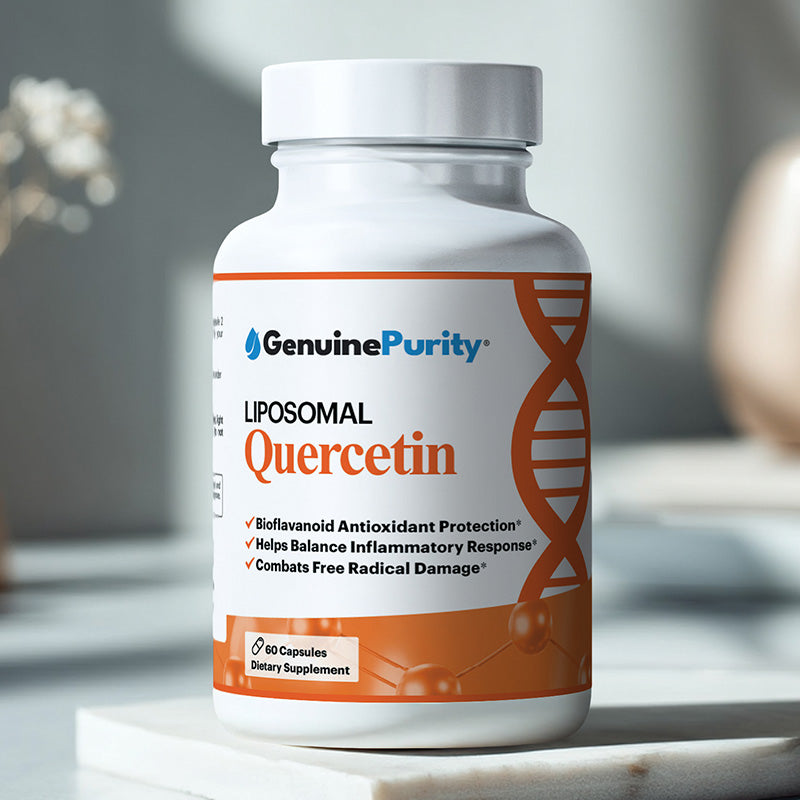
Affiliate disclosure: We sell GenuinePurity Quercetin through our affiliate link and earn a commission if you buy it. The form question matters commercially on this page, so it is answered first: the bottle on our shelf contains the plain form — the least engineered, least studied-in-humans version of the molecule — at 500 mg a day. Our full audit scores the product 6.0/10. Every product fact below comes from the maker's own pages; the evidence framing is the same one our allergy coverage used, because the form problem and the evidence problem are the same problem.
Quick Answer: Yes — a Milligram Is Not a Milligram
Quercetin's known weakness is delivery: the plain molecule is poorly absorbed, so what a capsule contains and what reaches the blood are very different quantities. The three forms in the conversation — plain quercetin, quercetin phytosome and isoquercetin — are three different answers to that delivery problem, and a dose printed for one does not describe another. 500 mg of plain quercetin is not 500 mg of phytosome exposure, any more than a studied dose of one drug formulation transfers to a different formulation at a fraction of the absorption. This is why the form question is the dose question: when a label or a headline quotes a number, the first thing to establish is which form earned it. On our shelf, the answer is checkable in one line — GenuinePurity sells the plain form, marketed as a liposomal capsule — and most of the human evidence buyers have heard about was earned by a form this bottle does not contain.
The Three Forms
Plain quercetin is the molecule as it comes: a flavonoid from plant sources (GenuinePurity's is sourced from Sophora japonica flower), sold as powder in a capsule. It is the cheapest form to make, the most common on shelves, and the one with the delivery problem in its rawest state — oral absorption is notoriously poor, which is why its human evidence file is thin relative to its laboratory file. When a product says nothing special about its form, this is what you are holding.
Quercetin phytosome is quercetin bound into a phospholipid preparation engineered specifically to fix absorption — and shown to be absorbed far better than the plain compound. It is the form behind the human allergy and rhinitis results most often quoted in quercetin's favour. That evidence is real evidence — about the phytosome, at the phytosome's doses, with the phytosome's delivery. It is the strongest human file any quercetin form has, which is precisely why it gets borrowed, in headlines and on labels, by products that do not contain it.
Isoquercetin is quercetin's sugar-bound (glycoside) variant, the third name in the forms conversation across editorial sources. Here this page has to state a gap plainly: the auditable material behind our shelf — maker pages and the research file we grade from — contains no head-to-head human comparison of isoquercetin against either other form, and no isoquercetin product whose label we could audit. It belongs in this article because buyers meet the name and ask the question, and because the honest answer is the same shape as everywhere else in this space: a variant form exists, its milligram numbers are its own, and any source that ranks the three forms by proven human exposure is working from less data than its confidence suggests. We do not fill that gap with figures we cannot check.
Why Form Changes the Dose
The mechanism of the problem is simple arithmetic with one unknown. A dose on a label is an input; what matters biologically is exposure — how much quercetin reaches circulation and tissue. For plain quercetin, the conversion from input to exposure is poor and variable. A delivery-engineered form exists to raise that conversion. So two products can both print "500 mg" while delivering materially different exposures, and a study that dosed the engineered form at a given milligram level tells you approximately nothing about what the plain form delivers at the same printed level. This is also why dose comparisons across forms in marketing copy — "the study used 500 mg; our capsule has 500 mg" — are a category error whenever the forms differ. The form is not packaging. It is half the dose.
These statements have not been evaluated by the Food and Drug Administration. This product is not intended to diagnose, treat, cure, or prevent any disease. This article is educational and is not medical advice.
The Evidence Belongs to a Form
Watch how this plays out in the one quercetin conversation with real human data behind it — allergies and histamine, covered in full in Quercetin for Allergies and Histamine. The laboratory case (mast-cell stabilisation, reduced histamine release) is form-agnostic chemistry. The human symptom results, where they exist, were gathered predominantly with the phytosome. For plain quercetin in people, the file is thin: small, short or absent trials. Meanwhile, the doses used in clinician-supervised histamine work — one clinic's published protocol runs 500 mg twice daily, up to 1,000 mg twice daily, describing quercetin as most effective at higher doses — illustrate the other direction of the same lesson: even within one form, the amounts practitioners reach for can be double to quadruple a retail label. A buyer holding a 500 mg-a-day plain-form bottle is therefore two steps removed from most of the numbers in quercetin's public conversation: a different form's evidence, at different doses. Neither step is the buyer's fault. Both are the label's responsibility to disclose — and most labels, ours included, do not.
The Bottle on Our Shelf, Form First
GenuinePurity's quercetin is plain quercetin in a capsule the maker markets as liposomal — its contents include a phospholipid blend derived from sunflower lecithin. That liposomal framing deserves one precise sentence: a lecithin-containing capsule is the maker's delivery choice, but it is not the phytosome preparation the clinical work used, and the maker cites no absorption comparison of its capsule against plain powder or against the phytosome. The dose is 250 mg per capsule, two a day — 500 mg a day total — in a published 60-capsule bottle (a 30-day supply), at $49, the lowest entry price in the maker's line. The rest of the audit is by now familiar in shape. No purity percentage is published anywhere for this product — the page says "Ultra-Pure & High Potency" and claims third-party testing, but prints no figure, so even the plain-form input side of the dose cannot be audited into verified milligrams of active. And the maker's page states two different guarantees: 97 days in its header, a 90-day satisfaction guarantee excluding shipping in its guarantee section. A form-honest label is a fair ask; this one is dose-published, form-plain, purity-silent and guarantee-conflicted — graded, in full, in our GenuinePurity Quercetin review (Our Score 6.0/10). Its senolytic pairing with the line's other flavonoid is compared in Fisetin + Quercetin: The Senolytic Duo.
Frequently Asked Questions
Does the form of quercetin really change the dose?
Yes, in the only sense that matters: exposure. Plain quercetin is poorly absorbed; the phytosome form was engineered to be absorbed far better and produced the human results most often quoted. The same printed milligrams in different forms do not deliver the same exposure, so doses are not interchangeable across forms.
Which form has the best human evidence?
Quercetin phytosome, for the allergy/rhinitis outcomes where human data exists. Plain quercetin's human file is thin, and for isoquercetin the material we can audit contains no head-to-head human comparison at all — a gap we state rather than fill.
Is GenuinePurity's quercetin the phytosome form?
No. It is plain quercetin (from Sophora japonica flower) in a capsule the maker markets as liposomal, with a sunflower-lecithin phospholipid blend in its contents. That is not the phytosome preparation used in the clinical studies, and the maker publishes no absorption comparison for its capsule.
How much quercetin is in the GenuinePurity bottle per day?
500 mg a day at the directed dose — two 250 mg capsules. Note that no purity percentage is published, so the verified-active fraction of that 500 mg cannot be confirmed from the maker's pages.
Can I just take more of the plain form to match the phytosome?
That arithmetic assumes a linear relationship between input and exposure that nobody has published for these forms — doubling a poorly absorbed dose does not reliably double exposure, and it doubles down on a file with no long-term human data at such intakes. It is an experiment, not an equivalence, and it belongs in a clinician conversation.
Final Verdict
The form question has a clean answer and an untidy shelf. Cleanly: yes, form changes the dose — plain, phytosome and isoquercetin are not interchangeable milligram for milligram, because delivery is quercetin's whole problem and each form answers it differently (or, for isoquercetin in the auditable record, unanswerably so far). Untidily: the form with the human evidence is the one most bottles — including ours — do not contain. GenuinePurity Quercetin (Our Score 6.0/10) is the plain form at a fair $49 with a published dose and bottle count, no published purity, and a guarantee its own page states two ways. Buy it as what it is — the plain form, honestly labelled here if not entirely on its own page — and never as the phytosome studies' stand-in.
Disclaimer: This article is for general information only and is not medical advice. Always consult a qualified healthcare professional before starting any supplement, especially if you have a medical condition or take prescription medication.
Last reviewed: October 2026
