
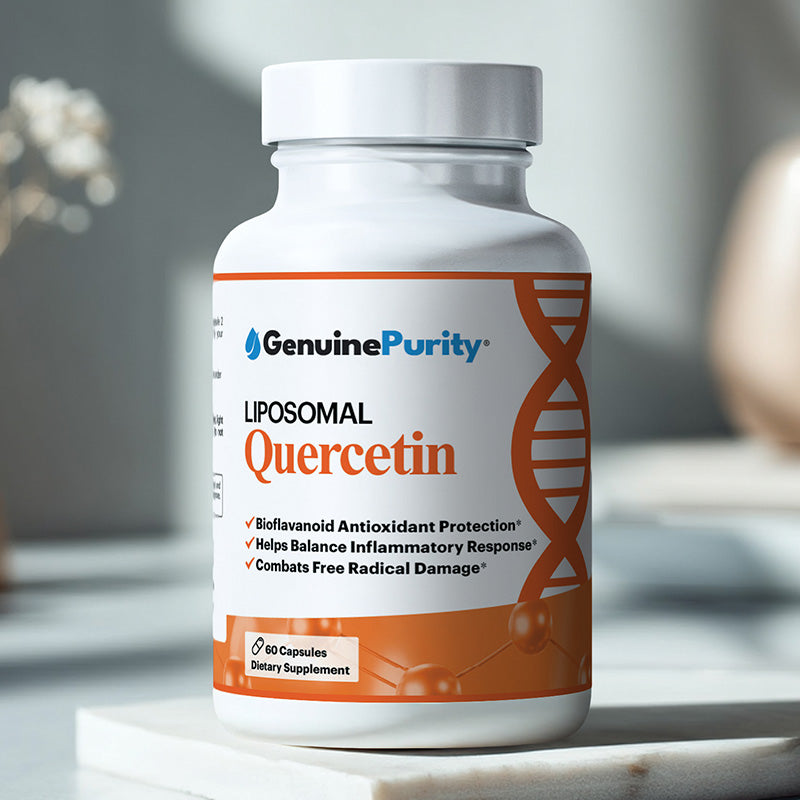
Affiliate disclosure: We sell GenuinePurity Quercetin through our affiliate link and earn a commission if you buy it. This article answers the allergy question from the published evidence — including the part most quercetin pages skip: the human data that exists belongs largely to a different, better-absorbed form of quercetin than the plain form in the bottle we sell. Our full audit of the product (Our Score 6.0/10) is on its product page; every product fact below comes from the maker's own pages.
Quick Answer
Quercetin has a plausible allergy mechanism — in laboratory work it stabilises mast cells, the cells that release histamine — and a thin human record. The evidence behind the mechanism is mostly tissue-culture and animal studies. The human allergy data that does exist was largely gathered with quercetin phytosome, a specially formulated, far better absorbed version — not the plain quercetin in ordinary capsules. GenuinePurity's product is the plain form (the maker markets the capsule as liposomal, but it is not the phytosome preparation the clinical work used), at 500 mg a day. So the honest answer to "does quercetin help allergies?" is: the idea is scientifically respectable, the proof in people is not yet there, and the strongest results on record were produced by a form this bottle does not contain. Anyone whose allergies need managing should read this as background, not as a treatment plan — quercetin is a supplement, not an approved allergy medicine, and nothing here replaces one.
The Question a Reader Actually Asked
This article exists because a reader asked the question in public. The People's Pharmacy — the long-running syndicated column built on reader questions — ran the query under the headline "Can Quercetin Control Your Allergy Symptoms?" A reader had come across reviews of quercetin, tried it, and reported relief, then asked the column to check the claim; the column noted it had heard from other readers who found quercetin helpful, and then did what this page tries to do: it went to the literature. Its finding, and ours, is the same shape — the published support for quercetin in allergy is real but lives mostly in the laboratory: studies of mast cells in tissue culture and of allergic responses in animals, with the human evidence thin and, where present, concentrated in a specific enhanced form. Reader relief is a genuine data point about one person's season. It is not a measurement, and the rest of this article is about the distance between the two.
Why Quercetin Is in the Allergy Conversation at All
The mechanism is not marketing invention. Allergic symptoms are driven substantially by histamine, released when mast cells and basophils degranulate on encountering an allergen. In laboratory studies, quercetin — a flavonoid abundant in onions, apples and capers — inhibits that release: applied to mast cells in culture, it reduces histamine output and dampens several inflammatory signals, an action often described as mast-cell stabilisation, conceptually similar to how some allergy drugs work (though quercetin is not one). Animal studies of allergic airway and skin responses point the same way. This is why serious sources discuss quercetin for allergies at all, and why we grade the idea differently from a random supplement claim: there is a mechanism, demonstrated repeatedly, in systems that are not human beings swallowing capsules. The entire problem of quercetin-for-allergies lives in that last clause. A compound can stabilise mast cells in a dish at concentrations a capsule never delivers to a nose — and for plain quercetin, delivery is precisely the weak point, because its oral absorption is notoriously poor. The evidence question is therefore not "does quercetin do anything?" but "does enough of this form reach the tissue?" — and that is a question about forms.
The Human Evidence — and the Form Problem
When quercetin has been tested in people for allergic conditions, the results worth citing belong predominantly to quercetin phytosome — quercetin bound into a phospholipid preparation designed to fix the absorption problem, and shown to be absorbed far better than the plain compound. Studies of that preparation in allergic rhinitis and asthma-type settings have reported symptom improvements. Whatever those results are worth, they are results about the phytosome: a different delivery system, delivering materially more quercetin to the blood, tested at its own doses. They do not transfer automatically to plain quercetin powder in a capsule, any more than results for one drug formulation transfer to another at a fraction of the exposure. For plain quercetin, the human allergy file is thin: small, short or absent trials, with the balance of the case resting on the laboratory and animal work above. GenuinePurity's bottle is plain quercetin — the maker calls the capsule liposomal (its contents include a sunflower-lecithin phospholipid blend), but it is not the phytosome preparation used in the clinical work, and the maker cites no allergy trial of its product; its own evidence presentation for the molecule runs to a study in aging mice and an unnamed human-trial claim about senescent cells, a different subject entirely. A buyer reading phytosome headlines onto this bottle is reading another product's evidence.
These statements have not been evaluated by the Food and Drug Administration. This product is not intended to diagnose, treat, cure, or prevent any disease. This article is educational and is not medical advice.
The Histamine-Intolerance Angle
A second, quieter conversation uses quercetin for histamine intolerance — the pattern of symptoms some people attribute to histamine from food exceeding their capacity to break it down. In clinic practice, quercetin is a standard consideration for such symptoms: one clinic's published protocol describes it as most effective at higher doses, using 500 mg twice daily and up to 1,000 mg twice daily in its histamine-intolerance work. Two honest qualifications belong with that. First, clinician usage is practice, not proof — it tells you what experienced practitioners reach for, inside programmes that usually change diet and several other variables at once; it is not a controlled measurement of quercetin. Second, set the doses beside the bottle: GenuinePurity's label delivers 500 mg per day in total — the bottom of the clinic range, and a quarter of its top. A reader importing clinic-protocol expectations onto a label dose is, again, reading one file onto another product. If histamine intolerance is your working theory, it deserves a clinician's workup rather than a supplement ladder built from a product page.
The Zinc Assumption, Cleared Up
Many buyers meet quercetin through a different claim entirely — the "zinc ionophore" idea, that quercetin ferries zinc into cells — and arrive at this bottle assuming the pairing is inside it. It is not. GenuinePurity Quercetin contains no zinc. Its formula is quercetin alone (250 mg per capsule, sourced from Sophora japonica flower), plus its capsule and filler list. If zinc is part of your plan, it is a separate purchase and a separate decision; nothing in this bottle provides it, and the ionophore claim itself rests on laboratory reasoning rather than human allergy or immune trials. We note it here because the assumption is common, the label is unambiguous, and the two should meet before checkout rather than after.
The Bottle on Our Shelf, on Its Own Paperwork
What the allergy evidence supports buying, if it supports buying anything, is a fairly priced plain quercetin with its paperwork in order — and on that narrower standard GenuinePurity's entry is a mixed file (Our Score 6.0/10). In its favour: the line's lowest price at $49, a published dose (250 mg per capsule, two a day, 500 mg total), a published bottle count (60 capsules — a 30-day supply, confirmed in the maker's FAQ, a basic fact several siblings in this line never state), and a named botanical source. Against it: no purity percentage is printed anywhere; and the maker's page states two different guarantees — 97 days in its header, a 90-day satisfaction guarantee excluding shipping in its guarantee section — without saying which governs an order. Neither flaw touches the allergy question directly; both touch whether the seller's paperwork deserves trust on the questions you cannot check yourself, like what is actually in the capsule. Links to the full audit are on the product page.
Frequently Asked Questions
Does quercetin help with allergies?
The mechanism is demonstrated in laboratory and animal work — quercetin stabilises mast cells and reduces histamine release in those systems. In people, the evidence is thin, and the better human results belong to quercetin phytosome, an enhanced-absorption form. For plain quercetin capsules, benefit is plausible but unproven. It is not an approved allergy treatment and should not replace medication that works for you.
How much quercetin do people take for histamine issues?
GenuinePurity's label directs 500 mg per day (two 250 mg capsules). Published clinic protocols for histamine intolerance have used 500 mg twice daily, up to twice that — but those are clinician-supervised programme doses, not label directions, and this page does not present them as a recommendation. More is not automatically better with a compound whose human data is this thin.
What is quercetin phytosome, and is it what I'm buying?
Phytosome quercetin is quercetin bound into a phospholipid preparation engineered for absorption, and it produced the human allergy results most often quoted. GenuinePurity's product is plain quercetin — marketed as a liposomal capsule, with a sunflower-lecithin blend in its contents — not the phytosome preparation the clinical studies used. The results of one do not automatically describe the other.
Does GenuinePurity Quercetin contain zinc?
No. The formula is quercetin alone — 250 mg per capsule from Sophora japonica flower — plus capsule and filler ingredients. The zinc-ionophore pairing sometimes discussed online would require a separate zinc product.
Is quercetin safe to take with allergy medication?
The maker's entire published safety content is one FAQ line advising readers on medication to consult a doctor. No interaction list, warnings or exclusions are published for this product. The maker's advice is the right advice: ask your doctor or pharmacist, particularly before combining anything with medication you rely on.
Final Verdict
A reader asked a newspaper column whether quercetin could control allergy symptoms, and the honest answer has not changed since: the laboratory case is real, the human case is thin, and the best human results were earned by a different form of the compound. GenuinePurity Quercetin (Our Score 6.0/10) is the plain form at a fair $49, with a published dose and bottle count and a guarantee its own page states two ways. Buy it, if you buy it, as an inexpensive experiment with your eyes open — not as the phytosome studies' beneficiary, and never as a substitute for allergy care that has actually been tested in people like you.
Disclaimer: This article is for general information only and is not medical advice. Always consult a qualified healthcare professional before starting any supplement, especially if you have a medical condition or take prescription medication.
Last reviewed: October 2026
