
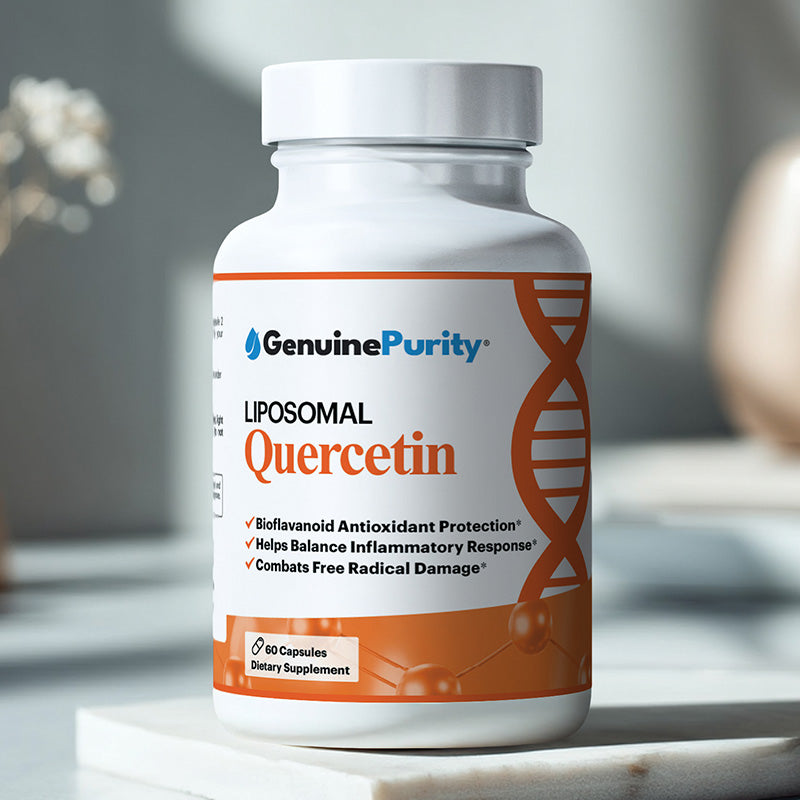
Affiliate disclosure: We sell GenuinePurity Quercetin through our affiliate link and earn a commission if you buy it. Two facts belong at the top of this page, before any checking begins. First: GenuinePurity Quercetin contains no zinc. Its formula is quercetin alone plus capsule and filler ingredients — if the ionophore idea is why you are here, this bottle is not the pairing you are imagining, and no reading of its label will make it one. Second: the ionophore claim itself — the idea that quercetin ferries zinc into cells — rests on laboratory reasoning, with no human trial behind it in the material we can audit. Our full audit of the product (Our Score 6.0/10) is on its product page. What follows checks the claim at the standard this store applies to every claim, including the ones attached to products we sell.
Quick Answer: A Lab Idea, a Seller Ecosystem, and an Empty Bottle Slot
The quercetin-and-zinc question is real — sellers' FAQ pages field it directly ("Can You Take Zinc and Quercetin Together?") — and the claim underneath it has a precise shape. An ionophore is a compound that carries ions across cell membranes; the suggestion is that quercetin can shuttle zinc ions into cells, raising intracellular zinc in a way zinc alone supposedly cannot. As chemistry, that is a coherent hypothesis with laboratory reasoning behind it. As a health claim about people swallowing capsules, it is unproven: no human trial in the auditable record tests quercetin as a zinc ionophore, measures intracellular zinc outcomes in buyers, or connects the pairing to any clinical endpoint. And as a shopping matter on this shelf, it has a simpler answer still: the quercetin we sell contains no zinc, so the pairing — proven or not — is a two-product decision that this one bottle does not make for you.
Where the Claim Comes From
Trace the claim's paperwork and it has three layers, none of them a human trial. The base layer is laboratory reasoning: quercetin's chemistry makes metal-ion transport plausible in vitro, and the ionophore framing grew from that plausibility — the same route by which several flavonoids acquired transport reputations in cell systems. The middle layer is extrapolation: if a compound can move ions in a dish, perhaps it moves zinc in a person; the "perhaps" is where the published record stops. The top layer is the seller ecosystem: FAQ pages and pairing guides that present quercetin-and-zinc as a recognised combination, answer "can you take them together?" in the affirmative, and sell one or both halves. Each layer is worth naming because the claim's confidence in conversation comes from the stack looking tall. Counted by evidence type rather than by pages, it is one laboratory hypothesis repeated at three volumes. Our allergy coverage met the same claim from the other side and graded it identically: the ionophore idea "rests on laboratory reasoning rather than human allergy or immune trials" — Quercetin for Allergies and Histamine.
What the Claim Would Need to Show
State the missing rungs explicitly, because "unproven" is a summary, not an argument. To promote the ionophore claim from hypothesis to finding, the record would need: a human study administering quercetin with zinc and measuring a zinc-status or intracellular endpoint against zinc alone; a dose relationship (which quercetin dose, in which form — see Quercetin Forms, because delivery is quercetin's known weak point and a transport claim lives or dies on delivery); and ideally an outcome a buyer cares about, not just a biomarker. None of those rungs exists in the material behind this shelf. There is also a quieter logical gap worth noticing: even the laboratory version of the claim is about quercetin's behaviour in controlled conditions at controlled concentrations — and plain oral quercetin's poor absorption (the reason forms exist at all) sits upstream of any membrane it is supposed to work at. A claim that requires the molecule to be somewhere it largely fails to reach carries its weakest link inside itself.
These statements have not been evaluated by the Food and Drug Administration. This product is not intended to diagnose, treat, cure, or prevent any disease. This article is educational and is not medical advice.
The Bottle Check: No Zinc, Stated Plainly
Because the assumption is common enough that buyers arrive with it, here is the label, in full. GenuinePurity Quercetin's active is quercetin alone — 250 mg per capsule, sourced from Sophora japonica flower — taken as two capsules a day for 500 mg. The remaining published contents are capsule and filler ingredients: vegetable cellulose, gellan gum and pectin (capsule), a phospholipid blend from non-GMO sunflower lecithin, microcrystalline cellulose, L-leucine, silicon dioxide and vegetable stearate. There is no zinc in any form, at any amount, anywhere in that list. This matters beyond tidiness: a buyer who purchases this bottle believing the quercetin-zinc pairing is inside it has bought half of an unproven combination and none of the mineral the combination is about. If zinc is part of your plan, it is a separate product, with its own label, its own dose and its own upper limits — a separate decision that deserves to be made as one, not inherited from a pairing headline.
If You Pair Them Anyway
Some readers will combine the two regardless, so the honest housekeeping is short. You would be running an unproven-mechanism experiment with two separately documented products. On the quercetin half, choose with the audit open: GenuinePurity's bottle is $49 for a 30-day supply (60 capsules, published), with no purity percentage printed anywhere and a guarantee its own page states two ways — 97 days in the header, 90 days excluding shipping in the guarantee section. On the zinc half, this store sells no zinc product and grades none, so we offer no pick. On safety, the maker's entire published content for its quercetin is one FAQ line — consult a doctor if you are on medication — with no interaction list or exclusions; zinc has its own well-known interaction and upper-limit considerations that a quercetin page will not cover for you. A pairing built from a laboratory hypothesis deserves at least that much paperwork discipline, and a clinician conversation if medication is anywhere in the picture.
Frequently Asked Questions
Does GenuinePurity Quercetin contain zinc?
No. Plainly and completely: the formula is quercetin alone (250 mg per capsule from Sophora japonica flower) plus capsule and filler ingredients. No zinc, in any form, at any amount. The quercetin-zinc pairing would require a separate zinc product.
Is quercetin really a zinc ionophore?
It is a laboratory hypothesis: quercetin's chemistry makes ion transport plausible in vitro, and the claim grew from there. No human trial in the auditable record tests quercetin as a zinc ionophore in people or connects the pairing to a clinical outcome. "Plausible in a dish, unproven in a person" is the accurate grade.
Can I take quercetin and zinc together?
People do, and sellers' FAQs encourage the pairing — but encouragement is not evidence. There is no human trial of the combination behind the ionophore claim, and the maker's only published safety line for its quercetin advises consulting a doctor if you take medication. Treat the pairing as an experiment with two labels to read, not as a studied protocol.
Why do so many pages present the pairing as established?
Because the claim is commercially convenient and mechanically narratable: a transporter story is easy to tell, and each half of the pair can be sold. The paperwork underneath is one laboratory hypothesis repeated across seller pages — repetition that reads as consensus until the layers are separated.
Does the zinc claim change what the GP bottle is worth?
No — because the bottle contains no zinc, the claim was never part of this product. The bottle stands or falls on its own file: plain-form quercetin at 500 mg a day, $49, no published purity, a self-contradicting guarantee — Our Score 6.0/10, in the full product audit.
Final Verdict
Checked, the quercetin-and-zinc claim resolves into three sentences. The ionophore mechanism is laboratory reasoning, not a human finding. The pairing's public confidence is a seller ecosystem repeating that reasoning at volume. And the product this question most often lands on — GenuinePurity Quercetin (Our Score 6.0/10) — contains no zinc at all. Buy the bottle, if you buy it, for what verifiably is in it: plain quercetin, 500 mg a day, at the line's lowest price. Buy zinc, if you buy it, as its own decision with its own label. And let any page that merges the two into one implied capsule stand as what it is — a headline doing work that neither the trials nor the ingredient list will do for it.
Disclaimer: This article is for general information only and is not medical advice. Always consult a qualified healthcare professional before starting any supplement, especially if you have a medical condition or take prescription medication.
Last reviewed: October 2026
